
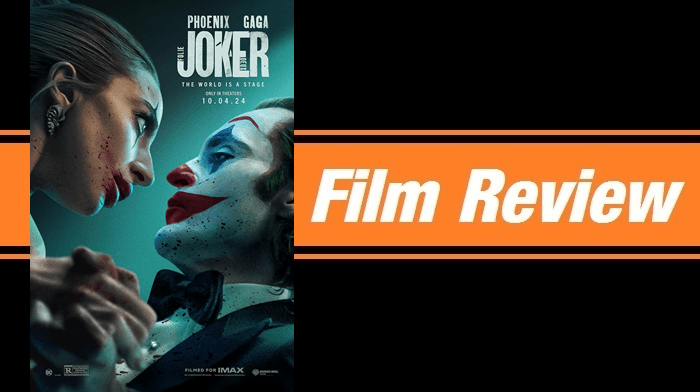
The road to the big screen has been interesting for “Joker: Folie à Deux”. The highly anticipated sequel to the 2019 box office juggernaut “Joker” puzzled many when it was first announced as a musical. Since then the studio has dialed back its emphasis on ‘Joker the Musical’ and has since promoted it in a more traditional manner. Yet fans of the first film (a group I’m happy to be a part of) remained a little hesitant and unsure of what to expect.
That kind of subversion of expectations can be a good thing, especially if your movie ultimately delivers. “Joker: Folie à Deux” delivers to a degree, but expect the reactions to be all over the map. Much like its predecessor, you can count on some being predisposed to disliking it. But it’s the diehard fans who will almost certainly end up split. That’s because “Folie à Deux” takes some wild creative risks, some of which pay off and others that frankly drag the movie down.
Todd Phillips returns to direct, produce, and co-write, this time with a budget that ballooned to nearly $200 million. Phillips reteams with several collaborators from the first film including his co-writer Scott Silver, his cinematographer Lawrence Sher, his editor Jeff Groth, and his Oscar-winning composer Hildur Guðnadóttir. But the most essential returning piece is Joaquin Phoenix, reprising the title role which earned him a Best Actor Oscar.
“Folie à Deux” (translated shared madness or madness for two) doesn’t play like a fully realized sequel. It’s more akin to an extended epilogue that follows the events from “Joker”. But the differences between the two films are significant and somewhat confounding. “Folie à Deux” splits its time between being a courtroom drama and a prison drama with Phillips injecting the dark edginess of the first film into both. But the movie eventually gets caught in a frustrating cycle that keeps bouncing us back-and-forth between the two without much happening in-between.

Phoenix is once again spellbinding as he follows the continued dark descent of Arthur Fleck, a part-time party clown and aspiring stand-up comedian who killed six people in the first film including a popular talk show host on live television. Arthur’s unhinged antics and vigilante Joker persona inspired a mob of disillusioned and (in some cases) equally deranged citizens to unleash a wave of violence and chaos across Gotham.
As he awaits his trial, Arthur remains locked up in Arkham State Hospital where he’s kept heavily medicated while swapping bad jokes for cigarettes with a semi-sympathetic guard named Jackie (Brendan Gleeson). Nothing much happens in these scenes other than a miserable Arthur trudging down cold drab hallways, escorted to and from to his cell, and occasionally let out in the prison yard. But he does find a spark of life after he meets and falls for a fellow inmate, Harleen “Lee” Quinzel (Lady Gaga).
With Arthur deemed competent to stand trial, his lawyer, Maryanne Stewart (Catherine Keener) gets busy preparing their case. She intends to argue that the Joker persona doesn’t represent the real Arthur. She contends that Joker is another personality – a manifestation brought on by years of abuse and neglect. Her claims that Arthur was an unwilling participant and a victim angers his many fans who see Joker as the catalyst for their twisted cause. It also frustrates Lee who encourages Arthur to embrace his true Joker self and take charge.
As with the Arkham drama, the courtroom scenes have a tough time gaining traction. In several ways they seem inspired by the trial of serial killer Ted Bundy. It’s a full-blown media circus. It’s being televised live. And like Bundy, Arthur gives into his Joker persona and decides to represent himself in court. It’s a scenario so full of potential but much of it is never fully realized. That’s because any dramatic momentum is routinely interrupted by trips back to Arkham or by an untimely musical number.

As for the musical numbers, they do play a big part in “Folie à Deux”. They represent an inspired and even bold approach to telling Arthur’s story. But their quality and execution are very much a mixed bag. On the positive side, they are designed as expressions of Arthur’s emotional turmoil and inner fantasies. The songs are a collection of covers, many rooted in Arthur’s past while others convey whatever feeling is overwhelming him in that moment.
Unfortunately the numbers grow burdensome over time. They become more intrusive than enlightening – taking screen time that could’ve been better spent developing a more involving story. The songs themselves aren’t likely to stick with you due to the calculated choice to sing them badly (as Phoenix confirmed to People magazine). Narratively it makes perfect sense. Neither Arthur or Lee are talented singers so why make them sound like Sinatra and Fitzgerald? But that doesn’t necessarily make for enjoyable listening, especially by the fifth of sixth tune.
Yet despite its frustrations and flaws, there’s something incredibly admirable about the movie’s audacity. In an era where we’ve been trained to expect very specific things from comic book movies, I love that Phillips and company have dared to make one that doesn’t abide by any established rules. Phoenix is once again intensely committed and hauntingly grim. And Gaga makes the most of her sparse screen time, taking an underdeveloped character and making her somewhat interesting.
At one point in the 2019’s “Joker”, Arthur says “I used to think my life was a tragedy, but now I realize it’s a comedy.” Those words are given a powerful new meaning in “Folie à Deux”, as are several other things from the first film. If only the two movies had more in common. Phillips puts aside the raw and incisive storytelling of “Joker” for something that’s more experimental but with less to say. And he tops it all off with a sour ending that may be fitting in some regards, but that feels like Phillips and Phoenix wiping their hands clean. I’m afraid that’s what “Joker” fans will want to do after seeing this ambitious but disappointing gamble. “Joker: Folie à Deux” is in theaters now.
VERDICT – 2.5 STARS

 Keith & the Movies
I’m going to wait for it on streaming as I did like Joker although it has flaws and I do think it’s somewhat overrated.
Joker is one of my favorite films of the last 10 years. Maybe that’s one reason this one was so disappointing.
I like them Rogers and Hammerstein musical pictures with that Swedish Julie Andrew on that mountain. I can’t wait to see this uplifting music picture with the clowns and daincing.
Well….ok
Great review as ever, Keith! I think you rightly pointed out the mixed nature of it while still admiring aspects of it. I liked it more than you and was shocked at how much it worked for me. I liked how it explored the more underhanded themes of the first film whilst evolving the fantasy/delusional perspective of the first film.
I really struggled finding that balance. But it didn’t stop me from enjoying several aspects of the movie. In fact, it may be one I enjoy more after a second viewing. But right now I can’t help but feel disappointed, especially considering how much I love the first film.
A second viewing is a must! Given how the first film was constructed, any sequel would be a disappointment, which is why I was surprised by how engaging it was and how much it still had left to explore from the 2019 picture.
Sequels so rarely match up don’t you think? Gaga only had ‘sparse’ time in the movie?? She seems a big part of the posters and trailer.
I expected more of Gaga but she’s very much a supporting role. You’re right, she was a huge part of the promotion.
Sorry to say I’m not surprised. It’s a contradiction to take the epitomy of villainy and scattershot him in non-conformity of that role. I think Lady GaGa is already a freak, so clowning her up is overkill. I appreciate anyone who dares to color outside of the lines, but it’s always a gamble.
I’ll give him credit, there are some interesting ideas here. But based on what was set up in the first movie and this being a popular property, this probably wasn’t the proper canvas for him to go in such a direction. And it doesn’t help that he stumbles through it.
Pingback: New on Home Video: “Joker: Folie À Deux” on 4K Ultra Blu-ray + Digital |