

It doesn’t seem possible, but Norman Jewison’s “Rollerball” turns 50 this year. The movie doesn’t quite blend with the filmmaker’s more lauded movies such as “In the Heat of the Night”, “Fiddler on the Roof”, “The Thomas Crown Affair”, and “Moonstruck”. But this dystopian science-fiction sports film from 1975 remains a favorite of mine out of Jewison’s rich catalog – a sentiment that was reinforced after a recent rewatch.
At the center of the movie is a futuristic sport called Rollerball – a violent fusion of roller derby, football, and motorcycles. Bizarrely, audiences at the time were so wild about the “sport” that several potential promoters and investors contacted Jewison in hopes of acquiring its rights. But considering the themes of the movie, it understandably never happened as the idea of an actual Rollerball league was repellent to the director.
The screenplay was penned by William Harrison who was adapting his own Esquire magazine short story titled “Roller Ball Murder”. It’s set in the ‘not too distant future’ of 2018 (which is both amusing and sobering for us in 2025) where our world is ruled by a multi-corporate dictatorship. The earth has been broken up into sectors, each controlled by a powerful global corporation. Together they run society by setting policy, enforcing the laws, and governing the working class in ways that protect their own self-interests.
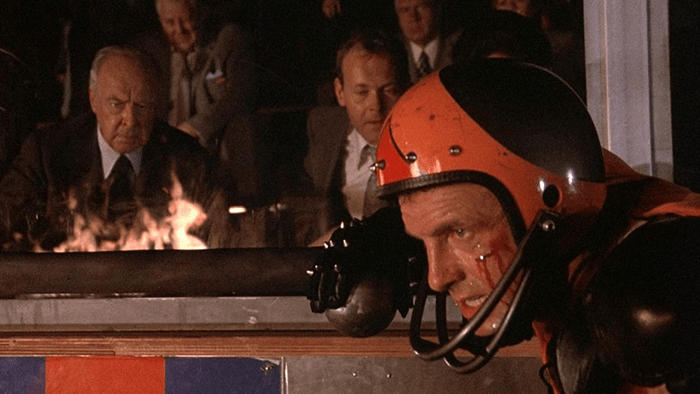
Though released in 1975, the movie’s insightful vision has proven surprisingly prophetic. Jewison and Harrison coat their story with a futuristic veneer. But its thematic core speaks to issues that some could argue are coming true right before our eyes. The corporate usurpation of democratic rule, the unwitting surrender of freedoms, and the suppression and control of information – all have a striking relevance today.
One of their biggest means of control is Rollerball, a corporately funded and globally sanctioned sport with a strict social purpose but that’s packaged as mainstream entertainment. Every sector has their own Rollerball team and a fiercely loyal fanbase. The executive board attributes Rollerball with putting an end to wars and curing society’s many ills. In reality the game was designed to “demonstrate the futility of individual effort” and it has had its desired effect
Jonathan E. (a terrific James Caan) is the very best in the sport and has become a star who is beloved all over the world. So much so that even fans of other teams chant his name. But Jonathan’s popularity and celebrity has certain executives concerned. They see his individual stardom as a threat to their control. The corporations believe Jonathan’s fame has made him bigger than the very game they use to keep the world’s population in line.
Jonathan is called to a meeting with Mr. Bartholomew (John Houseman), the chief executive of the Energy Corporation which oversees his sector and his Rollerball team. Bartholomew informs Jonathan that the executive board wants him to retire and they’re willing to give him a lavish retirement package that will set him up for life as well as a big public sendoff in his honor. But Jonathan doesn’t want to abandon his teammates and he doesn’t like the idea of being pushed out with no real explanation.

The majority of the movie follows Jonathan’s bitter resistance to retirement and the executive board’s growing impatience with his lack of cooperation. We learn that Jonathan hasn’t trusted the corporations since a high-ranking official took his wife Ella (Maud Adams) as his own spouse. And he grows even more disillusioned after discovering how the corporations keeps their tight grip on society.
The film’s thematic depth is often overshadowed by the Rollerball matches themselves. Jewison, along with acclaimed cinematographer Douglas Slocombe and editor Antony Gibbs, film the Rollerball matches with indomitable fury and panache. They take this wild and violent sport and clearly define it for us, not through exposition but through their camera. And it gets more barbaric with each game, especially once the executives start changing the rules in an effort to target Jonathan.
“Rollerball” released as a thrilling future shock yet to this day it maintains a sharp contemporary bite. It’s highlighted with slick production values and brimming with astute social commentary. And its all accented by a touch of violent 70s exploitation. As with any 50-year-old movie, you can pick at things that haven’t aged particularly well. But “Rollerball” remains a fascinating sci-fi opus with the brawn of a pulse-pounding action thriller and the brains of a razor-sharp social critique.
VERDICT – 4.5 STARS

 Keith & the Movies
I have never seen this film and I really want to. Anything to get rid of the stench that was the 2002 film (with the exception of Paul Heyman’s performance as a commentator).
It’s brilliant. I had forgotten just how well made it is. And another great James Caan performance.
Seen this a couple of times, great movie and one of Caan’s best roles. IMHO.
YES! He’s so good in it!
This is a must see for movie fans. It’s just as entertaining as The Running Man, but it has James Caan and more story material to think about.
110% agree.
Rollerball is a Horror movie about the Vietnam War
Just watched it again. A wonderful and underrated movie. The corporate control seemed believable and relevant to life today.
It really holds up well. And the themes still hit home.