
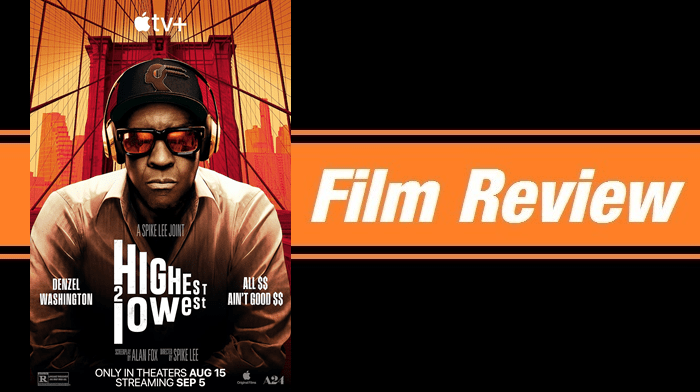
Spike Lee‘s latest joint sees him reteaming with one of the greatest actors of our time, Denzel Washington. “Highest 2 Lowest” is the pair’s fifth big screen collaboration and their first since 2006’s “Inside Man”. With their long overdue reunion it’s pretty clear they haven’t missed a beat. Lee’s direction is imbued with what feels like fresh energy. And the always watch-worthy Washington mixes swagger with solemnity with pitch-perfect savvy.
“Highest 2 Lowest” is an adaptation of Akira Kurosawa’s 1963 classic “High and Low” but reworked for 2025 by Lee and screenwriter Alan Fox. While catching the similarities between the versions is fun in itself, it’s the differences in Lee’s reimagination that make the movie purr. Aside from the many smaller details and style choices, there is the noticeably upbeat and less cynical tenor, the move from Yokohama to a vibrant New York City, the integral role of music in its story, the emphasis on Black culture, and the fascinating alterations to the final act.
But the richness of Lee’s verve could only carry the movie so far without Washington’s invigorating lead performance (among the actor’s best in years). Dripping with charisma that manifests itself in scenes of both grandiosity and subtlety, Washington takes Toshiro Mifune’s voracious shoe executive and fully transforms him into a beguiling modern day music mogul. Through his impeccably precise yet effortlessly smooth performance, Washington conveys a lifetime’s worth of aspiration, struggle, and resilience.
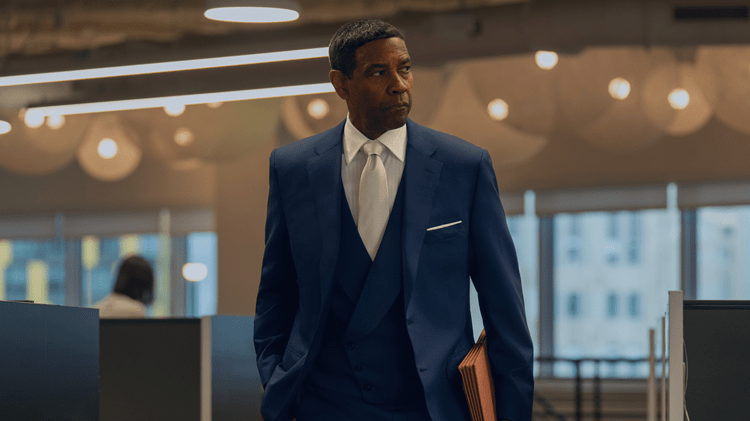
Lee kicks things off with a soaring opening credits sequence featuring rapturous views of New York City capped off by an elegant long zoom to the penthouse balcony atop Brooklyn’s waterfront Olympia Dumbo complex. There stands David King (Washington), a millionaire music executive and founder of Stackin’ Hits Records. Said to have “the best ears in the business”, David spent 25 years building a music business focused on cultivating and promoting black artists before deciding to sell his majority interest.
With his two co-owners on the verge of selling to a rival label, David convinces one of his partners (Michael Potts) to sell him his shares, allowing him to regain controlling interest in the business he founded. But to do so, David is forced to put up his penthouse and art collection to finance the deal, much to the concern of his wife Pam (an excellent Ilfenesh Hadera). While there is some good character work involved, all the early corporate drama is merely setting the table for the next act.
The tone shifts dramatically on the eve of his big business deal after David receives a call saying his son Trey (Aubrey Joseph) has been kidnapped and the ransom is $17.5 million in Swiss francs. It only takes one call from David before the NYPD arrive, led by three detectives (Dean Winters, LaChanze and John Douglas Thompson). They quickly find Trey leading to the reveal that the kidnapper snatched the boy’s best friend Kyle (Elijah Wright) by mistake. Kyle is the son of David’s childhood friend and chauffeur Paul (Jeffrey Wright).
One of Lee’s biggest and best changes to Kurosawa’s story involves David and Paul’s relationship. The two friends grew up together on the streets but their lives took different paths. David became a successful self-made entrepreneur while Paul ended up doing prison time. Yet their friendship stayed strong. But that friendship is tested with David’s sudden hesitation over paying the ransom – something he was fully prepared to do when he thought his son’s life was on the line. The thick moral haze only thickens once David’s pending business deal is factored into the scenario.
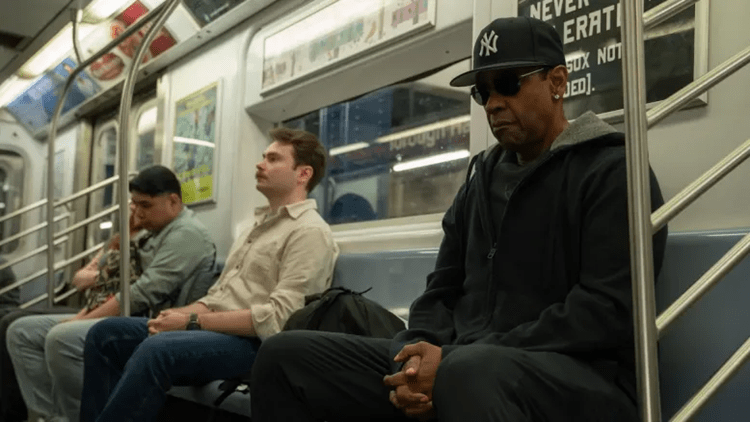
I don’t want to reveal too much, but the tone shifts again with the propulsive third act. After David agrees to pay, he’s instructed by the kidnapper to deliver the money himself. From there the story moves from the posh comforts of the penthouse to the vivid character-rich streets. It kicks off with an exhilarating set piece beginning on the 4 train from Brooklyn to the Bronx before spilling over into a Puerto Rican Day festival powered by a spellbinding street performance from the late jazz legend Eddie Palmieri. It’s a thrilling sequence with the only distraction being Winters and his incessant over-the-top yelling.
There’s so much more to appreciate and glean from Spike Lee’s 24th feature film. There’s his unique spin on Kurosawa’s examination of class. There are his statements on the influence of social media and public perception where “attention is the biggest form of currency”. There’s his admonition on preserving music and culture. Add to it Lee’s spirited perspective, seen most through his freshly polished direction, Matthew Libatique’s dynamic lensing, and the array of sublime performances highlighted by the force of nature that is Denzel Washington. Here’s hoping we see these two together again sooner rather than later.
VERDICT – 4 STARS

 Keith & the Movies
As you were describing the plot, I realized it sounded super familiar. I know I have never seen the original movie, so I was flummoxed at first. Then I realized that I had it in one of Ed McBain’s “87th Precinct” police procedural novels.
And I had no idea he had lifted the idea in such a wholesale manner.
That’s exactly it. Kurosawa’s movie was an adaptation of McBain’s book. Your instincts served you well.😁
Ohhh, then “I” read the original. Son of a gun. Well, it’s a small world after all 😉
I do want to see this as I wanna see what Spike and Denzel do but I need to rewatch High & Low and then do a proper comparison.
It’s cool seeing the similarities but also seeing Spike’s own alterations. And Denzel just kills it.