
REVIEW: “Hokum” (2026)

As fans of the genre well know, horror movies aren’t just a seasonal thing. But over the past several years, it seems they’ve pushed themselves more into the year-round mainstream. Studios are putting more effort into giving horror films wider releases and stronger promotion. And it’s easy to understand why. The formula is pretty simple. Horror movies are usually made on a small budget which means turning a profit is a lot easier. So it makes sense why we get so many.

The first of three horror films getting a wide release in May is writer-director Damian McCarthy’s “Hokum”. As with his previous two chillers, “Caveat” and “Oddity”, McCarthy relies mostly on atmosphere, mood, and patient pacing to unnerve us. He tells another emotionally grounded ghost story, shrouded in mystery and steeped in folklore. For the most part, it stays true to its effectively eerie approach, only occasionally disrupting things with a lazy jump-scare.

Image Courtesy of NEON

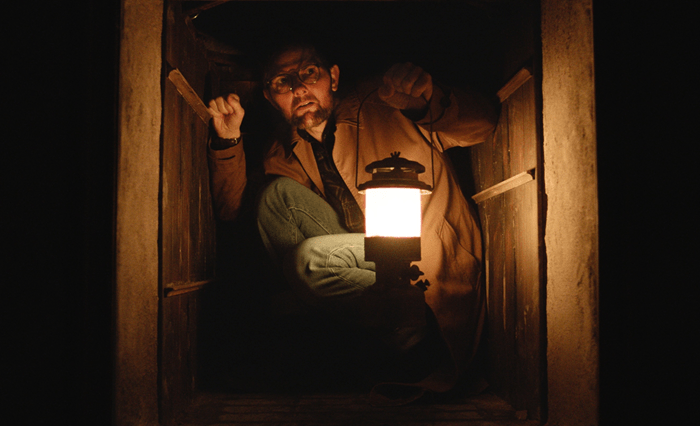
Adam Scott plays Ohm Bauman (Scott), a successful author struggling to finish the third novel in his popular Conquistador trilogy. He’s stuck on the epilogue to his bleak story, which may or may not be inspired by some pretty heavy personal trauma. But Ohm’s book briefly takes a back seat after he discovers some of his parents’ old belongings including a picture of his mother by a massive redwood tree in Ireland.

Ohm traces the picture back a remote country inn in Ireland called the Bilberry Woods Hotel. During happier days, it’s where his mother and father spent their honeymoon. So Ohm travels there with plans to stay for a week, hoping to spread his parents’ ashes by the big redwood tree from the photo, and finding closure for himself in the process. But there is a deeply troubled side of Ohm that ends up sending the movie down a dark path. And the events that unfolds will have you questioning much of what you see.

The hotel itself introduces an interesting assortment of characters including the creepy old owner named Mr. Cob (Brendan Conroy), the receptionist Mal (Peter Coonan), the groundskeeper Fergal (Michael Patric), the bellhop Alby (Will O’Connell), and the bartender Fiona (Florence Ordesh). The smug and sardonic Ohm leaves a bad impression with everyone other than Fiona who helps him locate the old redwood tree from his mother’s photo.

But then the movie broadsides us with a shocking turn which I won’t spoil. It’s a jolt that we never see coming, yet that never feels as significant moving forward as it clearly means to. Shortly after, Ohm learns that Fiona has gone missing. The semi-concerned hotel staff are quick to name a shaggy local named Jerry (David Wilmot) as the prime suspect. Yet they bristle at Ohm’s questions, especially when he asks why they refuse to search for her in the glaringly suspicious, locked-tight honeymoon suite.

Image Courtesy of NEON

Of course there turns out to be a lot more to the honeymoon suite. Ohm faces off against an unexpected enemy. He gets help from an equally unexpected ally. And the frights come from all directions, inspired by old witch tales, the notion of demons, and even classic haunted house stories. McCarthy weaves them all together into something genuinely macabre yet without fountains of blood and gore. And he succeeds in keeping us on the edges of our seats.

While it does borrow ideas from other horror movies that came before it, there is a uniqueness to “Hokum” that gives the film its own identity within a grounded and ever-growing field. That said, key elements of the story could have used more attention, whether it’s Ohm’s family issues or deeper explanations of the hotel’s secrets. Still, getting something that’s even slightly original to the horror genre is refreshing. And McCarthy continues to build a resume that makes him an exciting new voice going forward.

VERDICT – 3.5 STARS

EDFF 2026 REVIEW: “Honeyjoon”

One of big treats of the 2026 El Dorado Film Festival was the screening of writer-director Lilian T. Mehrel’s “Honeyjoon”. This is an emotionally rich, life-affirming dramedy that had its world premiere at the 2025 Tribeca Film Festival. Now as it continues to make its way along the festival circuit, more people are getting to experience this impressive feature debut from a filmmaker with a number of compelling interests on her mind.

Set and filmed in the gorgeous Azores islands off the coast of Portugal, “Honeyjoon” tells a mother and daughter story that has its own unique flavor. It’s a story with deep-rooted humanity that is conveyed in a variety of ways. It’s mostly seen through the two fully defined lead characters. Their individual experiences, their emotional complexities, their vastly different philosophies – it all fuels the heartfelt drama while setting the table for some smart and often unexpected humor.

The sensual June (Ayden Mayeri) and her more modest mother Lela (Amira Casar) travel to the Azores islands for the one-year anniversary of their husband and father’s death. Years earlier he had visited the islands and he had hoped to one day take his family. But he was diagnosed with cancer and died before he had the opportunity. So June and Lela make the trip themselves as a way of honoring his memory.

But the mother and daughter are at two dramatically different points in their lives. They have sharply contrasting views on how to grieve, how to move forward, and how skimpy June’s wardrobe should be. That last bit feeds one the film’s best running jokes, but it also adds some clarity to their clashing perspectives. To her credit, Mehrel doesn’t judge either of them. She simply explores what has shaped their points of view.

June and Lela arrive at there hotel to find themselves surrounded by honeymooners. To get away from all the intimacy, they book a private island tour that’s guided by a hunky surfer named João (José Condessa). The aggressively flirty June tries to get João’s attention. But he seems much more interested in philosophical conversations with Lela. Ultimately their time with João opens their eyes, allowing them to see each other in a new light.

Things start to come unglued in the final act as Mehrel dilutes the film’s theme of moving forward by linking it with sexual pleasure. It leads to a strange and unwieldy turn that probably looked better on paper than it turned out on screen. But Mehrel gets things back on track with a moving final sequence that really speaks to what “Honeyjoon” is all about.

With “Honeyjoon”, Lilian Mehrel balances a wealth of themes through her intimate and grounded mother-daughter story. It’s a funny and affecting drama that would never work without the sparkling chemistry between Mayeri and Casar. Her film is also a visual feast, from the breathtaking scenery to the impressive camera choices (crisp digital, an iPhone, and best of all, vintage Super 8). It all makes for a strong first feature and it will be exciting to see what Mehrel does next.

VERDICT – 3.5 STARS

REVIEW: “Hellfire” (2026)

When not playing a key role in the box office shattering Avatar film series, Stephen Lang is still making a variety of modest independent movies. His latest is “Hellfire”, a small town action thriller that tells a familiar story in a familiar setting about familiar characters facing a familiar dilemma. But Lang makes anything watchable. And supporting turns from Harvey Keitel and Dolph Lundgren add to the fun.

Set in 1988, the residents in the small one-horse town of Rondo, Texas live in the iron grip of a local crime boss and drug runner named Jeremiah Whitfield (Keitel). Whitfield owns most of the town and uses his power to force the handful of citizens to do his bidding. If they refuse, there’s a heavy price to pay. And they know too much for Whitfield to let them leave town.

Image Courtesy of Saban Films

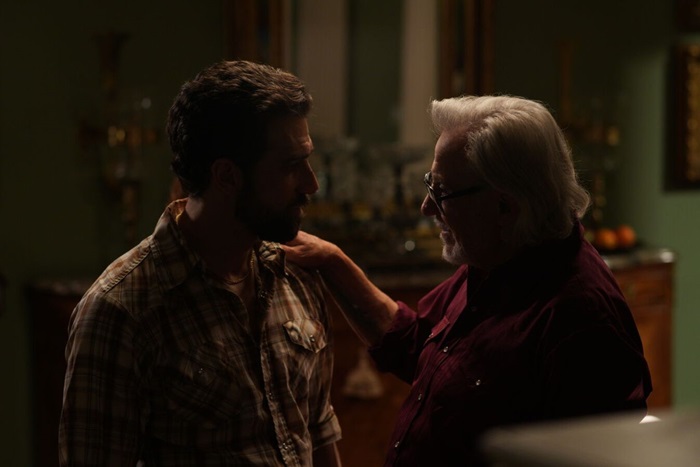
Among the oppressed townsfolk is Owen (Chris Mullinax) and his daughter Lena (Scottie Thompson) who run a local bar. They are frequently terrorized by an area thug named Clyde (Michael Sirow). He is Whitfield’s entitled son who happens to have an eye for Lena. The people get no help from their spineless and corrupt Sheriff Wiley (Dolph Lundgren) which leaves them with little choice but to do what they’re told.

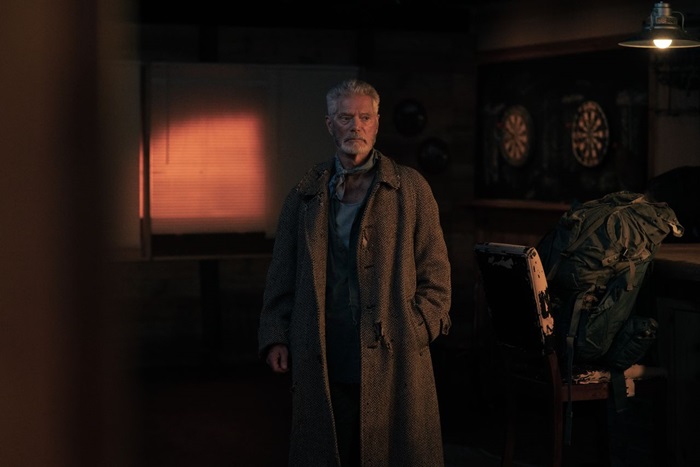
Things heat up when a drifter (Lang) wanders into town. He begins doing odd jobs for Owen in exchange for enough money for a meal and a motel room. But Whitfield is leery of newcomers. So he orders the sheriff to make sure the drifter, who Owen nicknames “Nomada”, packs his things and gets out of town. But the drifter decides to stick around, much to the chagrin of Whitfield’s gang who quickly learn that Nomada isn’t some helpless vagrant. He’s a highly skilled military war veteran with a possible higher calling.

Image Courtesy of Saban Films

What transpires from there isn’t hard to figure out. And generally speaking, the story plays out just as we might expect. But director Isaac Florentine and screenwriter Richard Lowry help things by throwing in a surprise or two, including an unexpected dark turn which we never see coming. Meanwhile Lang is a steady and sturdy presence who consistently elevates the material. And he’s especially good in the action sequences, showing remarkable physicality for a 73-year-old.

“Hellfire” is an easy and involving watch, and at 95 minutes it doesn’t drag out what is a pretty straightforward story. With the exception of one especially sharp turn, it doesn’t get a lot of mileage out of its well-travelled story. And it doesn’t have enough of its own flavor to leave a lasting impression. Still, Stephen Lang anchors the movie with grit and commitment while Keitel, Thompson, and Lundgren offer solid support.

VERDICT – 2.5 STARS

REVIEW: “The Housemaid” (2025)

Sydney Sweeney and Amanda Seyfried square off in Paul Feig’s “The Housemaid”, a movie that starts off as a fun campy throwback before nosediving in its final act by taking the cheapest and most predictable route available. It’s a shame because Feig has all the ingredients he needs, from a game cast to a genre formula that audiences tend to enjoy. But all of its entertaining buildup is wasted on a ridiculous and trite final act that narratively and thematically rehashes ideas we’ve seen several times before.

In fairness, “The Housemaid” is based on Freida McFadden’s 2022 novel of the same name and from all indications it sticks pretty close to the book’s central story. But if you’re unfamiliar with the novel and hoping for a movie with the slightest original punch, you might leave this adaptation disappointed. For me, seeing potential squandered for something this obvious is more frustrating than disappointing.

Image Courtesy of Lionsgate

Sweeney plays a young woman named Millie Calloway who we first meet as she’s arriving at a lavish estate in Great Neck, New York. There she meets Nina Winchester (Seyfried), a wealthy wife and mother who has invited Millie to interview for a live-in housemaid position. It’s an important opportunity for Millie who isn’t quite who she claims to be. While she hides it from Nina, we learn Millie is fresh out of prison after serving ten years of a fifteen-year sentence for a crime which comes to light later. And she needs a steady job to meet the requirements of her parole.

Millie gets hired and wastes no time moving into a cramped A-frame attic space in the Winchester’s home. The converted bedroom isn’t much, but it beats sleeping out of her car. Millie is also introduced to Nina’s young daughter Cece (Indiana Elle) and her hunky husband Andrew (Brandon Sklenar). It looks like the ideal scenario for Millie. Cleaning, organizing, some light cooking, and helping with Cece in exchange for living in a nice house with a nice family for a nice salary.

But of course Millie’s scenario turns out to be far from ideal. It starts with Nina’s wild fits of rage. She then begins lashing out at Millie, blaming her for things she hasn’t done. Things get even more twisted when Nina begins framing Millie to make her look foolish. In normal circumstances, Millie would quit on the spot. But she desperately needs the job to stay out of prison. Thankfully she finds an ally in the endlessly charming Andrew who routinely steps in to reassure and reinforce Millie with his dreamy eyes and winning smile.

Image Courtesy of Lionsgate

Without giving too much away, screenwriter Rebecca Sonnenshine wastes no time ratcheting up the drama before eventually turning the story on its head. Seyfried does unhinged well while Sweeney wins our sympathy and our suspicion. But neither performance hits every right note, mostly due the material. The script cunningly pushes both characters to their breaking point only to undo its own good work with a lame reveal that’s more interested in being relevant than original.

Sadly the predictable big twist lets all the air out of “The Housemaid”. Not only does it sour the good stuff that came before it, but it kills the film’s finish where things get wackier and bloodier. But even without the story’s eye-rolling “surprise”, the final 20 minutes are a wobbly mess. It’s an ending littered with arbitrary actions, an overly long explain-it-all flashback, and a final scene with ludicrous implications. But to be honest, by that point it didn’t really matter. The damage had already been done.

VERDICT – 2 STARS

REVIEW: “The Hand That Rocks the Cradle” (2025)

“The Hand That Rocks the Cradle” is a new Hulu streaming exclusive that may sound familiar to viewers of a certain age. That’s because it’s a remake of the 1992 Curtis Hanson directed film of the same name which starred Annabella Sciorra and Rebecca De Mornay. The original wasn’t a particularly great film, but it was an entertaining domestic thriller despite its silliness. This new spin on the story doesn’t fare quite as well.

Directed by Michelle Garza Cervera and written by Micah Bloomberg, this new iteration of Amanda Silver’s 1992 screenplay uses the basic framework of the original film but surrounds it with a considerably different and less convincing story. It’s enough to set the movie apart from its inspiration. But it’s mostly a drab contemporary reimaging that relies too much on the incompetence of characters and the willingness of audiences to go along no matter how frustrating things get.

Image Courtesy of 20th Century Studios

The film stars a committed Mary Elizabeth Winstead who squeezes what she can out of her character. She plays Caitlin Morales, a successful Los Angeles attorney who has just given birth to her second daughter. The tightly wound Caitlin and her remarkably dense husband Miguel (Raúl Castillo) live comfortably in a swanky suburb where the only real inconvenience are speeding cars and the need of a stop sign.

Caitlin is set to return to work while hoping to avoid another poorly defined post-partum episode like the one that followed the birth of her first child. To help, Caitlin and Miguel decide to hire a nanny to help watch their 10-year-old Emma and newborn Josie. They decide on Polly Murphy (Maika Monroe), a former client at Caitlin’s firm who impresses Caitlin with her knowledgeable of saturated fats and microplastics. Polly wastes no time ingratiating herself to the family, even earning an invite to move into their guest room.

Amazingly Polly’s hushed intensity and ice-cold demeanor doesn’t set off warning sirens. Instead, she gains Caitlin and Miquel’s full trust. Of course we know immediately that she’s up to no good and is not the person she claims to be. We watch as Polly secretly breaks Caitlin’s rules to win the children’s affection and methodically works on turning Emma against her mother.

Image Courtesy of 20th Century Studios

It takes a while before Caitlin finally grows suspicious but she gets no support from the oblivious Miguel who couldn’t see light if he were staring into the son. So we’re left to watch an hour of endless gaslighting as Polly pushes Caitlin over her psychological edge. It’s here that the frustration sets in as the movie becomes a near endless cycle of Polly’s ruthlessness, Caitlin’s suffering, and Miguel’s mind-boggling incognizance. Meanwhile any hint at a motive for Polly’s actions is stashed away until late in the movie when any chance at building suspense is gone.

Many of the movie’s wild swings at modernizing the story come off as thematically lazy. Look no further than its bungled attempt at addressing childhood trauma. Even more surprising is the lack of genuine tension, especially in a movie with this kind of premise. The pace does finally pick up as the movie races towards a payoff. But even then, the rush of final act reveals is too little too late. “The Hand that Rocks the Cradle” is streaming now exclusively on Hulu.

VERDICT – 2 STARS

REVIEW: “Highest 2 Lowest” (2025)

Spike Lee‘s latest joint sees him reteaming with one of the greatest actors of our time, Denzel Washington. “Highest 2 Lowest” is the pair’s fifth big screen collaboration and their first since 2006’s “Inside Man”. With their long overdue reunion it’s pretty clear they haven’t missed a beat. Lee’s direction is imbued with what feels like fresh energy. And the always watch-worthy Washington mixes swagger with solemnity with pitch-perfect savvy.

“Highest 2 Lowest” is an adaptation of Akira Kurosawa’s 1963 classic “High and Low” but reworked for 2025 by Lee and screenwriter Alan Fox. While catching the similarities between the versions is fun in itself, it’s the differences in Lee’s reimagination that make the movie purr. Aside from the many smaller details and style choices, there is the noticeably upbeat and less cynical tenor, the move from Yokohama to a vibrant New York City, the integral role of music in its story, the emphasis on Black culture, and the fascinating alterations to the final act.

But the richness of Lee’s verve could only carry the movie so far without Washington’s invigorating lead performance (among the actor’s best in years). Dripping with charisma that manifests itself in scenes of both grandiosity and subtlety, Washington takes Toshiro Mifune’s voracious shoe executive and fully transforms him into a beguiling modern day music mogul. Through his impeccably precise yet effortlessly smooth performance, Washington conveys a lifetime’s worth of aspiration, struggle, and resilience.

Image Courtesy of A24

Lee kicks things off with a soaring opening credits sequence featuring rapturous views of New York City capped off by an elegant long zoom to the penthouse balcony atop Brooklyn’s waterfront Olympia Dumbo complex. There stands David King (Washington), a millionaire music executive and founder of Stackin’ Hits Records. Said to have “the best ears in the business”, David spent 25 years building a music business focused on cultivating and promoting black artists before deciding to sell his majority interest.

With his two co-owners on the verge of selling to a rival label, David convinces one of his partners (Michael Potts) to sell him his shares, allowing him to regain controlling interest in the business he founded. But to do so, David is forced to put up his penthouse and art collection to finance the deal, much to the concern of his wife Pam (an excellent Ilfenesh Hadera). While there is some good character work involved, all the early corporate drama is merely setting the table for the next act.

The tone shifts dramatically on the eve of his big business deal after David receives a call saying his son Trey (Aubrey Joseph) has been kidnapped and the ransom is $17.5 million in Swiss francs. It only takes one call from David before the NYPD arrive, led by three detectives (Dean Winters, LaChanze and John Douglas Thompson). They quickly find Trey leading to the reveal that the kidnapper snatched the boy’s best friend Kyle (Elijah Wright) by mistake. Kyle is the son of David’s childhood friend and chauffeur Paul (Jeffrey Wright).

Image Courtesy of A24

One of Lee’s biggest and best changes to Kurosawa’s story involves David and Paul’s relationship. The two friends grew up together on the streets but their lives took different paths. David became a successful self-made entrepreneur while Paul ended up doing prison time. Yet their friendship stayed strong. But that friendship is tested with David’s sudden hesitation over paying the ransom – something he was fully prepared to do when he thought his son’s life was on the line. The thick moral haze only thickens once David’s pending business deal is factored into the scenario.

I don’t want to reveal too much, but the tone shifts again with the propulsive third act. After David agrees to pay, he’s instructed by the kidnapper to deliver the money himself. From there the story moves from the posh comforts of the penthouse to the vivid character-rich streets. It kicks off with an exhilarating set piece beginning on the 4 train from Brooklyn to the Bronx before spilling over into a Puerto Rican Day festival powered by a spellbinding street performance from the late jazz legend Eddie Palmieri. It’s a thrilling sequence with the only distraction being Winters and his incessant over-the-top yelling.

There’s so much more to appreciate and glean from Spike Lee’s 24th feature film. There’s his unique spin on Kurosawa’s examination of class. There are his statements on the influence of social media and public perception where “attention is the biggest form of currency”. There’s his admonition on preserving music and culture. Add to it Lee’s spirited perspective, seen most through his freshly polished direction, Matthew Libatique’s dynamic lensing, and the array of sublime performances highlighted by the force of nature that is Denzel Washington. Here’s hoping we see these two together again sooner rather than later.

VERDICT – 4 STARS