

The pre-release reactions haven’t been kind to “Mercy”, the latest film from screenlife innovator Timur Bekmambetov. The critical shalacking it’s getting is especially surprising considering the star power of the movie’s two leads, Chris Pratt and Rebecca Ferguson. Both are talented and charismatic performers who almost always make whatever movie they are in better.
The good news is “Mercy” isn’t nearly the unmitigated disaster it has been made out to be. It’s an easily digestible science-fiction thriller that doesn’t require much from its audience. It seems well enough aware of its own outlandishness, yet it takes itself just serious enough that we do too. It results in a movie that’s about as entertaining as it is preposterous.
But that’s not to say “Mercy” is a great movie or even a memorable one. It’s built around a silly premise that seeks to explore both the potential for good and the dangers of modern technology. Unfortunately its treatment is surface-level at best. Significantly worse is the script which frantically tells a story that hinges on an endless array of conveniences and contrivances. And a late, seemingly random twist only adds to the silliness.
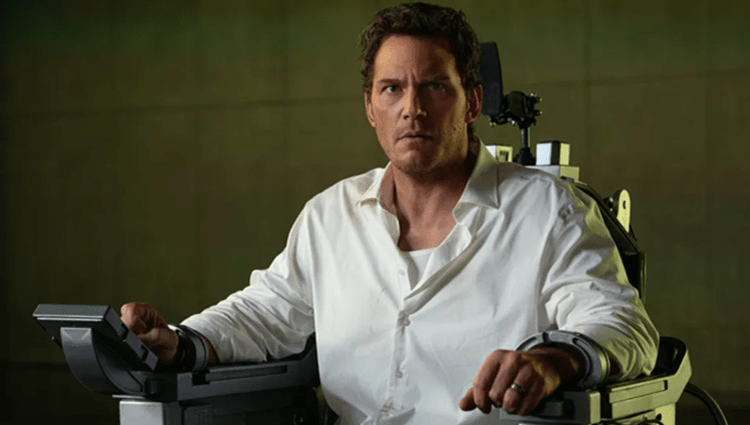
Set in 2029, the movie opens with robbery-homicide detective Chris Raven (Pratt) waking up in a room, strapped to a chair, and alone with Judge Maddox (Ferguson), an artificial intelligence adjudicator for the Mercy Court program. An exposition-heavy first act hurriedly establishes what the Mercy Court is and Raven’s connection to it. Essentially, the Mercy Count is a relatively new way of “quickly and efficiently” judging crimes. It was created to help clean up the crime-ridden Los Angeles, and Raven was one of its biggest proponents.
Here’s how it works: Due to substantial evidence, the accused are assumed guilty and forced to appear before an AI judge where they are given 90 minutes to bring their guilt probability down to 92%. To prove their innocence they’re granted access to a vast amount of digital data gathered through internet trails, social media accounts, surveillance cameras, cell phones, etc. If they fail to reach the threshold by the time the 90 minutes runs out, they will be executed on the spot.

So why is Detective Raven there? It turns out he has been found guilty of brutally murdering his wife Nicole (Annabelle Wallis) earlier that morning. Overwhelming evidence against him has set his guilt probability to 97.5%. Yet while the events of the last several hours are hazy to him, Chris is sure he didn’t kill his wife. So he begins making his case to Judge Maddox, employing the help of partner Jaq (Kali Reis), his close friend Rob (Chris Sullivan), and his daughter Britt (Kylie Rogers). What he uncovers sends the film careening down an unexpected path.
Most of the story is told using a blend of screenlife and traditional drama. After rushing us through the setup, Bekmambetov slows things down just a tad to let his mystery unfold. Yet even it feels pushed along faster than necessary. Chris turns into a digital super sleuth, parsing through data at lightning speed and making out-of-the-blue connections that often don’t make sense. To its credit, the film holds your interest throughout. But it seems like there is much missing in the buildup and in how it all plays out.
Surprisingly the action really ramps up in the final act as the story’s far-fetched twist opens the way to a far-fetched action sequence. And maybe I had succumbed to the craziness, but the bonkers finish was a lot of fun. Absurd and underdeveloped, but fun nonetheless. And that describes “Mercy” as a whole. The blueprint is there for something a lot better than what we get. It’s not without entertainment value. But the untapped potential leaves us thinking more about what might have been.
VERDICT – 2.5 STARS

 Keith & the Movies
Oh go on then, I’ll stream it when it comes.
Goodness, if only they WOULD bring back the death penalty nationwide….