
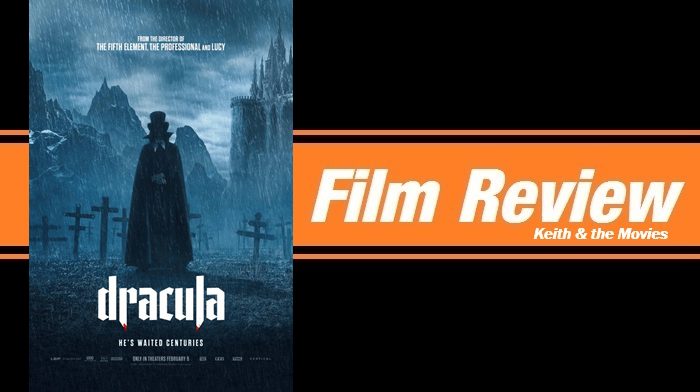
The latest cinematic expression of Bram Stoker’s seminal 1897 horror classic “Dracula” is the simply yet fittingly titled “Dracula”. It comes from writer-director Luc Besson who offers up an unconventional reimagining of vampire mythology and the Dracula story itself. He spins a dark tale rooted more in romance than horror. Yet it has splashes of blood, some wild creative strokes, and even injections of humor, all of which make this more than some generic Dracula rehash.
While the core of Stoker’s story remains, the differences in Besson’s retelling come to light frequently and fairly quickly. With its period romance focus comes some unique style choices which work in surprising harmony with the film’s Gothic horror elements. There’s also an interesting thematic shift from science vs. religion to faith vs. apostasy. We also see a chunk of the story taking place in Paris rather than London.
Other differences are more character related. Dracula’s three brides (or sisters, depending on what interpretation you hold) are replaced by comical stone gargoyles which uproots a prominent thematic layer to Stoker’s story yet makes this more of a singular love story. Also absent is Dr. Abraham Van Helsing. Instead we get an unnamed priest from an order of vampire hunters. And there is no Renfield, at least not the version of him we’re used to.
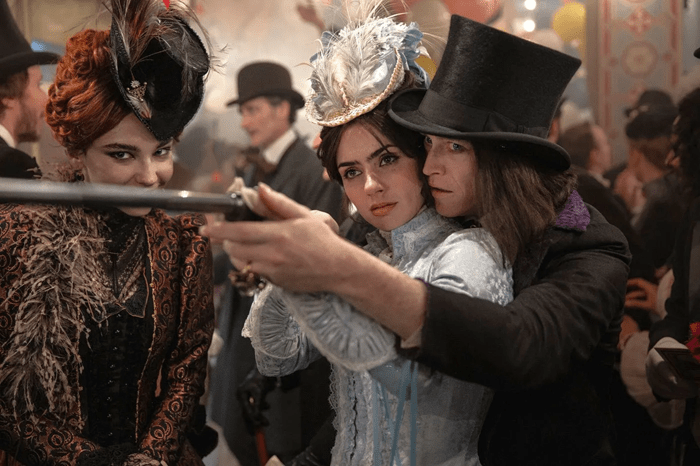
Besson’s story kicks off with a prologue set in 1480 Eastern Europe. Before setting out to face the invading Ottomans, Prince Vladimir of Wallachia (Caleb Landry Jones) seeks assurance from a high-ranking Cardinal (Haymon Maria Buttinger) that God will protect his precious wife Elisabeta (Zoë Bleu) while he’s in battle. But as she’s being ushered to a safer location, Elisabeta and her escort are ambushed and murdered. A devastated and angry Vladimir abandons God, vowing never to serve Him again until Elisabeta is returned.
400 years later in Paris, Dr. Dumont (Guillaume de Tonquédec) seeks help from the Vatican on a disturbing case that is outside of his expertise. He’s sent a Bavarian priest (played by a magnetic Christoph Waltz) from a group secretly commissioned by the Church. Once there, the priest is escorted deep below the hospital where Dumont introduces him to his patient, Maria (Matilda De Angelis), a volatile and seductive young woman who the priest quickly determines is a vampire.
We learn the priest’s order has been hunting the head vampire for centuries. And that head vampire is none other than Count Dracula, formerly Prince Vladimir. Now 400 years old and a husk of his former self, Dracula stays secluded in his Romanian castle while his “associates” scour the land for his reincarnated bride. But his search takes a turn when a solicitor from Paris named Jonathan Harker (Ewens Abid) pays him a business visit.
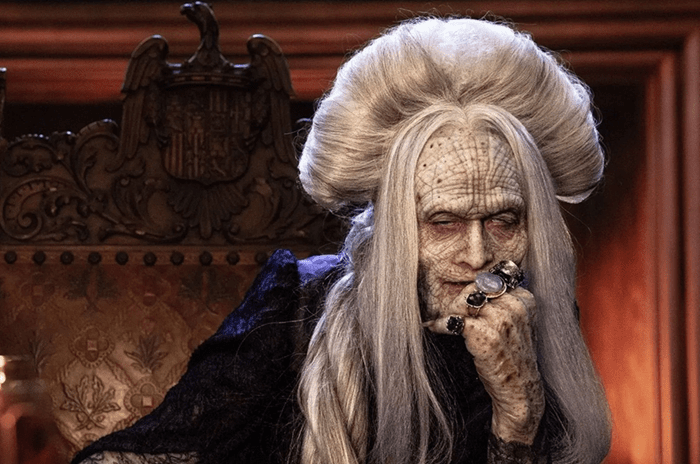
Over the course of his chilling stay at the Count’s castle, Harker shows Dracula a photo of his fiancé Mina (also Bleu) who bears a striking resemblance to his long departed wife. Certain that he has finally found her, Dracula departs for Paris to reunite with his Elisabeta. From there Besson branches out with two storylines that are destined to intersect. One follows Dracula’s venture into Paris as he searches for Mina. The other follows the priest’s investigation as he searches for Dracula.
As Besson’s vision unfolds, it’s hard not to enjoy his nods to the classic story but also his own original reinventions. Nearly every change he makes is there to serve his biggest revision – making this a doomed Gothic love story. Jones is outstanding in portraying Dracula as a creepy yet tragically heartbroken figure rather than a predatory bloodsucking monster. Bleu is a revelation in her crucial dual-ish role. And Waltz is his usual captivating self despite the priest being strangely underwritten in spots.
In addition to the stellar performances, Besson is also helped by Colin Wandersman’s bold cinematography and Danny Elfman’s sweeping score. The period-rich production design and costumes add to the film’s stylish verve. It all enhances this beguiling new spin on Stoker’s classic. It’s chilling, alluring, wonderfully weird, and slyly funny at the most unexpected times. Best of all, it doesn’t try to be the grandest of all Dracula incarnations. The movie is very much its own thing which is a key reason it works so well.
VERDICT – 4 STARS

 Keith & the Movies
Also absent is Dr. Abraham Van Helsing.
Yep, that’s a big ol’ fat “no” from me then. I don’t mind a director messing around with fringe parts of the story, but Helsing is as core to the story as Dracula himself. Why not get rid of Baron Harkonnen from Dune, or John McClane from Die Hard?
Tchhh, directors these days…..
Again, this is a unique spin on the story. Not a direct retelling of it. And it’s very open about that. To be honest, that’s a big reason it worked for me. I feel like I have seen and read the classic story so many times. I appreciated the fresh twist.
Glad it worked for you but I’m glad to know so I don’t watch it and end up frothing at the mouth 😀
LOL
I might. I was very disappointed with the new Frankenstein, this sounds more of the same kind of thing. But I’d give it a try if it streams.
While I loved Frankenstein, this is quite different. It’s much different than any other Dracula vision I’ve seen.
I think this movie borrows a little too much from Francis Ford Coppola’s film from 1992, and it eschews certain elements that are generally expected in a Dracula movie, but I have to say that this is easily Luc Besson’s best movie since The Fifth Element. Caleb Landry Jones as Dracula was phenomenal and heartbreaking. Zoe Bleu was also captivating, and it was those two that I think really held this movie together. Hey, at least we didn’t get Keanu Reeves with a terrible English accent, so THAT’S a win.
HA! Oh that Keanu accent! LOLOLOL