
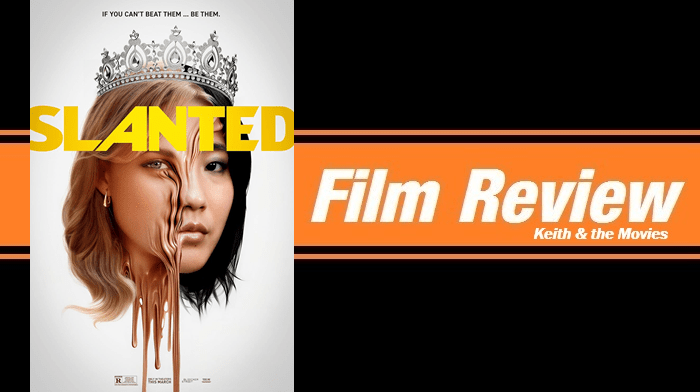
The very concept of “Slanted” put the film in a precarious position from the very start. It’s a deeply personal message movie that doubles as a bonkers social satire and triples as body horror chiller. It’s certainly an ambitious undertaking for writer-director Amy Wang who draws inspiration from her own life experiences and finds catharsis in exploring genres. Unfortunately she struggles to find the right balance, leaving “Slanted” to only go skin deep.
With “Slanted”, Wang has several interesting themes on her mind including identity, culture, and assimilation. More intimately, her film examines insecurity, self-worth, and validation. While nothing feels as thought out as it could be, there are times when Wang hits her marks. But it’s her broader critiques that fall apart, specifically in her observations on whiteness and Americanism. They’re too absurd to be seriously considered and too broad to be insightful.
A key strength of the film is Shirley Chen. She plays Joan Huang, a Chinese-American teen who has grown up on the outside of the popular (and glaringly white) social circles that she desperately wants to be a part of. Joan moved to the United States from China ten years earlier with her father Roger (Fang Du) and her mother Sofia (Vivian Wu). Wang drops them into a caricature of America where city streets are lined with stores like AR-15 Foods, ‘Merica Liquor, Yee-Haw Boots, and Freedom Beans. And where simply being white means you live in some kind of utopian bliss.
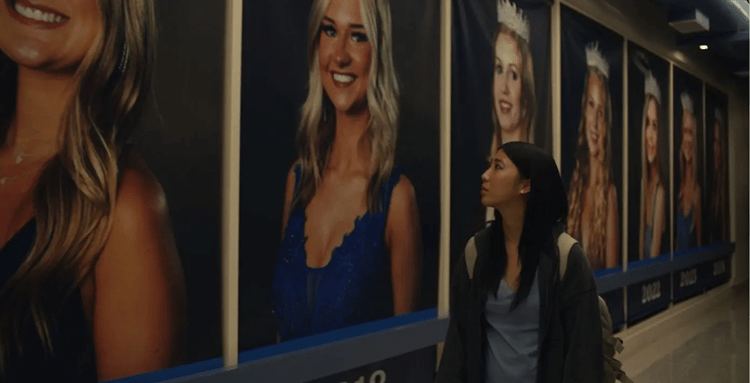
Now in her teen years, Joan attends the whitest high school imaginable where she emulates everything she sees from the popular crowd – their language, their style choices, their obscene self-absorption. She’s especially smitten with the reigning prom queen and social media maven, the insufferable Olivia (Amelie Zilber). At home, her bedroom wall is plastered with pictures of pretty white models plucked from magazines. She pinches her nose with a clothes pin to make it smaller. And she constantly uses cosmetic filters on her selfies to make her look ‘whiter’.
Joan’s obsession with fitting in at school puts a strain on her relationship with her parents. It’s especially difficult with her mother who tries to share their rich cultural traditions but is met with her daughter’s angst-driven indifference. And despite have a very close relationship with her father, Joan does a poor job hiding her embarrassment over his work as a janitor. The inner and outer conflicts provide moments when “Slanted” is at its best. The growing chasm between a daughter and her parents is heartbreaking to watch.
But Joan’s life takes a sudden turn after she gets wind of a mysterious company called Ethnos. They pitch themselves as “a place where we help you reach your true potential”. Joan decides to check out their office where she meets Dr. Willie Singer (R. Keith Harris). He tells her of a groundbreaking new ethnic modification surgery – a two hour procedure that permanently changes the patient’s pigmentation, facial and body features, and even their voice. It other words, it turns them white. “If you can’t beat them, be them,” the smarmy doctor says with a smile.
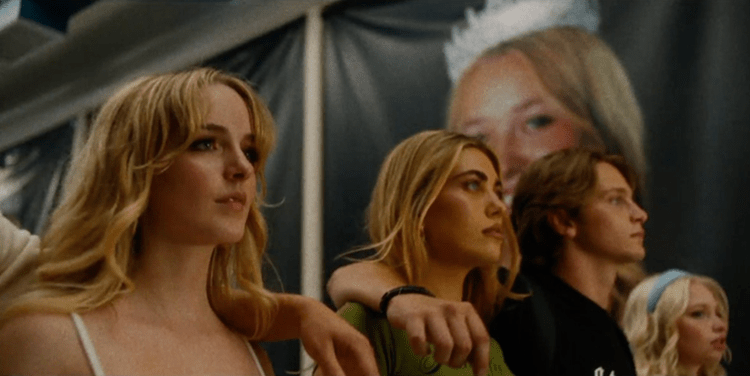
Of course Joan has the surgery and comes out pretty, blonde, and most importantly white. Now played by Mckenna Grace, Joan sets out to live the white life she’s always wanted. But there are speed bumps along the way, namely her parents and her best friend Brindha (Maitreyi Ramakrishnan) who may be the only other person of color left at school. Yet Joan gains the popularity she wanted and is even accepted into Olivia’s clique. But eventually it’s all threatened by some unexpected and disturbing consequences.
As Grace takes the baton from Chen, she adds several new layers to their character. Both give great performances that allow us to fully grasp Joan’s emotional journey. Du and Wu are equally good and in many ways are just as crucial to capturing the human element. Yet none of them can make the overall story crackle the way it needs to. They simply have too much working against them. The script’s shallow treatment of key themes waters things down. The storytelling is all over the map. And even the body horror (once it finally comes) is too tame to register.
“Slanted” does have some respectable creative flourishes, such as the clever shift from a 4:3 aspect ration to widescreen showing Joan’s feelings of confinement to freedom. But neither them, the strong performances, or Wang’s admirable personal investment can overcome the film’s inability to balance its message with either satire or horror. Somewhere in “Slanted” is a really good movie about cultural identity – one willing to go deeper than a cartoonish parody of whiteness and a shallow view of American values.
VERDICT – 2 STARS

 Keith & the Movies
Oh well, moving on….
As the great Lt. Frank Drebin once said… “There’s nothing to see here!”
😁
Let me be silly for a moment and say the title is “Slanted,” not “Balanced.” Sounds a like a tamer twist on The Substance?
There are definitely some surface-level comparisons to The Substance. Otherwise, this movie mostly squanders any ideas it has.
Slanted *could* have been (and I hoped it would be) a 21st Century successor to the iconic 1966 existential horror film Seconds. Unfortunately, Amy Wang chose to cop out and give us an ending that was not only “meh”, but worse yet, even somewhat “touchy-feely”. It was lame on a level with how Seconds would have been if it’d ended with The Company giving Arthur Hamilton his old face and life back, and sending him back to Scarsdale.🤮