REVIEW: “War” (2019)

The third installment in the now expanding TRF Spy Universe is the aptly titled “War”, a brawny Bollywood blockbuster that rivals any big-budget tentpole movie Hollywood puts out today. It’s a bit like “Mission: Impossible” meets “Fast and Furious” but with its own special sauce that fans of Indian action cinema will immediately recognize. It makes for a movie that’s exhilarating from start to finish and one with enough pizzazz to keep its audience glued to every eye-popping frame.

“War” is directed with style and verve by Siddharth Anand who more recently has directed the universe’s fourth film, 2023’s “Pathaan”. In “War”, Anand went BIG with his action scenes and clearly spared no expense. Taking place in stunningly shot locations all around the world, his set pieces are second to none and include a wild shootout in Tikrit, a killer pursuit across the rooftops of Marrakesh, a jaw-dropping motorcycle chase through Lisbon (that must be seen to be believed), and a sports car showdown in the Arctic Circle.

Adding to film’s list of strengths are the terrific lead performances from its two leads, Hrithik Roshan and Tiger Shroff. Both have leading man charisma as well as the gritty physicality their roles demands. But they also have the ability and the smarts to dial their performances down whenever a scene needs them to. Ultimately it adds a level of believability to their characters, even in the instances when the delightfully over-the-top action sticks them in some pretty wild and crazy situations.

The story moves at a propulsive pace and is full of twists and unexpected turns. Shroff plays Captain Khalid Rahmani, a RAW agent desperate to regain his family’s honor after his disgraced father betrayed his country and was killed as a result. Khalid was trained by one of RAW’s best agents, Major Kabir Dhaliwal (Roshan). Kabir was hesitant to take Khalid into his special unit, because of his father’s bad name. But Khalid proves himself in the field and earns Kabir’s trust. Kabir agrees to train Khalid, and the two develop a friendship.

But when Kabir suddenly assassinates a high ranking RAW official, it’s left to a shocked and hurt Khalid to hunt down and eliminate his former mentor. But that proves to be easier said than down as Kabir always seems to be one step ahead of Khalid and his team (much like the movie is with its audience). Every time we feel we have a grasp of where things are going, Anand throws us a curveball. Admittedly, a couple of the twists are utterly preposterous. But they’re also wildly entertaining.

While its story (written by a team of four that includes Anand) earns its spy thriller stripes, there’s so much more that makes “War” click. I mentioned Roshan and Shroff who are in perfect tune with their characters and each other. And again, there’s the incredible vistas that are exquisitely shot by DP Benjamin Jasper. There’s also the remarkable fight sequences put together by South Korean martial arts choreographer Se-yeong Oh. The extraordinary production design, the (mostly) incredible digital effects, the energetic but not overbearing score – all key ingredients that Anand uses to the fullest.

“War” is a thrilling ride built on a big vision and even bigger ambition. There’s not a dull moment to be found in the film’s hefty 154-minute runtime, and it does a great job leaving its audience hungry for more. As for its standing in the growing TRF Spy Universe, it’s hard to tell right now. A sequel to “War” is said to be in the works, and its connection to “Tiger 3”, the fifth film in the universe due out later this year, remains to be seen. But even on its own, “War” delivers everything action fans will want, plus some. “War” is available on VOD and streaming on Amazon Prime Video.

VERDICT – 4.5 STARS

REVIEW: “Cocaine Bear” (2023)

It’s hard to go into a movie called “Cocaine Bear” without having at least some sense of what you’re getting into. And if you’ve caught even a glimpse of the trailer, it’s even clearer what director Elizabeth Banks and her attractive cast of friends are going for. But no amount of self-awareness can make this schlocky, gore-filled dark comedy as fun as it desperately wants to be. Not even close.

“Cocaine Bear” is a movie that begs to be judged by the “it knows exactly what it is” standard. Sure it has its moments, and Banks tosses out all the rules. But it works so hard at being wild and irreverent that it seems to forget everything else. Stuff like good characters, a remotely interesting story, genuine humor, or even the slightest reason to care about anything we’re seeing. “Just go with it” is sure to be a common response, and I’m happy for those who are able to do it. But I needed more out of Jimmy Warden’s threadbare script.

It’s true that “Cocaine Bear” is open and unapologetic about its intentions (again, just look at its title). And if you stretch it far enough you might get lucky and find an actual theme. But for the most part, whenever the movie departs from its undeniably goofy and entertaining central conceit, the cracks start to show. In other words, whenever the film’s blitzed CGI American black bear isn’t gnawing off human limbs or slicing open abdomens, the movie crumbles.

The story is very loosely based on true events. In December of 1985, former narcotics officer turned drug smuggler Andrew Carter Thornton II (played briefly in the film by Matthew Rhys) was transporting cocaine from Columbia in a Cessna 404. Feeling his plane was overloaded, Thornton began dumping packages of coke and eventually jumped out himself. But his parachute malfunctioned and he fell to his death near Knoxville, Tennessee. Three months later a dead black bear was found in the Chattahoochee National Forest, surrounded by opened packages of blow. It has been nicknamed the Cocaine Bear and is currently on display at the Kentucky for Kentucky Fun Mall in Lexington.

All of that (except the part about the bear dying) takes place within the first two minutes of the movie. From there it’s all make-believe as the coke-craving bear slashes, maims, and mauls a gaggle of bland, disposable characters as it looks for its next fix. And that’s the film’s bread and butter. The problem is, we don’t get much of that at all. I only remember three noteworthy scenes of delightfully over-the-top bear savagery.

That means most of our time is spent stuck with the patently uninteresting and remarkably unfunny human characters. Paper-thin story aside, no one we meet are given an inch of depth and there’s barely a human trait to be found. It’s hard to even refer to them as sketches considering how shallow and fruitless they all are (and I do mean ALL of them). There are some really good names wasted here – Keri Russell, Alden Ehrenreich, Margo Martindale, O’Shea Jackson Jr, Ray Liotta (in his final role). They’re all trapped inside a movie that spends more time aping other ideas that building on its one original one.

Russell plays a mother looking for her daughter (Brooklynn Prince) and her young friend (Christian Convery). Ehrenreich and Jackson Jr play smugglers sent by a drug kingpin named Syd (Liotta) to find and retrieve the cocaine. Martindale plays a forest Ranger while Jesse Tyler Ferguson plays an animal rights activist. Isiah Whitlock Jr plays a police detective trying to bring down Syd’s organization. Through their own simplistic and convenient reasons, all find themselves in the Chattahoochee National Forest with the eponymous bear running wild. And that’s the story. All of it. Seriously.

The bar for “Cocaine Bear” was pretty low meaning this should have been a slam dunk. It could have really went wild with the B-movie schlock. It could have worked great as a Hollywood satire. As it is, everything hinges on the one big joke, and that would be fine except Banks doesn’t do nearly enough with it. That leaves us in the company of a dull and witless collection of human characters, none of whom register as interesting or (more importantly in this case) funny. Their low-rung, force-fed attempts at humor land with a deafening thud. Yet another thing that left me thinking of the many ways that this could have gone better. But hey, at least it “knows exactly what it is”. “Cocaine Bear” is now showing in theaters.

VERDICT – 1.5 STARS

REVIEW: “Jesus Revolution” (2023)

(CLICK HERE to read my full review in the Arkansas Democrat-Gazette)

In recent years there’s been a noticeable maturation of “faith-based” movies. It’s been visible in both the quality of the filmmaking and the depth of storytelling. Not only are their characters becoming more rooted in the real world, but they’re demonstrating a more lived-in faith. And filmmakers are finding that they can still convey their faith-centered messages without pounding their pulpit or speaking to their audience in platitudes. Obviously these welcomed shifts don’t guarantee great movies. But they do help these films to be seen and judged by a more equal standard.

The latest example is “Jesus Revolution” from co-directors Jon Erwin and Brent McCorkle. Based on Greg Laurie and Ellen Vaughn’s book of the same name, the movie tells of the Jesus Movement and its growth in Southern California during the early 1970s. The Jesus Movement was a Christian counterculture revolution that emerged in the late 1960s and exploded across the country in the early 1970s. Born out of the burgeoning hippie sub-culture, the movement wasn’t just restricted to disillusioned flower children. Young people from around the country left their traditional church settings and joined fellow “Jesus Freaks” in the many communes along the West Coast.

Image Courtesy of Lionsgate

Some within the Christian ranks have celebrated the Jesus Movement as the last great “spiritual awakening”. Many have praised its use the culture to draw young people; how its anti-establishment roots helped redefine church services; and how it gave birth to today’s lucrative contemporary Christian music industry. Critics saw it as more of a cultural movement than a biblical one. And they noted its emphasis on signs and experience over doctrine and theology. There’s certainly no doubting which side the movie lands on.

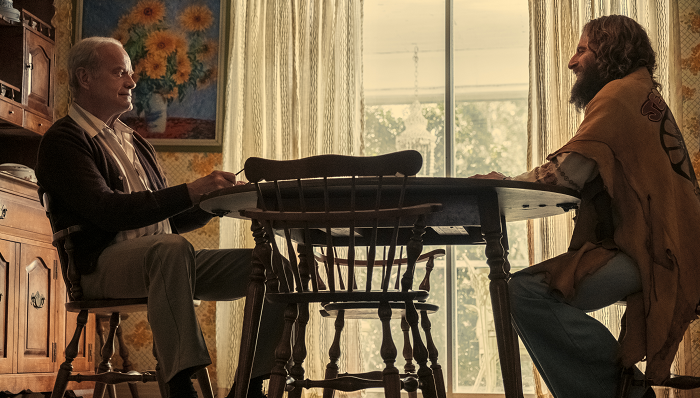
“Jesus Revolution” is taken from megachurch pastor and producer Greg Laurie’s early experiences as a member of the Jesus Movement. It’s a well made, well directed, and well acted mixture of biographical, coming of age, and faith-based elements. The “based on a true revolution” story (written by Erwin and Jon Gunn) covers a lot of ground and does so by focusing on three key characters: Greg Laurie (played by Joel Courtney), Chuck Smith (Kelsey Grammer), and Lonnie Frisbee (Jonathan Roumie).

The film opens in 1968, a time when you couldn’t turn on your radio or television without hearing about the growing peace-and-love hippie movement bursting out of San Francisco’s Haight-Ashbury district and across Southern California. It’s here that we meet a young Greg Laurie who lives in Newport Beach with his hard-drinking and hard-living mother (Kimberly Williams-Paisley). Greg gets a good taste of hippie culture after meeting and falling for a spirited and beautiful girl named Cathe (a terrific Anna Grace Barlow).

Meanwhile, Pastor Chuck Smith has watched his Costa Mesa church’s numbers dwindle down to a faithful few. His first inclination is to blame the culture, specifically the shaggy-haired, barefoot, drugged-out hippies who are all over the news. But when Chuck meets a traveling hippie street-preacher named Lonnie Frisbee, he’s immediately captivated by what he hears. He invites Lonnie and some of his Jesus-loving friends to his church. Of course it initially upsets Chuck’s congregation who the movie paints as a bunch of old starched and stuffy squares. But soon the church is drawing hippie youth from all around, including Greg and Cathe.

Image Courtesy of Lionsgate

The movie’s blinding affection for the Jesus Movement ultimately shapes how it’s portrayed. The filmmakers don’t offer any real critique and there’s certainly not much interest in a biblical assessment. It even comes through in their treatment of the real-life characters, most notably Lonnie Frisbee. He was undoubtedly a central figure in the Jesus Movement but also a complicated one. The movie touches on some of his later missteps but dodges the more controversial parts of his life.

But despite its obvious lean, “Jesus Revolution” still makes for an diverting look at a more recent slice of America’s spiritual and cultural history. The impressive production value, costume design, and needle-drops create a vibrant and authentic late 60s and early 70s atmosphere (although I did chuckle at a character in 1968 singing along with a song that actually came out in 1970). And there are moments that inspire, both spiritually and socially. There’s a good chance it’ll speak to those whose faith needs recharged or to those who simply need a reminder that people from different camps can come together in meaningful ways. Now there’s a message that we certainly need today. “Jesus Revolution” is out now in theaters.

VERDICT – 3.5 STARS

REVIEW: “Devil’s Peak” (2023)

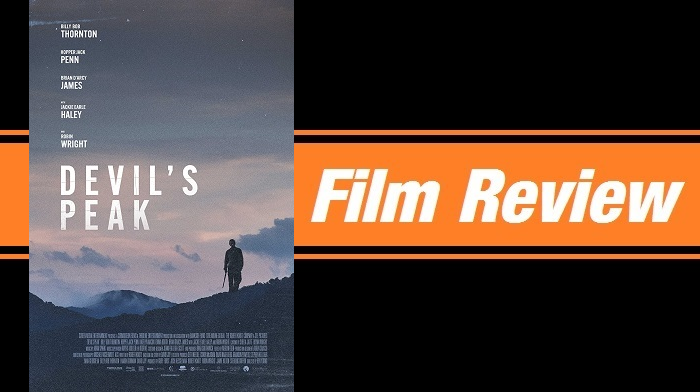
Based on the novel “Where All Light Tends to Go” by David Joy, “Devil’s Peak” is a modest crime thriller set in poverty-stricken, drug-infested rural Appalachia. It’s not the first movie to examine this troubled yet compelling region in the Eastern United States, but director Ben Young and screenwriter Robert Knott have some interesting pieces to work with. Unfortunately the material is plagued with overly simple story beats, thinly sketched characters, and an inescapable air of familiarity.

The story takes place in Jackson County, North Carolina and the roles are filled by a solid ensemble. Hopper Penn plays Jacob McNeely, the son of a hardcore drug dealer named Charlie (Billy Bob Thornton) who has had the impoverished local community by the throat for years. Jacob runs an auto body shop which is really a front for the father’s drug ring. We learn Charlie has had his son selling crystal meth since he was nine-years-old. It’s the family business.

But Jacob has a decency inside that sets him apart from his father. It comes out in his affection for his troubled mother and Charlie’s ex-wife Virgie (Robin Wright). We also see it in his love for his girlfriend Maggie (Katelyn Nacon) who is about to go to college in Wilmington. She’s the daughter of a crooked politician (Brian d’Arcy James) who’s not too keen on his daughter’s choice of a boyfriend. Jackie Earle Haley chips in as the local sheriff named Dwight while Emma Booth plays Charlie’s live-in girlfriend Josephine.

Much of “Devil’s Peak” focuses on the dysfunctional family tension between Jacob, Charlie, and Virgie. To no surprise Thornton, with his shaved head and bushy jet-black goatee, has no trouble playing a vile and irredeemable menace. It’s an effective performance that’s a little cartoonish but fittingly repellent. Wright brings more nuance, playing a junkie trying to overcome the mistakes of her past. Sadly Wright is dealt a bad hand and isn’t given much to work with. Penn isn’t quite as convincing. As Jacob struggles to get out from under his family name, Penn struggles to earn our empathy. His somewhat muted performance isn’t able to muster the excitement or emotion that the character and the movie needs.

“Devil’s Peak” could have taken its characters in a number of interesting directions. Instead it plays it safe, telling a story that follows its one trajectory to the very end. And despite the commitment of the cast, even the characters crumble under the weight of formula. To its credit, Young’s pacing ensures it’s never boring. But with so little under its Southern Gothic exterior, it’s hard to find much to get excited about. “Devil’s Peak” is now available on VOD.

VERDICT – 2 STARS

New to Home Video: “Training Day” 4K ULTRA HD

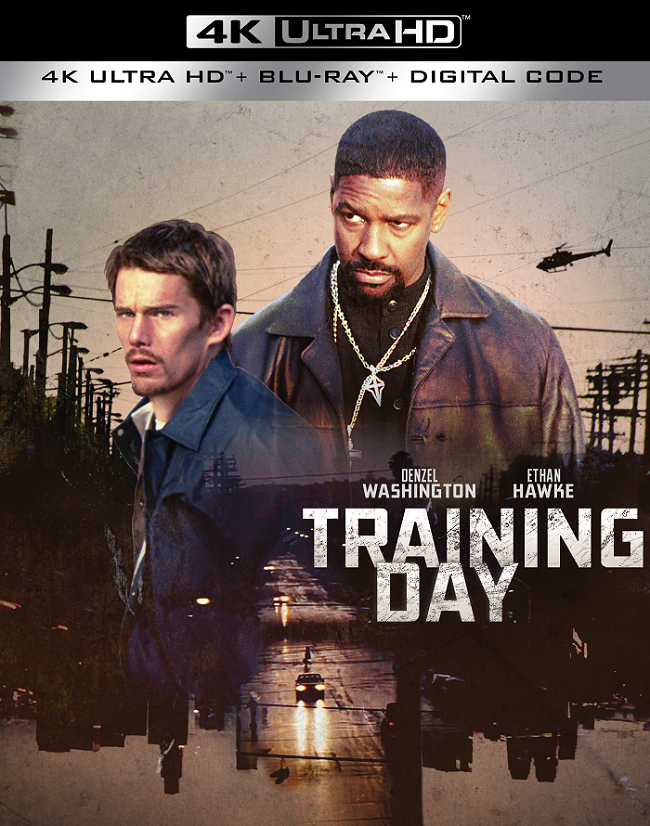
Led by Academy Award winner Denzel Washington and Academy Award nominee Ethan Hawke, “Training Day” comes to home video in a new 4K UHD combo-pack courtesy of Warner Bros. Discovery Home Entertainment. Now over 20 years old, this critically acclaimed crime thriller still boils with the same edge-of-your-seat intensity. It remains director Antoine Fuqua’s best film to date, and is among the best performances in the brilliant careers of both Washington and Hawke.

This new 4K Ultra HD edition of “Training Day” hits shelves FEBRUARY 28, 2023. See below for a full synopsis and breakdown of the bonus features.

OFFICIAL SYNOPSIS:

Year: 2001

Rating: R

Runtime: 122 Minutes

Director: Antoine Fuqua

Starring: Denzel Washington, Ethan Hawke, Scott Glenn, Eva Mendes, Cliff Curtis, Raymond Cruz, Noel Gugliemi, Dr. Dre, Peter Greene, Snoop Dogg, Nick Chinlund, Jaime P. Gomez, Macy Gray, Tom Berenger, Raymond J. Barry, Terry Crews, Denzel Whitaker, Charlotte Ayanna, Harris Yulin

About the Film:

Denzel Washington delivers an Academy Award-winning performance opposite Ethan Hawke in this gritty drama set in the morally ambiguous world of undercover police work. Every day a war rages between drug dealers and cops on the streets of America’s inner cities. With every war come casualties, none greater than 13-year veteran Los Angeles narcotics officer Alonzo Harris (Washington), whose questionable methods blur the line between legal and corrupt. Today Alonzo gets a new partner, idealistic rookie Jake Hoyt (Hawke), and Jake has one day–and one day only–to prove his mettle to his fiercely charismatic superior. Over 24 hours, Jake will be dragged into the ethical mire of Alonzo’s logic as both men risk their careers and their lives to serve conflicting notions of justice.

BONUS FEATURES

Training Day” Ultra HD Blu-ray contains the following previously released special features:

•           Pharoahe Monch’s “Got You” music video

•           Nelly’s “#1” music video

•           Deleted Scenes

•           Commentary by director Antoine Fuqua

•           Training Day: Crossing The Line Featurette

•           Alternative Endings

RETRO REVIEW: “Chinatown” (1974)

Revisiting “Chinatown” for the first time in years was like digging up a decades-old time capsule and rediscovering everything inside as if it were the first time. I’ve always appreciated “Chinatown”, but perhaps not quite like I should have following my first watch back in the early 1990s. It wasn’t until a second viewing some 15 (ish) years later that the movie really clicked for me. Since then my appreciation has only grown.

I was inspired to rewatch “Chinatown” following the recent release of Sight and Sound magazine’s “Greatest Films of All Time” poll. For those unfamiliar with it, the poll has been taken every ten years since 1952. A select group of film critics and industry insiders are asked to vote for the ten greatest movies of all time. It has generally been a highly regarded poll partly due to the exclusivity of its voting body. But last year brought both controversy and skepticism, with S&S boosting its voters to 1,639 hand-picked participants (there were 145 in the 2002 poll; 846 in 2012). Naturally it resulted in some big changes to list.

But I didn’t revisit “Chinatown” because of its prominent place on the S&S list. No, instead it was because the landmark 1974 classic was booted from the list entirely. On the surface it seems like a mind-blowing omission and a real shock to the poll’s credibility (“The Godfather Part II”, “Rio Bravo”, “Raging Bull” and others also got the boot). So I fired up the film to see if something had changed. Nope, it still hits every mark and impressed me more this time than during any of my previous viewings. Sorry Sight and Sound. You got this one wrong.

Image Courtesy of Paramount Pictures

“Chinatown” comes from director Roman Polanski, a blemish that alone probably cost the film several votes. But the pure quality of the movie itself stands on its own. As does the exceptional Oscar-winning screenplay from Robert Towne. As does the cool and charismatic lead performance from Jack Nicholson – arguably the best of his career. As does the stellar supporting work from Faye Dunaway and John Huston. As does the period set design and costumes. As does Jerry Goldsmith’s transporting score. I feel like I could go on and on.

Set in 1937 Los Angeles, Nicholson plays a private detective named J. J. “Jake” Gittes. One afternoon a woman (Diane Ladd) identifying herself as Evelyn Mulwray comes to his office. She suspects her husband, Hollis Mulwray (Darrell Zwerling), is having an affair and she wants Gittes to find out. He takes the job and upon investigating learns that Mulwray is the chief engineer at LA’s Department of Water and Power. Gittes starts tailing Mulwray, eventually snapping some photos of him with a young woman – photos that mysterious end up in the newspaper.

The next day Gittes is confronted by the real Evelyn Mulwray (Dunaway) who hits him with a lawsuit. Steamed that he’s been used by someone to disgrace Hollis Mulwray, Gittes and Evelyn cut a deal. He’ll find out who set up her husband, and she’ll drop the lawsuit. Seems simple enough, but of course it’s not. What started as an infidelity case soon gives way to lies, city corruption, and (as in most good noirs) murder. Even worse, there’s something far more sinister underneath it all.

For lovers of classic noirs, watching “Chinatown” is like putting on a soft warm sweater. It fits snugly within the bygone genre and feels right at home next to the many films that undoubtedly inspired it. Yet Polanski and Towne add their own special seasoning which makes this more than just a copy-and-paste experience. Much of it is in the way Polanski plays with POV or how he shoots his sun-baked Los Angeles (DP John A. Alonzo received an Oscar nomination). But it’s also evident in Polanski’s willingness to tinker with genre conventions, to the point that we’re never certain where he’s taking us.

Image Courtesy of Paramount Pictures

Then you have Towne’s absorbing screenplay. It has a few signature noir movie twists with everything being revealed at the very end (Interestingly, Polanski added some grit to the ending, changing it up in a way that initially frustrated Towne. Later, Towne would admit that Polanski’s climactic finish was the right choice). But there is so much more to Towne’s dense and complex story. He offers a deep and compelling spin on the California Water War and all the political deception and chicanery that went with it.

Towne also does some incredible character work. Written specifically for Nicholson, Gittes is a cynical wisecracking sleuth but with an uncommon sense of decency at his core. Dunaway’s Evelyn is an elegant and high-class femme fatale who does her best to hide her fragility. And of course there’s the devilishly good John Huston playing Evelyn’s wealthy and powerful father, Noah Cross. Towne fleshes them all out through his crackling dialogue and his patient attention to detail. They all have roles to play within his winding story, but they are also given plenty of room to develop.

“Chinatown” spends a lot of time covering a lot of ground, yet it’s surprisingly efficient. There’s simply no wasted scenes, no meaningless lines, and no throwaway moments. And while the disgraced director’s vile, post-“Chinatown” offenses undoubtedly hang over his work, there’s a richness to Polanski’s direction, and I love how he entrusts his audience to follow along. In the end, every facet of great filmmaking can be found in “Chinatown”. And I’m sorry to say it, but it’s hard to take a “Greatest Films of All Time” list seriously that doesn’t include this 1974 classic.

VERDICT – 5 STARS