REVIEW: “Savage Hunt” (2025)

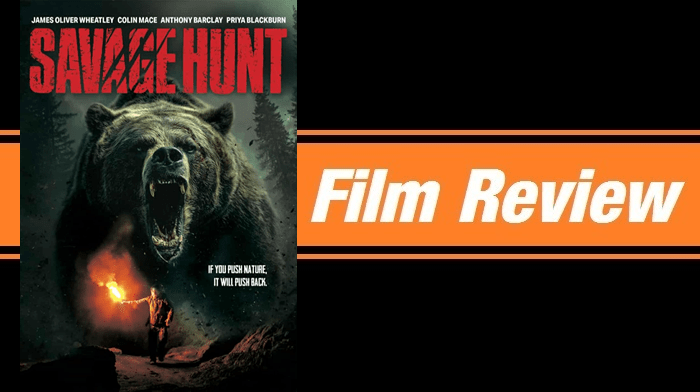
Dutch action filmmaker Roel Reiné directs, composes, and shoots the new survival thriller “Savage Hunt”. The film falls into the ‘Man versus Beast‘ category, centering itself around the bloody rampage of a giant bear in a sleepy Montana community. It’s a fairly straightforward genre movie that attempts to add several human layers to its story. But staying involved becomes difficult due to the film’s clear budget constraints and a paper-thin script that glosses over everything that could have made the story more interesting.

Screenwriters Chad Law and Christopher Jolley begin their story with two eco-activists making their way through the wilderness after scoping out a newly cleared construction site sitting in the middle of the pristine forest. The site belongs to a multinational conglomerate with plans of building a massive resort and spa. But as the activists are planning their sabotage, they are attacked and torn to shreds by a ravenous grizzly bear.
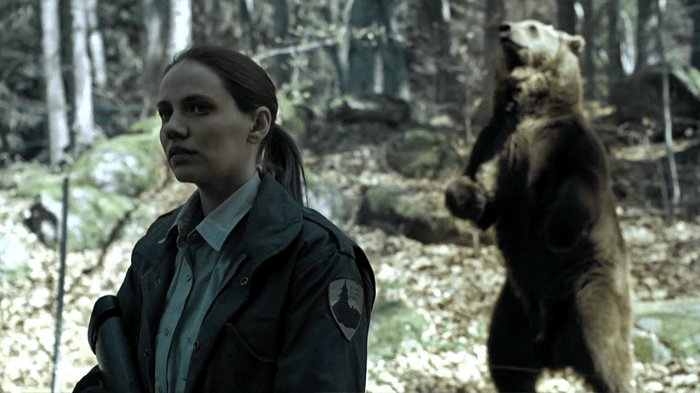
Image Courtesy of Shout! Studios

After discovering one of the victims and recognizing a bear attack, Sheriff Riggins (Colin Mace) and a local park ranger Kate Deeks (Fotina Papatheodorou) order the site to be shut down until they can hunt down the grizzly. Initially the site manager, Jace (Anthony Barclay) isn’t happy with their order. But he’s a bit preoccupied with the arrival of his wife Lacey (Noush Skaugen) and their daughter Alex (Priya Blackburn).

In the film’s most underdeveloped side stories, we learn Jace and Lacey are separated and she has brought divorce papers to be signed. There’s also some kind of disconnect between Jace and Alex which never fully forms into something relatable. In fact nothing about their family drama feels authentic. It’s not helped by the cold and stiff performances. But it’s mostly the script which only glazes over the themes it introduces rather than give them meaningful attention.

To add even more drama, more attacks lead Kate to seek help from Joe Regan (James Oliver Wheatley), a tormented local hunter and former ranger who she shares a traumatic history with Kate. After declining due to vague reasons that eventually gets explained (sorta), Joe reluctantly agrees and sets out to track the bear. Of course he ultimately comes face-to-face with the beast. But in the process, Joe is forced to reckon with his own haunting ghosts from the past.

Image Courtesy of Shout! Studios

Again, none of the human drama has much of an impact. And it’s hard to root for anyone when they’re constantly making bone-headed decisions, such as always finding ways to put themselves in the most dangerous positions. But at least we have the human vs. bear action, right? Well, not exactly. Much of the movie consists of people slow-walking through the scenic forest and what looks like stock footage of a bear running around in the wild. The lone exception is one weird scene of the bear randomly running down the Main Street of a small town.

Of course we’re treated to several bear kills which unfortunately range from serviceable to awkwardly bad. And other issues spring up along the way such as the shaky editing and the abrupt ending that seems strange for a movie already struggling to fill its 85 minutes. And it doesn’t help that “Savage Hunt” takes itself so seriously. It’s a mostly dour and joyless endeavor that would have been much better off embracing its absurdity. Instead we end up with a glacially paced, frustratingly hollow, and ultimately forgettable snooze.

VERDICT – 1.5 STARS

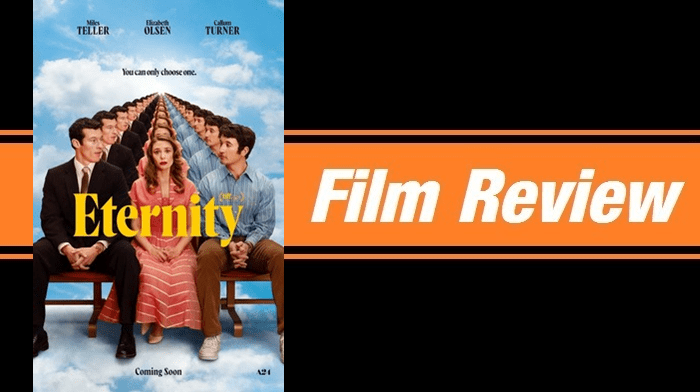
REVIEW: “Eternity” (2025)

With his ambitious new film “Eternity”, director David Freyne combines classic screwball comedy with an old-fashioned romance, seasoning it all with a dash of wacky fantasy. He tells a story (co-written by Freyne and Pat Cunnane) that’s so strange on paper it never should work on-screen. Yet the surprisingly sincere and impressively imaginative “Eternity” is considerably more entertaining than you would ever expect it to be.

“Eternity” begins with an elderly husband and wife on their way to a family gender reveal gathering. As they drive, the crusty Larry (Barry Primus) and the needling Joan (Betty Buckley) have all the qualities of a couple who has been married for 65 years. Larry is a bit of a curmudgeon but a very caring one. Meanwhile the opinionated Joan has been diagnosed with terminal cancer – heartbreaking news which they’ve yet to reveal to the kids and grandkids.

Image Courtesy of A24

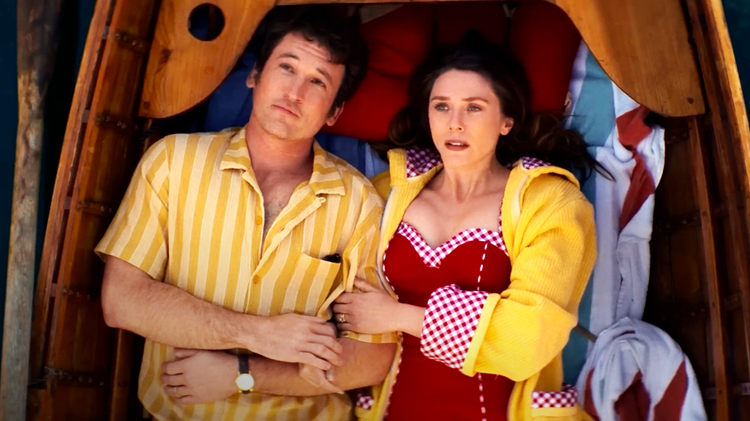
But their life together screeches to a halt when Larry chokes to death while at the party. In a snap, he suddenly awakes on a train, now as a much younger get version of himself (played by Miles Teller). When the train stops, Larry and a mass of other people are ushered into a waiting area called “the junction”. There he is instructed to wait for his Afterlife Coordinator. After a lengthy wait he’s finally greeted by his personal AO, Anna (Oscar winner Da’Vine Joy Randolph).

Anna immediately begins explaining things to the understandably confused Larry (and us). We learn Larry is in something resembling Limbo. It’s a depot of sorts where the recently deceased are given seven days to choose their eternal destination out of the many themed eternities offered. There’s an eternity for every taste imaginable – Beach World, Vampire World, Library World, Catholic World, Smoker’s World, Men Free World, and even a world dedicated to Paris in the 1960s. Once a person enters their chosen world they must stay their for eternity. Any attempt at escaping will see them cast into an ominous space called The Void.

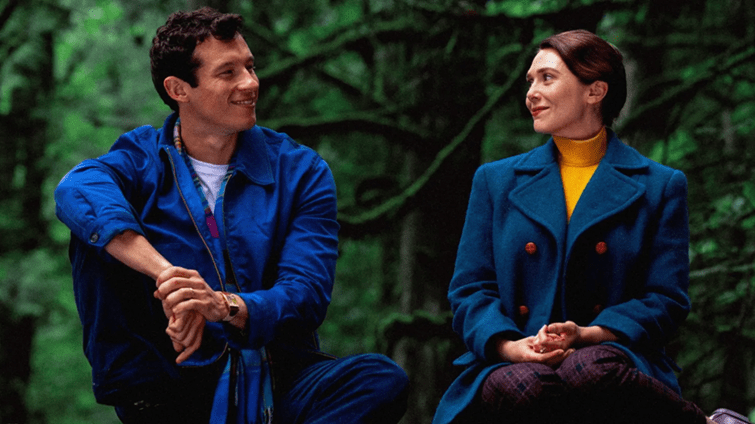
As for his younger appearance, Larry is told that after death people revert to the form of their happiest self in life. That’s why days later he is stunned to see a younger Joan (now played by Elizabeth Olsen) fresh off the train and just as confused as Larry was. But their sweet reunion is interrupted by the dashing Luke (Callum Turner), Joan’s first husband and the love of her life before he was killed in the Korean War. Luke reveals he has waited 67 years for Joan to arrive, biding his time as a bartender in the junction.

Image Courtesy of A24

So Joan is left with an impossible choice. Does she spend eternity with the man she had already built a life with or with the man who died before she was able to? That dilemma forms the crux of “Eternity”. For the most part Freyne keeps things sweet and endearing while also including some nice splashes of humor, mostly during his film’s first half. Yet there is an running undercurrent of heartache that grounds the many emotions surrounding this classic love triangle. And it doesn’t hurt to have such a capable trio as Olsen, Teller, and Turner anchoring things.

When it comes to world-building, “Eternity” plucks ideas from agnosticism, universalism, and Christian eschatology to create an equally interesting and imaginative fantasy setting. As for the story, you’ll find it easy to spot the cracks if you give it too much thought. But if you let the movie operate on its own terms, you’ll have a hard time denying its beguiling charm, admirable sincerity, well-struck comic beats, and welcomed originality. What can I say, I certainly found myself under its spell.

VERDICT – 3.5 STARS

REVIEW: “Rebuilding” (2025)

In the aftermath of a devastating forest fire, a cowboy who lost everything rediscovers what matters most in life. That’s a fitting summary of “Rebuilding”, the sophomore effort from writer-director Max Walker-Silverman. His latest film operates on the same quiet, delicate, and soulful wavelength as his debut feature, 2022’s sublime “A Love Song”. And in doing so, Walker-Silverman tells another heartfelt story that’s deeply rooted in the human experience.

I often find myself drawn to quiet, understated, and observant dramas from filmmakers with firmly human perspectives. “Rebuilding” is every bit of that. Led by a strikingly subtle Josh O’Connor lead performance, “Rebuilding” sits us down is a distinct setting and tells a rich character-centered story. But it’s the stillness, the patience, and the unvarnished honesty that sets it apart, bringing to mind the approaches of such classic auteurs as Robert Bresson and Vittorio De Sica.

Walker-Silverman sets his film in Colorado’s San Luis Valley, beginning with a sobering opening as his camera relays the aftermath of a devastating wildfire. Underneath the thick haze of smoke is a wasteland of ash with the occasional charred tree jaggedly pointing upward like a gnarled finger. It’s there that we meet Dusty Fraser (O’Connor), a cowboy who just lost his small family ranch in the blaze. Nearly all he has left are a few head of cattle which he is forced to sell at a local auction.

Through the scruffy and subdued O’Connor, we see the different sides of Dusty, both of which play a significant role in the story. Dusty is a man of dignity who takes pride in being a rancher as his dad was before him. So losing it all has a crushing impact. But he’s also a quiet, reticent man. And while we can see the defeated look in his eyes, he keeps is emotions pent up within him. It’s an impressive performance from O’Connor who speaks volumes, often without uttering a word.

In the midst of his despair, Dusty’s road to finding hope begins when he rekindles his relationship with his ex-wife Ruby (Meghann Fahy) and their daughter Callie Rose (Lily LaTorre). The movie’s title certainly speaks to survivors rebuilding after such a destructive disaster. But at its core, it’s Dusty rebuilding his relationship with Ruby and Callie Rose that forms the beating heart of the story. It’s here that Walker-Silverman’s patience pays the biggest dividends. He smartly lets their relationships breathe, allowing ample room for reconnection and healing.

Another impactful turn in Dusty’s journey comes when he relocates to a small temporary FEMA camp on a desert plain resting between the San Juan and Sangre de Cristo Mountains. Dusty moves into his cramped trailer and over time begins connecting with the small group of displaced survivors taking shelter at the camp. Not only does he find a new sense of community, but through them he discovers a new sense of purpose.

“Rebuilding” is full of small moments that leave big emotional impressions. Such as when Dusty and Callie Sue park outside a rural library to borrow the only free Wi-Fi in the area. Or when Dusty pays a visit to his beloved horse who is graciously being kept by a friend. Or nearly any time we see Amy Madigan as Ruby’s mom, Bess. She’s a gentle yet wise mother and grandmother who has a special affection for Dusty. Countless moments like these are woven into the very fabric of the film.

“Rebuilding” is a beautifully measured slice-of-life drama that moves with a quiet, heartfelt rhythm which is perfectly suited for the story it tells. The wildly versatile O’Connor gives one of his best performances while being surrounded by a well-tuned supporting cast. But Walker-Silverman drives it all, using a form of minimalism that relies on meditative pacing and a unique visual language. Through it he’s able to tell an affecting and resonating story of resilience and self-discovery. It’s impossible not to be moved.

VERDICT – 4.5 STARS

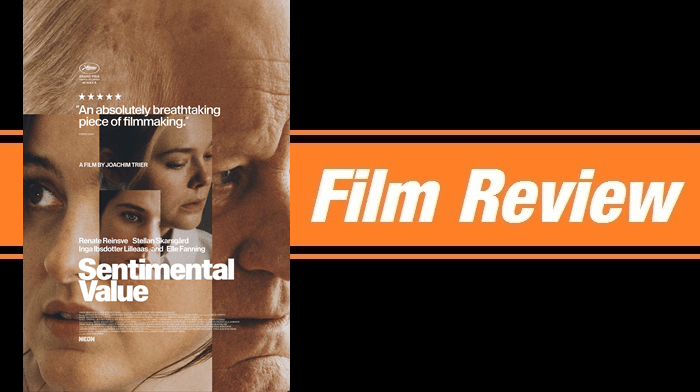
REVIEW: “Sentimental Value” (2025)

“Sentimental Value” is the latest film from director Joachim Trier and his follow-up to 2022’s Oscar-nominated “The Worse Person in the World”. It sees him rejoining his regular writing partner Eskil Vogt to tell a resonant and layered story that uses the behind-the-scenes drama of a film shoot to explore the idea of reconciliation through art. It’s tricky ground to cover, but Trier succeeds thanks to his keen focus and tight grip on this mature and thoughtful material.

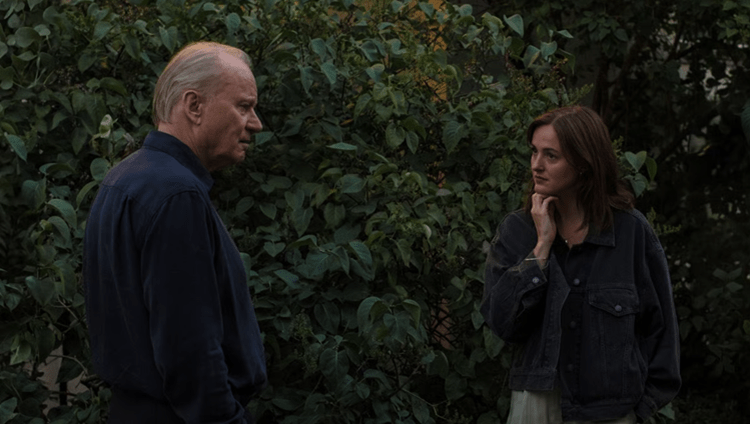
Trier also reteams with the extraordinary actress Renate Reinsve for their third collaboration. She plays a stage and television actress named Nora Borg. She and her younger sister Agnes (Inga Ibsdotter Lilleaas) have their world shaken when their estranged father Gustav (Stellan Skarsgård) re-enters their lives. Gustav left when the girls were still young and his reappearance brings back waves of painful feelings, especially for Nora.

Gustav has had a successful filmmaking career, but it has come at the expense of his relationships with his daughters. Yet despite his success, Gustav hasn’t released a feature film in fifteen years. But he has written a new script – one that is very close to his heart. And he uses it in as a means of reaching out to his daughters in the only way he competently knows how – through the very artistic language that pulled him away in the beginning.

Image Courtesy of NEON

In one of the film’s (and one of the year’s) very best scenes, Gustav invites Nora to a diner where they can finally have what he calls a “proper talk”. The father-daughter tension is immediate and it comes through in every word penned by Trier and Vogt. It also pours from the profoundly genuine performances of Reinsve and Skarsgård, who shrewdly convey the emotional complexities within their characters. The exchanges that follow are riveting.

Gustav tells Nora he has written what he thinks is the best script of his career. He presents her with a copy to read saying he wants her to play the lead. Galled by his nerve, a stunned Nora angrily rejects his offer. “I wrote it for you,” he declares as if expecting her to immediately reconsider. “You’re the only one who can play it.” As Nora storms out, we are naturally sympathetic to her side. But Trier doesn’t paint Gustav as a villain. Instead he leaves us with our own questions about the character. Is Gustav’s script just a tool to get back in his daughters’ good graces? Is he using Nora to get extra funding for his film? Or is there something deeper and more personal?

“Sentimental Value” is a movie about daddies and daughters. But it’s also a movie about sisters. Nora and Agnes have a thoughtfully drawn relationship that grew stronger with every family trial they endured together. Agnes seems to have the more stable life. She’s happily married and has an adorable young son. Nora’s prickly veneer hides a vulnerability that weighs on her soul. She struggles with anxiety and loneliness, trying to satisfy both with ill-advised choices that hurt more than help. But the sisters share a special connection that Trier observes through various lenses.

Image Courtesy of NEON

Another crucial character in the film happens to be the family’s ancestral home which houses several generations of memories and trauma. Gustav still owns the house – a fact his daughters learned after their mother died. Gustav was raised there, and the secrets within its walls inform why he’s reluctant to part with it. He’s still wrestling with those secrets which date back to his own childhood, and his new film is his way of reckoning with it.

The richly observed family dynamics only get more compelling with each dramatic turn. One of the biggest comes when Gustav decides to shoot his new film in the family’s house. Even more, he brings in Rachel Kemp (Elle Fanning), a popular American actress, to play the lead role that Nora turned down. It’s a compelling turn of events that allows Trier to take Nora and Gustav in revealing new directions which poignantly help to define their relationship.

“Sentimental Value” sees Joachim Trier cementing himself as one of the must-see filmmakers of our time. Some may argue he had already achieved that status. But his latest film is his best to date. In it we see Trier broadening his focus yet maintaining the intimacy that has made his other films so incisive and nuanced. His considerations of fractured relationships, past family trauma, and art as a means of healing have significant weight and are delivered with such an assured sense of purpose that we can’t help but be utterly captivated by the drama that unfolds on screen.

VERDICT – 4 STARS

First Glance: “How to Make a Killing”

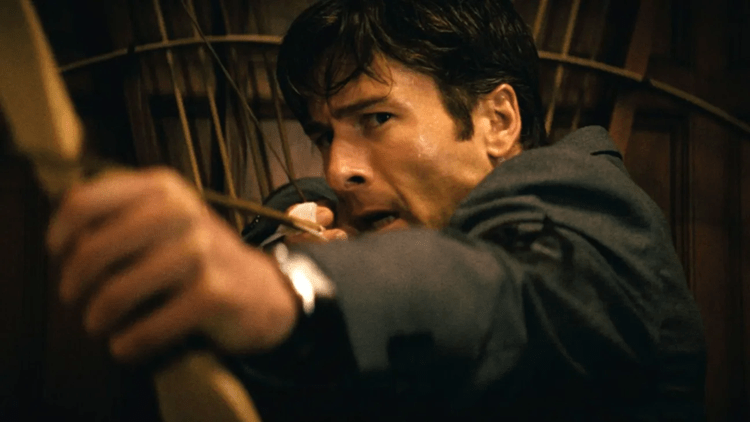
Glen Powell leads an intriguing cast in A24’s upcoming black comedy thriller “How to Make a Killing”. It’s John Patton Ford’s sophomore feature that follows his impressive 2022 debut “Emily the Criminal”. His script is loosely based on a 1949 British film titled “Kind Hearts and Coronets” which starred Valerie Hobson, Dennis Price, and Alec Guinness. A24 recently dropped the first trailer for this crazy looking confection and it leaves a good first impression.

Joining the everywhere man Powell is the everywhere woman Margaret Qualley. It also stars Bill Camp, Jessica Henwick, Topher Grace, Zach Woods, and Ed Harris. Powell plays Becket Redfellow, a disowned yet ambitious black sheep who begins thinning out his family line in order to become the sole heir to their $28 billion fortune. Henwick plays Becket’s girlfriend Ruth while Qualley plays his childhood friend Julia. Just judging by the trailer, this looks to be a blast.

“How to Make A Killing” releases in February. Check out the trailer below and let me know if you’ll be seeing it or taking a pass.

REVIEW: “The Secret Agent” (2025)

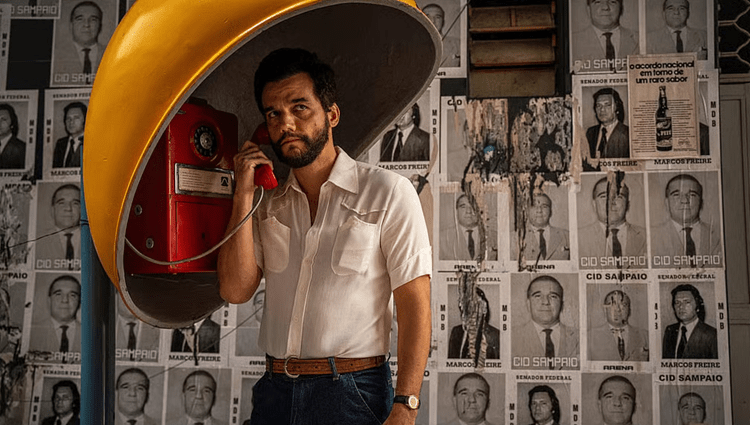
“The Secret Agent” opens with a sequence that highlights how beautiful filming in PanaVision can be. In sun-soaked rural Brazil, Marcela (Wagner Moura) pulls his canary yellow Volkswagen Beetle into a rundown gas station to fill up. After an encounter with a crooked local policeman, Marcela hits the road, eventually making his way to the city of Recife which is where the majority of the movie unfolds.

This opening sequence is an impressive introduction to the stunning look of this fascinating thriller. Brazilian director Kleber Mendonça Filho and cinematographer Evgenia Alexandrova shot “The Secret Agent” with PanaVision anamorphic lenses and vintage gear which not only captures the wider field of view, but it recreates the distinct visual style of the 1970s. And it’s not just some homage. The camera transports and immerses us into the story’s vibrant setting.

You could say “The Secret Agent” isn’t an overtly in-your-face political movie, but the politics of 1977 Brazil runs throughout this captivating period thriller. It’s described as “a time of great mischief” in the opening titles. But that seems gentile compared to the true Brazil of the time. The country was in the middle of a two-decade-long military dictatorship which saw the systematic persecution and silencing of those who opposed the authoritarian regime.

Image Courtesy of NEON

Once in Recife, Marcela seeks out Dona Sebastiana (a fabulous Tânia Maria) who secretly owns an apartment building that houses political refugees in hiding. We learn Marcela is one such refugee. His real name is Armando and he once was an engineering teacher and researcher. He was far from being a major threat to the regime’s stranglehold on power – a revealing point that Filho uses to emphasize the breadth of the era’s persecution.

We learn through a lengthy flashback segment that Armando was heading a university project on the verge of being shut down by a corrupt federal official named Ghirotti (Luciano Chirolli). Seeing the lucrative potential of Armando’s lithium battery studies, Ghirotti moves to shut down their department before selling their research to a private company that he owns stock in. But Armando and his wife Fatima (Alice Carvalho) resist, making them an enemy of Ghirotti.

Back in 1977, we learn that Armando’s wife died a short time ago and their son Fernando (Enzo Nunes) lives with her parents. Armando tells Fernando that his mother died from pneumonia, but we can’t help but be suspicious, especially after their run-in with Ghirotti. Speaking of Ghirotti, he gets wind that Armando is somewhere in the Recife. So he hires two hitmen from São Paulo, an ex-military thug Augusto (Roney Villela) and his step-son Bobbi (Gabriel Leone), to track down and assassinate Armando.

Image Courtesy of NEON

As you can tell, “The Secret Agent” has a lot going on and I’ve only scratched the surface. There are other key players with significant parts to play. We get some great scenes with Armando’s concerned father-in-law Alexandre (Carlos Francisco) who is a projectionist at the local cinema. The Chief of Police, Euclides Cavalcanti (Roberio Diogenes), is a corrupt lackey for the regime, doing their dirty work with the help of his two obedient sons. Even more intriguing is Elza (Maria Fernanda Cândido), the leader of a resistance network working to get Armando out of the city.

Wrangling together this many moving parts is no easy task. Yet watching Filho succeed is nothing short of fascinating. He works with an unhurried assurance, following his own set of rules at every narrative turn. At no point does he or his movie seem bound by formula or expectation. It brings a certain freedom to his filmmaking and storytelling. Yet that very freedom doesn’t always work in his film’s favor. Take his choice include a scene of a sentient severed leg attacking locals having open-air sex in a public park. In fairness, it’s based on an absurd newspaper cover-up story and it’s meant to symbolize the regime’s oppression of minority groups. But it’s such a preposterous and tonally distracting detour.

With this much story it’s not surprising that some characters and their storylines get shortchanged. Yet there is so much in Filho’s film to soak in. His richly detailed compositions transport us back to 1970s Brazil, vividly capturing every detail and never wasting an inch of the frame. From the sweltering heat to the chaos of the Carnival celebration, Filho immerses us into this turbulent period. Meanwhile Moura shines in a role that gets increasingly more complex as the story progresses. He is a terrific centerpiece to terrific movie.

VERDICT – 4 STARS