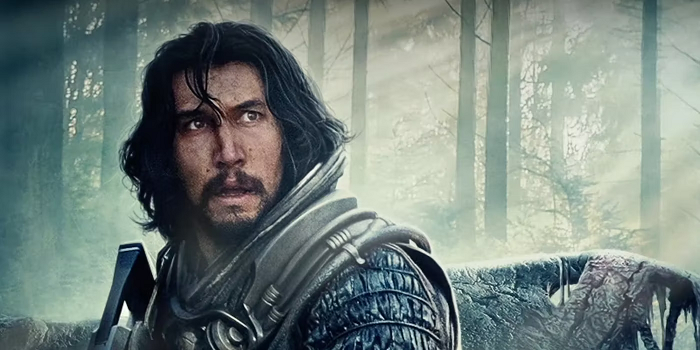
Boy the 2023 movie year just gets more and more stacked. The latest movie instantly added to my must-watch list is the Sam Raimi produced “65”. The early teases were intriguing, but the new trailer completely won me over. Written and directed by the duo of Scott Beck and Bryan Woods, “65” is a genre-bending science-fiction action-thriller with Adam Driver as its lead. That alone was enough to sell me.
But then I saw the new trailer, and the movie quickly climbed higher on my list. Driver plays a pilot who crash-lands on an unknown planet. As he explores the area he discovers a single lone survivor (Ariana Greenblatt). But the planet is also has its share dangers, and they’re of the prehistoric variety of you get what I mean. That’s quite the formula, and the trailer shows off the kind of production value that could make it a lot of fun. I can’t wait to see how it turns out.
“65” arrives in theaters on March 10, 2023. Check out the trailer below and let me know if you’ll be seeing it or taking a pass.
I never quite got onboard with fervent adoration for “Spider-Man: Into the Spider-Verse”. I enjoyed the family elements of the story and wish there had been more of it. And I enjoyed most of the animation up until the final act. But the movie never found a good balance. Sometimes it felt like a moving family story with the inescapable superhero baggage attached. Other times it was like watching someone else play a video game. The new trailer for the much-anticipated sequel looks very much the same.
“Spider-Man: Across the Spider-Verse” teases several of the things I liked about its predecessor while also showing several of the things I didn’t. The early family bits look great and the animation really shines in those clips. But when it amps things up, the sensory blasts of colors and hyper-stylized visuals overwhelm. Add to it my growing boredom for the current multi-verse fad that’s everywhere these days, and I’m just not sure this is for me. But I’ll still see it and hope that (like the first film) there’s enough of the good stuff to get by.
“Spider-Man: Across the Spider-Verse” hits theaters June 2, 2003. Check out the trailer below and let me know if you’ll be seeing it or taking a pass.
I had a great time once again appearing on Tavern Talk by Initial Reaction. This time I joined host Philip Price to discuss Sam Mendes’ ambitious but overstuffed drama “Empire of Light” which is out now in select theaters. As always, we had a blast talking about the movie and breaking down its strengths and weaknesses. Don’t worry, this is a spoiler-free review so please click below and give it a watch.
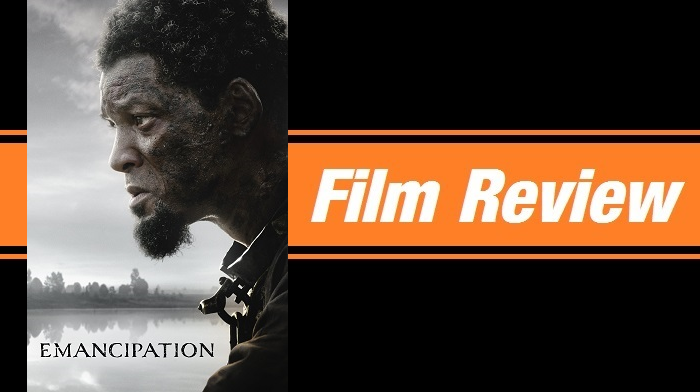
Coming off the highs of his first Academy Award win and the lows of his infamous slap of Chris Rock during the live Oscar broadcast, Will Smith has certainly had a lot to navigate over the past year. His shameful and embarrassing behavior tarnished what should have been the biggest night of his career. Sadly, it also seems to have sullied some of the excitement for his follow-up film, the $120 million slavery survival epic(ish) “Emancipation”.
“Emancipation” isn’t a bad movie. In fact, director Antoine Fuqua’s passion for the the material (written by William N. Collage) seeps out of nearly every desaturated image. And Smith delivers what might be the most fiercely committed performance of his career. But Fuqua (who’s known most for his gritty crime thrillers and popcorn shoot ’em ups) lets his urge to entertain muddy things up. He seems caught in between making a prototypical action flick and something more artistic and inspiring. It leaves the film feeling historically less convincing which isn’t good, especially when you’re dealing with such weighty subject matter. Collage’s script contributes to the problem by leaning too heavily on well-worn action tropes and not enough on character dynamics and history. Still, there are things to admire in this $120 million production.
“Emancipation” is taken from the true story of an escaped slave named Gordon (Peter by some accounts). In 1863, Gordon/Peter fled a Louisiana plantation owned by John and Bridget Lyons. For ten days he was chased by bloodhounds across the treacherous swampland, finally making it to Baton Rouge where he joined the Union army. While there, he was forever immortalized through a photo showing his bare back, scarred and mangled from countless whippings. The photo of “Whipped Peter” was first published in Harper’s Weekly but quickly circulated, pulling back the veil on the atrocities of slavery and energizing the abolitionist movement.
While watching “Emancipation” you get the sense that Fuqua and Smith want their film to have a similar impact as that 1863 photo. They’ve made a brutally graphic movie with shock value that is sure to unsettle some and frustrate others. Their intentions are honorable. They want to awaken their audience to the realities of slavery. But there’s a fine line to walk, and sometimes the Hollywood influence can be overpowering.
Despite President Abraham Lincoln’s proclamation that all slaves in the Confederate states were free, many people remained enslaved throughout the South. In Louisiana alone, 350,000 were still in bondage. Their only choices were to stay in captivity until the Union army eventually came or seek freedom on their own. “Emancipation” tells a story set within that dark window of time. Liberation was coming, but for many it was impossible to know when. And the wait seemed like an eternity.
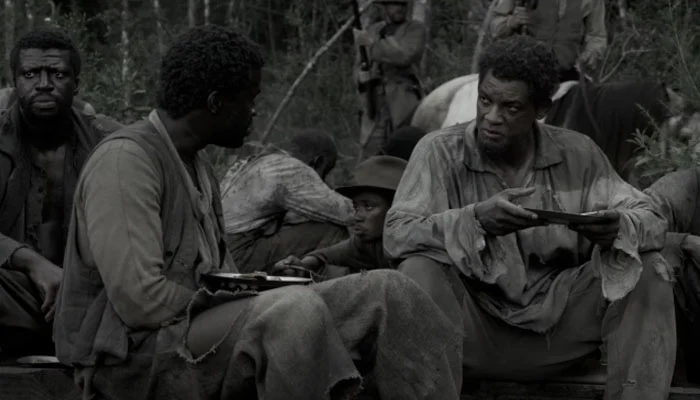
For a slave named Peter (Smith), a god-fearing husband and father of four, the urgency of freedom grows after he’s dragged from his family, thrown into a cage, and hauled to a labor camp where he’s put to work on a Confederate railroad. He promised his children that he would return, but the horrors surrounding him at the hands of brutal white foremen makes fleeing seem unlikely. But when he overhears that Lincoln has freed the slaves, he determines to escape and make his way to Baton Rouge where the Union army is stationed.
With a few swings of a shovel, Peter breaks free and escapes into the forest. He’s immediately pursued by Ben Foster’s Fassel, the film’s ruthless but otherwise empty villain who makes his own sociopathic sport out of hunting down “runners”. Foster is no stranger to playing heavies, but here he’s handed a dry and flavorless husk of a character who only serves the purpose of giving Peter someone to flee.
While the first 30 minutes is spent stressing the physical and emotional horrors of slavery (again, well-meaning but sure to turn off some), “Emancipation” quickly becomes a full-on survival thriller as Peter cuts through the gator-infested bayou with Fassel hot on his heels. Then in the third act, with very little buildup at all, the story takes a “Glory” like turn, complete with large-scale battlefield scenes, fierce combat, and lots of carnage.
These three dramatically different acts may lack the connecting tissue, but they each have their moments in large part thanks to Smith. Story-wise his narrowly confined character doesn’t allow him much room to stretch. But Smith transforms himself for the role, and the sheer physicality he pours into the performance is astonishing.
Then there’s DP Robert Richardson who squeezes nearly every ounce of color from his images to visualize a bleak and forbidding world. His sweeping overhead shots and beautiful framing can come across as showy and even a bit distracting. But more often than not the visuals amaze and show the more inspired side of the movie. They tease what “Emancipation” might have been without the genre trimmings. Thankfully the story of “Whipped Peter” stays intact, and Fuqua deserves credit for his willingness to tell it. “Emancipation is now streaming on Apple TV+.
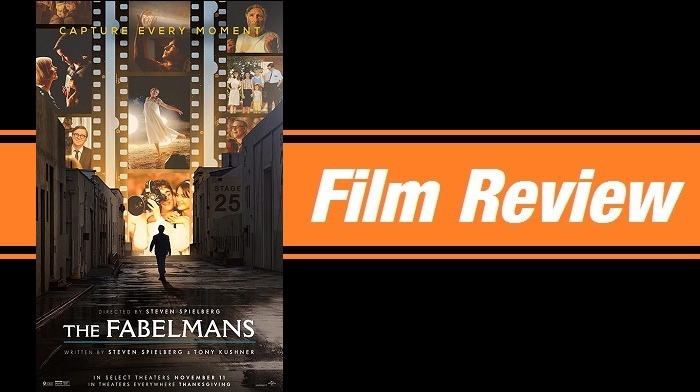
Steven Spielberg takes us back to his childhood with “The Fabelmans”, a semi-autobiographical odyssey that sees the acclaimed filmmaker at his most personal. I went in fully expecting to see an epic ‘love letter’ to moviemaking, and it certainly has some of that. But in reality, “The Fabelmans” is more of a testament to why movies are made. It explores what inspires and drives artists to tell the stories they tell. And to no surprise (with Spielberg at the helm), it’s also a testament to the transforming power of the cinematic language, especially in the hands of a gifted visionary and craftsman.
The film features Spielberg exploring key events in his life, making stops along his own personal timeline that impacted his family and shaped his decision to be a filmmaker. Many of the stops highlight specific moments when he began to see his parents, not just as his mom and dad, but as real people. Others show how it was filmmaking that not only helped him to understand the world around him, but also communicate his feelings to others. It doesn’t always come together as seamlessly as you would want, but when absorbed and then considered as a whole, it’s hard not to be impressed (and at times swept away) by what we’re given.
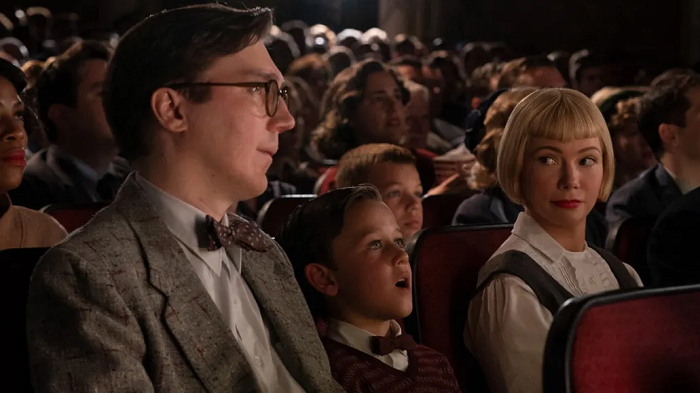
Spielberg’s stand-in is Sammy Fabelman (played as an eight-year-old by Mateo Zoryon Francis-DeFord and later as a 16-year-old by Gabriel LaBelle). We first meet young Sammy in 1952 as he nervously stands in line at his neighborhood cinema. His parents explain what’s about to happen once they go inside for Sammy’s first moviegoing experience. “Mommy and daddy will be right next to you,” his father assures him. “The lights will godown. There may be some organ music as the curtains open. Don’t be scared.” They then follow the line inside as the glowing marquee welcomes them to see “The Greatest Show on Earth”.
Image Courtesy of Universal Pictures
Needless to say, the film has an immeasurable impact on Sammy. Before long he’s attempting to recreate DeMille’s famous train crash scene with his own electric train set and a camera. It’s the first leg of his (and Spielberg’s) journey towards becoming a filmmaker. The starry-eyed Francis-DeFord is wonderful at capturing younger Sammy’s awe and wonder. Through him you can see the gears turning as the inquisitive young boy tries to grasp the creative forces behind what he has seen on screen.
While his growing love for cinema certainly has its place in the film, it’s Sammy’s family life, especially his relationship with his parents, that form the crux of the story. The Fabelmans were the only Jewish family in their middle-class New Jersey neighborhood. Sammy’s father Burt (Paul Dano) is a computer engineer and technician for RCA. His mother Mitzi (Michelle Williams) is a skilled pianist. As a couple, they have a compelling ‘man of science’ vs. ‘woman of the arts’ dynamic.
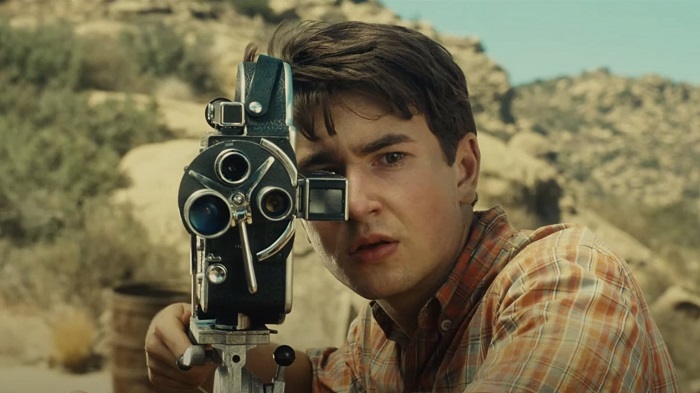
When Burt gets hired by General Electric, Sammy, his parents, his three sisters, and their goofball family friend Bennie (Seth Rogen) move to Phoenix. We then bolt ahead several years where Sammy (now a teenager) is ready to make his first bonafide movie. Inspired by “The Man Who Shot Liberty Valence”, he and a few pals from his Boy Scout troop shoot a Western short he calls “Gunsmog”.
Image Courtesy of Universal Pictures
From there Sammy’s passion for moviemaking only grows, but Burt routinely dismisses it as nothing more than a “a hobby”. He means well and he’s a good father. But his linear thinking and blind optimism constantly hinders him from seeing the obvious. Meanwhile his mother’s frustrations and insecurities lead to impulsiveness and eventually a growing emotional detachment. Cracks are forming and only widen after another move. This time to California, where Sammy’s rollercoaster high school years see him experience bullying and antisemitism, but also his first love and (of course) chances to make more movies.
But what’s most fun and revealing is watching Sammy learn the world through his camera. Not only does it allow him to tell stories, but also to truly see people. He finds that not only can the camera reveal the truth, but it gives the person looking through the lens control of that truth. They can conceal it or expose it; twist it or erase it altogether. He also discovers the camera’s ability to sway opinions, earn respect, and win hearts. And Sammy uses it to his advantage (an interesting bit of self-critique from Spielberg perhaps).
As we’re ushered through the family drama, Spielberg’s patchwork approach can feel a little messy. And while I loved most of the performances (Paul Dano is terrific and Judd Hirsch brings a jolt in his brief ten minutes), I sometimes struggled with Williams’ Mitzi – an emotional maelstrom who is rarely given a quiet moment. Yet in the end they all help bring life to Spielberg’s memories. They’re still a little blurry in spots, and some of the pieces are missing. But this inward looking feature achieves what it sets out to do. It sees one of cinema’s all-time greats not just showing how he became a filmmaker, but also what it means to be a filmmaker. Once that aim came into focus for me, my expectations suddenly didn’t matter, and Spielberg had me, just as he always has.
Here’s another movie tapping into the well-worn ‘hero with amnesia’ premise. You know the ones – the protagonist wakes up unable to remember who they are. Soon they’re shooting it out with a bunch of goons who want to kill them, all while trying to piece back together their memory. This latest spin on the story isn’t much of a spin at all. But it does star the ever likable Josh Duhamel, so there’s that.
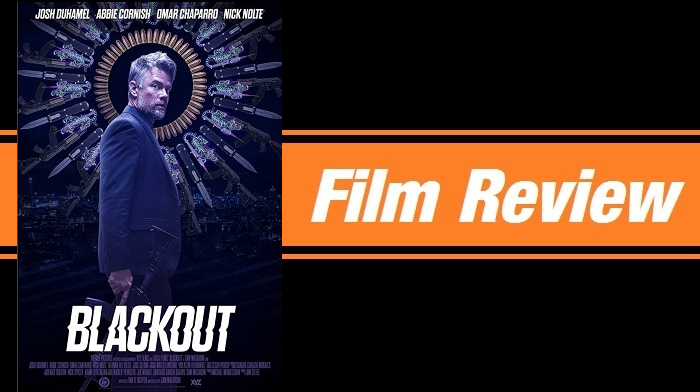
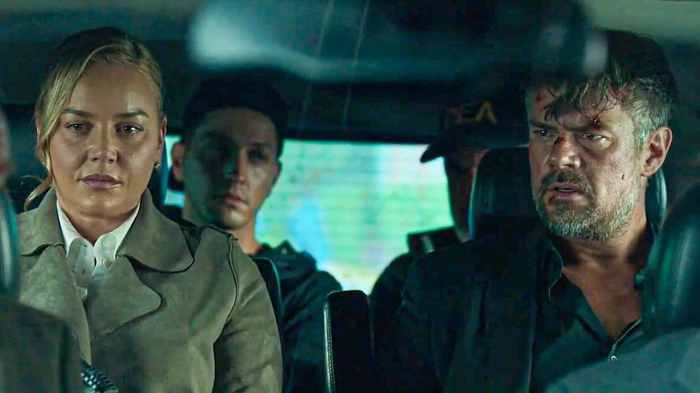
Sharing the same title with as least 30 other movies (according to IMDB), “Blackout” tells a story that ends up being as uninspired as its name. Duhamel plays John Cain, who wakes up in a hospital bed following a serious car accident. It just so happens that Cain has lost his memory. He has no idea who he is or how he got there. By his side is Anna (an incredibly dry Abbie Cornish) saying she’s his wife. Later he’s visited by Eddie (Omar Chaparro) claiming to be his best friend. But why can’t he remember either of them.
Image Courtesy of Netflix
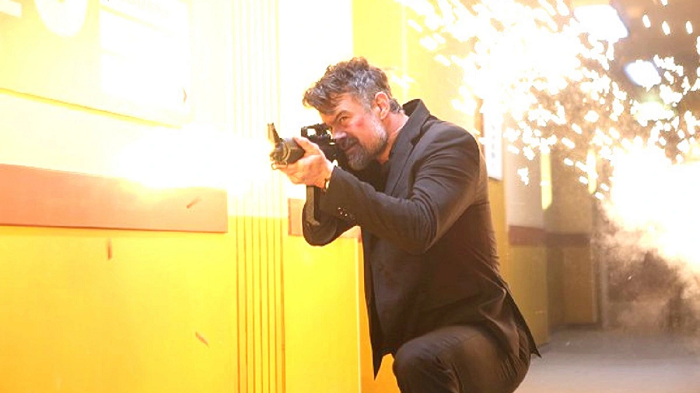
It turns out Cain possesses a briefcase full of something the drug cartels are desperate to get their hands on. The problem is he has no recollection of the briefcase or of what’s inside it. But as his memory slowly starts returning, he finds himself questioning the information different people are feeding him. What are lies? What’s the truth? Even more, if Eddie is Cain’s friend why is he suddenly trying to kill our woozy protagonist? Soon we have a full-scale shoot-em-up as the cartel locks down hospital, and Cain tries to escape while sorting out who he can ultimately trust.
Directed by Sam Macaroni and written by Van B. Nguyen, “Blackout” bops along fairly briskly after getting its setup out of the way. The mostly single setting is a compelling choice and Macaroni has a good eye for action. The fistfights and shoot-outs don’t always make sense and some are just plain silly. But they’re stylishly shot, and Duhamel has the physicality to pull them off.
Image Courtesy of Netflix
Unfortunately Nguyen’s script isn’t as reliable. First off, she’s bound by a pretty tired premise and doesn’t really offer anything new to the old formula. As for the suspense, Nguyen tries to keep us guessing by spoon-feeding just enough information. But there really aren’t many surprises, and everything plays out in a way most people will have figured out well before the not-so-big reveal. It’s also hampered by some pretty hokey dialogue, especially once Nick Nolte shows up. He plays DEA Agent Ethan McCoy, an old friend of Cain’s trying to help him from the outside. It’s great seeing Nolte on screen again. But the 81-year-old screen veteran struggles, and isn’t helped by some really hammy lines that frankly no one could sell.
So “Blackout” ends up being a pretty generic action-thriller that has some decent shootouts and a couple of good fight scenes. There’s just not enough under the hood to make this thing go. It’s simply too by-the-books and even the charming Josh Duhamel can’t liven it up or give it the kick it needs. It’s a shame because I still believe Duhamel can carry bigger movies and handle meatier roles if only given the chance. Sadly, “Blackout” won’t do anything to enhance those opportunities. “Blackout” is now streaming on Netflix.







 Keith & the Movies