REVIEW: “Pearl” (2022)

(CLICK HERE to read my full review in the Arkansas Democrat-Gazette)

I had reasonably high expectations for “X”, an unashamed ode to slasher movies and grindhouse sleaze that released earlier this year. Sadly, it ended up feeling more like a trashy knockoff than anything remotely fresh. But then a prequel was announced titled “Pearl”, and its trailer offered a stylish and delightfully brutal blast of technicolor-soaked horror. I was instantly intrigued.

Because of “X”, I entered “Pearl” with a fair amount of caution. After seeing it, I left the film mostly impressed by what West had put together. “Pearl” is impossible to put into a single box. It’s an origin story, a rural horror movie, a psychological thriller, a pitch-black comedy, a gonzo exploitation flick. And while not all of it fits together seamlessly, West’s focus is tighter and he doesn’t stray off course or get bogged down in as much nonsense this time around.

“Pearl” truly is West’s baby. He directs, edits, co-writes, and co-produces. But most people will leave the film talking about its star, Mia Goth (who’s also credited as co-writer). The British actress pulls out her thick Southern accent and steps back into the skin of Pearl, a troubled young woman with a twisted imagination and big dreams of becoming a movie star. Goth played an elderly Pearl in “X”, but here she gets to put aside the heavy prosthetics to play a younger Pearl at a crucial point in her life.

Image Courtesy of A24

The movie’s sumptuous opening puts us right back on the farm from “X”. West starts us in the barn, swinging open its large double doors to reveal a sun-bathed yellow farmhouse surrounded by bright green grass. It’s almost Rockwellian in its presentation. Yet before the opening credits are done, West and Goth give us a jolt just to let us know there’s nothing idyllic about the world we’ve entered. And from that moment there’s a lingering sense of unease which West maintains to the film’s eerie final frame.

I can’t overstate how essential that uneasy feeling is to the movie’s success. West wants us to know from the start that Pearl is unwell. Sure, people who have seen “X” already have a good idea. But for those who haven’t, West makes it clear in the opening moments. With that understanding comes anticipation. We know bad things are coming. We know she’s going to break. The question becomes when and how? What drives her? How far does she go? West has us in the palm of his hand. It’s just up to him to deliver the payoff. For the most part he does.

While the ever-present simmer of dread is vital, Goth’s performance is the centerpiece. Aside from the hints of theatrics in a few scenes, Goth really sells us her damaged character. But what stands out most is her ability to make Pearl uncomfortably deranged while earning our empathy. Some of it is due to West’s script which gives Pearl room to develop and her circumstances time to metastasize. But most comes from Goth who captures every twisted facet of her character.

“Pearl” takes place as World War I and the equally deadly Spanish Flu were nearing their ends, yet the reverberations of both were still being felt across the globe. With her husband Howard away at war, Pearl is left to tend to her parents’ farm and help her stern German-born mother (Tandi Wright) take care of her wheelchair bound father (Matthew Sutherland). But Pearl’s heart is elsewhere. She has an unhealthy obsession with being a movie star. She sees it as her ticket off the farm, much to the chagrin of her cynical mother.

Image Courtesy of A24

ThAfter developing its setting and her circumstances, the movie simply follows Pearl over the next several days as she encounters people and situations that will ultimately play into her inevitable breakdown. Among the key players is a hunky bohemian theater projectionist (David Corenswet) who shows Pearl a stag film he picked up while in Europe (a lazy, wedged-in attempt at linking to “X” and the upcoming third film). And there’s Mitzy (Emma Jenkins-Purro), Pearl’s sister-in-law who accompanies her to a church-sponsored dance troupe audition.

This simple yet effective approach paints us a rich and detailed portrait of Pearl – one that grows more unsettling by the minute. Along the way, West uses his story to comment on quarantine life, pandemic era paranoia, and the damaging effects of isolation. There’s also a brilliantly layered examination of family dysfunction that shows how deep-seated pain can fester into something toxic and destructive.

“Pearl” is a deliciously unhinged slice of period horror that’ll have you chuckling one minute and squirming in your seat the next. It improves on “X” in nearly every perceivable way, yet it’s very much its own movie that feels plucked out of time. The visual craft, the ingenious score from Tyler Bates and Tim Williams, and of course Mia Goth’s next-level performance are all crucial to realizing West’s vision. And while there are reasons to be leery of the teased third film, it doesn’t hinder the enjoyment of “Pearl” which is plenty able to stand on its own. “Pearl” is now showing in theaters.

VERDICT – 4 STARS

REVIEW: “Bandit” (2022)

Don’t let its bland title fool you. “Bandit”, from Canadian director Allan Ungar, is a nimble and multi-faceted heist movie built around a genuinely outrageous true story. The film is an adaptation of Ed Arnold and Robert Knuckle’s 1996 book about the real-life story of Gilbert Galvan Jr. aka The Flying Bandit. Galvan Jr. was a criminal who robbed a total off 59 banks and jewelry stores across Canada over a three year period. He holds the record for the most consecutive successful robberies in Canadian history (I guess the keep stats for those things).

From a script by Kraig Wenman, “Bandit” is a fascinating stew of genres. It’s a biographical drama, a lighthearted crime caper, a straight heist film, and even a heartfelt love story all wrapped into one surprisingly cohesive whole. And it’s led by Josh Duhamel who is finally given some material that lets him show what he can do.

Image Courtesy of Quiver Distribution

The movie opens with Gilbert Galvan Jr. (Duhamel) setting up his own story which plays out during the shifting 1980s. Through narration and a little self-aware fourth wall breaking, the good-natured Galvan ends up sentenced to 18 months in a Michigan prison for check fraud. Six months into his sentence he busts out and makes his way across the border into Canada.

Once in Ottawa, Galvan assumes the name Robert Whiteman and even entertains going straight. He gets a low-paying job selling ice cream and even hits it off with a beautiful young woman named Andrea (Elisha Cuthbert) who works at a church-ran hostel. But in this particular story, once a criminal always a criminal. Galvan/Robert begins casing area banks, noting their small staffs and lax security. Inevitably robbing them comes next, and it proves to be something Robert is really good at.

But he can’t just keep hitting the same local banks, so Robert looks to take his gig nationwide. To do so he needs some backing. He connects with Ottawa’s biggest crime boss, Tommy Kay (Mel Gibson) who fronts Robert with the initial cash (for a small cut of each score of course). From there Gilbert Galvan Jr./ Robert Wiseman begins flying all across Canada, successfully pulling bank jobs and taking in loads of cash. During this time he and Andrea move in together. He tells her he’s gotten a job as a traveling “security analyst”. Actually he’s on his way to becoming the most prolific bank robber in Canada’s history.

Robert’s association with Tommy eventually puts him on the radar of a frustrated police detective named John Snydes (Néstor Carbonell). He runs an underfunded task force called Project Café that’s focused on taking down Tommy’s enterprise. With all of his key pieces on the board, Ungar begins moving them around at a breezy pace, keeping us engaged mostly through the charm-soaked performance of its star, Duhamel.

Image Courtesy of Quiver Distribution

While this is certainly a crime story, “Bandit” is sure to surprise people with its heart and almost kid-like playfulness. Take the dashes of good humor sprinkled all throughout the movie. They’re seen mostly during the heist sequences, from Robert’s numerous zany disguises to his innate congeniality (he routinely encourages bank tellers with a soft-spoken and heartfelt “You did great”). These scenes sell because of the good-looking, easy-going Duhamel who not only makes you laugh, but slyly has us rooting for him as well.

As normal for stories like this, things begin to tense up in the final act. It’s one of those cases where you see the ending coming from a mile away, yet Ungar’s crisp direction keeps us engaged. The lone issue is with Galvan/Robert as a character. Yes he’s charming, witty, and whip-smart. But we never really get to know him. Aside from his genuine love for Andrea, our connection to him is always surface-level. It’s a nagging problem that keeps the movie from being as compelling as it otherwise might have been. Yet, much like the character he plays, Duhamel has a way of drawing us in with his infectious charisma. “Bandit” opens tomorrow in select theaters and on VOD.

VERDICT – 3.5 STARS

Movie Poster Spotlight: “Smile”

I haven’t gotten a good enough read of the upcoming horror film “Smile” to know whether to be excited for it or not. There are parts of the trailer that are genuinely creepy. But there are also hints that this could be yet another throwaway creeper with a fairly familiar premise. But I will say that the absolutely bonkers new poster certainly grab my attention. I’m not saying it’s great, but I have to admit it’s pretty wacky. And what can I say? I kinda like wacky. What do you think?

DIRECTOR – Parker Finn

WRITER – Parker Finn

STARRING – Sosie Bacon, Kyle Gallner, Rob Morgan, Caitlin Stacey, Jessie T. Usher, Kal Penn, Robin Weigert, Judy Reyes, Gillian Zinser, Dora Kiss, Kevin Keppy

RELEASE – September 30, 2022

REVIEW: “The Silent Twins” (2022)

(CLICK HERE to read my full review in the Arkansas Democrat-Gazette)

Directed by Agnieszka Smoczyńska, “The Silent Twins” is based on the book of the same name by investigative journalist and author Marjorie Wallace (portrayed briefly in the film by Jodhi May). Wallace met June and Jennifer Gibbons in 1982 after they had been committed to the notorious Broadmoor Hospital in Crowthorne, Berkshire, England. Over several years and numerous visits, Wallace eventually earned the sisters’ trust and was given the opportunity to chronicle their troubling story.

For those unfamiliar with June and Jennifer Gibbons, this isn’t an easy watch. The approach by Smoczyńska and screenwriter Andrea Seigel is unconventional, but it sharply captures the emotional complexity of the sisters’ story. The film can be sweet, heartbreaking, insightful, and even a bit bizarre at times. But it’s the humanity that matters most in a movie like this. The filmmakers understand that and never lose their grasp of that truth.

The film begins during June and Jennifer’s childhood (they’re played by two talented young actresses, Leah Mondesir-Simmonds and Eva-Arianna Baxter). Their family are immigrants from Barbados who moved the UK as part of the Windrush Generation. Their father Aubrey (Treva Etienne) is an air traffic controller while their mother Gloria (Nadine Marshall) is a hardworking housewife.

Image Courtesy of Focus Features

While the film doesn’t explore it, there’s a racial dynamic at play especially at school where June and Jennifer are the only black students. This leads to some disturbing scenes of bullying and abuse that impact the girls’ lives in a significant way. But what affects them most is a pact of silence they make, developing a form of cryptophasia and refusing to communicate with anyone other than themselves. Their utter silence crushes their parents and siblings and drives a wedge between them and their family. It also creates an unhealthy dependence between them.

The longer the sisters stay closed off, the more isolated the pair become. They begin seeing the world through their imaginations rather than experiencing it. To get us inside their heads, Smoczyńska periodically inserts these stop-motion puppet sequences inspired by June and Jennifer’s unique perceptions. They’re often cryptic and metaphorical; sometimes borderline macabre and unsettling. But it’s an ingenious way of conveying the way the two girls think and feel.

Another way Smoczyńska explores their mindsets is through DP Jakub Kijowski’s camera. We often get these daydream sequences which visualize the romanticized way June and Jennifer imagine certain experiences. These scenes often have a bright golden hue, and Kijowski plays with focus which accentuates their dreamy quality. Contrast that with the cold, harsh color palette whenever Smoczyńska switches back to reality.

Image Courtesy of Focus Features

While the entire movie is achingly sad, it’s most despairing moments come after the story shifts to June and Jennifer’s late teen years. Letitia Wright and Tamara Lawrance are extraordinary in portraying this darker phase of the sisters’ life. They share a dream of becoming published authors, but their lack of real-world connection leaves their stories lacking. But their attempts at rectifying that leads them down some bad paths. It begins when both June and Jennifer develop an infatuation with an abusive jock named Wayne (Jack Bandeira). He introduces them to drugs and takes advantage of them in a number of cruel and vile ways.

From there the girls watch their lives spiral, leading to them getting into trouble with the law and eventually being institutionalized in Broadmoor, a high-security psychiatric hospital. Through it all their pact of silence remained intact. But it’s also a key reason they find themselves confined and more isolated than ever before. And we watch every painful step through Smoczyńska’s ever-observing camera. Sometimes we feel like the third person in the room. Other times it’s as if we’re peering around corners or through doorways. These visual choices allow us to see these two lives in significantly different ways.

While Smoczyńska’s approach to the story gives us a lot to admire, there are times where her flourishes don’t quite connect. And the movie’s fleeting interest in the factors that led to June and Jennifer’s mental descent leaves too much untold. At the same time, “The Silent Twins” is most interested in capturing their experiences rather than exploring roots causes. And by keeping its focus directly on them, it gives us a better chance at understand where the two sisters are coming from even if we only get sketches of where they’ve been. “The Silent Twins” is now showing in select theaters.

VERDICT – 3.5 STARS

REVIEW: “K.G.F: Chapter 2” (2022)

On the heels of the successful “K.G.F: Chapter 1” and following a rather lengthy COVID-19 delay, writer-director Prashanth Neel delivered the second chapter of his two-part action-fueled crime saga. The highly anticipated sequel is the most expense Kannada-language film ever made and currently stands as the highest grossing Kannada-language movie of all-time. After finally seeing it, I can understand why.

Not only does Chapter 2 have a bigger budget, but it also has a bigger scope. Everything about it feels larger and the stakes are most certainly higher. But most importantly, the second chapter sticks to the same wild, over-the-top blueprint – high on style, heavy on action, and still driven by the powerhouse presence of its charisma-oozing star, Yash. And while Neel runs into some of the same problems as he did with the first film, they’re not nearly as pronounced this time around. He tightens up the storytelling and he does a better job with some of his characters – two slight beefs I had with Chapter 1.

If you remember, the first film was built around a veteran reporter and author, Anand Ingalagi (Anant Nag) being interviewed by television journalist Deepa Hegde (Malavika Avinash). After having his book banned by the Indian government, Anand comes to the television station to share his story which the Prime Minister (Raveena Tandon) is determined to erase. Chapter 2 uses that same framing device but with a twist.

After suffering a sudden stroke, Anand lies in intensive care unable to finish his story. While at the hospital, Deepa meets Anand’s son Vijayendra (Prakash Taj) who tells them his father was obsessed with the story of the Kolar Gold Fields (K.G.F.) and the rise to power of a renowned assassin named Rocky (Yash). Despite their troubled family history, Vijayendra insists that the rest of his father’s story be told. So he takes Deepa and her crew to his father’s library where they begin piecing together the second half of Anand’s tale.

From there we shift to the story of Rocky who (after killing the ruthless Garuda in Chapter 1) has taken over as the new boss of the K.G.F. He now runs the most precious piece of land on earth, funneling gold through the black market and amassing enormous wealth. It’s all in keeping with a pledge he made to his ailing mother when he was a child. While on her deathbed, she makes Rocky pledge to one day become rich and powerful so that people would remember his name. It’s what drives his out-of-control hunger for more.

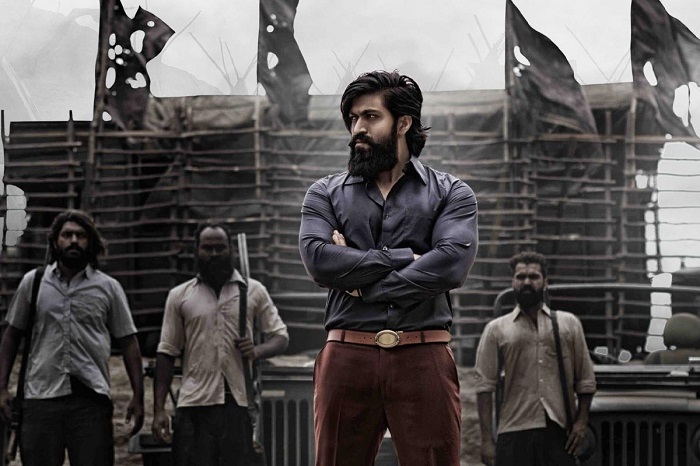
Despite having dirty hands, Rocky is loved by the miners and their families, winning their adoration by supplying them clothing and building them homes. While the adults praise his benevolence, the children herald him as a superhero. But there are forces on the outside who are unhappy with Rocky’s ascension. So he does what anyone would do in his situation – he builds an army to protect his empire.

Meanwhile, outside of the K.G.F. walls, the five crime bosses who hired Rocky in the first film now begin plotting against him. They don’t like than an outsider has disrupted their enterprise, and they’re not giving it up without a fight. At the same time, Rocky is branded “the biggest criminal in India” by the self-serving Prime Minister Ramika Sen who’s willing to use the full resources of the government to shut him down. But there’s a new player in the game; a violent wild card no one saw coming – Adheera (Sanjay Dutt), the brother of the ruthless kingpin Rocky killed in the first film.

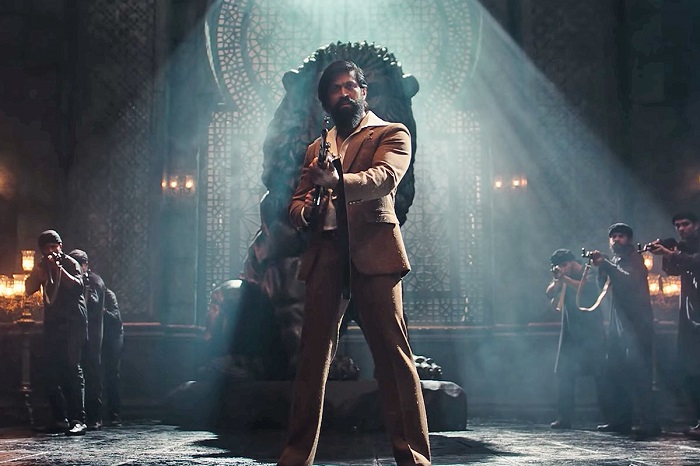
As I’m sure you expect, all of these combustible elements lead to some insanely fun action sequences as Rocky defends his fortune from all sides. Yash’s unmatched (and often hilarious) bravado energizes the fight sequences and shootouts, and returning DP Bhuvan Gowda once again shoots him as a near mythological force of nature. It’s the same unique visual language from the first film, but with crisper editing and even more ambitious. That means we get action scenes that are bigger, crazier, and always stunning to look at. But not all the action involves fists, guns, or explosives. Yet even then, Rocky always seems to be one step ahead of his enemies.

One of my biggest gripes about the first film was its handling of Srinidhi Shetty’s character, Reena, Rocky’s alleged love interest. I say “alleged” because there was no warmth between them whatsoever. And Shetty was quickly pushed into the background and forgotten. She makes for a more interesting presence in Chapter 2 and has a pretty significant role to play in the second half. Reena still isn’t as fleshed out as I had hoped, but at least she finally feels like a part of the story.

“K.G.F: Chapter 2” embraces the best things from the first film while correcting some of its missteps. Together, the two films make for a delightfully cohesive pair. Neel uses our love for legend to tell his story the same way we often do when talking about our heroes – with as much imagination as certitude. This dance between myth and truth is a big part of makes these movies tick. Chapter 1 gave us a good taste of it. Chapter 2 took the concept and ran with it. “K.G.F: Chapter 2” is available to stream on Amazon Prime Video.

VERDICT – 4 STARS

REVIEW: “K.G.F. : Chapter 1” (2018)

After the Indian government bans his book detailing the troubling history of the Kolar Gold Fields and the powerful crime boss who took control of it, veteran reporter Anand Ingalagi (Anant Nag) sits down with skeptical television journalist Deepa Hegde (Malavika Avinash) to share a story the sitting Prime Minister has vowed to erase. Their interview serves as the framing device for “K.G.F: Chapter 1”, a time-spanning crime thriller from writer-director Prashanth Neel.

This first chapter of Neel’s ambitious two-parter sets itself deep within Indian gangland. It’s a film that’s high on style, heavy on action, and is carried by the powerhouse presence of its charismatic star, Yash. As far as the story, it’s both fascinating and frustrating. The structure is unique and audacious, building a complex world full of colorful characters, mob politics, and violence. At the same time, the non-linear hopscotch can be a challenge to follow, especially in the film’s attempt at covering a five-decade time period.

One thing you’ll immediately notice is Neel’s unique storytelling rhythm. There’s an almost feverish quality to his pacing and a near idolizing zeal in the way he speaks of his protagonist (which shows itself both narratively and visually). It gives the impression that the story is being told from someone’s heightened point-of-view. Much like the way that we excitedly embellish our own heroes and share their mythologies. It’s a rhythm that takes some getting used to, but once I did I was locked in.

Yash plays the intensely serious Rocky, an anti-hero who rose from poverty in Mumbai to become a renowned underworld assassin. As a bitter young boy, Rocky made a pledge to his ailing mother to become wealthy and powerful so that people would know his name. It’s a vow that will drive his character and the story through both films. Following her death, Rocky began working for an underboss in Bombay named Shetty (Dinesh Mangaluru). Over the years he would quickly rise in the ranks, and soon his notoriety equaled that of his boss.

Meanwhile Suryavardhan (Ramesh Indira), a powerful gold-smuggling crime boss who runs the Kolar Gold Fields (K.G.F.) is on his death bed. His greed-driven associates begin to worry about what will happen to their partnership once Suryavardhan’s ruthless son and heir Garuda (Ramachandra Raju) takes over the K.G.F. Intent on protecting their stakes in the operation, the associates call on Rocky, promising him full control of the Bombay underworld in exchange for killing Garuda. Rocky accepts, seeing this as another step in keeping his promise to his mother.

It’s here that we’re introduced to Reena (Srinidhi Shetty), an intriguing but underutilized supporting player who happens to be the spoiled fiance of one of Suryavardhan’s associates. I think we’re supposed to believe there’s a romantic tension between her and Rocky, but it’s a big ask. That’s because there’s never any convincing reason for us to. There’s no warmth, no relatable attraction, and certainly no romance. The movie throws them together for a couple of scenes and then Reena get tossed to the back-burner. It’s one of the movie’s biggest shortcomings.

The second half of the story sees Rocky infiltrating the K.G.F., posing as a miner in his effort to get close to Garuda. But once inside, he discovers that the miners are actually kidnapped slave laborers, forced to work under the brutal fist of Garuda and his henchman. After witnessing numerous atrocities and experiencing oppressive living conditions reminiscent of those he grew up in with his mother, Rocky suddenly has the potential to be something more than a hardened assassin. He could be a savior.

The film does a good job visualizing Rocky’s internal conflict during the second half. It does drag a little as it takes its time finally getting to the inevitable climax. But there is a struggle within Rocky that is pretty compelling. He’s not there to free anyone. He’s there to murder a cruel crime lord in order to gain the very power he vowed to gain. But he finds himself sympathetic to the plight of the people. But is that enough to pull him away from his own mission?

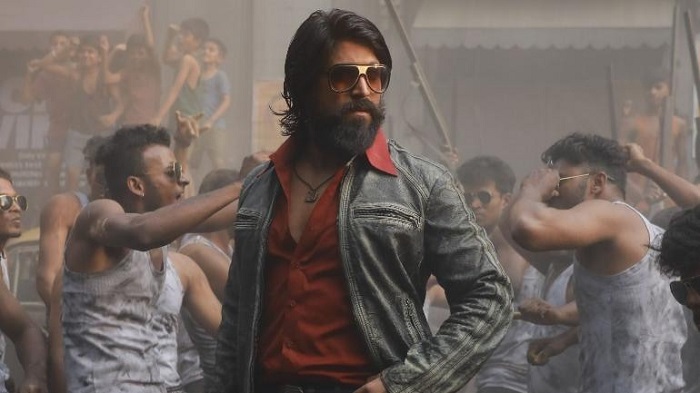
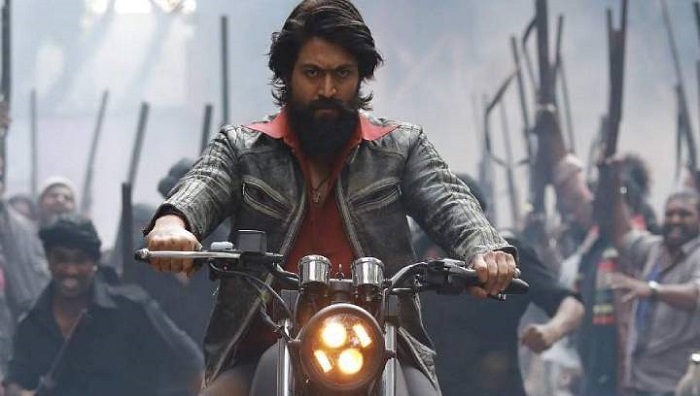
As the story’s simmer turns to a boil, we’re treated to a number of stylistic fight scenes and shoot-outs. The visual language of the action has a style all its own. It’s an array of brilliant choreography mixed with plenty of gratuitous slow-motion. At times it can be savage and completely over the top, yet all of it fits well within the almost mythical bounds of the film. The biggest inconsistency is with the editing. DP Bhuvan Gowda shoots one wow-worthy sequence after another, and he plays with a variety of cool techniques to give the movie its own energy. But the frenetic editing sometimes undermines Gowda’s eye-popping camerawork. It’s frustrating but hardly a deal-breaker.

By the end of “K.G.F: Chapter 1” I was both exhilarated and unsure. But the longer I’ve sat with it the more impressed I am with what Neel has created. Its criticisms make perfect sense. For some, the style-heavy flourishes will reach beyond overkill. Others will struggle with the fast-paced time-hopping and storytelling. Those are all legitimate beefs that do bring the movie down a notch. But once I fell in with its high-energy rhythm and its gritty immersive world, I was hooked. Better yet, I was all set for Chapter 2. “K.G.F: Chapter 1” is available to stream on Amazon Prime Video.

VERDICT – 3.5 STARS