A star-studded new Western was enough to capture my attention. Having it written and directed by none other than Walter Hill makes it even more intriguing. A quick gander at Hill’s filmography reveals an eclectic blend of genre films dating back to 1972. At 80-years-old, Hill slides on his boots, puts on his Stetson, and heads back to the Wild West, joined by Christoph Waltz, Willem Dafoe, Rachel Brosnahan, Hamish Linklater, and Benjamin Bratt. I love the idea and I love the cast, even if I don’t particularly love the new trailer.
Set in 1897, Waltz plays a notorious bounty hunter (a role he knows well) named Max Borlund who’s in Mexico in search of a wealthy businessman’s daughter (Brosnahan). While there, he runs into an old foe named Joe Cribbens (Dafoe). It turns out Joe is still upset that Max sent him to prison years earlier. Other players come into the mix and (as often happens in Westerns) things turn violent. While the trailer may be a touch bland, its hard not to be excited with this much talent on screen. Hopefully it delivers on its potential.
“Dead for a Dollar” opens September 30th. Check out the trailer below and let me know if you’ll be seeing it or taking a pass.
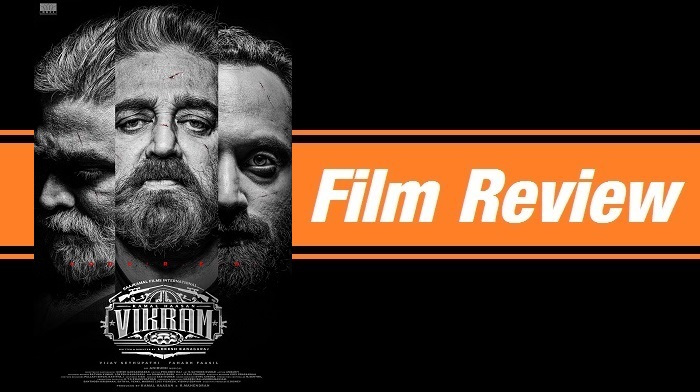
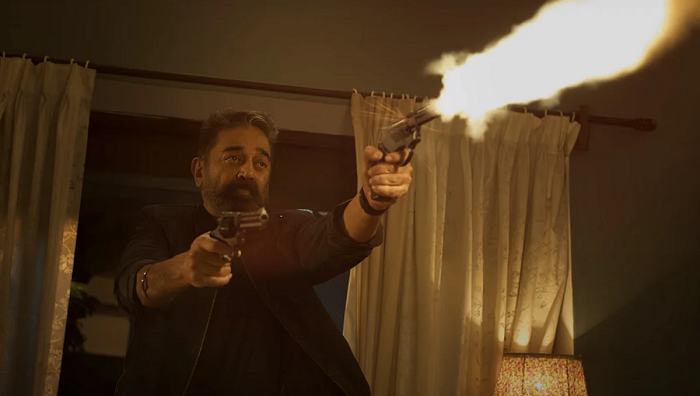
The Tamil action blockbuster “Vikram” has made its way to US streaming (Hulu) giving American audiences the chance to see their highest grossing film of the year. Written and directed by Lokesh Kanagaraj, this is the second film in his shared universe of action thrillers. It’s a movie loaded with ambition, and the craft is undeniable. But it takes some time getting into it. That’s because there are layers upon layers of plot mixed with a seemingly never-ending buildup. But once it gets its footing and all of the story threads start coming together, there’s a reasonably good crime thriller to be found.
Tops among the film’s many characters is Amar (Fahadh Faasil), the leader of an off-the-grid special unit called Black Squad. They’re an elite group who are brought in to solve crimes through methods not readily available to the more law-abiding police. Whenever they’re given a mission, Black Squad stealthily enters and melds into a city or community, connects with the locals for information, tracks down their targets, and brings them to justice by any means necessary.
In this specific case, Black Squad is called in to hunt down a masked killer who has been targeting and brutally slaying cops. Among his victims was a police inspector named Prabhanjan (Kalidas Jayaram). But what made his murder stand out from the others was that the masked man also killed Prabhanjan’s adopted father, Karnan (Kamal Haasan) who has no connection to the police department. Amar and his team latch onto this inconsistency in the killer’s pattern and make it the centerpiece of their investigation.
Through a heavy dose of flashbacks we begin learning more about Prabhanjan and especially Karnan, who becomes a raging alcoholic after his son was killed. As the mystery unfolds, Karnan’s story takes some unexpected turns. Meanwhile separate links to police corruption emerge. And a notorious drug lord Sandhanam (Vijay Sethupathi), the leader of the violent Vetti Vagaiyara gang, becomes a key player and one the main antagonists for the rest of the movie.
Layers continue to be peeled back like onions, and even more characters are introduced as the mystery at the heart of story gets less and less murkier. While the first half will test your endurance, the second half finally gets to a decent enough payoff – one that both (kinda) finishes this story while teases an inevitable sequel. And of course we get the style-heavy action scenes that offer a healthy dose of fight sequences and shootouts. They range from tense yet wildly fun to utterly preposterous.
Yet despite its more attractive pieces, “Vikram” never quite comes together as a whole. That’s because too much of its hefty 174-minute running time is spent weaving together a story that’s more complicated than it needs to be. We spend too much time waiting for the movie to kick into gear and deliver the big action beats we know are coming. These are nagging issues that the film’s star power and impressive style can’t quite make up for. “Vikram” is now streaming on Hulu.
Netflix has dropped the teaser trailer for one of my most anticipated movies of the year. “All Quiet on the Western Front” is the latest feature film adaptation of Erich Maria Remarque’s acclaimed 1929 novel. Directed by Edward Berger, the film is Germany’s submission for Best International Feature at the 95th Academy Awards. Beginning with the words “This is neither an accusation, nor a confession, and least of all an adventure”, the trailer reveals a vision that’s dramatically different than what we’re used to seeing from ‘war movies’.
The film marks the first time the novel has been adapted in its original German language, and it offers a uniquely German perspective. While Daniel Brühl gets top billing (playing vocal World War I opponent Matthias Erzberger), it’s newcomer Felix Kammerer who looks to be the soul of the movie. But this is mostly a tone-setting trailer, and it’s extremely effective. The film is sure to be a bleak and harrowing look at war through a gritty, unvarnished, and brutally honest lens. I can’t imagine it being an easy watch. But when dealing in truth, the results aren’t always pretty.
“All Quiet on the Western Front” opens in select theaters this October and streams on Netflix October 28th. Check out the trailer below and let me know if you’ll be seeing it or taking a pass.
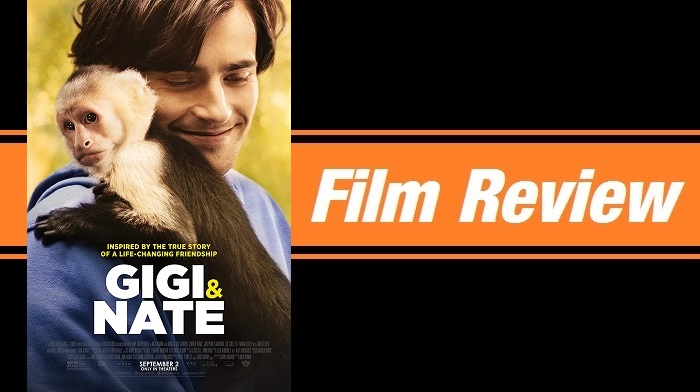
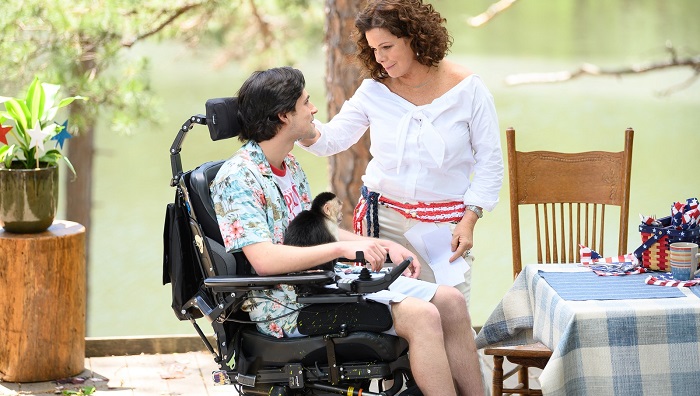
The new feel-good drama “Gigi & Tate” taps into that well-worn but tried-and-true ‘a boy and his dog’ formula. Except this time it’s a boy and his capuchin monkey. Directed by Nick Hamm from a script by David Hudgins, “Gigi & Nate” tells the touching true story of an unexpected friendship and shows how it saved a young man’s life and brought a hurting family together following a devastating tragedy.
Charlie Rowe plays 18-year-old Nate Gibson who we first meet only a couple of weeks before he’s to head off for college. He has big plans and a bright future ahead. That is until his life is forever changed. Nate contracts bacterial meningitis after cliff diving. Nate is med-flighted to a hospital in Nashville, Tennessee where his parents, Claire (Marcia Gay Harden) and Dan (Jim Belushi) and his two sisters, Katy (Josephine Langford) and Annabelle (Hannah Riley) are given some heart-shattering news.
Image Courtesy of Roadside Attractions
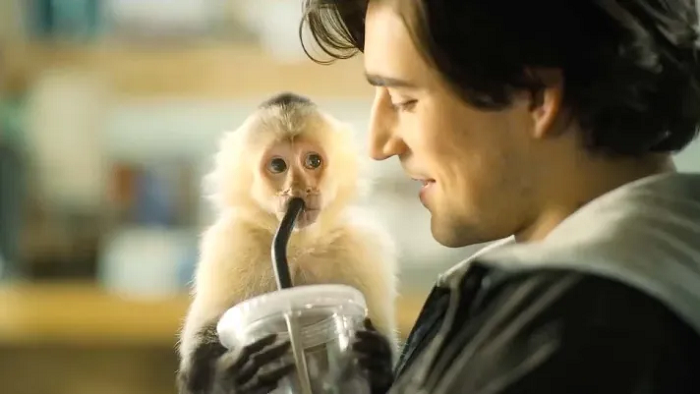
The movie leaps ahead four years where we learn Nate is a quadriplegic. Confined to a wheelchair and spiraling into depression, he finds solace in a capuchin monkey named Gigi. She was rescued from an abusive petting zoo in California and nurtured and trained to be a service animal. After some initial hesitation (by both Gigi and some of his family) Nate and the pint-sized primate bond. They develop a tender relationship that not only helps Nate and his outlook on life, but helps bring a splintering family back together.
But these days it seems like we always have to have an antagonist. Here we get it in the form of an absurdly one-note animal rights activist named Chloe Gaines (Welker White). She heads a group called Americans for Animal Protection, and she immediately puts Nate and Gigi in her legal crosshairs. The second half of the movie gets bogged down in their room-temperature conflict that includes a laughably phony protest sequence outside the Gibson’s home and some tensionless courtroom drama.
The clunky storytelling doesn’t exactly help things. The movie tends to skimp on details, often bypassing opportunities for some good character building. For example, there’s an early scene where we seen Nate in such a bad state of mind that he attempts to take his own life. But less than a minute later we see him at a service animal training facility, smiling and eager to meet Gigi for the first time. There’s not a single scene devoted to showing how Nate went from completely broken and suicidal to optimistic and excited. It turns out to be a reoccurring frustration.
While it’s hard not to take note of the Gibson family’s wealth, Hamm and Hudgins do a good job of helping us see the people beyond the privilege. The filmmakers put in the effort to connect us with this tight-knit family as they each try to cope with Nate’s condition in their own ways. As with other story elements, sometimes the movie breezes past opportunities to make this family dynamic even richer. But as a whole, we get a good sense of who these people are and of their efforts to recover individually and collectively.
Image Courtesy of Roadside Attractions
And then there’s Gigi. She’s brought to life by blending the work from a real capuchin monkey named Allie with digital effects. Of course we get a few saccharine scenes of animal cuteness meant to melt our hearts. But as a whole, the filmmakers use Gigi smartly and to great effect. She plays a pivotal part, not just in realizing the story, but in opening up a number of themes the movie is interested in. She too ends up undercut by some of the second-half sloppiness. But as animal portrayals go, Gigi is used well and has an undeniably heartwarming presence.
I can’t say enough about the movie’s message of hope and triumph. I love what it says about coping with tragedy and overcoming adversity. Yet while “Gigi & Nate” is full of compelling themes and scenes that are tender and earnest, it’s hampered by some nagging frustrations that make it hard to focus on the more meaningful moments. The corny villain angle, the jolts in the pacing, some wobbly performances – they pulled me out of a movie that really hinges on our emotional investment. “Gigi & Nate” is out now in theaters.
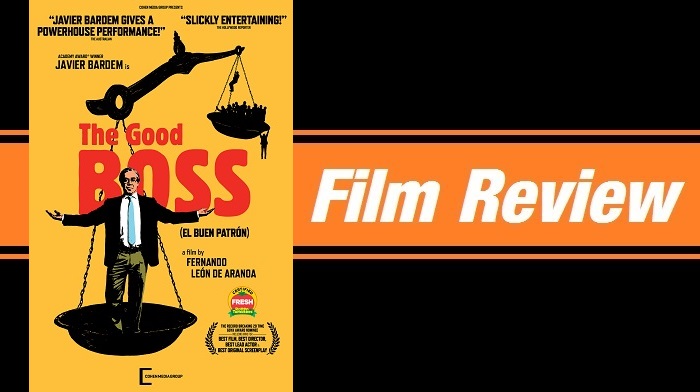
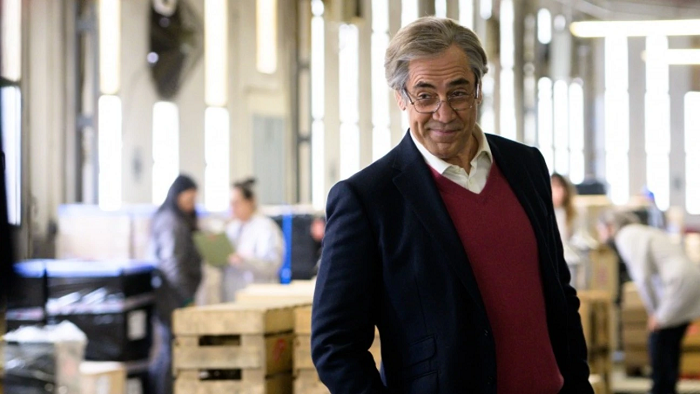
Writer-director Fernando León de Aranoa’s biting anti-corporate satire “The Good Boss” is the kind of movie that can have you snickering one minute and squirming the next. It’s a dark workplace comedy with a subtle edge; one driven by a tour de force performance from Javier Bardem, whose smooth-talking charisma-rich presence turns megalomania, duplicity, and self-serving passive-aggression into a captivating image you can’t turn away from. It’s some of the 53-year-old Oscar winner’s best work.
While Bardem is undeniably magnetic, just as key to the movie’s success is de Aranoa’s cracking script. With its many side characters and smorgasbord of sub-plots, there are so many ways this could have turned messy. But de Aranoa has such a firm and confident control of the material. It’s nicely paced; it has a near perfect balance of storytelling and character development; and the subtle shots of humor often come from the most hilariously unexpected places. Most importantly, the story maintains a remarkably tight cohesion throughout. Not easy for a movie with this many moving parts.
Image Courtesy of Bright Iris Film Co.
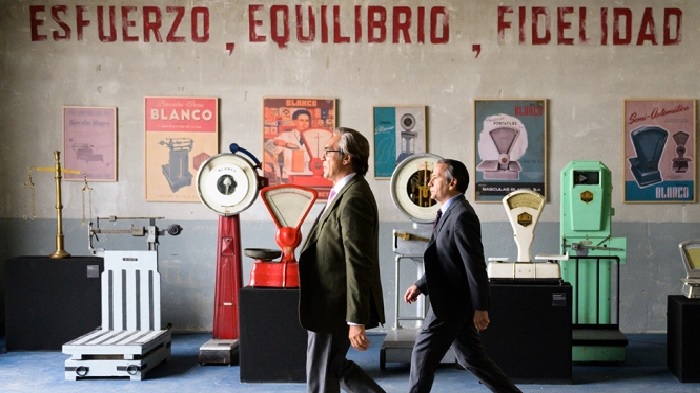
The story revolves around Julio Blanco (Bardem), the titular head of Blanco Scales. It’s a mid-sized company he inherited from his father that makes and sells weight scales of every shape and size (the richness of that reoccurring metaphor is impossible to miss). Along with his wife Adela (a really good Sonia Almarcha) who runs her own fashion boutique, the two are a working couple who never had children. Instead, Blanco claims his employees as his “children” to the point of frequently involving himself in their personal lives.
In reality, Blanco uses his “One Big Family” spiel as a tool to manipulate and control his workforce. Some see through his fatherly ruse and have learned how to manage it. Others fall victim. Take Jose (Óscar de la Fuente), a disgruntled former employee (and perpetual thorn in Blanco’s side) who sets up camp on a splotch of public land near the factory’s main entrance to protest being laid off. Or the string of young female interns who Blanco is quick to bring onboard and even quicker to replace once he’s had his way with them. So the irony in the movie’s title is pretty glaring.
Blanco’s company is one of three finalists for a prestigious industry award which he desperately wants to win. Winning would secure some much-needed subsidies, but deep down it’s all about the glory. Ever the narcissist, Blanco craves the adulation, and he even has a trophy wall which the film routinely cuts back to, highlighting the empty space that he has already prepared. And with the awards committee set to make a surprise visit, Blanco wants to make sure everything at the factory is in top form. Of course that proves to be easier said than done.
The bulk of the film follows Blanco’s attempts at managing his employees and their range of problems (many of which he is directly or indirectly responsible for) before the awards committee shows up. Days serve as chapters, starting on a Sunday, and the story moves throughout the week chronicling the growing workplace and personal drama.
Image Courtesy of Bright Iris Film Co.
Along the way we’re introduced to a fun array of surprisingly layered supporting characters. There’s Blanco’s oldest friend and the company’s Head of Production Miralles (Manolo Solo), his handyman and jack-of-all-trades Fortuna (Celso Bugallo), his dutiful second in command Rubio (Rafa Castejón), his factory’s front gate security guard Román (Fernando Albizu), an ambitious floor worker Khaled (Tarik Rmili), and a young marketing intern, Liliana (Almudena Amor) who proves to be more than some new flavor of the month. The more Blanco meddles in their lives the more complicated things get and his paternal charade quickly starts to crumble.
That may not sound like the most compelling story, but don’t be fooled. Even at two hours, “The Good Boss” keeps you locked in thanks to its whip-smart script and a powerhouse Javier Bardem lead performance. Again, this is some of his best work, and he takes this rich character and embodies him to the fullest. And Fernando León de Aranoa clearly knows what he has in Bardem and gives the actor the material he needs to vividly bring Blanco to life. De Aranoa does the rest, using his know-how to wrangle everything else together to fill out a story that never loses its wit or it’s bite. “The Good Boss” opens in select theaters August 26th.
It’s safe to say Amazon is pretty serious about “The Lord of the Rings”. The mega-company forked out $250 million for the television rights to the J.R.R. Tolkien classic following the successes of two Peter Jackson-helmed movie trilogies. Even more, Amazon has committed $1 BILLION to their new Prime Video streaming series, “The Lord of the Rings: The Rings of Power”. In unison with the Tolkien Estate, Amazon is eyeing five seasons and around fifty episodes to tell their massive story set thousands of years before Tolkien’s “The Hobbit”.
Regardless of the amount of money spent, venturing back into Middle-Earth, the place that Peter Jackson envisioned and visualized so well, was going to be a massive undertaking. And while I don’t hide my preference of the movie trilogy format over a streaming series, Amazon and their showrunners J. D. Payne and Patrick McKay presented a pretty compelling vision of their own. That didn’t remove every question/concern I had, but it did encourage me with its potential.
Based on Tolkien’s “The Lord of the Rings” novel and its appendices, “The Rings of Power” sets out to cover all of the key points of Middle-Earth’s Second Age (basically the period and events summarized in the five-minute prologue in “The Lord of the Rings: The Fellowship of the Ring”). Episodes 1 and 2 are all about introducing (and in some cases reintroducing) us to Tolkien’s vast and sprawling world. There are plenty of new places and even more new faces. But we also get some familiar locations and a few names fans know by heart.
Image Courtesy of Amazon Studios
Episodes 1 and 2 are directed by J. A. Bayona whose first two feature films were the dramatically different yet equally well made “The Orphanage” (2007) and “The Impossible” (2012). He later made “Jurassic World: Fallen Kingdom” (but let’s not talk about that one). With “The Rings of Power”, Bayona seems to have a good grasp of his critical task. It’s up to him to lay the enormous groundwork for what’s to come, and do it in a way that not only captivates audiences but leaves them hungry for more. Even more challenging, Bayona has to evoke those feelings of returning to Middle-Earth, recapturing the magic of the Jackson movies while presenting it a fresh new way. In a nutshell, he succeeds.
The eight-episode first season kicks off with two shows dedicated to table-setting and world-building, not unlike the first half of “The Fellowship of the Ring”. The big difference here is the series is much broader in scope meaning more characters and more time spent introducing them. Bayona and the team of writers do a good job putting faces and voices to these characters who undoubtedly will have pivotal roles to play going forward. But with so many players to ground in the world, we get a lot less action. Some might call it slow, and it occasionally is. But it’s also crucial to locking in our investment.
Among the many inhabitants of Middle-Earth we meet are a young Galadriel (played by Cate Blanchett in the Jackson movies and by a fabulous Morfydd Clark here). She’s an Elven warrior, driven by the death of her brother to root out a gathering evil that she believes is on the horizon. There’s also Elrond, a High Elven architect and politician (played by Hugo Weaving in the movies and in the series by Robert Aramayo). This young Elrond is optimistic and outgoing – much different than the cynical and world-weary leader he would become.
We also meet Durin IV (Owain Arthur), Dwarven prince of Moria (known here as the flourishing city of Khazad-dûm). And Arondir (Ismael Cruz Córdova), a Silvan Elf and soldier who has a forbidden love for Bronwyn (Nazanin Boniadi), a human healer in a small Southlands village. Then there’s also the adventurous young Nori Brandyfoot (Markella Kavenagh), a Harfoot who are this show’s hobbits. These are just some of the characters we meet in the first phase of this journey.
Image Courtesy of Amazon Studios
The performances are uniformly excellent with everyone feeling at home in their uniquely defined regions of the world. Much of Middle-Earth is still settling itself in the aftermath of war, and that weighs heavier on some races than others. This alone allows for a variety of stories to be told and an interesting range of performances. It’ll be fun watching these different experiences change and eventually meld together as this rebirth of evil once again plunges Middle-Earth into darkness.
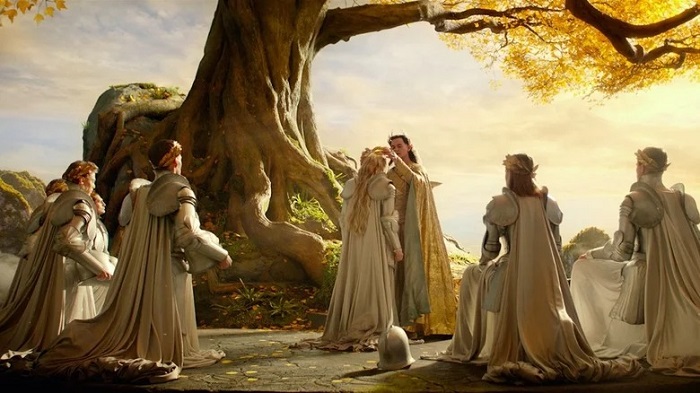
Back to the world itself, everything looks magnificent, including the stunning production design, the exquisite costumes, the breathtaking locations, and the spectacular special-effects. You can tell Amazon tapped into the talent pool behind the Jackson movies, bringing back several people who helped to so vividly bring Middle-Earth to life. There’s still a long way to go with the series, but if it keeps this level of visual quality, we’re in for a treat.
A fundamental part of what made “The Lord of the Rings” movies so special was the sheer wonder of the creative vision combined with how beautifully it flowed from start to finish. My biggest concern with “The Rings of Power” is in its ability to maintain that same creative cohesion. Can such an massive story with so many moving parts and even more directors flow as gracefully as the movies did before it? Time will tell, but I love what they’ve given us so far. The first two episodes of “The Rings of Power” are a visual feast, and the character-building helps lay a solid foundation for what’s to come. I don’t know how it will all come together, but I can’t wait to find out.
“The Lord of the Rings: The Rings of Power” is streaming now on Prime Video.









 Keith & the Movies