REVIEW: “The Invitation” (2022)

I happen to be a big fan of movie trailers. When done right there are a few better ways to get moviegoers excited about an upcoming film. Of course there are several ways a movie trailer can go wrong. One of the biggest (and sadly most prevalent) ways is by revealing too much. It’s something that can be incredibly frustrating and has driven many to simply skip trailers altogether. I mean who can blame them when the studios are spoiling key chunks of their movie in what amounts to a two-minute advertisement?

I felt that frustration after seeing the trailer for “The Invitation”. Not only did it more or less give away the entire story, but it revealed what looked to be the movie’s big twist. I was hoping that wouldn’t be the case when I sat down to watch this gothic supernatural horror film. But it kinda is. From start to finish the story plays out just as we see in the trailer with practically no shocks or surprises. Yet “The Invitation” is a surprisingly easy watch in large part thanks to a nice lead performance from Nathalie Emmanuel.

Evie Jackson (Emmanuel) works for a New York City caterer where she serves hors d’oeuvres to their snooty upscale clientele. Evie is bright and talented but has been stuck at her go-nowhere job, unable to get a leg up in her career. Personally things have been even worse. Her father died several years back and she’s still mourning the recent loss of her mother to cancer. With no siblings, aunts, uncles, or cousins, Evie can’t help but feel all alone.

But that changes after she’s tries a mail-in ancestry kit called ‘Find Yourself’. It’s one of those deals where you send in a DNA sample, the company traces your family history, and contacts you with the results. Evie is surprised to learn that she has a second-cousin in London named Oliver Alexander (Hugh Skinner) and it just so happens that he’s going to be in New York City in the upcoming days. So the two connect and arrange a meet-up for coffee. The enthusiastic Oliver tells her all about her wealthy family in England and invites her to another cousin’s upcoming wedding where she can meet her newfound kin.

With practically no hesitation (gulp), Evie accepts the all-expenses-paid offer and jets off to England. Oliver picks her up at the airport and whisks her away to New Carfax, a posh abbey remotely nestled in the British countryside. The manor itself is custom-made for a horror movie. It has an extravagant yet alluring storybook exterior. But inside is cold Gothic architecture with dimly lit hallways, drafty bedrooms, and jagged bars on the windows to keep out those pesky carnivorous birds (or so Evie is told). Think of it as a beige-colored Highclere Castle on the outside and a home fitting of Barnabas Collins inside.

Image Courtesy of Sony Pictures

Despite the numerous red flags that would send most people rushing back to the States, Evie sticks around, eventually falling for the charms of Walter Deville (Thomas Doherty), the suave and dapper lord of the manor. A romance blooms and everything seems to be falling into place for our protagonist. But we know better (even if our clueless heroine doesn’t). Even if you haven’t watch the trailer, it’s glaringly obvious that something is not quite right at New Carfax. It takes a while to get there, but once the reveal comes things get batty and we’re treated to bloody finish that ranges from fairly entertaining to utterly ridiculous.

Directed by Jessica M. Thompson and written by Blair Butler, “The Invitation” does a good job creating an atmosphere fitting for what’s to come. It also builds its own compelling mythology that centers around four filthy-rich families and a centuries-old pact. And though frustratingly oblivious to the clear signs in front of her, Emmanuel manages to make Evie a character we actually root for, especially when put up against the smug aristocracy.

But there are too many areas where the movie flounders. Many of them are in the handling of its themes. There are constant on-the-nose references to how “white” Evie’s new family looks and acts – a dull-edged attempt at racial commentary that never quite goes anywhere. Slightly more effective yet still lacking the needed bite are the film’s messages on class and patriarchy. They’re more natural to the story, but even they fail to resonate in the way the movie wants them to.

I can see where some may take issue with the movie’s slow pace. Others will be disappointed in its lack of scares. I wouldn’t be surprised to hear audiences vocally chiding the protagonist as she repeatedly breaks some of the basic cardinal rules of horror movies. It’s such a shame because there are some good ingredients here. But every time when I would get onboard with what the movie was doing, it would go off and do something that would leave me shaking my head. Take the final 15 minutes of so. It was just bonkers enough to get me smiling but then ends with a hokey final scene that left my face firmly planted in my palm. Like I said, such a shame. “The Invitation” is now playing in theaters.

VERDICT – 2.5 STARS

REVIEW: “Three Thousand Years of Longing” (2022)

If you’ve had the chance to see the trailer for the new film “Three Thousand Years of Longing” you’ll probably go into it expecting a trippy, gonzo bonanza of big effects and crazy imagery that could only come “from the mad genius of George Miller”. After all, he’s the visual virtuoso whose last movie was none other than the 2015 action masterpiece “Mad Max: Fury Road”. So George Miller comes packaged with some expectation of eye-popping bombast.

Surprisingly, “Three Thousand Years of Longing” is tamer than you might think. I mean there’s still plenty of stylistic flourishes and excesses. But not as much as the trailer might have you believing. Even more surprising, with the exception of a scene or two, it’s when the movie ventures off into the fantastical that some of its weaknesses really show. I mean who would’ve guessed that the best parts of a George Miller movie would be Tilda Swinton and Idris Elba in white terrycloth bathrobes sitting in a hotel room talking?

Image Courtesy of Roadshow Entertainment

“Three Thousand” is full of big ideas that never quite gel and ambition that it never quite fulfills. Based on the short story “The Djinn in the Nightingale’s Eye” by A. S. Byatt, the script (penned by Miller and Augusta Gore) gets off on the right foot. We get a really nice setup, and once Elba is introduced, he and Swinton immediately grab our interest. The movie is at its best when sticking to its intimate two-hander framework. But then we get these sequences from the past, each coated in Elba’s aching but rather drab narration. While interesting at first, these detours quickly start to wear thin.

Swinton is very good as Dr. Alithea Binnie, a narratologist who we meet as she’s arriving in Istanbul for a literary conference. Alithea was once happily married. But a heartbreaking miscarriage followed by an unfaithful husband led to the end of her marriage. Since then, she has walled off a part of herself, traveling abroad and focusing on her work. “I’m a solitary creature by nature,” she says proudly describing her new approach to life which sees her happy and content on her own. Or is she?

While walking through Istanbul’s grand bizarre, Alithea stops in a small shop and purchases a memento – a small blue and white stained glass bottle. She takes her knickknack back to her hotel room to give it a good cleaning. While doing so, the bottle pops open and out filters a pointy-eared djinn (Elba) the size of a cement truck. Now that would be quite a jolt for anyone, even more so for someone like Alithea who doesn’t believe in fate and spends many of her lectures teaching that gods have outlived their purposes. So what to make of the djinn in her hotel suite?

After the djinn sizes down to more human proportions the two begin their rather fascinating introductions. He explains to her that he has the ability to grant her heart’s desire. All she has to do is wish it. Alithea is both cynical and dispassionate to the point that she’s not interested in the djinn’s offer. It sets up an interesting dynamic between the two. The djinn needs Alithea to make a wish because it would finally free him from his centuries of servitude. She has no interest in wishes, but she is an admirer of stories. And that’s something the djinn has plenty of.

So the djinn begins telling Alithea the stories of his previous masters. As he does, Miller makes several pseudo historical trips back in time, including to the days of King Solomon (Nicolas Mouawad) and the Queen of Sheba (Aamito Lagum) as well as the Ottoman Empire during the reign of Suleiman the Magnificent (Lachy Hulme). Considering this is a Miller film, you’d think these peculiar mixes of history and fantasy would be the movie’s high points. It’s quite the opposite.

Image Courtesy of Roadshow Entertainment

When Miller leaves the hotel room for centuries past, the movie hits a wall and bogs down. And frankly, it’s because the djinn’s stories simply aren’t that interesting. There’s not enough weirdness. There’s not enough excitement. There’s practically no suspense whatsoever. The drama is very low-key. And some of Miller’s choices range from bland to lurid and tasteless. There are a few layers of excess that are more off-putting than audacious. Even the visuals are lacking, often highlighted by cheap-looking digital backdrops or glaringly artificial sets.

The movie always gets better whenever it shifts back to Alithea and the djinn in the hotel room. Their conversations are emotionally rich and revealing. Both characters are portraits of longing. His is more open and pronounced. Hers has been suppressed. Both the dialogue in these scenes and the chemistry between Swinton and Elba make them sparkle. Sadly, they can’t make up for the unremarkable flashbacks and the assortment of issues that come with them. And so we end up with a movie exploring why we tell stories that is ultimately undone by a character telling stories? Ironic.

VERDICT – 2.5 STARS

REVIEW: “Samaritan” (2022)

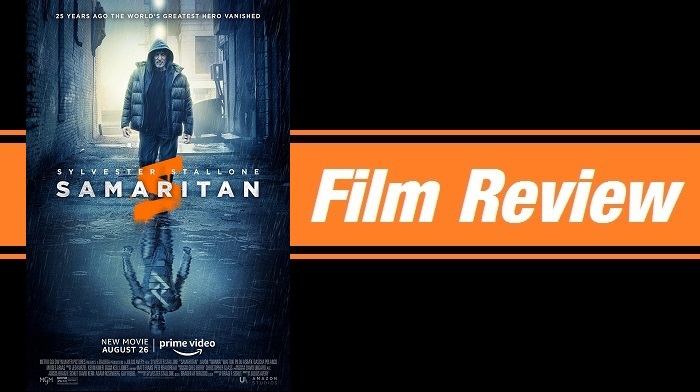
Samaritan and Nemesis were super-powered twin brothers who went down dramatically different paths after their parents were killed. Samaritan served and protected the people of Granite City. Driven by fury and revenge, Nemesis fought against law and order. The two became sworn enemies which culminated in an epic battle ending in the deaths of both brothers. The loss of their superhero now hangs over the city like a shroud.

That’s the gist of the opening setup for the new movie “Samaritan”, a superhero action film but not in the tradition sense. In fact, you could call “Samaritan” an anti-superhero movie with the way it gleefully tosses aside both the tropes and expectations commonly attached to modern day superhero flicks. To its credit, “Samaritan” has its own ideas, and there’s enough originality in the story to make this feel surprisingly fresh. It also has a welcomed edge to it – something that caught me off guard.

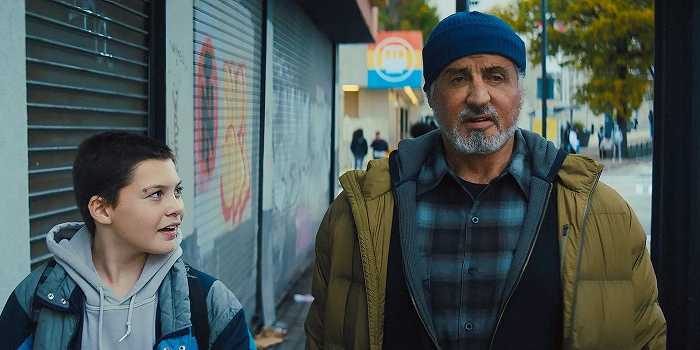
Julius Avery directs from a script by Bragi F. Schut, and the film is produced by Sylvester Stallone’s Balboa Productions. The story follows 13-year-old Sam (Javon Walton), a Samaritan super-fan who soon begins to suspect that his neighbor, a grizzled, blue-collar sanitation worker named Joe Smith (Stallone), is his beloved (and long thought dead) hero. To no surprise the truth eventually comes out, but it’s the path to that reveal that ended up being far more entertaining than I anticipated.

One of the first things you immediately notice is the impressive inner-city world-building. The poverty-stricken Granite City is on the verge of collapse. Union strikes and unemployment has hit the urban areas the hardest with homelessness and crime on the rise. Avery captures the decaying city with remarkable detail. The weathered concrete and asphalt; the rust and grime; the graffiti covered walls and the trash collecting along the streets. Avery gives us an authentic sense of place.

Image Courtesy of Amazon Studios

This is the world Sam lives in with his struggling single mother (Dascha Polanco). She works long hours at low-paying jobs just to pay their rent. In the meantime Sam runs around with his buddy Jace (Abraham Clinkscales) stripping copper wire out of old abandoned buildings for a few bucks. But when he gets in with a local hood named Cyrus (Pilou Asbæk), Sam learns there’s no such thing as easy money.

Sam, who has bought into the theory that Samaritan actually survived his epic fight with Nemesis and is secretly living among them, Begins taking notice of Joe who lives in an adjacent apartment building. After watching him manhandle a pack of thugs, Sam becomes convinced that Joe is none other than Granite City’s lost hero. While the two develop an unexpected friendship, Cyrus connects with his inner Nemesis and hatches a plan to carry out his super-powered idol’s ultimate plan – plunge Granite City into anarchy and chaos in the name of “returning the power to the people”.

And like that the pieces are in play for the bulk of the story which bops along at a fun and energetic pace. Stallone gives a solid performance and slides seamlessly into his role. His tired eyes and deep growl fits his frustrated, world-weary character. But we also get hints of a buried softer side, specifically in Joe’s scenes with Sam. Best of all, their scenes together aren’t what we’re used to getting. Rather than the usual cloying, superficial mush, this is a kid/adult friendship that feels organic, both in how it begins and grows.

The eventual action beats are done pretty well, using a mix of the 76-year-old Stallone, stunt doubles, and some decent CGI. Like much of the movie, the action has grit, but it’s not over-the-top or excessively brutal. And as most things, it’s done in a way that fits well with the story. As far as the villain goes, Asbæk has an appearance that’s a cross between a cartoon and Kiefer Sutherland from “The Lost Boys”. But minus a couple of goofy chest-pounding moments, he makes for a good baddie. And he too is a nice fit for this ‘superhero movie in name only’ feature. One that nicely separates itself from all the others in the genre. Yes, it’s a little corny in a few spots, but it has its boots planted in the real world. And it has a few nice surprises that turned out to be icing on the cake. “Samaritan” premieres today on Amazon Prime Video.

VERDICT – 3.5 STARS

REVIEW: “Lightyear” (2022)

One of the few box office misfires to come from the Disney goldmine known as Pixar was “Lightyear”. The House of Mouse poured $200 million into the acclaimed animated studio’s latest feature, not counting marketing. Yet to date the film has only managed a meager $222 million take. Hardly the results Pixar expected or are accustomed to.

“Lightyear” is a spin-off from the popular “Toy Story” film series but not in the conventional sense. It centers around Buzz Lightyear, but it doesn’t take place in the same universe as the main “Toy Story” films. Instead it’s framed as the movie that young Andy watched in the early 1990s that made him love Buzz. It’s what drove him to want the Buzz Lightyear toy figure (voiced by Tim Allen) in the four “Toy Story” movies. It’s a strange yet inspired idea from first-time director, Angus MacLane.

On the positive side, “Lightyear” is a visual achievement that features stellar animation – some of my favorite to date from Pixar. The sharply detailed textures, the incredible lighting, the cinematic framing – it all creates this stunning space spectacle that is a joy for science-fiction lovers like me. And speaking of that, it’s evident that much of “Lightyear” is inspired by countless sci-fi movies that MacLane clearly has an affection for.

Image Courtesy of Walt Disney Studios

But despite starting strong, “Lightyear” begins to fizzle and before long finds itself stuck in one gear. It can’t muster any real excitement from its action scenes and has a hard time generating a much-needed emotional connection. The characters are fine and they’re each given their own dramatic scenes meant to reveal heart. But these moments feel almost mechanical to the point of leaving no real impression.

Out is Tim Allen, replaced by Chris Evans who makes for a solid but unremarkable voice of Buzz. We first meet him in uncharted space where he and his best friend and commanding officer, Alisha Hawthorne (Uzo Aduba) stop at an unidentified planet after picking up signatures of life forms. The plant-based life turns out to be hostile forcing the space rangers to flee. But when Buzz’s insistence on doing things on his own results in their ship crashing back down on the planet, the crew and the team of scientists find themselves marooned.

A year passes and during that time Space Command constructs a community and research facility built around harnessing the strange planet’s resources to find a way back to Earth. It culminates in the creation of a new hyperdrive which Buzz is set to test. His goal – launch into orbit, reach hyperspeed within four minutes, and then return to the planet with the results. During the test he fails to reach hyperspeed. But when he returns he’s shocked to learn that the four minutes for him was actually four years, three months, and two days on the planet.

Image Courtesy of Walt Disney Studios

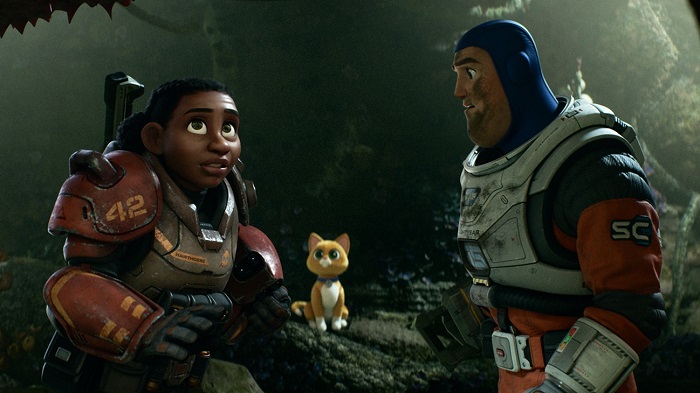
Without giving away the story or getting into details, Buzz returns from a final test to find Alisha and his friends gone and the planet under assault by a mysterious villain named Zurg and his army of robots. He and his robot cat, Sox (a scene-stealing Peter Sohn) encounter three young recruits from the colony’s defense force hiding out in a training camp. One is Izzy Hawthorne (Keke Palmer), Alisha’s young adult granddaughter. There’s also the skittish and insecure Moe (Taika Waititi), and an elderly ex-convict named Darby (Dale Soules). While Buzz initially plans on repelling the robot assault on his own, he soon comes to realize he’ll need to rely on the help of others if he wants to beat Zurg and find a way back home.

The message of “Lightyear” is glaringly clear from the start, but it’s a good one. It’s about humility, trust, and accepting help rather than doing things on your own. Sadly it’s the storytelling that hits a wall, especially once Buzz teams up with the three recruits. Their ‘adventure’ sees the movie at its most conventional and kid-focused. But then things really bog down once MacLane and his co-writer Jason Headley throw in talk of time dilation and temporal paradoxes. It becomes hard to identify the target audience.

“Lightyear” offers plenty of pretty things to look at and one funny/adorable robot kitty. But it hardly reaches to infinity, and it certainly doesn’t go beyond. Instead much of it sits idle in orbit unsure of what kind of story it wants to tell. Worst of all, the story just doesn’t have the ingredients for something truly memorable. The animation is second to none, but it can only carry the movie so far. “Lightyear” is now streaming on Disney+.

VERDICT – 2.5 STARS

REVIEW: “Beavis and Butt-Head Do the Universe” (2022)

I don’t know if there has ever been a more fittingly named duo than Beavis and Butt-Head. For fans of their eight-season show that ran through the mid-90s, their names bring immediate images of two oblivious, insanely moronic, nacho-loving, “scoring”-obsessed teen slackers from Highland, Texas who were the personification of rank stupidity at its funniest. They released their own feature film in 1996, and believe it or not they’re back with a sequel some 26 years later.

“Beavis and Butthead Do the Universe” (streaming exclusively on Paramount+) sees creator Mike Judge return to the characters he made infamous. Judge co-writes and voices the doltish duo in yet another absurd adventure that’ll have you shaking your head and laughing aplenty. Going in I had two questions: 1) How on earth could Judge and his co-writer Lee Morton make these two VERY 90’s characters fit in a modern-day story? 2) Would they still have the same unabashed politically incorrect humor that made them the beloved imbeciles they became?

Image Courtesy of Paramount

As it turns out yes, Judge and company do have a story idea to bring Beavis and Butthead to the modern-day. It’s utterly ridiculous, but that’s to be expected. And yes, “Beavis and Butthead Do the Universe” has the exact same mind-meltingly stupid sense of humor that is sure to thrill fans while leaving some newcomers in a state of utter bewilderment. I mean, it’s the kind of movie that’s so boldly honest about it’s stupidity that it advertises itself as “the dumbest science fiction movie ever made”.

The story goes something like this. In 1998, Beavis and Butthead inadvertently burn down (literally) the Highland High School Science Fair. They’re arrested and appear before a judge known as the toughest in the state when it comes to sentencing. But instead of sending them to jail, the judge (inspired by an episode of “Touched By An Angel”) sends our two “at-risk youths” to eight weeks of NASA space camp. What could go wrong?

As it turns out, everything! Beavis and Butthead arrive at Johnson Space Center (I shouldn’t need to tell you joke there) and for all the wrong reasons become enamored with a space station docking simulator. They impress astronaut Serena Ryan (Andrea Savage) who invites the boys to join NASA’s space mission to study a black hole. They accept after misinterpreting Serena’s invitation as an offer to “score”. Of course things go awry and the pair find themselves sucked into the time-jumping black hole that drops them into the ocean near Galveston, Texas in the year 2022.

Image Courtesy of Paramount

In our time, Serena is the state’s governor, and after seeing her re-election billboard the boys set out to “complete their mission”. From there its Beavis and Butthead clashing with modern society in a steady number of comical encounters, some of them laugh-out-loud hilarious while others not as much. The funniest comes when they crash a college gender studies class and are informed of their white privilege by the professor (voiced by a pitch-perfect Tig Notaro). Adding to the silliness, the dimwitted Feds set out to apprehend Beavis and Butthead after misconstruing their time-jump as the arrival of two potentially dangerous aliens.

It all comes together in a ludicrous but admittedly funny stew. The decision by Judge and co-directors John Rice and Albert Calleros to stick with the classic formula was most definitely the right one. And the culture clash element allows for some hilarious moments. On the negative side, fans might be disappointed by the absence of the show’s wonderful blend of side characters (I was). And just like the MTV television show in the 90s, this movie won’t be for everyone. A little of Beavis and Butthead can go a long way. But to the filmmaker’s credit, they deliver exactly what they promised. Decide for yourself whether that’s a good thing or bad. “Beavis and Butthead Do the Universe” is streaming exclusively on Paramount+.

VERDICT – 3.5 STARS

REVIEW: “Delia’s Gone” (2022)

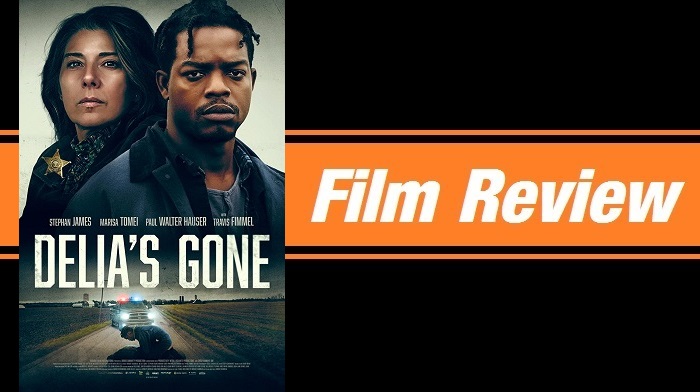
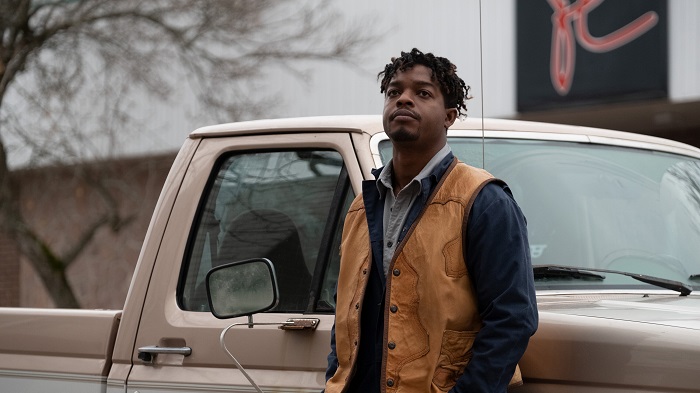
With “Delia’s Gone”, writer-director Robert Budreau combines crime thriller elements with a compelling character study to form a story that works as both a murder mystery and a pointed small town introspection. But it’s the man at the center, Louis, who makes it all work, and it’s through his eyes that we’re able to see and understand the small but progressively ugly world he’s forced to navigate. And it’s through him that the themes of loss, injustice, and resilience boil to surface.

Over the years filmmakers haven’t shied away from portraying autism in their movies. But while these films have been sensitive and respectful in their depictions, they often make a similar mistake. They hone in on the external traits rather than the intense internal struggles that mark their day-to-day lives.

“Delia’s Gone” doesn’t fully avoid those trappings. In fact much of star Stephan James’ lead performance relies on those very external tics and verbal barriers. But Budreau’s script builds a story around Louis that gives us a sense of the chaos brewing in his mind as he tries to process his circumstances and curb his growing anxiety. It’s far from comprehensive and there are a few times where we lose that internal connection with Louis. But Budreau is both thoughtful and sincere in his treatment, and James (so good in “If Beale Street Could Talk”) keeps his performance grounded and true.

Set in small-town Ohio, Louis (a gentle soul with ASD) lives with his troubled sister Delia (Genelle Williams). The two are close, but Delia’s struggles with addiction is taking a toll on her. One evening she surprises Louis with news that she has decided to leave town. Upset and against his better judgement, Louis gets into Delia’s booze cabinet. “It makes me mean,” he says of alcohol early on – a line of dialogue we’re clearly meant to catalog in our minds.

Louis wakes up the next morning and finds blood on his hands and the living room ransacked. He goes to check on Delia only to find her dead on the kitchen floor. Within minutes the town’s sheriff Fran (Oscar-winner Marisa Tomei) and her deputy, Bo (Paul Walter Hauser) arrive and take Louis into custody. With little investigation and even less defense, Louis is convicted and sentenced to five years in prison for involuntary manslaughter.

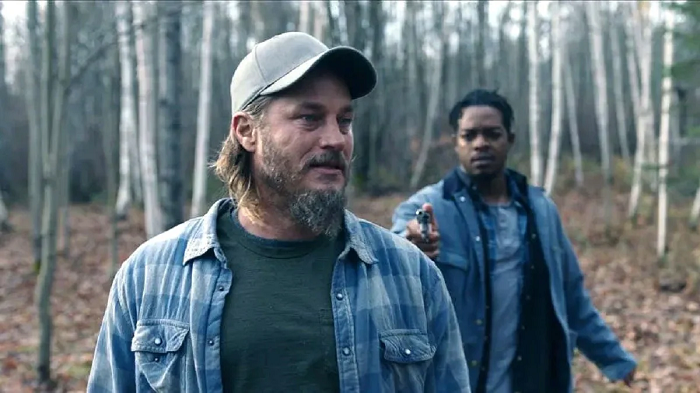
The story then jumps ahead seven years with Louis having served his sentence and now living in a special care facility. He’s surprised by a visit from Stacker Cole (Travis Fimmel), a man from his hometown. Stacker is a man burdened by guilt and looking for some degree of absolution. He tells Louis he has information about the night Delia died. But before he can share it, Louis gets aggressively upset and Stacker is asked to leave. Shortly after, Louis leaves the facility and sets off for his hometown, determined to find answers about his sister’s death.

From there Budreau ramps up the mystery side of his story as Louis follows crumbs of information that lead him to other players intent on hiding the truth. Fran re-enters the picture, now as a state police detective, as does Bo who replaced her as sheriff. Everyone we meet in the second half seems to know more than they’re willing to share, and while we begin to get an idea of where the story is heading, Budreau is able to keep things under wraps until the finale. And while the reveal may not have the jolt it could have, what transpires packs a pretty good punch.

With Budreau’s deliberate pacing and strong character focus along with terrific performances throughout (especially from James and Fimmel), “Delia’s Gone” turns out to be a well-conceived and dramatically rich drama. And while I couldn’t always make sense of certain characters, they feel very much rooted in this world. And we do too, which is yet another reason the movie works so well. “Delia’s Gone” is out now in theaters. “Delia’s Gone” is out now in theaters.

VERDICT – 3.5 STARS