REVIEW: “Jimmy” (2026)

James “Jimmy” Stewart left an impressive on me well before I knew anything about him. As a kid, I had the good fortune of growing up in a household that loved and appreciated movies. I had parents who frequently carried me with them to theaters. We had a backyard satellite dish that had most of the movie channels. We were often in front of the TV for the networks’ Movie of the Week. And our weekend trips to the video rental store opened up even more for the movie-loving young me.

Somewhere in there I was introduced to Jimmy Stewart through his perennial Christmas favorite “It’s a Wonderful Life”. Though I knew nothing about him beyond his name, I remember being captivated by him on screen. It was the ease with which he brought personality and humanity to George Bailey. It was his effortless wit and infectious charm. But it was also his raw vulnerability that grounded his character. At the time I couldn’t put it into words, but I knew I liked Jimmy Stewart. And that was before I knew of the ‘wonderful life’ he had beyond the big screen.

The simple but aptly titled “Jimmy” is a new biographical drama that offers one compelling slice of Stewart’s extraordinary life. Director Aaron Burns and screenwriter Justin Strawhand hone in on Stewart’s military service which came near the high point of his movie career. It turned the beloved star known for his everyman appeal into a full-blown American icon. But as with many of his fellow soldiers, it also came at an emotional cost.

Image Courtesy of Fathom Entertainment

New Zealander KJ Apa takes on the role of Jimmy Stewart, offering us more than a simple impersonation. He may not look like him, but Apa gets Stewart’s uniquely recognizable vocal pitch and register to near perfection. But he also nails Stewart’s demeanor, his posture, and his mannerisms. That’s more than enough to sell us of what we’re seeing. Burns’ sure-handed direction and Strawhand’s focused script does the rest, keeping the audience centered on a chapter of a life rather than trying to cover a whole book.

The story kicks off in 1941 with Jimmy Stewart winning the Best Actor Oscar for “The Philadelphia Story”. It’s a significant yet uncomfortable moment for the reserved and self-effacing actor. So rather than bask in the glory, Jimmy heads back home to Indiana, Pennsylvania, where he props his Oscar in the window of his father’s hardware store. He also informs his folks that he has received a draft letter. His ex-military father doesn’t believe he’s cut out for it, and the studio heads want to use their pull to get him out of it.

But Jimmy sticks with his convictions, leaving the comforts of Hollywood for the battle-torn skies of Europe. He’s assigned to the Army Air Force’s 703rd Bomb Squadron where he quickly climbed the ranks to squad leader. But even there he found himself facing adversity, with everyone from commanders to fellow aviators using his celebrity against him. But we watch as Jimmy earns their respect where it matters most.
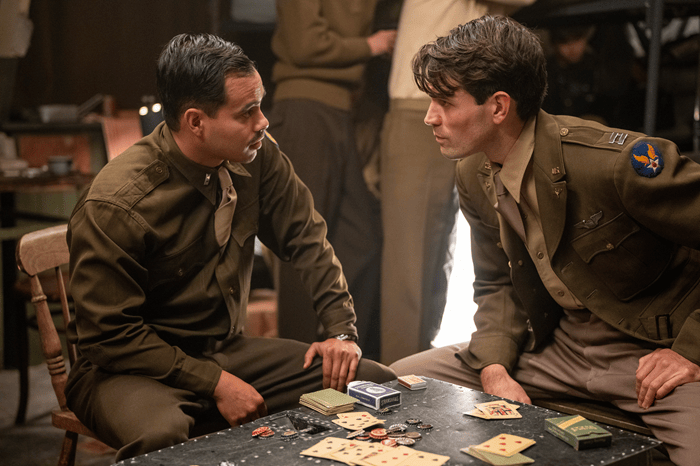
Image Courtesy of Fathom Entertainment

History tells us that Stewart flew a total of twenty missions over the North Atlantic and Europe. “Jimmy” puts us in the B-24 with him and his crew as they carry out dangerous bombings of Nazi factories, supply lines, and airfields. While there are some instances of spotty CGI, the action sequences are quite often harrowing. And they do their job of immersing us in the combat. But we also witness the war’s emotional toll on Jimmy, such as losing soldiers under his command. And having to write letters to the families of those killed in action.

The story of Stewart’s military service is bookended by scenes with Jimmy being urged by his close friend and director Frank Capra (played by Max Casella) to join him in making “It’s a Wonderful Life”. The eventual Christmas classic was an important movie for Stewart. Coming out of the war, he was struggling with anxiety and nightmares brought on by PTSD. Working on the film was therapeutic and gave him a much needed outlet to channel his own pain. Burns deftly captures it by taking us onto Capra’s set where he delivers the film’s most moving scenes.

“Jimmy” embraces several biopic clichés and there’s no denying the affection the filmmakers have for their subject. At the same time, the choice to narrow its focus works well with KJ Apa’s full-bodied performance to give us a good sense of who Jimmy Stewart was beyond the Hollywood spotlight. Even specific filmmaking choices cleverly hearken back to the cinema style of the 1940s. It altogether works to make “Jimmy” a worthwhile biopic and an unexpected surprise.

VERDICT – 4 STARS

REVIEW: “Godzilla Minus Zero” (2026)

Dunesday is just a little over a month away and legions of fans are already percolating. The MCU’s next Avengers installment and the final film in Denis Villeneuve’s Dune trilogy are easily two the most anticipated blockbuster sequels of the year. But just as high on my own personal list is Takashi Yamazaki’s kaiju epic “Godzilla Minus Zero”. It’s the follow-up to 2023’s phenomenal “Godzilla Minus One” and the 39th film in the enduring Godzilla franchise.

“Minus One” saw the great Toho Studios teaming with director, writer, and visual effects supervisor Yamazaki for a Godzilla movie that was both visually spectacular and emotionality resonant. Its title, “Minus One”, is a reference to the state of Japan in the wake of World War II. After atomic bombs were dropped on Hiroshima and Nagasaki, the decimated country was essentially reduced to ‘zero’. Godzilla’s devastating attack sent Japan further down to “minus one”. The movie centered on everyday people fighting their way back to “zero”.

For “Minus Zero”, Yamazaki explores some of the same thematic territory by once again effectively rooting his story in the struggles of post-World War II Japan. Set in 1949, two years after defeating Godzilla, the country is still finding its way in the painful aftermath of two atomic bombs and one equally destructive kaiju. The human element has often been front and center in the best Godzilla movies. That remains the case here.

Image Courtesy of Toho Studios

Several characters from the first film return including Kōichi Shikishima (Ryunosuke Kamiki), a former kamikaze pilot who was integral in taking down Godzilla. Kōichi is now married to Noriko (Minami Hamabe) who narrowly survived Godzilla’s Ginza attack. Together they are raising their adopted daughter Akiko (Sae Nagatani) with the help of their friend and next-door neighbor Sumiko (Sakura Ando), who now runs the War Orphans Relief Home.

Not far away in Matsumoto City, a massive new threat emerges. An enormous winged creature resembling a dragon lays waste to the city, quickly killing thousands and sending the nation back into a state of shock. As the creature lies dormant, the Disaster Response Bureau, led by its director, Kenji Noda (a returning Hidetaka Yoshioka), immediately begin planning a course of action. Blending the words for “chimera” and “hydra”, they name the new beast “Ghidorah”.

The rest of the story follows the desperate joint efforts by scientists and the military to stop Ghidorah. Noda brings aboard a meteorology prodigy named Makoto (Masami Nagasawa) to track the beast. The Americans offer to provide state-of-the-art weaponry, much to the chagrin of biologist Murakami (Min Tanaka), who lost his family in the bombing of Hiroshima. And Kōichi and Noriko eventually find themselves assisting in Noda’s ultimate plan which includes the King of the Monsters himself, Godzilla.

While the movie steadily builds towards its inevitable kaiju climax, Yamazaki makes sure the human toll is always in sight. The haunting echo of the war reverberates throughout his movie, and it can be felt in a number of compelling ways. For example, American involvement reopens old wounds and understandably sparks skepticism and distrust. And the impact of war trauma is once again powerfully expressed through several characters. On a more personal level, Kōichi and Noriko labor over their duties as parents to Akiko verses their call to service which could save thousands of lives. Again, humanity is central.

But Godzilla fans shouldn’t worry. The action-packed payoff to the buildup is well worth the wait. The special effects in “Minus One” were extraordinary, leading it to being the first Godzilla movie to win an Academy Award. Nothing changes in “Minus Zero”. Everything from the spectacular framing of the action to the kaiju themselves will take your breath away. Through Yamazaki’s artistry, every scene involving his monsters feel enormous. And composer Naoki Satō’s simple yet nerve-racking score soaks it all in a steady sense of dread.

One area that could have used a little more attention is the film’s unique spin on G-Cells. It’s not that they’re poorly handled or even shortchanged. It’s that they add such a compelling layer to the story and we’re left wanting to know more. Aside from some occasionally shaky acting, that’s about as close to a criticism as I have. Otherwise, “Minus Zero” had this Godzilla fan in a state of cinematic euphoria. The kaiju are jaw-dropping spectacles to behold. The scale of the action sequences is breathtaking. The human drama is anchored in emotional truth. Yamazaki has once again delivered the radioactive goods, and I can only hope he and Toho have more in store for us.

VERDICT – 4.5 STARS

REVIEW: “The Invite” (2026)

Some people have a hard time watching a movie full of characters they don’t like. It’s often because of their need to have someone to root for. For others it’s a case of needing a ‘good guy’ to connect with. That has rarely been a problem for me. A character’s likability has never been a prerequisite. In fact, there are a ton of great movies about terrible people. At the same time, there’s a big difference in not “liking” the characters and not liking the time you spend with them.

That brings me to “The Invite”, the latest swing from actress and director Olivia Wilde. It’s a movie that locks us in an apartment with two incredibly obnoxious couples. Again, that in itself is hardly a deal-breaker. The problem was being in the company of four people I couldn’t stand spending time with. “The Invite” is 100 minutes of stagey tail-chasing, as we absorb the verbal antics of four pretentious irritants stuck in an endless cycle of incessant bickering, schticky humor, and room-temperature sex talk.

Image Courtesy of A24

Based on Cesc Gay’s 2020 Spanish film “The People Upstairs”, Wilde’s adaptation has quickly become a darling of many critics and awards season prognosticators. It has gotten some outrageous comparisons to the stage and film classic “Who’s Afraid of Virginia Woolf?” and has been called a lock for multiple Oscar nominations including Best Picture. I wouldn’t be surprised if the latter turns out to be true. But that doesn’t stop “The Invite” from being a repetitive one-note frustration, soaked in cynicism and self-loathing.

Written for the screen by Will McCormack and Rashida Jones, the story is a chamber piece about two couples spending an evening in an apartment. Wilde plays Angela, a San Francisco housewife who is married to Joe (Seth Rogen). Angela was an aspiring artist before surrendering to what she considers to be an unfulfilling life as a stay-at-home wife and mother to their daughter Maggie. Joe is a peevish doofus who once played in an indie punk band but is now a miserable associate band teacher at a conservatory.

It’s obvious from the start that Angela and Joe’s marriage is on the rocks. Right as he gets home from work, the couple immediately begin arguing, starting with passive aggressive jabbing that turns into an all-out screaming match. It makes for a long and loud opening fifteen minutes. Joe is especially angry that Angela has invited their upstairs neighbors, Hawk (Edward Norton) and Piña (Penélope Cruz), to their apartment for dinner. The weirdly smitten Angela desperately wants to impress their guests. An annoyed Joe is eager to confront them about the loud raucous sex they have at all hours of the night.

Hawk and Piña are uniquely different yet no less irritating. He is a retired fireFIGHTER (don’t you dare call him a fireMAN) with an obsession for home decor, especially exotic rugs. She is a saucy Spanish psychotherapist and sexologist with no filter and who can whip up a mean flan. Hawk and Piña are portrayed as proudly open and free-spirited. They’re social swingers who are everything Angela and Joe are not. In truth, they function more as shallow plot devices meant to get us to the unearned emotional payoff in the film’s final ten minutes.

Image Courtesy of A24

“The Invite” fancies itself as having something meaningful to say about marriage, even beginning with a quote from Oscar Wilde that is more pessimistic than insightful. Yet it leaves us with nothing we don’t already know. And sure, Wilde and company grab attention by talking explicitly about sex. Yet they have nothing new to say about the topic. Instead, it all comes off as posturing rather than profound. And no amount of pseudo-sophistication or impromptu wit can give it any kind of weight.

In the cast’s defense, they essentially play their characters as they’re written and directed. If only they were written and directed well. Instead they’re stuck giving slight variations of characters they’ve played before (with the exception of Rogen who is in full copy-and-paste mode). In some ways they too are victims of a movie that turned out to be everything I hoped it wouldn’t be. But fans shouldn’t worry. It’ll still get plenty of accolades this awards season.

VERDICT – 1.5 STARS

REVIEW: “Drummer Boy” (2026)

“Drummer Boy” is the second 2026 movie from Angel Studios set during the American Revolutionary War, the first being “Young Washington”. But while the two share obvious similarities, “Drummer Boy” has some notable distinctions that set it apart. Look no further than the film’s unique fusion of genres. It’s a historical drama but also a war movie with no shortage of action. There’s even a romantic subplot that fuels several of the story’s bigger themes. But here’s the real kicker – it’s also a musical.

“Drummer Boy” has been a near decade-long effort from brothers Ben and Joel David Smallbone. The directing duo (of the music group For King + Country) work from a script by Richard L. Ramsey to tell a vibrant and moving story about forgiveness, freedom, sacrifice, and the search for significance. The story is unpacked through three distinct perspectives, each highlighting one or more of the film’s core themes. Then there are the musical numbers and their fairly seamless integration into the narrative.

Image Courtesy of Angel Studios

Set on the cusp of the American Revolution, the central story follows Jeremiah Clem (Joel David Smallbone) and his younger brother Benjamin (Lucas Leach). When they were kids, they left England and migrated to America with their father, Nathaniel (Ioan Gruffudd) and mother, Rachel (Melora Hardin). But just as they were approaching land, their ship was attacked by the French and their father killed in front of them. Now several years later, the brothers and their mother run a mill supplying grain to a growing British settlement.

But as tensions peak between the British and the freedom-seeking colonists, the brothers find themselves as odds with the English locals. Jeremiah keeps their opinions to himself in the interest of protecting his family. But after the outspoken Benjamin angers the townsfolk, Jeremiah steps in to prove their loyalty to the crown in the only way he can – by joining the British army. Meanwhile Benjamin secretly sets out to join the early Colonials, seeing it as a chance to finally prove himself.

As the brothers go their separate ways, each must face their own personal trials. For Jeremiah, it’s finding a way to stay true to his convictions while becoming an inspiration to the soldiers on the field. For Benjamin, it’s getting the troops to look beyond his braced leg and see him as a fellow soldier rather than just a drummer boy. Their paths inevitably cross, but it’s their individual journeys that build and defines the dramatic crescendo. “Drummer Boy” is at its best when it concentrates on their stressed family dynamic and wartime drama.

Slightly less effective is the romance. Before heading off to war, Jeremiah grows smitten with Elizabeth Balfour (Beth Easdown), the spoiled daughter of his commanding officer (Charles Esten). But there’s also Emmaline (India Brown), the Balfour’s young slave who he shares a special connection with Jeremiah. The trio’s complicated relationships fuel a romance that sometimes gets stuck on the film’s back burner. Yet they also feed some of the story’s more profound themes. Such as exposing the utter hypocrisy of a war fought for freedom while the vileness of slavery exists in the very same time and space.

Image Courtesy of Angel Studios

“Drummer Boy” looks great, from its period-perfect costumes and rich production design to the capable battle sequences and the striking landscapes where they take place. But the film’s pulse comes from its characters and the contradictory world unfolding around them. Smallbone and Leach capture the burdens and conflicts that are central to their roles. Brown grounds the movie with honesty and pathos. Iain Glenn is superb as Major Ambrose, who teaches Benjamin far more that battlefield strategy and tactics. Only Hardin feels shortchanged, but she’s still terrific in the scenes she’s given.

Then there’s the music, an interesting collection of rousing pop-infused anthems and more straightforward, narrative-centered tunes. A couple are a little jarring in the moment, but most accent the story in a number of entertaining and compelling ways. They also bring a distinct musical energy that keeps the movie from sliding into more conventional territory. Some parts of the story could use more attention, and the emotionally seismic final sequence is undeniably manipulative. But its hard not to be drawn into what is a powerful and soul-stirring musical tale of freedom, forgiveness, and reconciliation.

VERDICT – 3.5 STARS

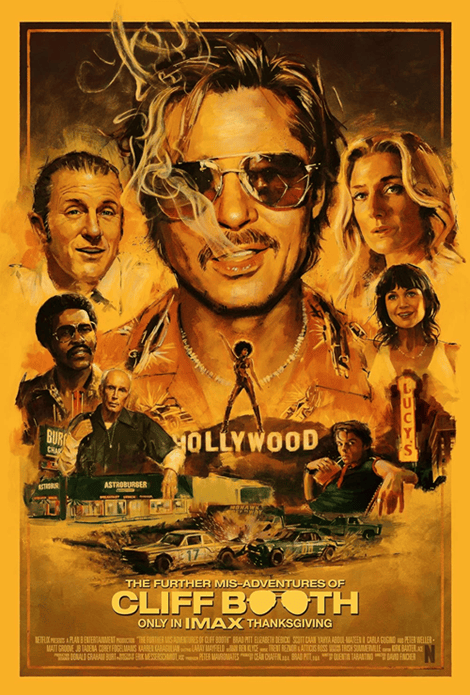
First Glance: New Teaser and Poster for “The Further Mis-Adventures of Cliff Booth”

A huge tip of the hat to the creative minds at Netflix who yesterday released one of the coolest movie teasers I’ve seen in years. It’s for the highly anticipated period comedy-thriller “The Further Mis-Adventures of Cliff Booth”. It’s the standalone sequel and spin-off to Quentin Tarantino’s superb 2019 feature “Once Upon a Time in Hollywood”. Tarantino once again writes the script but interestingly hands over the directing reins to David Fincher. Together they form a filmmaking combo that is impossible for me to resist. One look at the new teaser and you’ll know why.

Set eight years after the events of “Once Upon a Time in Hollywood”, Tarantino’s script sees Brad Pitt reprising his role as Cliff Booth, a former stuntman who has now become a Hollywood studio fixer. Netflix has kept the story details mostly under wraps, but the small bits we’ve seen have been more than enough to pique my interest. And look at the supporting cast: Elizabeth Debicki, Scott Caan, Yahya Abdul-Mateen II, Timothy Olyphant, Holt McCallany, Emily Alyn Lind, Peter Weller, Carla Gugino, and many more. I can’t wait.

“The Further Mis-Adventures of Cliff Booth” will receive a special two-week exclusive IMAX theater release starting November 25th. It’s then set to release on Netflix December 23rd. Check out the new teaser and poster below and let me know if you’ll be seeing it or taking a pass.

REVIEW: “The Last Temptation of Becky” (2026)

Lulu Wilson returns as the unlikeliest of antiheroes in “The Last Temptation of Becky”, the third entry in the Becky film series. She reprises her role as Becky Hooper, a young woman with serious anger management issues and a knack for brutality. The character first appeared in the bloody 2020 action thriller “Becky”. Then again in 2023’s equally savage “The Wrath of Becky”. Now she’s back to off a new batch of Neo-Nazis for our viewing pleasure.

The Becky movies pride themselves in being over-the-top and outrageous. They have an ingrained self-awareness that pushes things to near comical levels without ever fully winking at the camera. That formula has worked very well through two films. But it starts to wear a little thin in movie #3. And while “Temptation” strikes some of the same gonzo chords fans will be looking for, it also takes the overall absurdity to another level.

Image Courtesy of Quiver

Following the events from the last film, Becky is now a covert CIA field agent working under her mentor (of sorts) Agent Montana (a returning Kate Siegel). Becky is in hot water with the agency’s Director Baker (Fiona Marr) after botching two critical missions with her aggressively violent approach. But Baker gives her one more chance. It will be Becky’s very first solo mission and her very last chance to keep her job with the CIA.

Becky’s assignment takes her to Poland where she is to locate the Wolf’s Lair, Hitler’s military headquarters during the Second World War. It’s there that General Wilhelm Reuss (Neil Patrick Harris) is in the final stages of a multi-pronged plan to usher in the Fourth Reich. Reuss is the grandson of a prominent Nazi officer during the war. Now he has dusted off his grandfather’s old Nazi duds, recruited a handful of simple-minded followers, and is ready to pick up where the Führer left off.

Becky’s orders are to go in undercover, collect intel, and report back – nothing else. But it doesn’t take long for her to disobey those instructions. And after she discovers that Reuss may have connections to her father’s death in movie #1, “Temptation” turns into a full-blown revenge thriller, with plenty of potty-mouthed sass, lots of ludicrous action, and copious amounts of blood. And it’s not just Reuss Becky must deal with, but also his psycho wife Helga (Catherine Walker), daughter Luisa (Aoife Hughes), and son Otto (Noah Leggott).

Image Courtesy of Quiver

Director Jenn Wexler takes plenty of notes from the first two Becky films, but she really amps up the silliness. Wilson once again has a field day in the skin of Becky, who’s crass, slightly unhinged, and even a touch sadistic. But she’s even more off-the-rails this time around, like a berserk James Bond with a semi-righteous bloodlust and significantly more violent gadgets. It’s beyond goofy, but the movie knows it which makes it easy to digest.

There is fun to be had in watching Becky wreck havoc and kill a bunch of Nazis. But don’t put too much thought into anything beyond that. That’s because there are so many things that simply don’t make sense. As for the action, it’s serviceable but nothing memorable. In fact, lukewarm shootouts and underwhelming fight choreography only work because of the blood-splattered payoffs. And those payoffs are quite fun, much like the film’s ending, which is so ridiculous that you can’t help but be entertained. And that’s a pretty apt description of “The Last Temptation of Becky” as a whole.

VERDICT – 3 STARS