Andrew Dominik’s much talked about Marilyn Monroe biopic(ish) “Blonde” is set to premiere at this year’s Venice Film Festival. With it only weeks away, Netflix has given us our deepest look yet with a brand new trailer. Prior to this our information has mostly consisted of some images, a teaser, and Dominik’s rather haughty defense of his film’s NC-17 rating. This new trailer looks terrific, but whether it steers clear of exploitation and indulgence remains to be seen.
Ana de Armas takes on the demanding role of Marilyn Monroe in a movie that’s said to be more of an “experience” than a full-on biography. Some have compared its approach to Monroe’s story to what “Spencer” did with Princess Diana. I’m not sure how I feel about that. But de Armas looks to be a compelling fit for the part and the cinematography looks to be exquisite. The biggest question centers around how well Dominik captures Monroe’s life. Will it feel authentic or exploitative? We’ll know soon.
“Blonde” premieres September 28th on Netflix. Check out the trailer below and let me know if you’ll be seeing it or taking a pass.
I’m far from what you would call an animated film connoisseur. For reasons that I’ve never quite been able to pinpoint, animated movies have never registered with me in the same way they do with millions of other moviegoers. Now there are some I’ve genuinely loved (“The Illusionist”, “The Lego Movie”, “Fantastic Mr. Fox”, “Ratatouille”). But it’s nearly impossible for me to muster the enthusiasm others do whenever a big new animated feature is announced. I’m kinda jealous.
But there was something about the trailer for the recent Dreamworks Animation film “The Bad Guys” that clicked with me. Not enough to get me to see it at the theater, but definitely enough to check it out on Peacock where it’s now streaming. Directed by Pierre Perifel and written by Etan Cohen, “The Bad Guys” touted an interesting premise and was said to pull inspiration from a variety of films like “Oceans Eleven”, “Reservoir Dogs”, and “Pulp Fiction”. And then there’s a cast: Sam Rockwell, Marc Maron, Zazie Beetz, Awkwafina, Craig Robinson, Anthony Ramos, and more.
Image Courtesy of Universal Pictures
Loosely based on a children’s book series by Aaron Blabey, “The Bad Guys” follows a notorious criminal gang of anthropomorphic animals. We have their smooth-talking leader, Mr. Wolf (Rockwell); his cranky best friend and the gang’s safecracker, Mr. Snake (Maron); hacker extraordinaire, Ms. Tarantula (Awkwafina); a master of disguise, Mr. Shark (Robinson); and there’s Mr. Piranha (Ramos), a loose cannon who loves a good fight.
Together they have avoided capture despite the dogged efforts of the manic Police Chief Misty Luggins (Alex Borstein). That’s because they always play it smart and never make a job personal. But after the newly elected Governor Foxington (Beetz) puts them down in a televised speech, Wolf decides to pull a heist that will prove their reputation and cement their legacy.
Their job is a big one – steal a trophy called The Golden Dolphin during a gala where it is set to be presented to Professor Rupert Marmalade IV (Richard Ayoade), a beloved guinea pig philanthropist. But their caper hits a snag after Wolf gets an unexpected taste of being good. Things go south, the gang loses the Dolphin, and a conflicted Wolf begins to rethink their Bad Guy status.
Image Courtesy of Universal Pictures
As stories goes, this one has it moments in large part thanks to the characters and the terrific voice work. There’s nothing particularly innovative here and it’s not as funny as I had hoped. But there’s a good chemistry between our reluctant heroes that makes them fun to spend time with. And the animation style is inspired and more often than not quite good.
Unfortunately the movie does fall victim to some of the same tired gags that seem to find their ways into many modern animated films. For example, Perifel and Cohen not only throw in fart jokes and butt jokes, but they come back to them several times. I also found myself checking out a bit during the chaotic and unrestrained finale. But while these things bring “The Bad Guys” down a notch, there’s still plenty to like especially if you’re already a fan of the formula that many of these Hollywood animated films follow. “The Bad Guys” is now streaming on Peacock.
While Ti West’s ode to slasher films “X” started with promise, it ultimately succumbed to a slew of missteps that left it feeling like a trashy knock-off rather than something refreshing and new. Now it has a prequel titled “Pearl”, and after seeing its stylish first trailer, I can say this one looks to deliver everything I had hoped “X” would. And with it set to premiere in a few weeks at the Venice Film Festival, we won’t have long to wait.
“Pearl” (which was written during the production of “X” and shot right after the first film wrapped) sees a returning Mia Goth player the titular character Pearl, the psychotic killer who butchered a group of wannabe porn stars in “X”. This film sets out to tell her backstory and the glimpses we are given are as bonkers as they are bloody. I don’t want to get my hopes up too much, but I really like what I see here.
“Pearl” hits theaters September 16th. Check out the trailer below and let me know if you’ll be seeing it or taking a pass.
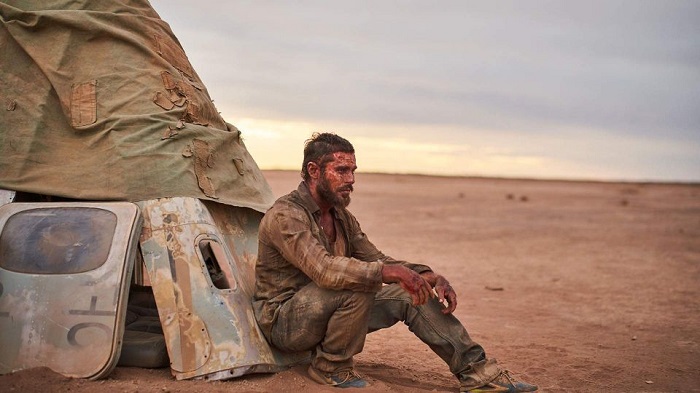
In the opening scene of “Gold”, director Anthony Hayes wastes no time immersing us in his harsh dystopian setting. A drifter (played with remarkable restraint by Zac Efron) sits in a railway boxcar as it slowly moves across the dry parched outback. The man, with his face caked in grime and his clothes covered in dust, hops off the train at a barren depot made mostly of rusted tin and tarp. He’s there to meet another man who is to drive him to a mysterious place called “the compound”. This opening sequence (and really the entire movie) does such a good job drawing you into its world that you can almost taste the grit in your mouth.
Co-written by Hayes and Polly Smyth, this Australian thriller moves at a visceral slow-boil, relying as much of the visual language of DP Ross Giardina’s camera than a driving narrative. Set “Some time. Some place. Not far from now…”, the striking cinematography conveys a not-too-distant future that’s both stunning to behold and undeniably forbidding. And Hayes’ uncompromising dedication to realizing his gritty and minimalist vision makes for an experience that’s hard to shake.
Image Courtesy of Hulu
Perhaps it’s unjust of me, but Efron is an actor that I never expect much from. While there has been a hint or two of his talent, he’s wasted a lot of time on forgettable dramas, corny rom-coms, and lame raunchy comedies. But he proves me wrong in “Gold”, delivering what I feel is the best performance of his career. Efron shows an intense commitment both physically and dramatically and the above-mentioned restraint allows him to show off a side of his talent that I didn’t know he had.
Efron’s drifter is a bit of a mystery. He’s clearly had a tough run as evident by deep scar across his face and a noticeable limp. We learn that he’s from “back west” and is heading to the compound for what he understands to be an opportunity to work and make some money. When he’s picked up at the depot by his driver (played by Hayes himself) the two head off across the grueling landscape. As they drive, their conversations shed a little light on the world’s crumbing society. But Hayes leaves most of that to our imagination and instead hones in on these two men who make a life-changing discovery.
While stopped in the middle of nowhere, the two men stumble across a massive deposit of gold. Unable to dig it out of the ground or pull it out with the truck, they put together a plan to claim their fortune. The driver will take the truck to a village some two days away and get an excavator. The drifter will stay behind and guard their treasure from any potential passerbys. Of course that will require surviving the scorching sun, the harsh land, and packs wild dogs with minimal food and water.
Image Courtesy of Hulu
With the driver gone, we spend all of our time with the drifter as his story turns from fortune to all-out survival. The layers of detail Hayes brings makes the drifter’s worsening circumstances feel remarkably real. Filming near the Flinders Ranges in the South Australian outback creates an authentic setting that is a sparse and arid spread of sand, bushes, and deadwood. Then there are the details Hayes commits to his lead character. Whether it’s his face covered in flies or the various stages of sunburn realized through the incredible work of makeup artist Beth Halsted. Efron’s performance is equally crucial to making it all feel painfully genuine.
As “Gold” unfolds it evolves into a story of greed and the dissolution of humanity. It’s also a man-versus-nature movie but with a slight “The Treasure of the Sierra Madre” vibe. All of these themes and influences come together in a taut, focused, and surprisingly potent thriller. It also features a terrific Zac Efron performance that gives long-time naysayers like me a chance to rethink our past feelings on the 34-year-old actor. “Gold” is streaming now on Hulu.
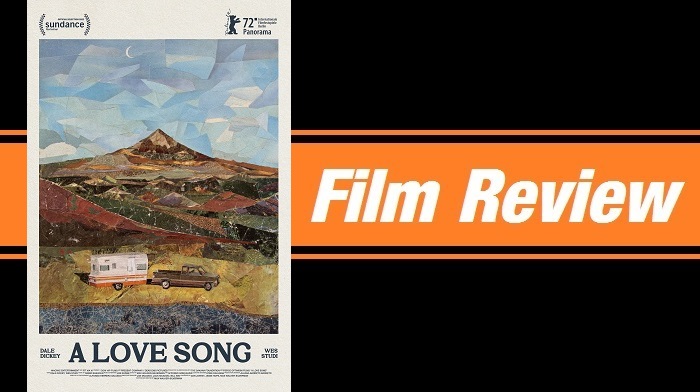
* I had the pleasure of seeing Max-Walker Silverman’s “A Love Song” at this year’s Sundance Film Festival. The film comes out in select theaters this Friday (July 29th). In a nutshell, I couldn’t recommend the film enough. And with its release upcoming, I wanted to repost my review for this beautiful and touching drama.
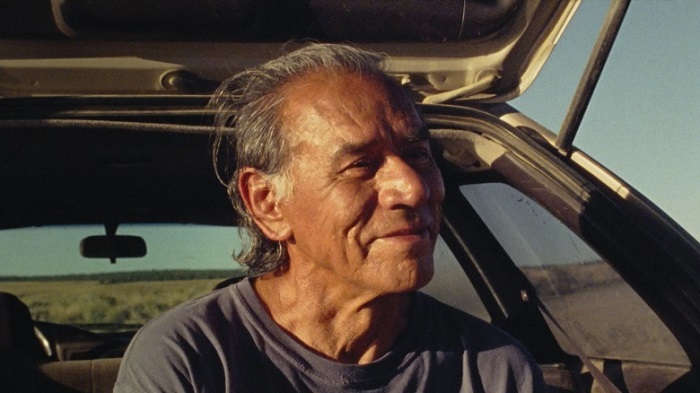
I’ve always had a deep admiration for Wes Studi and what he brings to his movies. Whether it was his role as the brutal yet complex Magua in Michael Mann’s “The Last of the Mohicans”, his often underappreciated portrayal of Geronimo in Walter Hill’s “Geronimo: An American Legend”, or playing a police detective alongside Al Pacino and Robert De Niro in “Heat”. There’s an unmistakable sincerity and gravitas Studi brings to every film he’s a part of.
So what better way to start my 2022 Sundance Film Festival than by screening a new drama that sees the 74-year-old Studi given a nice meaty role. The film is “A Love Song”, written and directed by Max Walker-Silverman. As the title suggests, this isn’t the kind of movie Studi is most known for. But for fans of his work, it’ll come as no surprise to hear that he, much like the film itself, is a joy to watch.
But the real star of “A Love Song” is Dale Dickey, an outstanding character actress who may be best remembered for her scene-stealing work in 2010’s “Winter’s Bone”. This is a rare leading role for Dickey whose name you may not remember, but whose face is impossible to forget. It’s a remarkable face chiseled out of real life and with bone-deep honesty found in every look and every expression. She’s a perfect choice for Walker-Silverman’s film which sees him working on the same lyrical meditative wavelength as Kelly Reichardt and pre-“Eternals” Chloé Zhao. But Walker-Silverman brings enough of himself to “A Long Song” to give the film its own special identity.
Image Courtesy of Bleecker Street
In “A Love Song”, Dickey brings her signature quiet intensity but this time to a much different character. Here she plays a widow named Faye who hitches her small camper trailer to her Chevy S-10 and drives it to a remote Colorado campsite. She sets up next to a small lake with the Rocky Mountains sitting in the distance like a watercolor painting still wet on the canvas. This is where she’ll stay for the rest of the film’s lean 80-minute running time.
At first, it may be tempting to get caught up in Faye’s similarities to Frances McDormand’s Fern from last year’s Best Picture winner “Nomadland” or to Robin Wright’s Edee from Sundance 2021’s “Land”. But while all three woman unquestionably have things in common, Faye has several distinctions that separates her from the other two. Those distinctions also set this movie on a different course which I was delighted to see.
We don’t learn a lot about Faye or where she came from, but that actually serves the minimalist storytelling perfectly. We do find out she once flew planes for the forestry service. She’s also one heck of a mechanic. And she loves listening to music on her Longines Symphonette World Traveler AM/FM radio. “It always plays the perfect song,” she says in a tender scene later in the film, “even if in the moment you ain’t sure why.” Faye birdwatches (poorly) during the day. Then it’s Busch beer and crawfish for dinner as she watches the sun set over the mountains. After dark, she searches the starry sky for constellations. And that’s her routine.
As you watch Faye, it’s hard to miss her melancholy gaze; the sense of loneliness; the shallowly buried heartache. The source of her sadness is the death of her husband Tommy. He’s been gone for seven years, yet you can tell she’s still carrying the weight of grief. But unlike Fern, who finds contentment in unplugging and living on the road or Edee, who disconnects from society altogether, Faye is at the lake for a specific reason. She’s waiting for someone she hopes will come.
Image Courtesy of Bleecker Street
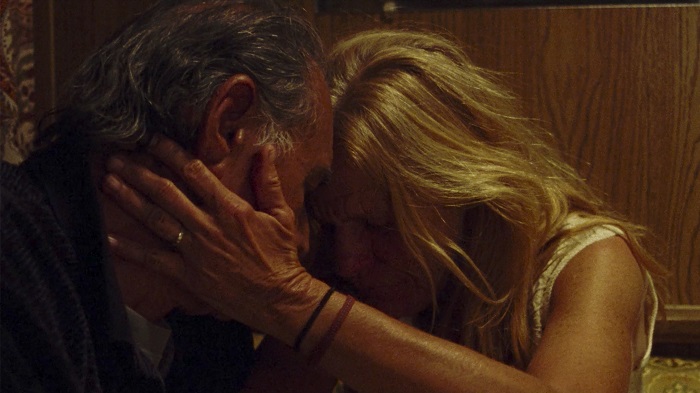
That someone is Lito, an old classmate and crush who Faye hasn’t seen in decades. Much like Faye, Lito has recently lost his spouse, Shirley. It’s not really a spoiler to say that Lito does come and the two wounded souls reconnect. Walker-Silverman’s script allows for all of the awkwardness, uncertainty, and even guilt to bleed through. And the restraint of two performances feels as natural as the painterly surroundings that adorn nearly every frame. Their conversations are simple but true, and it’s often what goes unsaid that resonates the most. And while nothing about their reunion is assured, Faye and Lito long so deeply for companionship that it’s worth a shot.
While the theme of loneliness reverberates throughout the movie, Walker-Silverman also makes it a point to show us the essential nature of human connection. Faye has reoccurring encounters with an assortment of quirky side characters. My favorite is a well-mannered young cowgirl and her four significantly older brothers (the little sister clearly runs the show). They would feel right at home in a Coen brothers comedy. There’s also the camp’s courteous postman and a couple camped out on the other side of the lake. Their appearances may seem inconvenient, but they always pop up when Faye seems at her lowest. And their presence takes her mind off of her sadness.
With “A Love Song” Max Walker-Silverman has given us a delicate, honest, and soulful study of loss, loneliness, and navigating grief. It’s a beautiful and touching exploration, handled with keen instincts, remarkable control, and a clear affection for the story being told. Not only does the film showcase an exciting emerging voice, it also gives starring roles to two exceptional veteran actors. And that’s something all too rare in movies these days.
This morning we got our first look at the lineup for the 2022 Venice Film Festival and it is an embarrassment of riches. Several of the world’s best filmmakers will be represented both in and out of competition. It’s exciting considering Venice has quite the knack for premiering eventual Academy Award winners. Films like “Nomadland”, “Marriage Story”, “Joker”, “Roma”, “The Power of the Dog”, and “Dune” were all highlights at the festival and went on to make a lot of noise at the Oscars.
This year’s batch of big names and big debuts begins with Noah Baumbach’s black comedy, “White Noise” which stars Adam Driver and Greta Gerwig. Two-time Best Director Oscar winner Alejandro González Iñárritu is premiering his new comedy, “Bardo”. Todd Field directs his first film in 16 years with “Tár”. Joanna Hogg follows up her “Souvenir” movies with “The Eternal Daughter”. Christoph Waltz and Willem Dafoe team with director Walter Hill in the Western “Dead for a Dollar”. Also premiering in Florian Zeller’s “The Son”, his much anticipated second film after 2020’s superb “The Father”.
Also making headlines at the festival, Paul Schrader’s “Master Gardener”, Jafar Panahi’s “No Bears”, Olivia Wilde’s “Don’t Worry Darling”, Ti West’s “Pearl”, Luca Guadagnino’s “Bones and All”, Darren Aronofsky’s “The Whale”, Martin McDonagh’s “The Banshees of Inisherin, and Andrew Dominik’s “Blonde” among others.
There will plenty of competition for this year’s Golden Lion when the festival kicks off August 31st. Check below for a full list of all the films from this year’s Venice Film Festival.
Competition
“White Noise” – Noah Baumbach (Opening Night Film)
“Il Signore delle Formiche” – Gianni Amelio “The Whale” – Darren Aronofsky “L’Immensita” – Emanuele Crialese “Saint Omer” – Alice Diop “Blonde”- Andrew Dominik “Tár”- Todd Field “Love Life” – Koji Fukada “Bardo” – Alejandro González Iñárritu “Athena”- Romain Gavras “Bones and All” – Luca Guadagnino “The Eternal Daughter” – Joanna Hogg “Beyond the Wall” – Vahid Jalilvand “The Banshees of Inisherin” – Martin McDonagh “Argentina, 1985” – Santiago Mitre “Chiara” – Susanna Nicchiarelli “Monica” – Andrea Pallaoro “No Bears” – Jafar Panahi “All the Beauty and the Bloodshed” – Laura Poitras “A Couple” – Frederick Wiseman “The Son” – Florian Zeller “Our Ties” – Roschdy Zem “Other People’s Children” – Rebecca Zlotowski
Out of Competition – Fiction
“The Hanging Sun” – Francesco Carrozzini (Closing Film) “When the Waves Are Gone” – Lav Diaz “Living” – Oliver Hermanus “Dead for a Dollar” – Walter Hill “Call of God” – Kim Ki-duk “Dreamin’ Wild” – Bill Pohlad “Master Gardener” – Paul Schrader “Siccita” – Paolo Virzi “Pearl” – Ti West “Don’t Worry Darling” – Olivia Wilde
Out of Competition – Non Fiction
“Freedom on Fire: Ukraine’s Fight for Freedom” – Evgeny Afineevsky “The Matchmaker” – Benedetta Argentieri “Gli Ultima Giorni Dell’Umanita” – Enrico Ghezzi, Alessandro Gagliardo “A Compassionate Spy” – Steve James “Music for Black Pigeons” – Jorgen Leth, Andreas Koefoed “The Kiev Trial” – Sergei Loznitsa “In Viaggio” – Gianfranco Rosi “Bobby White Ghetto President” – Christopher Sharp, Moses Bwayo “Nuclear” – Oliver Stone
Out of Competition (Series)
“The Kingdom Exodus” – Lars von Trier “Copenhagen Cowboy” – Nicolas Winding Refn
Horizons/Orizzonti
“Princess” – Roberto de Paolis “Victim” – Michal Blanko “On the Fringe” – Juan Diego Botto “Trenque Lauquen” – Laura Citarella “Vera” – Tizza Covi, Rainer Frimmel “Innocence” – Guy Davidi “Blanquita” – Fernando Guzzoni “Pour La France (For My Country” – Rachid Hami “A Man” – Kei Ishikawa “Bread and Salt” – Damian Kocur “Luxembourg, Luxembourg” – Antonio Lukich “Ti Mangio IL Cuore” – Pippo Mezzapesa “To the North” – Mihai Mincan “Autobiography” – Makbul Mubarak “La Syndicaliste (The Sitting Duck)” – Jean-Paul Salomé “World War III” – Houman Seyedi “The Happiest Man in the World” – Teona Strugar Mitevska “The Bride” – Sérgio Tréfaut
Horizons/Orizzonti Extra
“Origin of Evil” – Sébastien Marnier “Hanging Gardens” – Ahmed Yassin Al Daradji “Amanda” – Carolina Cavalli “Red Shoes” – Carlos Eichelmann Kaiser “Nezouh” – Soudade Kaadan “Notte Fantasma” – Fulvio Risuleo “Without Her” – Arian Vazirdaftari “Valeria Is Getting Married” – Michal Vinik “Goliath” – Adilkhan Yerzhanov