Sundance Review: “When You Finish Saving the World” (2022)

Sundance is no stranger to highly anticipated directorial debuts. This year it’s Jesse Eisenberg with his new film “When You Finish Saving the World”. The movie is based on Eisenberg’s own award-winning 2020 audio drama of the same name which revolves around a mother and her son separated by the ever widening generational gap between them. Starring the always terrific Julianne Moore and rising star Finn Wolfhard, this was one of the most intriguing films on the Sundance program.

Already backed by A24, “When You Finish Saving the World” has an interesting premise and features the kind of snappy wry humor you would imagine coming from Jesse Eisenburg. At the same time, there’s a toxicity to this small yet well conceived drama that will make it a tough watch for some audiences. Most of our time is spent with two characters who can be endearing but are almost always insufferable.

In fairness, that doesn’t make “When You Finish Saving the World” a bad movie. It gets back to that age-old discussion about the necessity of “likable” characters. I’ve said it before, I’ve never demanded “likable” characters. Doing so would dramatically limit the kinds of stories I allow myself to be told. But Eisemberg’s characters, Evelyn (Moore) and Ziggy (Wolfhard) aren’t one-note and they aren’t easily categorized. They have layers. It’s just that peeling them back isn’t particularly pleasant.

To be so at odds, Evelyn and Ziggy have several things in common. They’re just from two completely opposite worlds. They’re both condescending and narcissistic. Both are stubborn and strong-willed to a fault. And neither can understand the other nor do they put much effort into trying.

Image Courtesy of Sundance

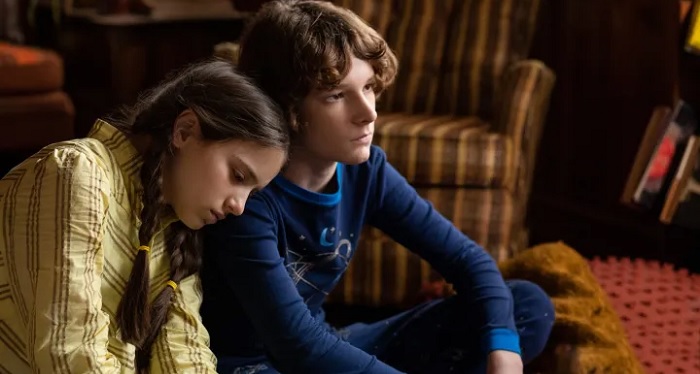
Evelyn has a poorly veiled obsessive personality and she believes her way of doing things is THE right way. She loves classical music and relishes her position as the head of a domestic abuse shelter. To Evelyn, she’s doing the kind of work that “matters”. Ziggy is brash, self-centered and impertinent, often lashing out at his parents in ways that would have left me grounded for a decade. He writes and plays his own songs which he describes as “classic folk rock with alternative influences”. He then livestreams them for his 20,000 followers on a YouTube-like platform called High-Hat.

Eisenberg puts a lot of effort into showing this daughter/son clash of ideals and values. But while they live in their own generational bubbles, there are attempts on both parts the bridge the gap. Ziggy seeks his mom’s help with impressing a left-wing activist classmate named Lila (Alisha Boe). Evelyn invites her son to come do some part-time work at her shelter. Neither attempt goes well.

The movie is helped along by a collection of interesting performances, particularly from its two leads. Moore wonderfully portrays a woman doing everything she can to hide her unhappiness. She puts up a facade of confidence and fulfillment, but it cracks and crumbles as the movie progresses. Wolfhard nicely juggles Ziggy’s many contradictions. He’s cocky and obnoxious at home, but elsewhere he’s awkward and often oblivious. We also get a scene-stealing Jay O. Sanders as the husband and father who often finds himself caught in the middle of Evelyn and Ziggy’s warfare.

There’s a lot to like about “When You Finish Saving the World”. You can tell that Eisenberg has a good sense for creating characters and telling their stories. With splashes of satire mixed with deep human drama, his behind-the-camera debut is both intimate and ambitious. Yet there’s that lingering toxic element that always keeps the two lead characters at arms length. It makes it hard for us to feel either empathy or sympathy. And by the time their repressed charm and compassion finally comes into view, the caustic back-and-forths have taken their toll.

VERDICT – 3 STARS

Sundance Review: “Fresh” (2022)

(CLICK HERE for my review in the Arkansas Democrat-Gazette).

Mimi Cave holds nothing back in her gnarly directorial debut “Fresh”, an upcoming thriller written by Lauryn Kahn and produced by Adam McKay. The film just had its premiere at Sundance and has already been snatched up by Searchlight Pictures who plan on streaming the film via Hulu starting March 4th. So you don’t have long to wait.

“Fresh” isn’t the easiest movie to review. It’s a movie that demands you go into it knowing as little as possible. It’s a movie guaranteed to completely upend any expectations you may have. It’s a movie that ends in a very different place than it begins. And it’s a movie that goes places that words like “dark”, “twisted”, and “grotesque” can’t adequately describe.

This scathing critique of modern dating culture comes packaged with bites of “Promising Young Woman”, “American Psycho”, and “Get Out”. Yet Cave delivers a full course meal with a taste all her own. Her film is brimming with relevant themes, cutting satire, and even some B-movie flavor particularly in the last act where things come dangerously close to unraveling. But Cave holds it all together, ending with a fitting and satisfying knock-out punch.

Image Courtesy of Sundance

The film gets off on the right note with its casting. A fabulous Daisy Edgar-Jones (Hulu’s “Normal People”) plays Noa and to say she hates dating is an understatement. She hates the ritual. She hates the awkwardness. She hates the questions and answers. She hates the projections of perfection. She hates the humiliation and the disappointment. She’s starting to wonder if it’s even worth the effort. “I’ve been alone so long,” she says at one point, “I’m actually pretty good at it.“

Yet deep down she’s still a romantic, and her appetite for companionship is what keeps her browsing a dating app called Puzzle Piece. That’s where she meets and sets up a date with Chad (Brett Dier), a goof with a deep affection for scarves. The two sit down for dinner at a cheap cash-only Chinese restaurant where Chad rambles on about his acid reflux and about how the older generation of women cared more about their appearance (it’s a direct shot at Noa’s baggy jeans and frumpy sweater). It’s no wonder Noa hates dating.

Just as she’s about to hangup the whole dating thing, she meets a sweet good-looking plastic surgeon named Steve (Sebastian Stan) in of all places the supermarket produce section. The hunky Texas transplant has all the ingredients for the perfect guy – humble, undeniably charming, a glowing smile. At first Noa is hesitant, but after such a sweet old-fashioned meet-cute she decides to go for it and the two begin dating.

Not long after, Steve surprises Noa and asks her to go away with him for the weekend. His plan is for them to stay at his place for the night and then get an early start the next morning to a surprise destination. Noa surprises herself and agrees, much to the concern of her brutally honest best friend Mollie (Jojo T. Gibbs) who’s worried things are moving too fast. Steve picks up Noa and drives her to his house, cozily nestled in the woods well outside of the city. And of course there’s no cell phone service. Talk about a recipe for something bad.

All of above plays like its own 38-minute romantic comedy. AND THEN we get the actual title screen. That’s when the meaning of Cave’s grisly parable comes boiling to the surface. I won’t dare spoil the big twist (too many have done that over social media), but Cave cleverly lays out numerous hints, many of which won’t come into focus until after you see the movie. But suffice it to say, “Fresh” takes its audience to some appalling depths, sprinkling in pinches of pitch-black humor with horror that can range from eerily suggestive to shockingly explicit.

Image Courtesy of Sundance

Daisy Edgar-Jones is astonishingly good in a role that pulls her in several different directions. Certain points of the film need her to be witty and charming. Other times illusive and cunning. Some scenes demand vulnerability and terror while others require strength and resilience. Edgar-Jones not only fully commits, but delivers on every layer. But her biggest challenge may be acting next to Sebastian Stan. Together the two have an effortless chemistry. But while Edgar-Jones’ job is more complex, Stan is a propulsive force, quickly shedding his character’s ‘good guy’ facade to reveal a sinister maniacal side. Stan gets to go BIG, even getting an utterly outrageous dance number to Animotion’s 1984 synth-pop song “Obsession”. It’s an incredible scene that people will forever link to his career.

It also helps that the movie looks incredible. Cave develops a rich unsettling visual style that makes for an exhilarating (and at times horrifying) sensory experience. The strategic uses of colors, closeups, and angles; the gruesome imagery shot with a stomach-churning elegance. It makes sense considering the cinematographer is Pawel Pogorzelski whose credits include “Hereditary” and “Midsommar”. But it’s also Jennifer Morden’s exceptional production design which really shines in the final hour.

Hopefully I’ve danced around the details enough to leave you intrigued yet still in the dark. Without question that’s the best way to approach this wickedly unsettling horror thriller. Be warned: “Fresh” is not for the squeamish and it earns every morsel of its R-rating. But if you can endure its disturbing macabre elements, you’ll find a sickly satisfying chiller with more on its mind that you might think. It doesn’t always make sense, and there are moments where it veers a little too close to all-out absurdity. But Cave covers most her bases and delivers a dish that’s as savory as it is vile.

VERDICT – 4 STARS

Sundance Review: “Watcher” (2022)

A young couple moves into a new apartment in Bucharest, Romania just as news of a serial killer sweeps across the city. That’s the surface level setup for director and co-writer Chloe Okuno’s “Watcher”. But underneath its genre exterior is a clever and shrewdly made exploration of fear, isolation, and a woman’s need to be heard and believed. Those are the things Okuno is most interested in bringing to light.

This psychological slow-burn stars Maika Monroe as Julia, a former actress who leaves New York City and follows her husband Francis (Karl Glusman) to Bucharest following his recent job promotion. While she puts on a good show, you can’t help but sense Julia’s anxiety as she tries to adjust to her new surroundings. It’s a piece of cake for Francis who knows the language and plugs right in at work. But it’s harder for Julia, who doesn’t know anyone in Bucharest and doesn’t speak Romanian.

While Francis works long hours at his new job, Julia spends most of her time alone. She tries getting out and exploring the city. But without fail, the language barrier always comes into play. She can’t talk with her loud and abrasive landlady. She can’t understand the television reports of a suspected serial killer on the loose. Even standing in a group with Francis and his Romanian-speaking colleagues leaves her feeling like an outsider.

Among Okuno’s many good choices was the decision not to use subtitles. Romanian is spoken a lot in the film, and every word of it is subtitle-free. It’s a smart move that goes hand-in-hand with Okuno’s desire to put us in Julia’s headspace; to enable us to feel what she feels. For Okuno, the film’s visual language is essential to representing Julia’s state of mind. There are some clever tricks with the lensing and framing that create vast, seemingly empty spaces that emphasize Julia’s growing feelings of isolation. There are also interesting uses of color to convey mood and an increasing sense of dread.

The more time Julia spends alone, the more she withdraws. Fear and paranoia set in after she begins noticing a man from the apartment building across the street watching her from his fifth floor window. All she can see is a silhouette, but she’s soon convinced her watcher is the same man as the one who has been creepily following her around town (played by the always captivating Burn Gorman). Her fears are exacerbated after a woman is found murdered in their neighborhood – a death that is later attributed to the serial killer known as “The Spider”. A shaken Julia shares her suspicions with Francis who quickly brushes it off as “stress”.

Another of Okuno and her co-writer Zack Ford’s good choices was the decision not to paint Francis as the proverbial ‘bad guy’. In fact he’s quite the opposite. He genuinely loves and cares for Julia. At the same time, you want to hurl your shoe at the screen each time he attempts to explain away her unease. And he doesn’t even know he’s doing it. You could say he’s oblivious to his own condescension.

But Julia wants answers and before long she becomes the watcher, determined to connect the man stalking her to the shadowy figure in the window. This is where inspirations like Hitchcock, Polanski, and Lynch really come into focus. Yet even as the movie begins playing more with genre in the second half, it keeps us firmly planted in Julia’s head. It’s a tricky balance which works in large part thanks to Monroe who offers the right mix of vulnerability and fortitude.

“Watcher” is an eye-opening and artful directorial debut for Chloe Okuno who uses her deceptively simple premise to challenge those quick to doubt and dismiss female victims. Shot on location in Bucharest, the film uses the city’s beauty as both inviting and terrifying. DP Benjamin Kirk Nielsen, production designer Nora Dumitrescu, and composer Nathan Halpern all work in unison to ensure that we feel the same loneliness and dread as Julia. Ultimately that’s the key. Okuno wants her audience to enjoy the thriller genre dressing. But it’s the moody reflective psychodrama she wants us to sink our teeth into.

VERDICT – 4 STARS

Sundance Review: “A Love Song” (2022)

I’ve always had a deep admiration for Wes Studi and what he brings to his movies. Whether it was his role as the brutal yet complex Magua in Michael Mann’s “The Last of the Mohicans”, his often underappreciated portrayal of Geronimo in Walter Hill’s “Geronimo: An American Legend”, or playing a police detective alongside Al Pacino and Robert De Niro in “Heat”. There’s an unmistakable sincerity and gravitas Studi brings to every film he’s a part of.

So what better way to start my 2022 Sundance Film Festival than by screening a new drama that sees the 74-year-old Studi given a nice meaty role. The film is “A Love Song”, written and directed by Max Walker-Silverman. As the title suggests, this isn’t the kind of movie Studi is most known for. But for fans of his work, it’ll come as no surprise to hear that he, much like the film itself, is a joy to watch.

But the real star of “A Love Song” is Dale Dickey, an outstanding character actress who may be best remembered for her scene-stealing work in 2010’s “Winter’s Bone”. This is a rare leading role for Dickey whose name you may not remember, but whose face is impossible to forget. It’s a remarkable face chiseled out of real life and with bone-deep honesty found in every look and every expression. She’s a perfect choice for Walker-Silverman’s film which sees him working on the same lyrical meditative wavelength as Kelly Reichardt and pre-“Eternals” Chloé Zhao. But Walker-Silverman brings enough of himself to “A Long Song” to give the film its own special identity.

Image Courtesy of Sundance

In “A Love Song”, Dickey brings her signature quiet intensity but this time to a much different character. Here she plays a widow named Faye who hitches her small camper trailer to her Chevy S-10 and drives it to a remote Colorado campsite. She sets up next to a small lake with the Rocky Mountains sitting in the distance like a watercolor painting still wet on the canvas. This is where she’ll stay for the rest of the film’s lean 80-minute running time.

At first, it may be tempting to get caught up in Faye’s similarities to Frances McDormand’s Fern from last year’s Best Picture winner “Nomadland” or to Robin Wright’s Edee from Sundance 2021’s “Land”. But while all three woman unquestionably have things in common, Faye has several distinctions that separates her from the other two. Those distinctions also set this movie on a different course which I was delighted to see.

We don’t learn a lot about Faye or where she came from, but that actually serves the minimalist storytelling perfectly. We do find out she once flew planes for the forestry service. She’s also one heck of a mechanic. And she loves listening to music on her Longines Symphonette World Traveler AM/FM radio. “It always plays the perfect song,” she says in a tender scene later in the film, “even if in the moment you ain’t sure why.” Faye birdwatches (poorly) during the day. Then it’s Busch beer and crawfish for dinner as she watches the sun set over the mountains. After dark, she searches the starry sky for constellations. And that’s her routine.

As you watch Faye, it’s hard to miss her melancholy gaze; the sense of loneliness; the shallowly buried heartache. The source of her sadness is the death of her husband Tommy. He’s been gone for seven years, yet you can tell she’s still carrying the weight of grief. But unlike Fern, who finds contentment in unplugging and living on the road or Edee, who disconnects from society altogether, Faye is at the lake for a specific reason. She’s waiting for someone she hopes will come.

Image Courtesy of Sundance

That someone is Lito, an old classmate and crush who Faye hasn’t seen in decades. Much like Faye, Lito has recently lost his spouse, Shirley. It’s not really a spoiler to say that Lito does come and the two wounded souls reconnect. Walker-Silverman’s script allows for all of the awkwardness, uncertainty, and even guilt to bleed through. And the restraint of two performances feels as natural as the painterly surroundings that adorn nearly every frame. Their conversations are simple but true, and it’s often what goes unsaid that resonates the most. And while nothing about their reunion is assured, Faye and Lito long so deeply for companionship that it’s worth a shot.

While the theme of loneliness reverberates throughout the movie, Walker-Silverman also makes it a point to show us the essential nature of human connection. Faye has reoccurring encounters with an assortment of quirky side characters. My favorite is a well-mannered young cowgirl and her four significantly older brothers (the little sister clearly runs the show). They would feel right at home in a Coen brothers comedy. There’s also the camp’s courteous postman and a couple camped out on the other side of the lake. Their appearances may seem inconvenient, but they always pop up when Faye seems at her lowest. And their presence takes her mind off of her sadness.

With “A Love Song” Max Walker-Silverman has given us a delicate, honest, and soulful study of loss, loneliness, and navigating grief. It’s a beautiful and touching exploration, handled with keen instincts, remarkable control, and a clear affection for the story being told. Not only does the film showcase an exciting emerging voice, it also gives starring roles to two exceptional veteran actors. And that’s something all too rare in movies these days.

VERDICT – 4.5 STARS

Sundance Film Festival 2022

Today kicks off the 2022 Sundance Film Festival, the largest independent film festival in the United States. The event was founded in 1978 by Sterling Van Wagenen under the name the Utah/US Film Festival. It was originally a festival to showcase and celebrate American cinema. But over the next several years, Sundance grew and evolved into the premiere film festival in the country, expanding its vision to include movies from all over the globe.

Over the next several days I’ll be covering some of my most anticipated films from this year’s program. I have a pretty hefty slate of movies and (barring life’s interruptions) hope to have several Sundance reviews and impressions on the site. I hope you’ll follow along.

Here are JUST SOME of the films I’ll be seeing over the next several days. Let me know what you think.

892” (Director: Abi Damaris Corbin, Starring: Jon Boyega, Michael K. Williams, Nicole Beharie, Connie Britton)

SUNDANCE SYNOPSIS: “Living in a cheap motel in Atlanta and separated from his wife and child, former U.S. Marine veteran Brian Easley is desperate. Driven to the brink by forces beyond his control, the soft-spoken, kind man decides to rob a bank and hold hostages with a bomb. As police, media, and family members descend on the bank and Brian, it becomes clear he’s not after money — he wants to tell his story and have what is rightfully his, even if it costs him his life.”

A Love Song” (Director: Max Walker-Silverman, Starring: Dale Dickey, Wes Studi)

SUNDANCE SYNOPSIS: “After unhitching her camper at a lakeside in the mountains, Faye finds her rhythm cooking meals, retrieving crawfish from a trap, and scanning her old box radio for a station. She looks expectantly at the approach of a car or the mailman, explaining to neighboring campers that she’s waiting for a childhood sweetheart she hasn’t seen in decades. When he does arrive, Lito and Faye, both widowed, spend an evening reminiscing about their lives, losses, and loneliness.”

After Yang” (Director: Kogonada, Starring: Colin Ferrell, Jodie Turner-Smith, Justin H. Min, Haley Lu Richardson, Malea Emma Tjandrawidjaja)

SUNDANCE SYNOPSIS: “When Yang — a lifelike, artificially intelligent android that Jake and Kyra buy as a companion for their adopted daughter — abruptly stops functioning, Jake just wants him repaired quickly and cheaply. But having purchased Yang “certified refurbished” from a now-defunct store, he’s led first to a conspiracy theorist technician and then a technology museum curator, who discovers that Yang was actually recording memories. Jake’s quest eventually becomes one of existential introspection and contemplating his own life, as it passes him by.”

Fresh” (Director: Mimi Cave, Starring: Sebastian Stan, Daisy Edgar-Jones, Jonica T. Gibbs, Charlotte Le Bon, Dayo Okeniyi)

SUNDANCE SYNOPSIS: “Frustrated by scrolling dating apps only to end up on lame, tedious dates, Noa takes a chance by giving her number to the awkwardly charming Steve after a produce-section meet-cute at the grocery store. During a subsequent date at a local bar, sassy banter gives way to a chemistry-laden hookup, and a smitten Noa dares to hope that she might have actually found a real connection with the dashing cosmetic surgeon. She accepts Steve’s invitation to an impromptu weekend getaway, only to find that her new paramour has been hiding some unusual appetites.”

Honk for Jesus. Save Your Soul” (Director: Adamma Ebo, Starring: Regina Hall, Sterling K. Brown, Nicole Beharie, Austin Crute)

SUNDANCE SYNOPSIS: “As the proud first lady of a Southern Baptist megachurch, Trinitie Childs carries immense responsibility on her shoulders. Her church, Wander To Greater Paths, once served a congregation in the tens of thousands, but after a scandal involving her husband, Pastor Lee-Curtis Childs, forced the church to close temporarily, Trinitie is struggling to manage the aftermath. Now Trinitie and Lee-Curtis must rebuild their congregation and reconcile their faith by all means necessary to make the biggest comeback that commodified religion has ever seen.”

Living” (Director: Oliver Hermanus, Starring: Bill Nighy, Tom Burke, Alex Sharp, Aimee Lou Wood)

SUNDANCE SYNOPSIS: “A veteran civil servant and bureaucratic cog in the rebuilding of Britain post-WWII, Williams expertly pushes paperwork around a government office only to reckon with his existence when he’s diagnosed with a fatal illness. A widower, he conceals the condition from his grown son, spends an evening of debauchery with a bohemian writer in Brighton, and uncharacteristically avoids his office. But after a vivacious former co-worker, Margaret, inspires him to find meaning in his remaining days, Williams attempts to salvage a modest building project from bureaucratic purgatory.”

Resurrection” (Director: Andrew Semans, Starring: Rebecca Hall, Tim Roth, Angela Wong Carbone, Josh Drennen, Rosemary Howard)

SUNDANCE SYNOPSIS: “Margaret leads a successful and orderly life, perfectly balancing the demands of her busy career and single parenthood to her fiercely independent daughter Abbie. But that careful balance is upended when she glimpses a man she instantly recognizes, an unwelcome shadow from her past. A short time later, she encounters him again. Before long, Margaret starts seeing David everywhere — and their meetings appear to be far from an unlucky coincidence. Battling her rising fear, Margaret must confront the monster she’s evaded for two decades who has come to conclude their unfinished business.”

When You Finish Saving the World” (Director: Jesse Eisenberg, Starring: Julianne Moore, Finn Wolfhard, Alisha Boe, Jay O. Sanders)

SUNDANCE SYNOPSIS: “From his bedroom home studio, high school student Ziggy performs original folk-rock songs for an adoring online fan base. This concept mystifies his formal and uptight mother, Evelyn, who runs a shelter for survivors of domestic abuse. While Ziggy is busy trying to impress his socially engaged classmate Lila by making his music less bubblegum and more political, Evelyn meets Angie and her teen son, Kyle, when they seek refuge at her facility. She observes a bond between the two that she’s missing with her own son, and decides to take Kyle under her wing against her better instincts.”

You Won’t Be Alone” (Director: Goran Stolevski, Starring: Noomi Rapace, Alice Englert, Carloto Cotta, and Sara Klimoska)

SUNDANCE SYNOPSIS: “In an isolated mountain village in 19th-century Macedonia, a young girl is taken from her mother and transformed into a witch by an ancient, shape-shifting spirit. Left to wander feral, the young witch beholds the natural world with curiosity and wonder. After inadvertently killing a villager and assuming her body, she continues to inhabit different people, living among the villagers for years, observing and mimicking their behavior until the ancient spirit returns, bringing them full circle.”

I hope you’ll follow along and share your thoughts along the way.

REVIEW: “Delicious” (2021)

The French period drama “Delicious” is (pardon the corniness) a mouthwatering mix of character, country, and cuisine. Written and directed by Éric Besnard and featuring some of the most exquisite cinematography you’ll see, “Delicious” pulls from real history to help tell its largely fictional but utterly compelling story of France’s very first restaurant. At the time, Inns and lodges provided small meals for weary travelers, but the idea of a walk-in restaurant as we know it today didn’t yet exist.

The film is set in 1789 with France on the eve of a Revolution. It’s a time of growing unrest as commoners scrounge for food across the famine stricken countryside. Meanwhile France’s nobility fill their bellies with lavish, meticulously prepared gourmet meals, even using their gastronomical overindulgence as a symbol of power and to flaunt their status.

The film opens with one such extravagant meal being prepared. The camera and the sound design vividly captures the energy and bustle of chef Pierre Manceron’s kitchen. Pierre (a terrific Grégory Gadebois) is the personal chef to the haughty Duke of Chamfort (a wonderfully pompous Benjamin Laverhne). He and his team of cooks rush to put the finishing touches on a lavish dinner he’s preparing for the Duke and his blue-blooded guests.

After the meal Pierre is summoned to the dining area for “comments”. What follows is a scene that highlights both the absurdity as well as the hypocrisy of the aristocracy. At first Pierre is showered with compliments from the table. But then one particularly grumpy friar takes a shot at his lovingly manicured appetizer. “That is your only false note,” he grumbles. It immediately sets off a barrage of insults and ridicule from the very people who were just singing his praises. An embarrassed Duke demands his humiliated chef apologizes. When Pierre refuses, he is promptly fired.

With his Rousseau-quoting son Benjamin (Lorenzo Lefèbvre) in tow, a dejected Pierre retreats to a ramshackle old inn once ran by his late father. There he’s content with letting his dream die. “I’ve lost the taste for cooking,” laments the defeated master chef. Instead he fixes up and reopens the inn, providing a rest place for travelers to stop, stretch their legs, and feed their horses. And for those hungry, there’s no Duck à l’Orange, Braised Pork, or Boeuf Bourguignon. Nope, it’s lukewarm broth over a piece of bread. Bon appétit!

Soon after, a mysterious woman named Louise (Isabelle Carré) arrives on a passing stagecoach asking to be Pierre’s apprentice. “Sorry, I don’t cook anymore,” he grumbles. When she refuses to leave he tries discouraging her with his chauvinistic barbs. “Cuisine is a man’s affair,” he chides. “Women don’t understand it.” Yet Louise stays and over time not only earns Pierre’s trust, but inspires him to look beyond his own self-pity and vainglorious goals.

“Delicious” avoids any dewy-eyed and mawkish trappings by throwing us a few curveballs in its final act. They don’t exactly feel in tune with the rest of the story, but the twists (mild as they are) allow the film more time to dig into the widening gap between the haves and the have-nots. Food proves to be a good tool to do it. Where the Duke and his ilk arrogantly believe that “common people” aren’t capable of properly appreciating cuisine, Pierre and Louise set out to create a place where everyone, regardless of status, can enjoy the happiness and comfort of good dining.

Through it all DP Jean-Marie Dreujou’s breathtaking images go well beyond the sumptuous dishes. The rolling hills, the grassy meadows, the autumn colors – they are all shot with a painterly beauty and would make for a stunning coffee table book. And there are several visual tricks that really impress. Such as one scene where the camera sits outside of Pierre’s inn and we watch a seasonal transition sped up for affect. That sequence is a pure delight, as are several other memorable visual moments.

History says that the first restaurant was actually Le Grande Taverne des Londres which opened in Paris several years before “Delicious” takes place. While the movie creates its own fictionalized origin story, it feels so much a part of that era that you would never question its authenticity. There are some other touches that really enhance the story. For example, there’s a genuine warmth in watching Manceron and Louise inevitably grow closer. And with the French Revolution knocking on the door, having young Benjamin as the voice of the people reminds us that change is on the way. It will come at a sobering cost, but change is coming nonetheless. “Delicious” is now available in select theaters and on VOD.

VERDICT – 4.5 STARS