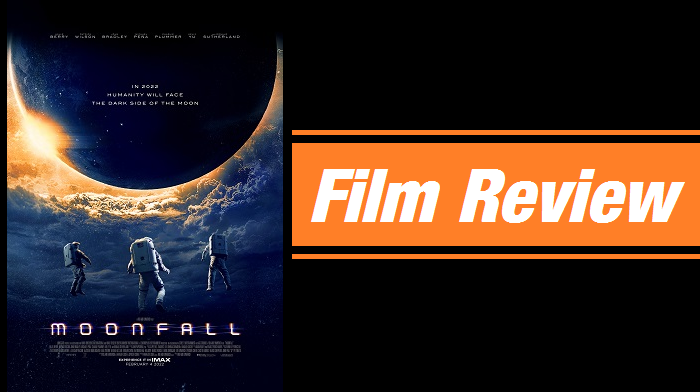
REVIEW: “Moonfall” (2022)

(CLICK HERE to read my full review in the Arkansas Democrat-Gazette)

Roland Emmerich and the phrase “global cinematic destruction” go together like peanut butter and jelly. A quick gander at his Wikipedia page will give you a good idea of the 66-year-old German-born filmmaker’s penchant for blowing up our world. He’s done it with aliens (twice), a giant lizard, extreme weather, and whatever the heck was happening in his 2009 flick “2012”. In fairness, Emmerich has done more than just disaster movies, but they are what clearly whets his appetite.

New to theaters this weekend is “Moonfall”, Emmerich’s latest exercise in computer-generated decimation of our planet. As the film’s title makes glaringly clear, this time it isn’t extraterrestrial armies or the next Ice Age that’s threatening us. Nope, this time it’s our moon which has been knocked out of its orbit and is barreling towards earth. Absurd you say? Well rest assured, “Moonfall” is every bit as ridiculous as it sounds, and that’s part of what makes it such a surprisingly fun ride.

Sometimes movies hit you at just the right time. Such is the case with “Moonfall”. After over two months of cramming awards season features followed by a jam-packed week covering the Sundance Film Festival, I was ready for a light and breezy popcorn flick. “Moonfall” certainly fits the bill. It’s the kind of movie that you go into knowing exactly what you’re going to get. If you’re hoping for more, you’ll probably be disappointed.
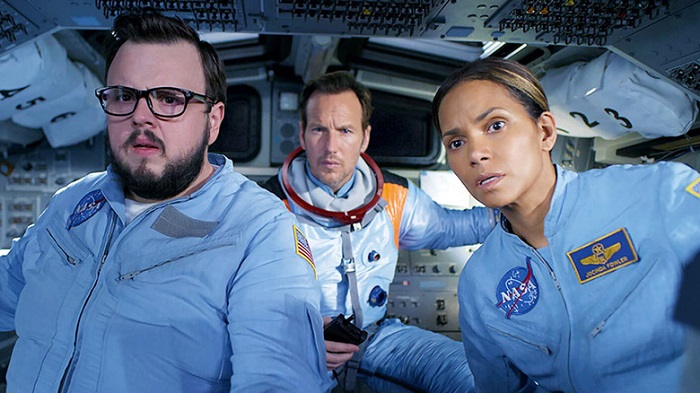
Image Courtesy of Lionsgate

In 2011, astronauts and close friends Jocinda “Jo” Fowler (Halle Berry) and Brian Harper (Patrick Wilson) are on a routine satellite repair mission above Earth. While working on a relay and debating the lyrics of Toto’s 1982 pop hit “Africa”, they are suddenly walloped by a mysterious swarm-like force that destroys the satellite and kills the third member of their team. The mysterious entity (later defined as a “technological space anomaly”) heads to our moon and begins boring a hole in its surface.

Jump ahead ten years where Jo and Brian are no longer on speaking terms. A decade earlier he tried to tell the world that the incident was the result of an attack by something never seen before. She stuck with the “officially statement” from NASA, that it was the result of a solar flare. Jo was able to keep her job with the space program. Brian lost everything and now spends his days working on his old sports car and dodging eviction notices.

But then self-described megastructuralist and astronaut wannabe K. C. Houseman (John Bradley) makes an alarming discovery – the moon is out of its orbit and heading towards Earth. NASA won’t return his calls and Brian brushes him off. So he takes it to the media. In the meantime, Jo and her team make the same discovery. They send up a lunar recon mission which ends disastrously after it’s confronted by the same swarm-like entity Brian warned them about.

So for those keeping tabs, you have the moon hurtling towards Earth, an unidentified but clearly aggressive “technological space anomaly”, and roughly three weeks for our leaders to come up with a plan to save humanity. And as you can probably guess, it’ll all come down to our three unlikely heroes: a disgraced astronaut, the former friend/colleague who sold him out, and a conspiracy theorist who a week earlier was working the window at a burger joint. Normally that wouldn’t leave much cause for hope. But in the movies…
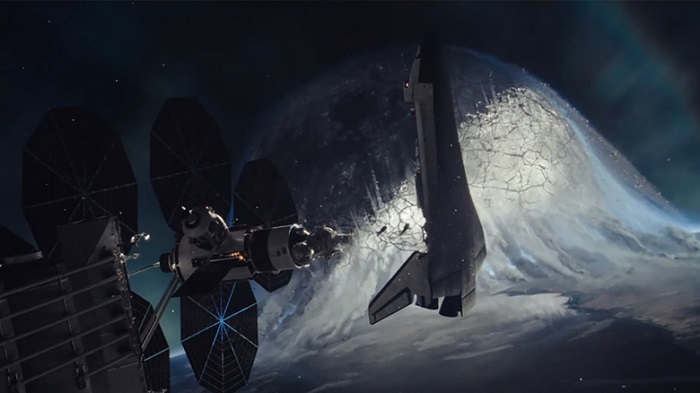
Image Courtesy of Lionsgate

Eventually the film boils down to the events unfolding on two fronts. You have what’s happening in space as Brian, Jo, and K.C. launch into orbit to meet the moon head-on. Then you have what’s happening on Earth where Brian’s estranged son, Sonny (Charlie Plummer) and several other underdeveloped side characters try to survive amid the tidal waves, crashing moon debris, and the occasional shotgun-toting rednecks. Both allow Emmerich ample opportunities to shower his audience with eye-popping spectacle.

“Moonfall” almost plays like two genre films wrapped in one. The cornier and less interesting stuff on Earth is your standard-issue disaster material – dazzling large-scale digital destruction and characters in constant peril. The much better space stuff is full-blown science fiction. It’s surprisingly dense and well conceived and is inspired by everything from the Dyson sphere theory to Larry Niven’s “Ringworld”. Better yet, it goes further down the rabbit hole than I was ever expecting (and that’s a compliment).

Of course all of it is undeniably preposterous and there is no shortage of unintentional laughs (My favorite may be our dimwitted government whose plan is to nuke the moon. You heard me right – they literally think nuking our moon is a viable option. Fifth grade science anyone?). But if I’m honest, that kind of nuttiness is half the fun with a movie like this. It may prove too much for some, but for me “Moonfall” hit at just the right time. And I would be lying if I didn’t admit to being entertained. “Moonfall” opens today exclusively in theaters.

VERDICT – 3.5 STARS

Sundance Review: “Emergency” (2022)

One of the last (and as it turns out most well received) movies I saw at this year’s Sundance Film Festival was Carey Williams’ “Emergency”, a feature film adaptation of a short film that Williams debuted at Sundance back in 2018. The movie introduces itself as a college buddy comedy, but it slowly takes a different form over the course of its lively 105 minutes.

Written by KD Dávila, the story revolves around two best friends with opposing world views who have their friendship challenged over the course of one long and wild night. While comedy plays a significant role, the movie soon reveals its deeper thematic interests, namely the bond of true friendship and what it means to be a young black man in America. The only problem is once you have a good sense of its message, it’s pretty easy to see where things are heading.

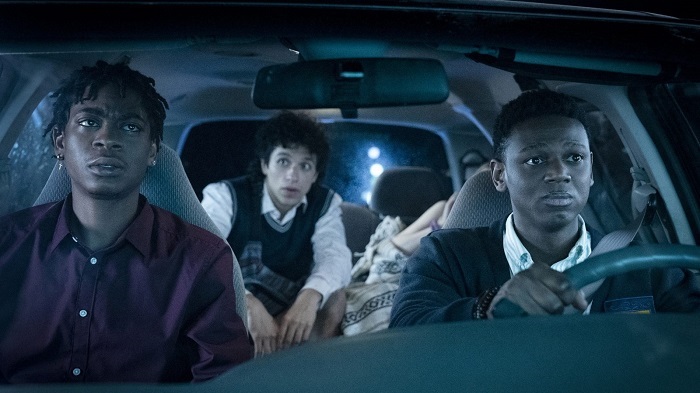
Kunle (Donald Elise Watkins) and Sean (RJ Cyler) are two best buddies and roommates at Buchanan University. While the two have a lot in common, they come from very different places. The buttoned-up and bookish Kunle is an aspiring doctor who comes from a wealthy suburban family. The more cynical and hardened Sean (RJ Cyler) comes from a much tougher background. Kunle has already been accepted into Princeton, but he needs to ace his thesis to seal the deal. Sean spends more time vaping and scouting out the local party scene than nailing down his goals for the future.

The two pals have a big plans for the evening – hitting seven legendary campus parties in one night. When they go to their apartment to prep for the “pre-game”, they discover an unconscious white girl (Maddie Nichols) laying in their living room floor. Kunle’s instincts are to immediately call 911. The more pessimistic Sean’s first thought is that once the police see two two young black man and an unconscious white girl, they’ll be arrested or maybe even gunned down.

Attempting to be the voice of reason, a nervous Kunle demands they at least take the girl to the hospital. Stoned and reeking of weed, Sean suggests dumping her on a nearby sorority house’s lawn. These are the kinds of wildly opposing ideas the two throw out for most of the film. With the help of their skittish Latino roommate Carlos (Sebastian Chacon), the trio load the girl into their car. But what follows is a madcap series of good intentions but horrible decisions.

Image Courtesy of Amazon Studios

To add another wrinkle, at a nearby party a brash and egotistical co-ed named Maddie (Sabrina Carpenter) realizes her sister Emma is missing. You guessed it – Emma is the girl passed out on Kunle and Sean’s living room floor. So she, her incredibly tolerant best friend Alice (Madison Thompson), and Alice’s hunky crush (Diego Abraham) set out to find Emma.

It all moves towards a comically combustible yet poignant finish – one that’s (unfortunately) predictable yet still manages to be powerful. One reason the finish packs such a punch is because of the performances from the terrific young cast. Watkins and Cyler are especially good, possessing a snappy chemistry that enables us to buy into every facet of Kunle and Sean’s friendship (despite getting painfully little in terms of their backstory). And when the ending does come, the two actors give us something that’s both emotionally rich and palpable.

Another of the film’s strengths is found in Williams’ willingness to scrutinize both young men’s perspectives. From Sean’s cynicism to Kumle’s naïveté, both are earnest and very much shaped by their own life experiences. But as the story plays out, we see the strong points and flaws in both worldviews. As a result, it presents a more honest examination, one that takes on its serious real-world subject matter with an open-eyed sincerity.

“Emergency” has a lot going for it and it’ll be interesting to see how big of an audience it attracts (it has already been picked up by Amazon Studios). It doesn’t fully avoid the occasional on-the-nose preachiness and unfortunately it does tip its hand well before we get to the film’s big finish. But Williams mostly stays on course and skillfully maintains his balance between buddy comedy silliness and insightful commentary. He also puts together some scenes that will stick with you, none better than a late conversation between Kunle and Sean that is a masterclass in dramatic writing. It’s also a showcase for these two fine young actors who we should a lot more of in the years to come.

VERDICT – 3.5 STARS

Sundance Review: “You Won’t Be Alone” (2022)

Yet another debut feature that premiered at this year’s Sundance Film Festival was “You Won’t Be Alone” from Goran Stolevski. The Australian-Macedonian writer-director has over 25 short films to his credit, and here he brings a unique and fresh twist to the familiar witch story. His folk horror concept is intriguing. His visual style is stunning. And at different times his film can be both chilling and beautiful. If only it played as well as it sounds.

Snatched up by Focus Features prior to the festival, “You Won’t Be Alone” is already slated for an April 1st release. It will be interesting to see the reactions considering how shockingly gruesome it can be. Yet it can also be quiet and soothing, with the meditative rhythm and visual sensibility of a Malick film. It fully embraces the ghoulish and grotesque, while also taking an often tender and poignant look at what it means to be human. Unfortunately, certain indulgences keep it from seamlessly combining those two extremes.

Set in a remote mountain village in 19th century Macedonia, the story begins on an disturbing note. A mother finds a hideously scarred crone (Anamaria Marinca) hovering over her newborn baby’s crib. Legend says she’s a shape-shifting witch known as the Wolf-Eateress. Others in the village refer to her as Old Maid Maria. The mother breaks down and begs the ghastly woman not to take her child. The two come to an agreement – the mother can raise her daughter until she turns 16. At that point the crone will return and take the girl for her own. But before leaving the old woman leaves her mark on the child (not an easy watch).

The mother takes her daughter to a sacred cave in the mountains. Her motives are good – hide and protect her daughter (named Nevena) from the witch. But by raising her in such stark isolation, Nevena has no understanding of the real world when Maria inevitably finds her. The old maid takes her prize to the forest and endows Nevena (now played by Sarah Klimoska) with her shape-shifting ability. But Nevena’s childlike and open-hearted curiosity infuriates Maria who casts out the young witch. Alone, Nevena wanders into the nearby village where the movie’s bigger interests unfold.

Image Courtesy of Focus Features

To say much more would be a disservice, but broadly speaking, Nevena begins (rather gruesomely) inhabiting the bodies of villagers. And with each new person she inhabits, she gets a new perspective on the world. It’s a captivating conceit – living and experiencing humanity through the bodies (and in turn the experiences) of others. It gives Nevena the opportunity to see both the ugliness and the beauty of the human condition. It also allows Stolevski to explore a number of social themes that are still relevant today.

In addition to Klimoska (Macedonia), Stolevski puts together a well-tuned international group to play the witch’s different incarnations. Noomi Rapace (Sweden) plays an abused wife who vividly portraying the travails of women, Carloto Cotta (Portugal) is a handsome village beefcake who embodies patriarchal privilege, and Alice Englert (Australia) as a sweet innocent little girl who allows Nevena a taste of the childhood she never had. Each offer moments of insight and challenge many modern-day norms despite being set in the 1800s.

While the film impresses with its surprising amount of emotional depth, some of the more practical things aren’t as convincing. Take Nevena’s strangely eloquent internal monologue which doesn’t exactly ring true considering all her time spent disconnected and in isolation. She was barely a step above a feral child when Maria found her and took her away. Yet the mellifluous and poetic flow of thoughts in Nevena’s mind at times sound like the words of a seasoned lyricist rather than a wild and untamed girl. Perhaps it’s meant to simply convey feeling, but it doesn’t come across that way.

There’s also Maria’s appearance which too often looks like a rubber suit and thick makeup. It’s unquestionably a reflection of the film’s budget, but it also keeps Maria from being as visually forbidding as she could be. But that’s okay because it’s her backstory that’s most haunting. As is often the case in stories like this, the history behind Maria’s scars are both horrifying and tragic, and Stolevski brings it to light with unsettling clarity.

With “You Won’t Be Alone” Goran Stolevski has created something that defies categorization. He brings with him an undeniably artful vision and a truly thoughtful mind. Along with it comes a few needless excesses, such as the sometimes weird and almost obsessive way he uses sex and gore. But beyond that is movie of impeccable craft. An arthouse drama with a folk horror veneer that doesn’t reach every mark it’s going for. But at least it’s reaching for something.

VERDICT – 3 STARS

First Glance: “After Yang” (2022)

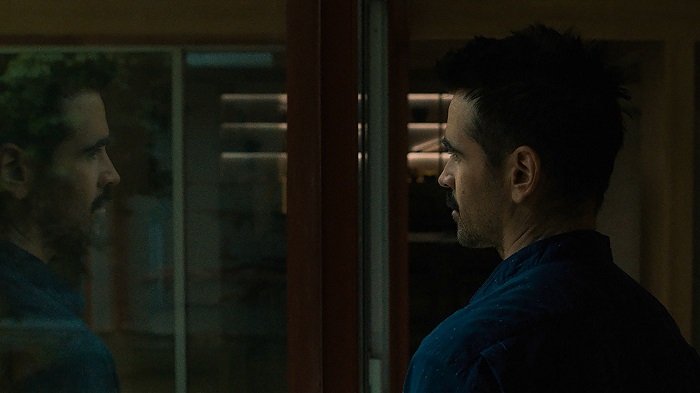
If you have followed my Sundance 2022 coverage you probably already know that I was a huge fan of “After Yang”, the new film from Kogonada. In many ways it’s the perfect followup to the filmmaker’s 2017 feature film debut, “Columbus”. Both films are thoughtful and moving meditations and both feature Kogonada’s easy narrative rhythm and elegant poetic visual style.

“After Yang” was high on my ‘most anticipated’ list and it delivered exactly what I hoped for. This endearing yet melancholy story of a family working through the sudden loss of their android turns out to be a deeper reflection on humanity, life, family, and finding your place in the world. I won’t rehash my review, but I loved the film and now A24 has released its first trailer. It has me even more excited to see it again.

“After Yang” is believed to be heading towards a March 4th release although the trailer simply says “coming soon”. Regardless, check out the trailer below and let me know if you’ll be seeing it or taking a pass.

Sundance Review: “Alice” (2022)

Genres galore make up the craziness that is Krystin Ver Linden’s “Alice”, a film that teases big things but is ultimately undone by both its ambition and execution. It’s a movie centered around an idea that has all the potential to be a wild and stylish Tarantino-esque revenge thriller. Instead, “Alice” never gets its footing and is compromised by woefully underdeveloped characters, a scattershot script, and narrative shortcuts galore.

With a twist that would make M. Night Shyamalan blush, the title character Alice (Keke Palmer) escapes from a late 19th century Georgia plantation only to discover the year is actually 1973. If the premise sounds familiar that’s because 2020’s “Antebellum”, a movie that wasn’t nearly as horrible as the pounding it took would indicate, was built around a similar twist. With “Alice” it’s mostly about the revenge…kinda.

Without question, Palmer is the film’s biggest strength and she does her best with the haphazard screenplay (written by Ver Linden). But neither the early scenes on the plantation or the 1973 scenes that follow allow her room to do anything interesting with her character. And as the movie spirals from perplexing to laughably bad, Palmer is left stranded with little to do but stick with it till the end.

Image Courtesy of Sundance

Minus some missing details (possibly due to budget constraints), the early scenes are pretty convincing. In fact, another strength is in the production design and how well Ver Linden captures two vastly different periods. The plantation setting is believable in large part thanks to the location, costumes, and the immersive way Ver Linden shoots it. The issue (as it is throughout the film) is the storytelling.

While the antebellum plantation scenes look great and the performances are solid, they check more boxes than tell a good story. You have the slaves working the crops while the berating white foreman looks on. You have the by-the-book wicked plantation owner Paul Bennet (Jonny Lee Miller). You have the seemingly mandatory one scene of a slave being tortured. And you have the various attempts to escape. In between it all is Alice who we first meet as she secretly weds her love Joseph (Gaius Charles), a smart, strong and passionate fellow slave.

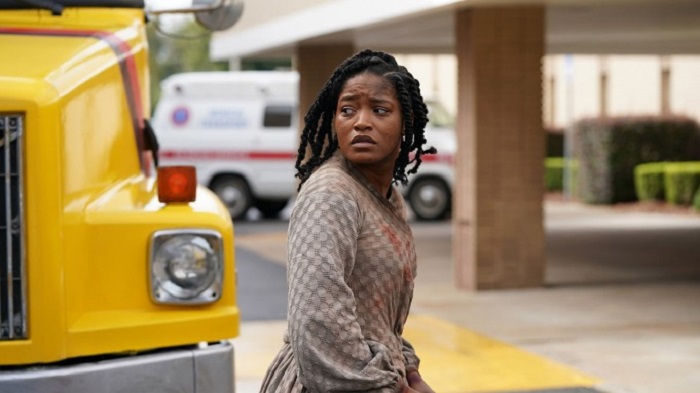
After learning he’s about to be shipped away to another plantation, Joseph attempts an escape, vowing to come back for Alice. But when he’s captured and beaten to a pulp, Alice can’t take it. She tries an escape of her own, running to the point of exhaustion. With little strength left, she wanders out of the woods onto a paved highway where she’s nearly hit my a big rig. Yep, it’s 1973. After fainting, the truck’s driver, Frank (Common, working at the exact same temperature and tenor as he does in every film) takes her to an area hospital, convinced she has amnesia. Oh how little he knows.

Image Courtesy of Sundance

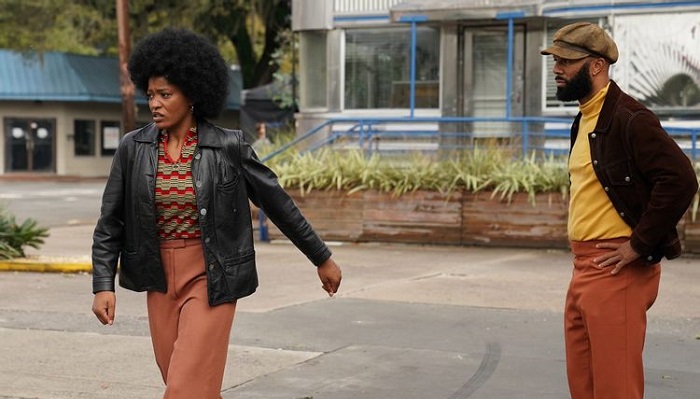
After some truly silly and narratively convenient guesswork, Frank decides to take her to his house (with little thought and practically no buildup) to help jog her memory. He starts by sharing life’s finer pleasures such as “Sanford and Son”, soul music, and bologna sandwiches. But who knew all it would take was an encyclopedia, a few newspaper clippings, and Pam Grier’s “Coffy” for Alice to get caught up on African-American history and current day fashion. Quite literally, within 24 hours Alice is fully adjusted to 1973 society and in full avenging angel mode.

“Alice” hits a point where its Blaxploitation motifs kick into gear and the movie teases something it never fully delivers. Yes, Alice puts together a plan to return to the plantation so she can free her people and dish out some good old-fashioned revenge on the Bennets. But the Pam Grier vibes are paper-thin, and other than her look, Alice never feels anything like her inspiration. Nor does this movie have any of the energy or style of those 70s era genre flicks.

“Alice” is a movie chock-full of squandered potential. Outside of Keke Palmer’s committed performance and some visual touches showing Ver Linden’s promise as a director, there’s little here to latch onto or get excited about. Its issues really come back to the writing which ranges from dreadfully shallow to glaringly on the nose. It keeps “Alice” stuck in a weird gear and never allows it to get as crazy as it could be or as insightful as it should be.

VERDICT – 1.5 STARS

First Glance: “Texas Chainsaw Massacre” (2022)

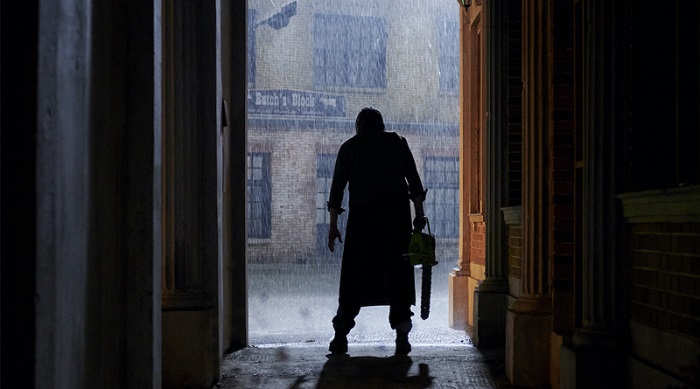
I’ll say it again – I hate this current trend where horror movie sequels rehash the same title as the original film in their franchise. “Halloween” did it. “Scream” just did it. And now “Texas Chainsaw Massacre” is doing it (they actually did it back in 2003, but that was a remake rather than a sequel). This latest slasher flick comes courtesy on Netflix. And while I can’t say we really needed a new TCM, I gotta admit the new trailer looks pretty cool.

Directed by David Blue Garcia and written by Chris Thomas Devlin, this incarnation of “Texas Chainsaw Massacre” was conceived by Fede Álvarez and Rodo Sayagues, the Uruguayan duo behind the “Evil Dead” remake and “Don’t Breathe”. The film is considered a sequel to the classic 1974 original film and sees Leatherface once again after some unfortunate travelers. But this time someone comes to their rescue – Sally Hardesty, the lone survivor of the ’74 movie. Will this be good? I don’t know. Am I going to give it a shot? Absolutely!

“Texas Chainsaw Massacre” premieres on Netflix February 18th. Check out the trailer below and let me know if you’ll be seeing it or taking a pass.