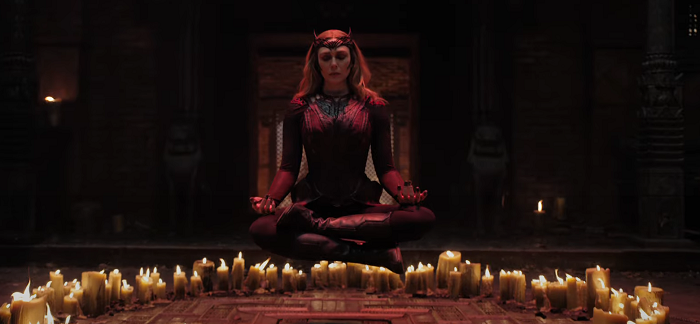
While my excitement for the Marvel Cinematic Universe has somewhat lessened since “Avengers: Endgame”, one of the movies on the MCU roadmap that has always had my attention was “Doctor Strange and the Multiverse of Madness”. One of the big reasons was the return of Director Sam Raimi to the superhero genre. But there’s also the sheer craziness of the idea behind it. And the ‘anything goes’ possibilities in the wake of what happened in “Spider-Man: No Way Hone” means this movie could have a major impact on the MCU’s future. The new trailer proves that to be true!
Just before the Super Bowl, Disney dropped a trailer that gives us a good idea of how far Raimi and company are going. As already known, Doctor Strange and Wanda Maximoff are going to have prominent roles and the trailer teases some pretty potent back-and-forths between them. We also see Strange facing punishment for his inadvertent actions in the Spider-Man flick. But perhaps the most buzzworthy thing sinners around a certain voice that we hear. I’ll let you watch and discover it for yourself. Needless to say, I’m excited.
“Doctor Strange and the Multiverse of Madness” opens in theaters May 6th. Check out the trailer below and let me know if you’ll be seeing it or taking a pass.
I’ve been hungry for a good old-fashioned whodunnit for a while now. So what better time for Kenneth Branagh to serve up his much-delayed Agatha Christie adaptation “Death on the Nile”. Branagh directs, produces and stars in this period mystery that’s based on Christie’s popular 1937 novel. And it’s the second installment in Branagh’s film series centered around renowned Belgian detective Hercule Poirot (the first being 2017’s “Murder on the Orient Express”). I love that this cinematic universe is a thing.
Branagh returns as super-sleuth extraordinaire Hercule Poirot and he brings along another star-studded cast. This one includes Gal Gadot, Annette Benning, Russell Brand, Armie Hammer, Ali Fazal, Letitia Wright, Emma Mackey, Tom Bateman, Sophie Okonedo, Rose Leslie, and more. The story is handled by returning screenwriter Michael Green and it takes us from war-torn Belgium to a buzzing London to ancient Egypt where the over 4,000 mile Nile River snakes through its vast desert sands.
Branagh opens his film up with a backstory we never knew we needed – the origin of Poirot’s extravagant signature mustache. OK, so I’m being a little facetious. There’s a little more to the exquisitely shot prologue than that. Set in 1917 on a war-scarred Belgian battlefield, young Poirot’s keen sense of deduction saves his company. But he can’t save his captain who is killed by an explosion that leaves the future detective’s face horribly scarred. Later in a medical hospital, a lovely young nurse named Katherine (Susannah Fielding) pays him a visit. The two clearly have a connection, but he fears she’ll leave after seeing his face. “You’ll grow a mustache,” she says with a tender, heartfelt smile.
Image Courtesy of 20th Century Studios
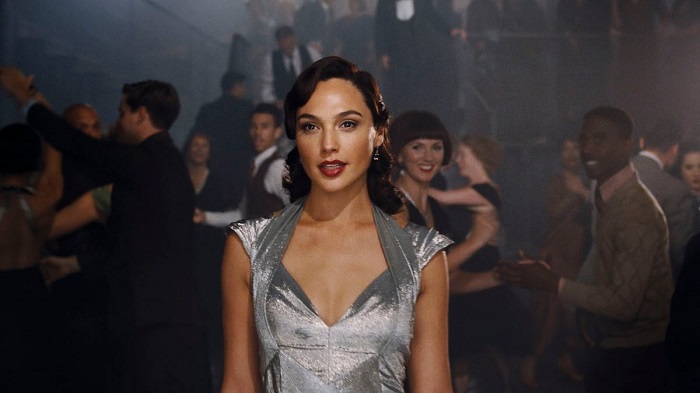
Bop ahead to 1937 London where the mustachioed Poirot sits in a night club soaking in the soulful tunes of jazz singer Salome Otterbourne (Okonedo). His bright blue eyes scope out the patrons, noticing every detail and logging them in his mind. Lighting up the dance floor is the dashing Simon Doyle (Armie Hammer) and his beautiful fiancé, Jacqueline de Bellefort (Emma Mackey). Minutes later, in walks Linnet Ridgeway (played with an ever-present sizzle by Gal Gadot), a wealthy heiress and Jacqueline’s close friend. Remember those names.
Six weeks later, Poirot is vacationing in Egypt, admiring the Great Sphinx of Giza from the shores of the River Nile. There he unexpectedly bumps into an old friend, Bouc (Tom Bateman) who’s in the area with his artist mother Euphemia (Annette Bening) to attend a wedding party at a posh 5-Star hotel. Poirot agrees to join them and several handpicked special guests at the obscenely lavish event where he meets the recently married couple of honor – Simon Doyle and ….. Linnet Ridgeway, NOT Jacqueline de Bellefort.
But as you might imagine, the embittered, scorned and slightly unhinged Jacqueline is not out of the picture. In fact, she’s been shadowing the newlyweds around the globe, popping up at every stop to stir up trouble. When she shows up at their shindig in Egypt, Simon and Linnet rent out a luxury riverboat, the SS Karnak, for them and their handful of guests. Linnet convinces Poirot to come as well, secretly sharing her distrust for her privileged party. “When you have money no one is ever really your friend,” she explains. “I don’t feel safe with any of them.”
The swanky vessel chugs up the Nile, eventually dropping anchor in front of the famed Abu Simbel shrine. The massive monument to King Ramesses II forms a picturesque background for the knotty story that unfolds. One that involves deception, betrayal, and course murder. With one dead body, Poirot sets out to find the killer before more meet the same fate. And you couldn’t ask for a better collection of suspects: the former classmate, the old flame, the accountant, the singer, the painter, the doctor, the maid, the godmother, and so on.
One of the trickiest parts of a movie like this is defining the suspects. You have to root out some kind of believable motive in each of them while also giving us reasons to believe them innocent. It also has to put us in a similar mindset as Poirot. We need to become detectives – watching, listening and soaking up the details. It then needs to bring it all to a satisfying conclusion. One that connects the pieces and makes sense. While I was left with a couple of minor questions, “Death on the Nile” mostly accomplishes all of the above. I was engaged throughout.
Image Courtesy of 20th Century Studios
The ensemble cast is in fine form with a few notable standouts. Branagh is terrific in the lead, capturing Poirot’s steely professional ego but also his more closely guarded sensitivity. There’s an unexpectedly warm subtext found in Poirot’s hidden fascination with love and its many textures. It’s born out of his own personal sense of loss and adds an extra layer to the character which Branagh handles in just the right key.
I mentioned Gadot’s sizzle. We also get a wonderfully understated and nearly unrecognizable Russell Brand playing (I love this name) Linus Windlesham, Linnet’s former beau. Rose Leslie is really good as Linnet’s maid/gopher. I also like the sultry confidence and style Sophie Okonedo brings to Salome. Of course the distracting ickiness associated with Hammer’s casting is hard to avoid, but it wore off over time as the character took the place of the disgraced actor. Still, it’s an obstacle.
In a way, “Death on the Nile” feels like a relic from a bygone era which I found to be one of its most alluring traits. Branagh whole-heartedly embraces the style of the classic whodunnits which I loved but will certainly impact some of the critical reaction. I also loved the look of the film from how Branagh and his DP Haris Zamabarloukos shoot the characters to the outstanding use of the Egyptian setting. It may not have the most seamless conclusion, but it’s a satisfying one. And watching Branagh’s Poirot once again crack another case left me with a grin on my face and hope for a third adventure. “Death on the Nile” is out now in theaters.
To say Jordan Peele’s filmmaking career has started with a bang would be an understatement. His debut picture “Get Out” released to almost unheard of adoration and praise (I’m still trying to figure that one out. It’s a pretty good movie, but one with plenty of first-time writer/director missteps). His next film “Us” was a major step up for Peele and features one of the best performances in recent years from Lupita Nyong’o. And that brings us to his third feature, “Nope”.
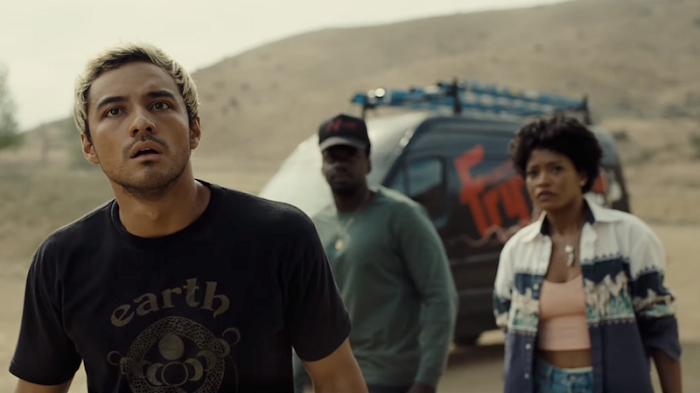
The long-awaited first trailer dropped hours before this year‘s Super Bowl and to say it’s intriguing would also be an understatement. There’s not much revealed in terms of plot, but it definitely gives us a good sense of the vibe Peele is going for. It also sees Peele reteaming with Daniel Kaluuya, an actor with a lot of intensity but who generally only works at one temperature. But the rest of the cast excites me more, especially Keke Palmer and Steven Yeun. I like what this trailer teases and I’m excited to see where “Nope” goes.
“Nope” is scheduled to release in theaters July 22nd. Check out the trailer below and let me know if you’ll be seeing it or taking a pass.
It’s February which means it’s the time of the year for yet another Liam Neeson movie. February seems to be the month of choice for these cookie-cutter action thrillers starring the gruff Irish-born screen veteran. Since taking off as an unlikely action hero with 2008’s “Taken”, Neeson (who turns 70 this June) has carved out his own niche and these movies have almost become a genre all their own.
Most of these films follow a fairly familiar blueprint and it’s often hard to differentiate one from the other (their aggressively generic titles don’t help). The similarities between these movies often comes down to the ingredients. For example, Neeson’s characters almost always have some kind of military or special forces background. There’s often some kind of connective family tissue that’s intended to raise the stakes (although if you’ve watched enough of these you pretty much know how they turn out). And there is always a call for Neeson to unleash his “very particular set of skills”.
His latest venture “Blacklight” comes packaged with the hilariously bad tagline “They’re Gonna Need More Men” and it’s the first of two Neeson flicks set to release during the first half of 2022 (the other being the Martin Campbell directed “Memory” in April). His character, Travis Block fits the above archetype to a tee. He’s ex-military who now works “off the books” for the FBI. His strict dedication to his work made him a rotten husband and father, yet he’s determined to make up for it by being a better grandfather. But to no surprise, those dreams of domestic bliss are abruptly (and predictably) interrupted.
Travis is the long-time friend and right-hand man to FBI Director Gabriel Robinson (Aidan Quinn). The two served in Vietnam together and now Travis runs covert missions for Robinson, pulling compromised agents from deep cover assignments. Travis is loyal, dependable and never questions orders which makes him invaluable to Robinson. But it doesn’t take a rocket scientist to figure out that Robinson is a little shady. His fanboy affection for J. Edgar Hoover is concerning enough, but there are plenty of other red flags that pop up along the way.
When not secretly rescuing agents from white supremacist militias or underground terrorist groups, Travis works hard to make amends for his past failings as a father. But the OCD that makes him so good at his job has festered into paranoia which drives his daughter Amanda (Claire van der Boom) up the wall. From putting up security cameras at her house without her permission to teaching his granddaughter Natalie (Gabriella Sengos) to memorize all the exits in every building she enters. These scenes add a lighthearted touch, but it’s hard to tell if they’re meant to be played straight or as comedy.
Travis’ work and family inevitably collide after he’s tasked with bringing in a disillusioned young agent named Dusty Crane (Taylor John Smith). Dusty claims to possess damning information related to the recent murder of a fiery congressional candidate (who’s shamelessly modeled after AOC). Travis tries to get to Crane before he can turn his evidence over to a tenacious reporter named Mira Jones (Emmy Raver-Lampman). Robinson turns out to be involved and he’s determined to erase anyone connected, Travis and his family included.
Director Mark Williams keeps things going at a reasonably good pace, but he has a hard time generating much suspense. That’s because there are no big twists or surprises to be found anywhere. All of the story pieces are laid out early, and they eventually fit together exactly the way you expect them to. And while I like the idea of fearless journalists exposing government cover-ups and Travis reckoning with his government-sanctioned past, none of those angles take the story in any unexpected direction.
And the movie isn’t helped by its unsatisfying ending. Perhaps its another casualty of predictability, but it’s almost as if Williams wasn’t quite sure how to end his story. We end up with something overly tidy, remarkably shallow, and just generally hard to swallow. It more or less just wraps things up, filling the final five minutes with corny dialogue and one of the worst final confrontations you’ll find in a movie.
“Blacklight” may have enough to win over the most ardent fans of these Neeson thrillers. For everyone else, this is more of the same but with even less energy and grit. Also (and I hate to say this), this is a case where Neeson’s age really shows itself in the action scenes. It’s certainly not his fault, but in movies like this where buying into the action is crucial, it becomes a pretty big issue. “Blacklight” opens today in theaters.
The “Jurassic Park” films have a special place in my heart and not because I’m a huge fan myself. But they happen to be my son’s favorite franchise (at least next to Star Wars). To clarify, for me the first “Jurassic Park” was an extraordinary experience that still holds up today. I absolutely love it. And I enjoyed the two sequels that followed (to lesser degrees). I had some fun with 2015’s “Jurassic World” but felt 2018’s “Jurassic World: Fallen Kingdom” was a huge disappointment. As goofy as it was, “Fallen Kingdom” did leave the series in an interesting place. And that brings me to the new trailer for “Jurassic World Dominion”.
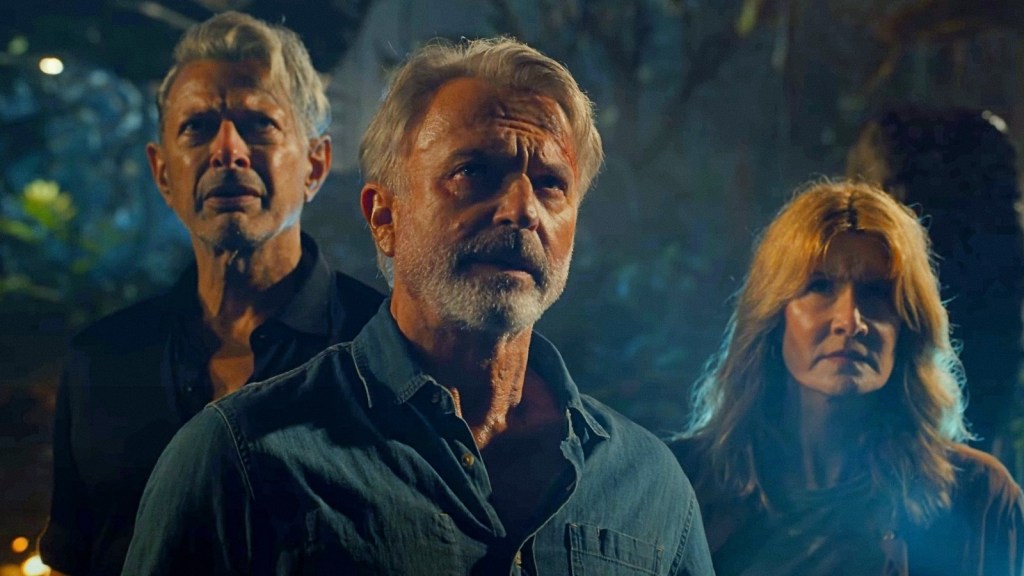
Set four years after the previous film, “Dominion” takes place in a new era with genetically engineered dinosaurs and humankind attempting to co-exist. After being released on America’s mainland, the dinosaurs have turned society on its head – the very result of mankind‘s meddling with nature. It’s hard to really nail down the plot as the trailer is mostly full of dinosaur spectacle and some awesome returning faces. But it looks like such a wild ride, and I am incredibly curious to see where they are going with this.
“Jurassic World Dominion” hits theaters June 10th. Check out the trailer below and let me know if you’ll be seeing it or taking a pass.
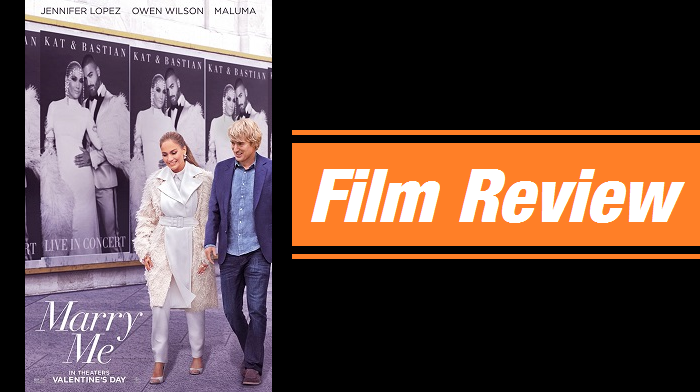
If I were to take a survey asking people to choose two stars they think would be perfect for an on-screen romance, I doubt many of you would say Jennifer Lopez and Owen Wilson. Yet guess who stars in the new romantic comedy “Marry Me”, a movie built around an preposterous premise but that manages to work because of the sheer star wattage and (I can’t believe I’m saying this) chemistry of its two leads.
On paper, nothing about “Marry Me” should work. And before you get too carried away, you should know it does come unglued during its corny and cloying final 15 minutes or so. But for a stretch “Marry Me” actually clicks. And I mean it really clicks in sweet, smart, and genuinely funny ways. Director Kat Coiro, along with the writing trio of John Rogers, Tami Sagher and Harper Dill, give space for the film’s central relationship to develop and grow. The committed and charismatic couple of Lopez and Wilson handle the rest. That is until the movie eventually caves to the more mawkish and conventional.
Lopez plays Kat Valdez, a pop superstar adored by millions of fans around the globe. Her highly publicized romance with fellow Latin sensation Bastian (Maluma) makes headlines and routinely sets social media ablaze. Their agents come up with a publicity stunt for the ages – have a concert/wedding where the recently engaged super-couple take their vows on stage in front of a live New York City crowd and with 20 million people watching worldwide.
Image Courtesy of Universal Pictures
Wilson plays the blandly named average-Joe Charlie Gilbert (apologies to all the Charlie Gilberts out there). He’s a buttoned-up and slightly neurotic junior high math teacher – kinda like a domesticated Gil Pender. But rather than being infatuated with Paris, its equations and formulas that butter Charlie’s biscuit. And sponsoring the school’s math club (hilariously called the “Pi-thons”) is as close as he comes to an actual social life.
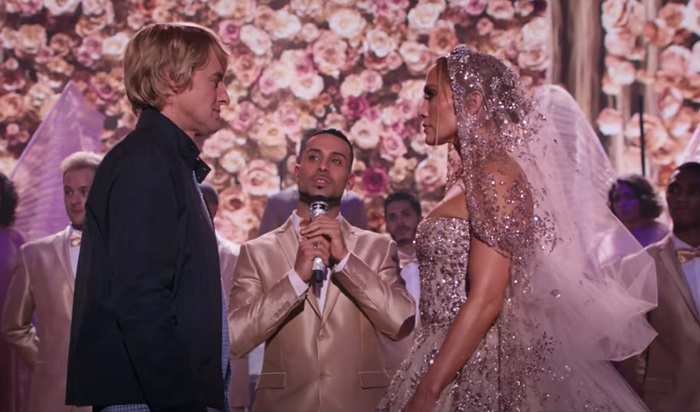
Charlie is perfectly content with his dull and boring existence, but he’s having a hard time connecting with his 12-year-old daughter Lou (Chloe Coleman). In an effort to convince Lou that he’s “fun”, Charlie heeds the advice of his friend and colleague Parker (Sarah Silverman) and takes Lou to Kat and Bastian’s big show. But as Kat takes the stage to get married in front of the world, a video goes viral showing Bastian cheating on Kat with her assistant.
A hurt and humiliated Kat sees Charlie in the crowd holding his daughter’s “Marry Me” sign (it’s the name of Kat and Bastian’s new hit single). On a whim, she calls Charlie to the stage and agrees to marry him on the spot. A stunned but sympathetic Charlie goes along with it and is immediately thrust into the spotlight. Kat’s handlers, specifically Collin (John Bradley) urge her to end the charade. But she refuses to let the world or Bastian see her heartbreak. So she and Charlie go on a whirlwind publicity tour, and (of course) grow closer in the process.
Image Courtesy of Universal Pictures
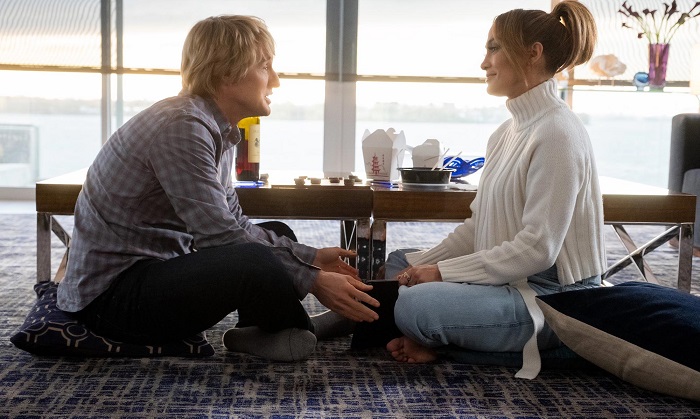
From there it’s not too hard to see where things are going. You have two vastly different people from wildly different worlds which leads to the quintessential (and inevitable) ‘opposites attract’ romance. But it works because of the two stars. Wilson has a disarming sincerity and an infectious charm that’s impossible to resist. He’s very much playing an Owen Wilson character, and (once again) he does it to perfection. Meanwhile, Lopez leans into her glamorous persona while also bringing sensitivity and compassion to her larger-the-life character.
But eventually (and most unfortunately) the filmmakers pull out the old Hallmark blueprint. You know, where things look great for our bubbly couple until that one conflict (in this case a ridiculously shallow one) pulls them apart and threatens to end their fairytale romance. Of course we know how things are going to turn out which is another reason I’m tired of this stale rom-com formula. And it’s not helped by the ending – a predictable and super-syrupy finish that’s too scripted and phony to convey the sweetness it’s going for.
But let’s get back to the stars. Lopez and Wilson may not be the most obvious on-screen couple. But both deserve a ton of credit for what they manage to do in “Marry Me”. They take this utterly ridiculous concept from a mostly formulaic and predictable movie and actually make us care. They make us care about their characters and their prospect of a future together. And it’s all because of that unexpected chemistry. They can’t make the trite suddenly original or the schmaltz more truthful. But they do make the film not only watchable, but surprisingly enjoyable. “Marry Me” opens tomorrow (February 11th) in theaters and streaming on Peacock.