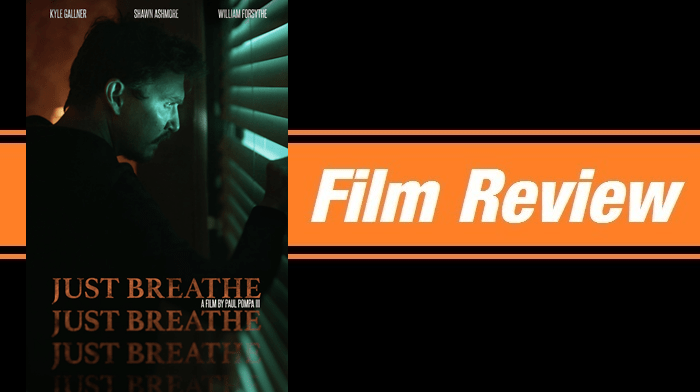
REVIEW: “Just Breathe” (2025)

In the new crime drama “Just Breathe”, Kyle Gallner plays Nick Bianco, a hardened yet well-meaning man who battles with serious anger management issues. He’s finally started therapy at the behest of his girlfriend Mel (Emyri Crutchfield). Nick is crazy about Mel. So much so that he’s bought an engagement ring with big plans to ask her to marry him. But those plans are put on hold after one jarringly violent encounter.

“Just Breathe” is written and directed by Paul Pompa III who conceives a fairly intriguing crime story and then presents it like an early 1990s thriller. That’s both good and bad, depending on how you look at it. It’s conflicts are certainly well-defined and the stakes couldn’t be clearer. But everyone other than Nick seems shackled to that familiar 90s thriller formula. Meanwhile the story hits a few too many predictable beats, right up to its mostly by-the-book finish.
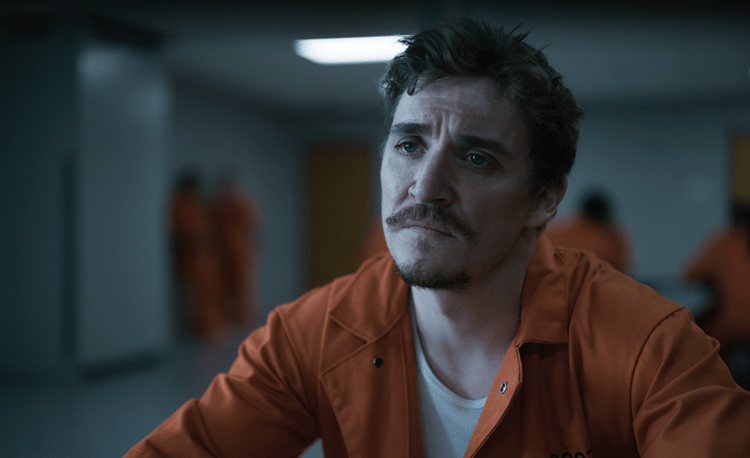
Image Courtesy of Shout! Studios

On the very night Nick is set to propose, his temper gets him into serious trouble. While having dinner with Mel at a swanky downtown restaurant, Nick overhears their waiter insulting her while in the bathroom. Nick snaps and savagely beats the guy into a bloody pulp. The incident costs him a year in prison, and even worse, forces him to put his proposal to Mel on hold.

We then jump ahead a year as Nick is getting out of prison with hopes of picking up where he left off with Mel. But she’s (understandably) in no hurry to rekindle their relationship. And things are made even more complicated by Chester (Shawn Ashmore), Mel’s new landlord who clearly has a thing for her. But it gets even crazier as Chester is also Nick’s parole officer. We quickly learn that he is thoroughly corrupt and uses his authority to force desperate parolees into doing his bidding.

Things heat up when Chester begins using his abovementioned authority to keep Nick out of Mel’s life. Again, it’s a fairly intriguing premise with some compelling possibilities. But much of it is undermined by one noteworthy weakness – Mel. She’s a character plagued by bad decisions, horrible judgement, and an inexplicable inability to see through Chester’s glaringly obvious unhinged infatuation. And she isn’t helped by Crutchfield’s oddly subdued performance.
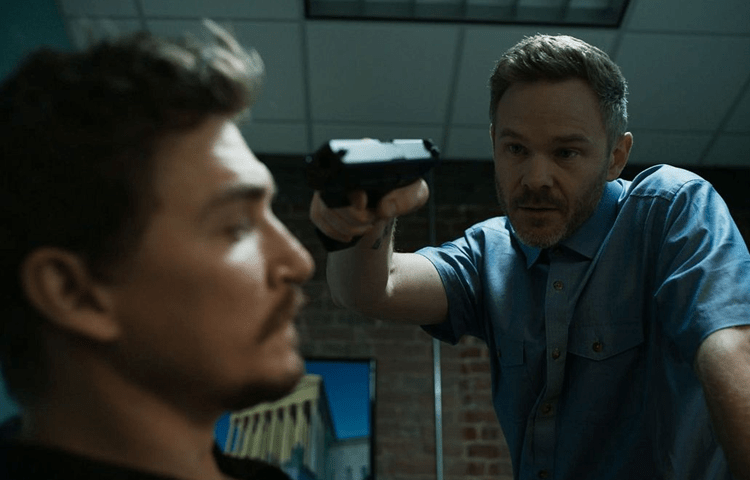
Image Courtesy of Shout! Studios

As for Gallner, he brings all the toughness and volatility needed, but he coats it with a level of sincerity that makes Nick more than some brutish lunkhead. And while the script pigeonholes him a bit, Ashmore makes Chester an appropriately vile villain – a tad cartoonish in spots but every bit as detestable as he needs to be. William Forsythe even shows up playing Nick’s cold and callous father although the screen veteran isn’t given a lot do.

Things escalate too quickly in the final act as the movie barrels towards its big climactic finish. It all ends up in a fairly obvious and predictable place. It works well enough as an ending though it’s not enough to smooth over the film’s rougher edges. The pieces are there and Gallner once again shows he has the acting chops to carry a lead’s workload. But the material lets him down and doesn’t quite develop the kind of intensity a story like this needs. “Just Breathe” releases on VOD September 16th.

VERDICT – 2.5 STARS

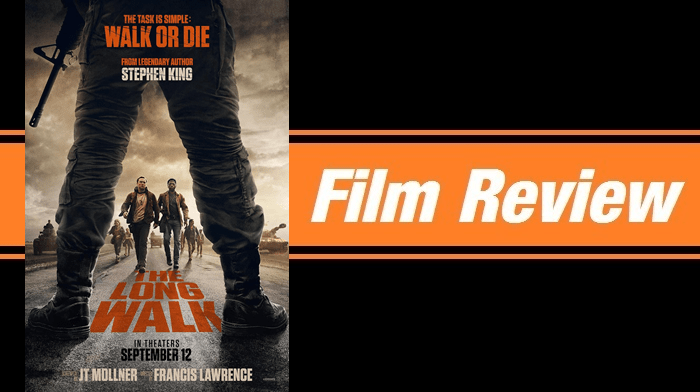
REVIEW: “The Long Walk” (2025)

“The Long Walk” has a premise that undoubtedly sounds silly on the surface. But as director Francis Lawrence (“The Hunger Games” films) begins to plow deeper, we see a wealth of themes sprout up, most explored through the film’s young characters. Yet despite the strong performances and its surprising thematic heft, “The Long Walk” is hampered by several minor annoyances that together turn into bigger frustrations.

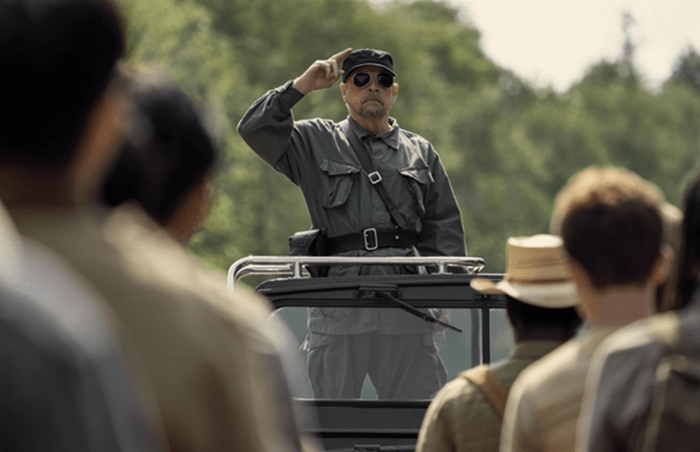
“The Long Walk” is based on a 1979 Stephen King novel of the same name. Written for the screen by JT Mollner, this survival thriller takes place in a dystopian America where a nebulous collapse of society has led to mass poverty and famine. The country is seemingly ran by a totalitarian regime which is embodied in the film’s almost cartoonish antagonist known only as The Major (Mark Hamill).

Image Courtesy of Lionsgate

In this visually captivating America, The Long Walk is an annual “contest” where one young man from every state is chosen by lottery to participate. The “walkers” gather at a designated starting line and then walk until only one remains standing. The winner then receives a huge cash prize and one wish to be granted by The Major. Of course the walk comes with some pretty strict rules. First, the walkers must maintain a speed of 3 mph. Second, they cannot step off the road. Here’s the kicker – breaking the rules results in immediate execution.

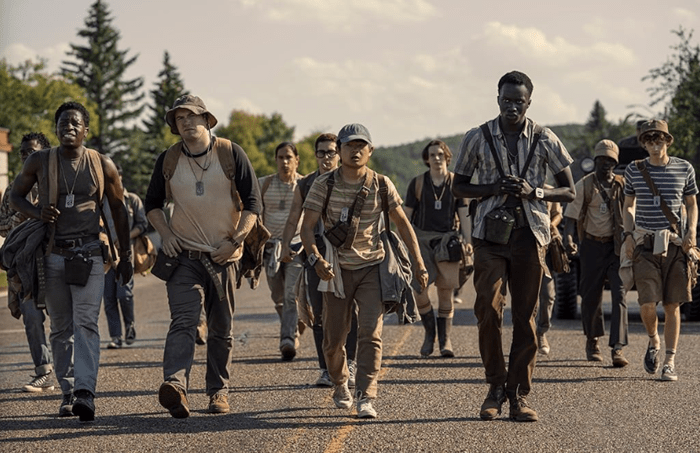
One of the last participants to arrive is Raymond (Cooper Hoffman) who immediately forms a bond with fellow walker Peter (David Jonsson). As the event is set to begin, we’re introduced to several other competitors including the potty-mouthed Hank (Ben Wang), the physically imposing Stebbins (Garrett Wareing), the religious Arthur (Tut Nyuot), the obnoxious bully Barkovitch (Charlie Plummer), the quiet and austere Collie (Joshua Odjick), and the nervous Curley (Roman Griffin Davis).

Essentially this is a movie that solely follows young men walking which makes the characters the centerpiece. Lawrence does a fine job propelling the story forward despite the clear limitations in the premise. And the performances are top-to-bottom impressive from what is a predominantly twenty-something cast. Everyone is onboard and committed, and they do everything they can to breathe personality into these characters.

Image Courtesy of Lionsgate

But the script doesn’t make things easy, often oscillating between brilliant and disappointing. Most of the issues revolve around the characters who all seem to be cut from the same societal cloth. Aside from their physical appearances and on-the-nose personality traits, there’s not much to distinguish them. The only differences of substance are found in vague personal testimonies that often come right before a character is offed. There was certainly time to flesh them out more, especially in the first half. But too much of it is wasted on shallow adolescent banter coming from cast members who look much older than they’re made to sound.

Now there are a few exceptions with some characters standing out more than others. The growing relationship between Raymond and Peter is especially compelling. As for the story, it touches on such rich themes as survival, nihilism, humanity, and brotherhood (just to name a few). And it is unflinchingly brutal in ways that fit firmly within the bleak world we’re thrust into. But the abovementioned character issues never go away. And it isn’t helped by an ending that frankly doesn’t make much sense. It’s a shame because there is much to admire, despite its shortcomings.

VERDICT – 2.5 STARS

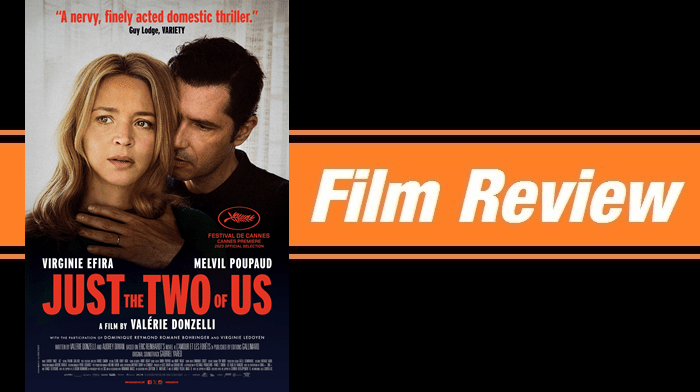
REVIEW: “Just the Two of Us” (2024)

There have been many movies tackling the difficult subject of domestic abuse. But few have offered a more comprehensive on-screen depiction of a deteriorating relationship as “Just the Two of Us”. This well-conceived and well-acted French psychological thriller begins with a romantic first encounter that blossoms into love, marriage, and children. But as insecurity gives way to possessiveness, one person’s happiness slowly and painfully turns to horror.

“Just the Two of Us” first released in France in 2023 and received a very limited theatrical release here in the States last year. But now it’s more widely available via a digital and home video release courtesy of Music Box Films. It’s directed by actor-turned-director Valérie Donzelli who works from a script she wrote with Audrey Diwan. Together they adapt Éric Reinhardt’s 2014 novel “L’Amour et les Forêts”, shrewdly adding their own strokes which gives the film a sharp modern-day resonance.

Image Courtesy of Music Box Films

Virginie Efira stars as both Blanche and her twin sister Rose, two siblings who couldn’t be more different. Blanche is somewhat closed off and reserved while Rose is an outgoing straightshooter. But while they may be opposites, as with most twins, they are extremely close and look after each other. After some coaxing by Rose, Blanche agrees to go to a party where she meets an old acquaintance, Grégoire (Melvil Poupaud). An unexpected romance blooms and this immediately becomes Blanche’s story.

At first Grégoire is everything Blanche could want. After she discovers she’s pregnant, the two get married and have their first of two children. But we see the first cracks after Grégoire moves them away after getting transferred by his job. Blanche struggles adjusting to being so far away from her sister. But the real difficulty comes after she learns Grégoire wasn’t completely honest about his transfer. And it only gets worse after Blanche accepts a substitute teaching position at a local high school much to her husband’s chagrin..

As the story progresses, Donzelli skillfully peels back layers of Grégoire’s abuse while revealing the damaging effects through Blanche’s eyes. Grégoire’s insecurities manifest themselves through shaming, degradation, and gaslighting. Blanche’s aggravation turns to discomfort quickly which gives way to fear. And as his crushing mental cruelty intensifies, her suffocating anxiety grows unbearable. The film gets increasingly harrowing as Donzelli ratchets things up.

Image Courtesy of Music Box Films

Much of the film’s resonance comes through the two central performances. Poupaud impresses by providing a captivating mix of charm and menace, showing the allure of affection and the perturbation of possessiveness. But truthfully it’s all about Efira who is the film’s lifeblood. She brilliantly delivers an emotionally textured performance that allows the film’s themes to fully take form. Even when the story begins to veer into genre, Efira keeps things firmly rooted in truth.

“Just the Two of Us” is a perceptive psychological drama about navigating a crumbling, abusive relationship. The final act sees the tension at its thickest before finally letting us up to breathe. It’s capped by an engaging finish that brings Blanche’s journey to a satisfying inflection point. Not everything the characters do makes sense, more specifically in the second half. But the movie’s handling of psychological abuse, isolation, and trauma is well grounded, and Efira makes it all resonate on a profoundly human level.

VERDICT – 4 STARS

REVIEW: “The Jester 2” (2025)

It’s Halloween night – that beloved evening in late October when kids dress up in their favorite costumes and take to their neighborhood streets in hopes of scoring bags full of candy. It’s also a preferred time of the year for deranged and diabolical movie masked murderers to go on blood-drenched killing sprees. It’s a cinematic truth that both slasher and non-slasher film fans know well.

The latest movie to let its Halloween night killer loose is “The Jester 2”. The film’s titular character debuted in a trio of well-made short films that are currently available to stream on YouTube. The shorts paved the way for a 2023 feature length film although it didn’t leave much of an impression. Yet writer, director, and editor Colin Krawchuk (who has helmed every Jester project to date) was able to get a sequel made – a true testament to his passion for his creation.

Image Courtesy of Dread

The Jester (impressively played by Michael Sheffield) is a mysterious mute trickster sporting a bright suit, top hat, and a hideous joker mask covering his face. He’s a little bit magic, a little bit demonic, and a whole lot of demented. Unfortunately he’s not much beyond that. Midway through the film we get a supernatural explanation for why he does what he does. But it feels more out of necessity rather than something organic to the character and his story.

As for our protagonist, 15-year-old Max (Kaitlyn Trentham) is a sweet and timid introvert who struggles to fit in. At home she’s constantly denigrated by one of the worst movie moms of the year (Jessica Ambuehl), and at school she’s an easy target for the preppy bullies. Her one real love is magic and her one real friend is Willie (Dingani Beza), the owner of a small local magic shop.

Decked out in her homemade magician costume, Max heads out to enjoy her Halloween night. But after a run-in with some obnoxious classmates followed by a pep talk from Willie, her evening takes a twisted turn when she encounters the Jester. At first Max is enamored by the silent trickster who not only wows her with his magic, but who does something few others do – shows an interest in her. But after she witnesses him use his magic to murder a woman right before her eyes, Max realizes she is in the presence of evil.

Image Courtesy of Dread

From there the movie pretty much plays out according to formula. But for slasher movies that’s not necessarily a bad thing. They have long been a sub-genre of horror built largely upon fan expectations. In that sense “The Jester 2” seeks to deliver, offering up a fairly unique and often bloody variety of kills. Still, as with many of these movies, the originality is often found in the killer. The Jester certainly has an unsettling sadistic side which makes him both creepy and compelling. Sadly, too much about him remains a mystery.

Interestingly, “The Jester 2” features some of the same strengths and weaknesses as its predecessor. It creates a genuinely eerie atmosphere and the Jester himself certainly grabs our attention (in large part thanks to Sheffield’s physically chilling performance). But there is so much mythology and backstory left untold. And while the story we do get is serviceable, it doesn’t do enough to keep us engaged as it moves from one kill to the next.

VERDICT – 2 STARS

First Glance: “Nouvelle Vague”

The French New Wave movement has played a critical role in my deep love for cinema. While it bloomed well before I was born, I later found myself infatuated with the works of Truffaut, Godard, Rohmer, Rivette, Chabrol, Varda, Resnais, and others. So naturally I was drawn to “Nouvelle Vague”, a playful and passionate reimaging of the making of one of the movement’s signature films, “Breathless”. And if that wasn’t enough, it just so happens to be directed by one of the best, Richard Linklater.

From its first trailer, Guillaume Marbeck offers a spitting image of film critic turned filmmaker Jean-Luc Godard. Zoey Deutch has a stunningly similarity to Jean Seberg. And Aubry Dullin channels the cool suavity of Jean-Paul Belmondo. The film was filmed in Paris and entirely in French. It was also shot in pristine black-and-white in a period-perfect 4:3 aspect ration. We get a taste of all of this and more in the exciting new trailer which has managed to leave me even more excited.

“Nouvelle Vague” releases in select theaters on October 31st before streaming on Netflix November 14th. Check out the trailer below and let me know if you’ll be seeing it or taking a pass.

REVIEW: “Caught Stealing” (2025)

In terms of style and substance, Darren Aronofsky movies tend to have many similarities. Most offer dark examinations of the human experience, often focusing on such themes as self-destructive obsessions, psychological trauma and the like. But his latest is something quite different. “Caught Stealing” is a loud and messy attempt at mixing black comedy with a crime thriller. It has its moments of pop appeal, but not enough of them.

Aronofsky directs from a screenplay written by Charlie Huston. It’s a screenplay based on Huston’s own 2004 novel of the same name. For me, the film’s biggest draw is rising star Austin Butler. With an Academy Award nomination already under his belt, the 34-year-old Butler has certainly made a name for himself, having worked with such names as Tarantino, Villeneuve, Nichols, Aster, and now Aronofsky.

Set in 1998, Butler plays Hank Thompson, an alcoholic in denial who works as a bartender in New York City’s Lower East Side. Hank was a high school baseball phenom who was expected to be the top pick in the Major League Baseball draft. But his future was derailed after a drunk driving accident kills his friend and severely injures his knee. Now he’s left regretting his past and wondering what might have been. To get by he relies on a lot of booze and his overly patient girlfriend Yvonne (Zoë Kravitz).

One afternoon Hank and Yvonne arrive at his apartment where they’re greeted by his neighbor, an obnoxious punk rock hellion named Russ (Matt Smith). Russ informs Hank that he’s returning to London to see his dying father and he needs someone to look after his cat. Hank reluctantly agrees. But things get crazy when Hank is visited by two Russian mobsters, Aleksei (Yuri Kolokolnikov) and Pavel (Nikita Kukushkin) who are looking for Russ. Hank gets beaten to pulp and threatened with more if he doesn’t find Russ and the money he stole before skipping the country.

From there Aronofsky’s loud, brash, and violent crime romp moves at breakneck speed. As it does, more characters enter the chaos, most notably Regina King as a dogged police detective, Elise Roman. And I can’t forget Liev Schreiber and Vincent D’Onofrio as Hasidic brothers Lipa and Shmully Drucker, two notorious gangsters with connections to Russ and the missing money. Like every other character, they’re each given standout moments. And like every other character, they’re sometimes lost in the mayhem.

For most of its running time, “Caught Stealing” bops along as a comically violent, gleefully profane, and inherently silly mishmash. Yet there are a handful of what should be emotionally crucial moments that are impossible to take seriously amid the zany genre hopscotch. At the same time, the glimpses we get of Aronofsky’s usual deep-thinking interests remain hazy due to the film’s frustrating identity crisis. And even a terrific ensemble led by the effortlessly charismatic Butler can’t make this uneven exercise crackle the way it should.

VERDICT – 2 STARS