First Glance: “The Little Things”

LITTLE

What a fun day! Warner Bros. dropped the first trailer for one of my most anticipated films, John Lee Hancock’s “The Little Things”. I loved Hancock’s last two movies 2016’s “The Founder” and 2019’s “The Highwaymen”. But the big draw here is the cast led by three Oscar winners, Rami Malek, Jared Leto, and one of my all-time favorites Denzel Washington. Personally I’ll see anything Denzel does, but all of these extra ingredients only adds to the excitement.

“The Little Things” looks to be a gritty crime thriller that sees Washington playing a Kern County Deputy Sheriff who joins up with a Los Angeles police detective (Malek) in hunting down a brutal serial killer. Their methods clash a bit and tensions rise especially when the slippery prime suspect (played by Leto) begins playing his games. The screenplay is written by Hancock and the glimpses we get of John Schwartzman’s cinematography hint at a dark, moody tone. I can’t wait!

“The Little Things” opens January 29th, 2021 in theaters and on HBO Max. Check out the trailer below and let me know if you’ll be seeing it or taking a pass.

REVIEW: “Another Round” (2020)

ANOTHERpost

Filmmaker Thomas Vinterberg and actor Mads Mikkelsen struck gold with 2012’s “The Hunt”, a searing drama about a man wrongfully accused of sexually abusing a child and the hysteria that engulfs a small close-knit community as a result. The two team-up again for “Another Round”, an absorbing character study about middle-aged disillusionment and another home-run for the Danish duo.

A large part of the film was shaped by a personal tragedy. The movie was original set to star Vinterberg’s 19-year-old daughter Ida. But just four days into filming Ida was killed in a car accident. Utterly devastated but determined to make his movie in honor of his daughter, Vinterberg reworked the script with co-writer Tobias Lindholm and made what is “Another Round”. Vinterberg’s goal was to change it to something “life-affirming”, but you can’t miss the undercurrent of sadness that’s felt from the film’s pre-title montage to its exhilarating yet heartbreaking final scene.

Mikkelsen has always been an actor able to root out the inner complexities and conflicts of his characters. Here he is magnificent playing a high school history teacher named Martin. Mikkselsen’s emotionally detailed performance reveals a detached man, his eyes lightless, melancholy etched into every expression. Martin is in the throes of a midlife crisis, stuck in a mire of unfulfillment and uncertainty. “I don’t know how I ended up like this,” he laments. He’s lost his fire both at school and at home. His grades-conscious students notice it, even putting together an intervention of sorts. His wife Anika (Maria Bonnevie) also notices and is constantly taking on night shifts at work (you get the sense it’s to get away from her husband).

ANOTHER1

Image Courtesy of Samuel Goldwyn Films

One evening Martin and fellow teachers Tommy (Thomas Bo Larsen) and Peter (Lars Ranthe) attend a birthday dinner for friend and colleague Nikolaj (Magnus Millang). After some needling Martin agrees to join them for some light drinking. As the four begin loosening up Nikolaj shares a hypothesis from Norwegian psychologist Finn Skårderund. His idea was that the blood alcohol content in humans is 0.05% too low and that light day drinking would lead to “increased social and professional performance.” Martin has reached a point where he’s willing to try anything so the four decide to test Skårderund’s theory.

First they set the rules for their cockeyed social experiment. It would consist of daily alcohol consumption maintaining but not exceeding 0.05% BAC. There would be no drinking after 8:00 PM and none on weekends. Throughout the ‘experiment’ each would take notes and report back with the results. Their sets of rules and procedures attempt to give it all a sense of legitimacy, but it’s clear each are trying to fill holes in their individual lives. For a desperate Martin it’s about being able to feel again; about finding the zest for life he once had. It’s about rekindling the relationship with his wife and rediscovering his enthusiasm for the classroom. In other words, for Martin it’s about living again.

It’s really a nutty premise, the kind Hollywood is almost certain to remake and probably botch. But it works here because Vinterberg isn’t as enthralled with the concept as much as he is the people involved. Even when the movie ventures into black comedy territory, Vinterberg’s focus is set firmly on Martin and the other characters. And as silly as the concept sounds, it opens up the characters in a number of surprisingly intimate ways, allowing us to see deeper inside them. This is where the acting shines brightest, especially from Mikkelsen who gives a subdued yet full-bodied performance that can be darkly funny but that is undergirded with an unshakable sense of tragedy.

ANOTHER2

Image Courtesy of Samuel Goldwyn Films

Interestingly (and wisely) Vinterberg doesn’t judge the four men or their actions. In fact he even hints that there may be some truth to Skårderund’s wild theory after the buzzed teachers begin seeing success both at work and at home (I guess there are reasons for the nicknames “spirits” and “liquid courage”). Also the experiment brings the friends closer together than they’ve ever been. At the same time Vinterberg subtly reminds us that the potential consequences, both personal and professional, are enormous. This becomes even clearer when the four begin stretching their own rules by increasing their daily intake. We know they’re in a precarious position and the tightrope they’re walking could snap at any moment.

I’m still astonished by how effectively Vinterberg brings all of his parts together to make something playful yet perilous; something that sounds absurd but ends up being as captivating as it is provocative. And despite its smattering of dark humor, you can’t miss the elements of Vinterberg’s real-life personal anguish that permeates scene after scene. And what better actor to soulfully channel it than Mads Mikkelsen who (here I go again) gives what’s easily one of the year’s best performances.

For the most part there isn’t a lot of variety when it comes to movies strictly about drinking alcohol. There are your care-free party movies full of boozing but often free of consequences and repercussions. The others are usually sad somber tales of people languishing in the grip of alcoholism. “Another Round” nimbly finds its place somewhere in the middle. It fully acknowledges the pleasures and appeal of drinking for some people. At the same time the film shows that the gap between social drinking and dependency can close quicker than you think. And while a couple of glasses of wine may loosen you up, it’s no cure for deep-seated psychological pain. And in the end that pain is what “Another Round” is most interested in exploring.

VERDICT – 4.5 STARS

4-5-stars

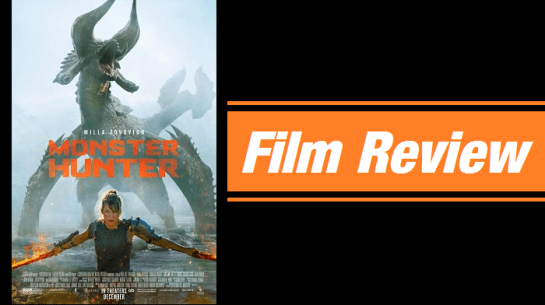
REVIEW: “Monster Hunter” (2020)

MONSTERposter

Writer-director Paul W. S. Anderson and actress Milla Jovovich are no strangers to movies based on video games. The husband and wife first met in 2002 on the set of “Resident Evil”, an action-horror flick based on Capcom’s popular video game franchise. Since then the two have collaborated in some way on five sequels. And while I would never be so bold as to call those films “great”, they are very honest and self-aware and are made with a very particular audience in mind.

Their latest video game-to-big screen venture is “Monster Hunter”, yet another popular Capcom franchise but one lacking the movie genre allure of something like “Resident Evil”. Still it caters to the same audience and will likely live or die based on how that group turns out for it. That’s because there’s simply not much there for those with no connections to the games or for anyone in need of the slightest bit of depth. “Monster Hunter” is far more interested in cranking up a new franchise than creating relatable well-conceived characters and giving them a good story to tell.

MONSTER2

Photo Courtesy of Screen Gems

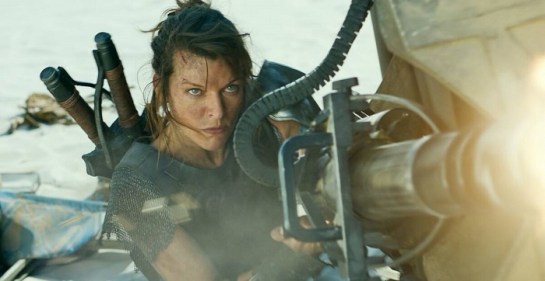
Jovovich stars as Captain Natalie Artemis, a US Army Ranger and head of a United Nations joint task force. She leads a team of interesting faces but dull and forgettable personalities who sport macho military handles like Axe, Link, Dealer, and Dash. And if you’re interested in learning more about them, don’t be. “Monster Hunter” certainly isn’t. Instead all we get is some laughably bad soldier banter. Nothing of substance. Even Jovovich’s Artemis, the clear star of the movie, is paper-thin and woefully underwritten. All we’re allowed to learn about her is that she’s tough, she can fight, and she can adapt. That’s it.

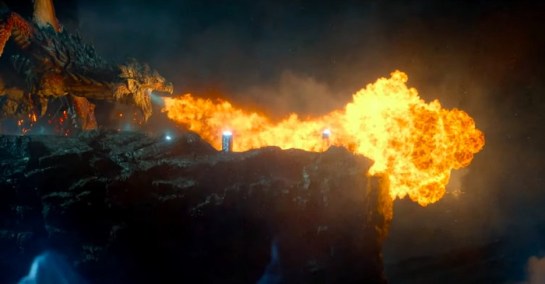
Stationed in some unidentified desert country, Artemis and her unit are sent out to find Bravo Team who never reported back following their last patrol. During their search they encounter a sandstorm that’s actually hiding a mysterious portal. In a snap the team is sucked in and transported to another dimension. One with a considerably vaster desert and one massive creature who doesn’t like trespassers. The outmatched soldiers quickly learn they don’t have the firepower to fight such a beast so they hightail it towards a lone rocky island in the ocean of sand with the mammoth monster nipping at their heels.

As they tend to do in movies like this, the team members are picked off one by one. Meanwhile on the rocky refuge (yea right) is Tony Jaa playing a character simply called the Hunter. He spends the first half of the movie jumping from boulder to boulder watching Artemis and her team in various states of peril and shooting the occasional exploding arrow at a monster. When Artemis is the only one left, the Hunter (who has been stranded there for who knows how long) reveals himself, not with a handshake and a “help me get off this rock.” Instead his first impulse is to attack her which leads to a pointless series of fight scenes that just delay their inevitable come-together moment. That’s the only way to kill the sand monster and to find a way home. Oh, and there’s that ominous tower in the distance that’s sure to have some part in all of this, right?

Sarcasm and snark aside, “Monster Hunter” actually delivers exactly what it promises and criticizing it for not delivering more seems a little unfair. It’s silly, bombastic, get-away entertainment. Nothing more, nothing less. Anderson and his effects team put together some really impressive set pieces and visually there are a lot of interesting things going on. And later the film opens up some intriguing new environments. Also Anderson seems to have a real reverence for his source material. His film drips with fan service from the sets, the monsters, the weapons, the attire. And can we take a quick second to appreciate Ron Perlman who shows up later with the most hilariously dreadful wig I’ve ever seen in a movie (and yes, I’m counting that as a plus).

MONSTER1

Photo Courtesy of Screen Gems

But I also can’t begrudge anyone who wants interesting characters or some semblance of a coherent story. There are a few decent moments between Jovovich and Jaa when the film briefly turns into a buddy survival adventure. But otherwise the story leaves nothing worth talking about. And you can bet its eye-rolling non-ending will leave some feeling annoyed and unsatisfied. And while the creature effects and bigger set pieces range from good to great, some of the more up-close action must have been hacked to pieces in the editing room. The frantic quick-cuts make the scenes borderline indecipherable.

While I am an unapologetic player and appreciator of video games, they don’t exactly have a glowing track record when it comes to big screen adaptations. I don’t think “Monster Hunter” will do much to change that. But honestly I don’t think Anderson and company care. They’ve set out to make a certain kind of movie for a certain kind of moviegoer. If nothing else, some people will enjoy it just for the non-stop action and CGI spectacle. But that doesn’t hide the glaring lack of story and character development. Or the frustrating non-ending that seems much more interested in teasing a future movie rather than finishing this one. “Monster Hunter” is now showing in theaters.

VERDICT- 2.5 STARS

2-5-stars

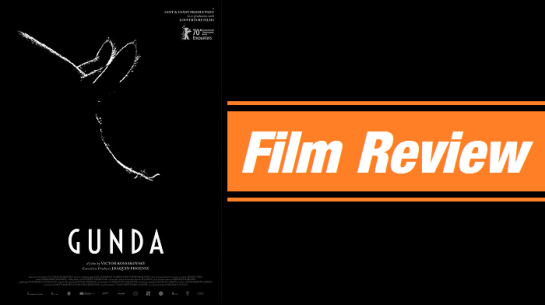
REVIEW: “Gunda” (2020)

GUNDApost

I’ve always been amazed by cinema’s ability to take the simplest idea and turn it into something powerful and deeply affecting. It’s a mark of great moviemaking that has impacted generations since the birth of the industry. For a more recent example look no further than the quietly meditative and subtly message-minded “Gunda” from Russian filmmaker Viktor Kossakovsky. The film also sports Joaquin Phoenix as its executive producer.

This Norwegian documentary sees Kossakovsky directing, co-writing, co-editing as well as sharing cinematography duties. Shot in stunning high-contrast black-and-white, “Gunda” opens with a gorgeous still shot of a small wood pigsty. A sow lays on a bed of hay, its head partially out of the sty basking in the sun’s warm glow. The camera sits on the shot, admiring its simplicity and beauty. Then we notice movement in the shadows. Tumbling over its mother and out the doorway is a tiny piglet followed by another and then another. The shot cuts to inside where we get a clearer picture of what’s going on. Gunda, the eponymous sow is giving birth. It’s a beautiful scene and a clear introduction to the kind of film Kossalovsky has for us.

GUNDA1

Image Courtesy of NEON

“Gunda” shrewdly brings us into the farm animal’s world, immersing us in the everyday minutiae of farm life from their distinct perspective. To emphasize their point-of-view Kossalovsky is always shooting from his subject’s eye level. And when mixed with Alexandr Dudarev’s sublime sound design you get the indescribable sensation of not only being present but within arms length. Take an exquisitely captured sequence when Gunda and her piglets go for a stroll in the farmyard. The unintrusive camera subtly follows the rambunctious little ones at ground level, watching as they root and roughhouse while mama keeps a watchful eye. With the extraordinary closeness comes a certain unshakable intimacy and the clarity of the images means we catch every astonishing detail.

There are the occasional shifts to other livestock that almost work as interludes to Gunda’s story. One features a resilient one-legged chicken who refusing to let his disability slow him down. Later we watch cows burst out of a barn and then run across the field like kids on a playground racing to their favorite spot. Neither segment can cleanly escape feeling a little like filler. Yet both are shot with the same equally captivating photography and both feed into the film’s goal of getting its audience to reconsider how they think of farm animals.

GUNDA2

Image Courtesy of NEON

But Gunda and her piglets are the stars and the film always comes back to them after a chunk of time has passed. As the film moves forward and the piglets get older, an impending sense of doom sets in. Interestingly not a single human being is ever seen on screen nor a single voice ever heard. We only see the marks of their presence. But over time the audience is faced with the inevitable realization that it’s the humans who are the determiners of fate. This is shown with heartbreaking clarity in the film’s heartbreaking final moments.

While its message is crystal clear “Gunda” never lectures or browbeats. There’s no music to guide our emotions or narration to explain what we’re seeing. It doesn’t frame or stealthily edit scenes for dramatic effect. Instead “Gunda” asks its audience to observe, absorb and ponder. It’s unflinching dedication to its vision could prove too tedious for some. But for those able to fall in with the movie’s gorgeous poetic rhythm, it’s sure to resonate in a number unexpected ways. All while showcasing what Paul Thomas Anderson could only describe as “pure cinema”. “Gunda” received a limited release December 11th.

VERDICT- 4.5 STARS

4-5-stars

REVIEW: “Sound of Metal” (2020)

METALpost

In filmmaker Darius Marder’s “Sound of Metal” Riz Ahmed plays Ruben Stone, a drummer and one-half of the punk rock duo Blackgammon. The other half is Lou (Olivia Cooke), lead singer, guitarist and Ruben’s girlfriend. The two drive their RV/home from city to city playing small gigs and selling just enough merch to get by. Both were lost and wayward souls but found safety and refuge in each other and the music they make together. And then Ruben lost his hearing.

From its earliest moments “Sound of Metal” brandishes a gritty authenticity in its story, its characters, and even the filmmaking. It all starts with Riz Ahmed and his star-making turn as a recovering heroin addict who has put every bit of himself into traveling across the country with his girlfriend performing gigs and working on a new album. Once the threat of losing it all sets in the richness of Ahmed’s performance really comes out. Anger, bitterness, fear, denial – Ahmed maneuvers through his crumbling character’s emotional cycles with a true and uncompromising fervor. It’s soulful and hard-nosed acting that avoids showiness and other similar trappings.

METAL1

Image Courtesy of Amazon Studios

Ruben’s trouble begins after a show in Missouri when he suddenly loses most of his hearing. Nicolas Becker’s gnarly sound design (easily some of the year’s best) conveys Ruben’s condition by putting us in his head, surrounding us with the same disorienting hums and muffled tones. It’s intensely effective and quite harrowing especially when Marder begins contrasting the normal sounds with what Ruben is actually hearing. Ruben is certain he can fix it despite a doctor telling him his hearing loss is not only permanent but will most likely get worse.

Lou has a better grasp on reality and reaches out to Ruben’s sponsor who finds him a rural rehab facility for the deaf. It’s ran by a kind spirit named Joe (Paul Raci) who immediately gets Ruben into group meetings and starts him learning sign language. After some initial hesitation Ruben begins to make connections, especially with a teacher named Diane (Lauren Ridloff) and her students at a local school for the deaf. At the same time everything he’s doing is to get back to old life instead of learning how to live his new one. It’s a key internal conflict and a central focus of the film’s second half.

METAL2

Image Courtesy of Amazon Studios

“Sound of Metal” tells the kind of story that filmmakers have often struggled to get right. That’s because there’s almost an inherent temptation to ramp up the drama rather than trusting the story and the audience. In “Sound of Metal” there is no condescension and no overwrought sentimentality. The film’s proverbial feet are firmly planted in the real world (maybe too much so in some cases) and the movie benefits from Marder’s willingness to keep things grounded and character-focused. Same with his choice to cast members of the deaf community. It both adds to the authenticity and fairly represents an often underrepresented group.

Despite being underwritten in places “Sound of Metal” is easily one of the more pleasant surprises of 2020. The film’s tough-minded yet thoughtful story plows some heavy ground and asks challenging questions. How do you put aside everything you’ve ever known and carve out a new identity? At what point do you give up on your dream and face a new reality? Marder gives us lots to ponder and Riz Ahmed embodies it with a performance full of grit and raw emotion. It’s hard to take your eyes off of him and he earns our empathy the very moment the terrifying muffled hum first sets in. “Sound of Metal” is now available on Amazon Prime.

VERDICT – 4 STARS

4-stars

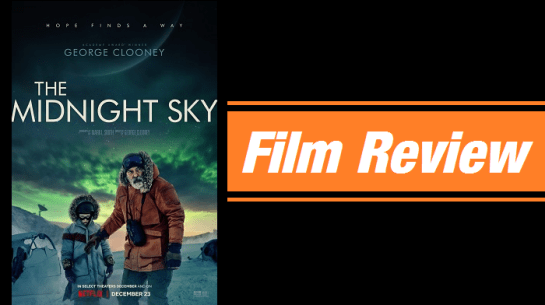
REVIEW: “The Midnight Sky” (2020)

SKYposter

No one can doubt George Clooney’s celebrity status nor can they reasonably throw dirt at his work in front of the camera. A quick scan of the Oscar winner’s acting credits shows a career many would envy. It’s when you mention his directing that things get a little shaky. He has hit his mark a few times namely with “Good Night and Good Luck” and “The Monuments Men” (that’s right, I’m an actual defender of that movie. Nice to meet you.). But his misfires have been pretty pronounced with “Leatherheads” and the abysmal “Suburbicon” instantly coming to mind.

His latest film “The Midnight Sky” sees Clooney as both lead actor and director, his first dual-duty role since 2014. The story is adapted by screenwriter Mark L. Smith (“The Revenant”) from Lily Brooks-Dalton’s 2016 debut novel “Good Morning, Midnight”. It’s an interesting choice for director Clooney, bigger in scale and more ambitious than anything he has helmed before. Here he has made a movie that wears its inspirations on its sleeve which may push away demanding viewers hungry for something completely original. But “The Midnight Sky” is no stale uninspired rehash and reducing it to such ignores the film’s more personal aims.

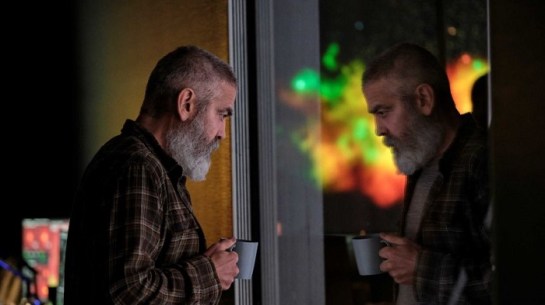
This moody dystopian drama is set in 2049, three weeks after an unspecified global catastrophe (referred to only as “the event”) caused deadly levels of radiation to begin spreading across the earth’s surface. Clooney plays Augustine Lofthouse, a renowned astrophysicist and the last remaining soul at the Barbeau Observatory deep in the Arctic Circle. His colleagues and their families have evacuated, heading south to hole up in underground safehouses. But Augustine stayed behind, unconvinced that leaving was the best course of action and content to live his last days alone with his terminal illness.
SKY2

Image Courtesy of Netflix

Augustine passes his time monitoring the radiation’s rapid spread and attempting to establish communication with the rest of the world. The thick-bearded, gravelly-voiced Clooney gives one of the best performances of his career portraying a somber tormented soul wrestling with feelings of deep-rooted regret (three short but well-handled flashbacks reveal a squandered relationship, the source of his melancholy). He’s the embodiment of loneliness, a man self-condemned and resigned to his fate. But then two unexpected twists change his course.

First he notices the crew of the planet’s last active space mission Operation Aether are returning to earth following a survey mission to a potentially habitable moon. If Augustine doesn’t re-establish contact with the unaware space station and warn them of the earth’s status the five-person crew will be arriving to their own deaths. Second he discovers a little girl named Iris (bright-eyed newcomer Caoilinn Springall) left behind during the evacuation. It sets up the well-worn father-figure/daughter-figure dynamic that actually works thanks to Clooney’s wounded sincerity and Springall’s quiet and unadorned presence.

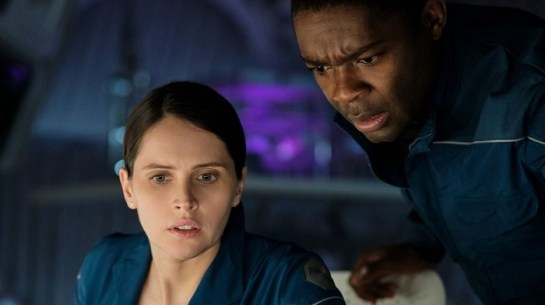
Meanwhile aboard the Aether the crew carries on their daily duties despite growing concerns about losing contact with earth. The diverse and talented group of Felicity Jones, David Oyelowo, Kyle Chandler, Demián Bichir, and Tiffany Boone make up the team of home-sick scientists, some more fleshed out than others but each believable in their role. The visual effects pop off the screen from the imaginative ship design to the simple but foreboding way the movie contrasts the darkness of space with the blinding white of the Arctic tundra. And then there’s the film’s biggest set piece, a stunning spacewalk to repair a communications array that clearly borrows from “Gravity” but packs its own quiet white-knuckled intensity. There is a musical number to Neil Diamond’s “Sweet Caroline” that I could have done without but be that as it may.
SKY3

Image Courtesy of Netflix

The story jumps back-and-forth between the Aether‘s crew pushing through unforeseen dangers and Augustine setting out with Iris across the frozen wasteland to a remote weather station with a stronger antenna. It sounds action-packed, something akin to summer blockbuster material. But while it has its genre moments, this is a much different film. At its core “The Midnight Sky” is reflective and tragic, even poetic; a bleak meditation on humanity’s last days. Some are sure to push back on Clooney’s unrushed approach, but it’s exactly what this type of story needs. Even DP Martin Ruhe’s extraordinary cinematography and Alexander Desplat’s elegant yet aching score support the film’s contemplative framing.

One of the biggest mistakes you could make with a movie like “The Midnight Sky” is falling into the comparison trap. Sure, if you look for it you can see a few story beats from “Interstellar”, a set piece inspired by “Gravity”, and the occasional ruminative rhythm of “Ad Astra”. At times you may be reminded of “The Martian”, “Moon”, “2001”, and “Arrival”. In other words it does what so many sci-fi movies do at this stage in the genre’s history – it embraces its inspirations. But it also has its own story to tell about loss, love and the yearning for what we leave behind.

“The Midnight Sky” is destined to be a divisive movie. For some it will be emotionally cathartic and fitting for a year like 2020. Others will find it to be shallow, derivative and lacking its own identity. For me its issues are considerably smaller. It splits so much time between earth and space that some of its characters get shortchanged. And as a result some of the big emotional moments don’t quite have the punch they should. But thankfully “The Midnight Sky” doesn’t hinge on a scene or two. And I like the fact that George Clooney, both the actor and director, sticks to his vision while tipping his hat to many of his important influences. “The Midnight Sky” is now showing in select theaters and will premiere on Netflix December 23rd.

VERDICT – 4 STARS

4-stars