RETRO REVIEW: “Children of the Corn” (1984)

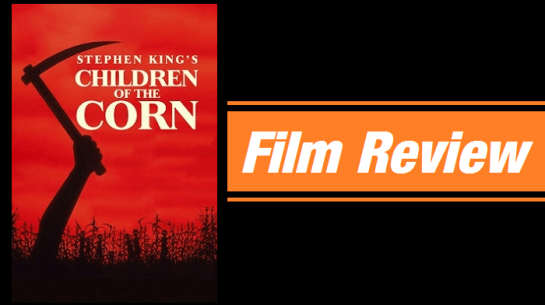
CORNposter

For the past few months I’ve dedicated several Wednesdays to doing Retro Reviews. The way it works is I put up three options on my Twitter feed (you can follow me @KeithandMovies). Followers vote, I rewatch the movie, and then post the review the following Wednesday. Whatever film finishes second comes back the next week against two new choices. So basically you pick what I watch and review.

When you hear “Children of the Corn” you almost can’t help but be amused. Not at the concept (the idea is actually quite chilling), but at the title itself. And after watching it for the first time in years the title isn’t the only thing that made me giggle. Yet despite very much being a movie of its time, there is something about director Fritz Kiersch’s folk horror feature from 1984 that I still find enjoyable.

The film is based on Stephen King’s 1977 short story of the same name. King was originally set to handle the screenplay, but the filmmakers felt his draft was too “internal” much like a novel and lacked the required cinematic quality. Much to King’s chagrin, his script was tossed and George Goldsmith was brought in for rewrites. Goldsmith invented two child characters and used their perspectives to tell much of the story.
CORN1

Photo Courtesy of New World Pictures

The film opens with scene-setting shots of dry, crisp corn stalks blowing in the wind, the cracked sun-baked ground, and a dilapidated old shed looking centuries old. The images are interrupted by the ringing church bells Grace Baptist Church of Gatlin, Nebraska. The sign out front advertises the Sunday sermon – “Corn drought and the Lord”. After church many of the congregation, including a young boy named Job (Robby Kiger) and his father, gather at the small town’s diner as they do every Sunday. But instead of a cozy hometown meal, the adults are poisoned and butchered by entranced blade-wielding teens. All of Gatlin’s adults were murdered that day in a series of brutal ritual killings.

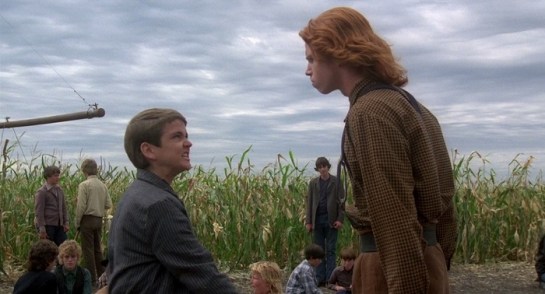
That was three years earlier. Jump ahead to present day where the brainwashed kids live out in the cornfield following a creepy pre-teen cult leader named Isaac (John Franklin). He allegedly speaks for a demonic entity referred to only as “He Who Walks Behind the Rows” (catchy name). Isaac’s right-hand enforcer Malachi (Courtney Gains) handles the cult’s field work. Namely carving up nosy adults passing through, organizing the human sacrifices, and yellow cult-like things super loudly.

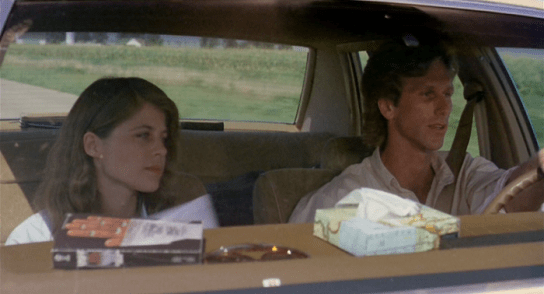
Enter Vicky (Linda Hamilton) and her boyfriend Burt (Peter Horton), a recent medical school graduate. The couple are driving across the Midwest on their way to Seattle where Burt is set to begin his first internship. While traveling through rural Nebraska a jolting accident diverts them through the deserted town of (you guessed it) Gatlin. Soon they find themselves knee-deep in killer kid cultists and the only help comes from Job and his little sister Sarah (Anne Marie McEvoy).
CORN2

Photo Courtesy of New World Pictures

“Children of the Corn” may have more lows than highs, but it does some things really well. Kiersch makes good use of the isolated farmland setting. Whether its the never-ending cornfields or the dried-up town (a possible analogy for dying small town Americana). Also I wouldn’t go as far as to call the film a slow burn, but it uncoils at a very deliberate pace which actually serves the story well and shields it from some pretty obvious limitations.

But not everything works as well. When approached with the needed suspension of disbelief, Goldsmith’s story itself is fine. But some of his dialogue is glaringly wooden and can be downright corny (sorry, I couldn’t resist). And while you never want to come down hard on child actors, some of their performances here are excruciating. Wobbly dialogue mixed with even worse acting equals some pretty bad scenes. And I feel guilty for even mentioning the special effects. Clearly the movie had budget restrictions and it wisely avoids big effects shots. But when they do come near the end of the film….ouch.

Still despite its obvious shortcomings, “Children of the Corn” remains entertaining which is a big reason it has earned a pretty loyal cult following in the 36 years since its original release. It’s hard to praise it too much, but it’s still an easy-to-digest horror picture build on some cool ideas. It’s also fun watching an early pre-Terminator Linda Hamilton performance. It hasn’t aged particularly well, but the fun hint of nostalgia I felt during the rewatch in undeniable.

VERDICT – 2.5 STARS

2-5-stars

REVIEW: “You Should Have Left” (2020)

SHOULDposter

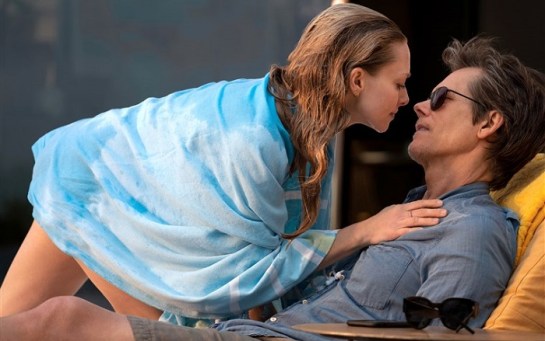
Kevin Bacon and Amanda Seyfried make an intriguing couple in the new aggressively titled psychological thriller “You Should Have Left”. Right off the bat you can’t help but notice the significant age difference (Bacon is a spry 61 while Seyfried is 34). It’s something the film is aware of and even has fun with (“You’re her dad?” a security guard sincerely asks Bacon). You may be able to squeeze some commentary out of their relationship, but the movie has other interests.

Bacon plays Theo Conroy, a wealthy ex-banker stained by a tabloid-rich scandal from his past involving the death of his first wife. Theo has steadily maintained his innocence and even the courts agreed with him. Still his high-profile case gained him unwanted notoriety and he hasn’t fared as well in the court of public opinion. As a result Theo battles frequent nightmares as well as bouts with insecurity. He combats those issues by keeping a doctor-prescribed daily journal and quietly meditating to self-help lessons.

Should1

Photo Courtesy of Universal Studios

Seyfried plays Theo’s much younger wife Susanna with whom he shares a daughter, 6-year-old Ella (Avery Tiiu Essex). Susanna is a working actress, forever tethered to her cellphone, and seemingly impervious to how some of her choices may affect her husband. Whether it’s constantly giggling and leaving the room when getting texts from a male co-star or having her husband visit the movie set on a day she’s filming a sex scene. Do you chalk it up to the age difference? Is it Theo’s petty jealousy? Or is something else going on?

Realizing they need a getaway, Theo and Susanna rent the proverbial house in the middle of nowhere – a two-story modernist home in very rural Wales. Before the three have time to settle in we begin noticing peculiar things about the house’s design. It only get weirder as lights begin coming on by themselves. Doors appear one night but are gone the next. Spooky Polaroids start popping up. And someone (or something) has scribbled a chilling warning in Theo’s journal. “You should leave – go now” followed by “You should have left.”

SHOULD2

Photo Courtesy of Universal Studios

At first it’s hard to watch and not think of “The Shining” just on a smaller scale. Clearly something’s up with the house and the longer the family stays there the more macabre things get. At the same time Theo begins to unravel in ways we’re used to seeing in these types of thrillers. But thankfully writer-director David Koepp gives his movie enough of its own identity to keep it from feeling like a routine genre exercise. He also tosses in some chilling and inspired twists. Unfortunately they run head-first into a clunky final reveal dump that basically takes place over a single phone call.

“You Should Have Left” is never really scary although it does occasionally get under your skin. I does some clever things with the haunted house formula which keep it from feeling tedious or redundant. At the same time you can’t help but notice some things that are undeniably familiar (especially if you’ve seen the recent and much better “Relic”). But the biggest draw is Kevin Bacon and even though this isn’t top quality material, it’s great to see him on screen again and he keeps us invested from start to finish.

VERDICT – 3 STARS

3-stars

REVIEW: “Waiting for the Barbarians” (2020)

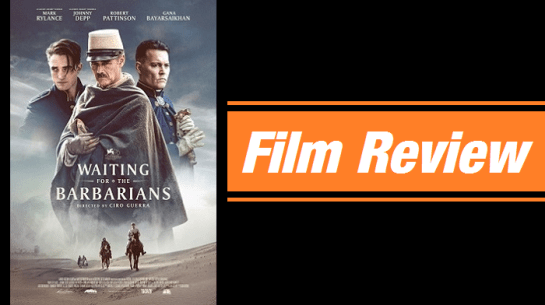
BARBposter

Set within an unnamed territory, an unnamed Magistrate oversees a remote outpost for an unnamed empire. This shrewdly calculated ambiguity has a steady presence throughout “Waiting for the Barbarians”, the new film and English-language debut from Columbian director Ciro Guerra. It’s ambiguous for a reason – to sharpen the relevance for today by not assigning or restricting what we witness to a specific time or nation. Through a broad yet clear lens Guerra indicts both the practices of the past and the mindsets of the present.

“Waiting for the Barbarians” is an adaptation of J. M. Coetzee’s 1980 novel which explored the ugliness of imperialism and its lasting influence on modern thought. Coetzee also wrote the screenplay (his first) which patiently unwraps the story through its ruminative rhythm and well-tuned characters. And even as its dense early table-setting gives way to the quieter yet more visualized tragedy of the second half, the sense of pertinence is ever-present. And let’s be honest, it doesn’t hurt to have Mark Rylance, Johnny Depp, and Robert Pattinson fleshing our your characters.

Rylance plays the well-meaning magistrate and if there ever was an actor who exuded gentle, unfeigned integrity it’s Rylance. His Magistrate manages the frontier settlement with an air of peaceful passivity. He’s content with his life there, quietly collecting and cataloging old area artifacts while occasionally mediating minor squabbles among locals. He carries himself admirably and is convinced that his benevolence makes him a welcomed presence. However, good intentions and feelings of self-fulfillment blind him to a glaring hypocrisy which he’s eventually forced to reckon with.

BARB2

Photo Courtesy of Samuel Goldwyn Films

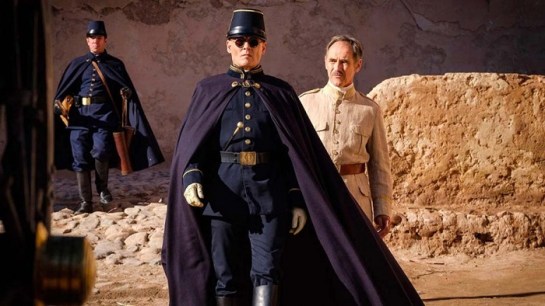
Everything changes with the arrival of Colonel Joll (Depp), a member of the Empire’s security force who has been sent to inspect the outpost and investigate alleged unrest on the outskirts of the frontier. We see hints of Depp’s patented eccentricity in his rigidly upright posture, stony-faced demeanor, and steampunkish sunglasses (they’re all the rage back home). But it’s Depp’s words that reveal the most about his character. Joll speaks with an icy malice, coldly absorbing the Magistrate’s initial hospitality before getting down to the business of his visit.

Joll begins rounding up and questioning local nomads with the avidity of an authoritarian, torturing those deemed to be “barbarians” by his superiors. No scene captures Joll’s dry and calloused ruthlessness better than his chilling explanation of the “patience and pressure” approach to interrogation (hint: far more emphasis is on pressure). “Pain is truth. All else is subject to doubt.” And just like that Guerra and Coetzee put a spotlight on the real barbarians. Meanwhile all the Magistrate can do is helplessly watch.

Joll and his soldiers depart almost as quickly as they arrive leaving the Magistrate to handle the mess they left behind. But it’s not as though he has clean hands. The almost messianic overtones of the early scenes fade as the Magistrate’s complicity, though subtle and seemingly benign, are brought to light. And as much as he wants to disassociate himself from Joll’s terror, he slowly begins to see that (though cut from a different cloth) he and Joll do the biddings of same master.

BARB3

Photo Courtesy of Samuel Goldwyn Films

As a form of self-instituted penance the Magistrate takes in an indigenous woman ravaged by Joll’s brutality (she’s opaquely played by Gana Bayarsaikhan). He nurses her back to health, but more as a balm for his own bruised conscience rather than for her well-being. It’s only when he’s jolted out of his guilt-stricken haze that he finally does the right thing. But in doing so he sparks the ire of the Empire and finds himself under the boot of the very authority he once represented.

Coetzee’s deliberately paced script gives the actors plenty of room to leave their marks. While Depp instantly grabs your attention with his convincingly sinister presence, it’s Rylance who carries the emotional workload. With a soft-spoken and heartfelt authenticity, his performance manages to secure our sympathy and pity. He’s gives us a man on a journey, who eventually finds his conviction, and willingly pays a price for it. Pattinson gets a small but effective role as young officer who’s clearly a product of the Empire. By the time he comes around, good and evil have been clearly defined.

“Isn’t that what war is about?” a young officer brashly asks the appalled Magistrate, “compelling a choice on someone who would not otherwise make it?” The ugliness of the question highlights the deep-rooted metaphor at the core of “Waiting for the Barbarians”. Underneath cinematographer Chris Menges’ stunning sun-blasted desert landscapes and some key performances lies a stinging rebuke of the past, a mirror to the present, and a warning of the future. It’ll be too broad and figurative for some, but I loved its willingness to trust the viewer. And the near apocalyptic final shot only adds to the title’s richness. “Waiting for the Barbarians” premieres this Friday in select theaters and on VOD.

VERDICT – 4.5 STARS

4-5-stars

First Glance: “Honest Thief”

THIEF

Liam Neeson has been busy. After already flexing his dramatic muscles in two earlier 2020 dramas (“Ordinary Love” and “Made in Italy”), Neeson gets back in crowdpleasing mode with his upcoming banger “Honest Thief”. And judging by the new trailer, the film has all the markings of a Neeson action-thriller right down to the signature gravelly-voiced one-liner “I’m comin’ for you.” Sound familiar?

Neeson plays a highly-skilled bank robber who the authorities have never managed to snag. But he turns over a new leaf once he meets and falls for Annie (Kate Walsh). Hungry for clean living, he prepares to surrender the money to police in exchange for a immunity. Two crooked cops and a shot federal agent later, Neeson finds himself framed for murder with two money-hungry detectives on his tail. I’m in.

“Honest Thief” opens October 9th. Check out the trailer below and let me know if you’ll be seeing it or taking a pass.

REVIEW: “Radioactive” (2020)

RADIOposter

Biographical films aren’t as easy to pull off as it may seem. There are plenty of conventional biopic trappings and many movies fall victim to them. But I appreciate the ones that open my eyes in meaningful ways to people I’m not familiar with. Shamefully Marie Sklodowska-Curie is one such person and the new film “Radioactive” from Amazon Studios offers a good yet flawed look into her fascinating life.

Madame Curie made groundbreaking discoveries in the world of science while paving the way for other women in a male-dominated field. Among her many notable accomplishments: She discovered two new elements, discovered and even coined the term “radioactivity”, and championed the use of X-rays during World War I which saved countless lives. She also became the first woman to win a Nobel Prize, the first person (man or woman) to win it twice, and the first female professor at the University of Paris.

RADIO1

Photo Courtesy of Amazon Studios

“Radioactive” from director Marjane Satrapi works hard to avoid hitting the routine biopic beats with varying degrees of success. It’s most notable attempts come in its frequent use of flashbacks and (much more prominently) flash-forwards. They’re ambitious choices that yank us out of her personal drama to show the reverberation of her discoveries through the decades that follow. They are mostly well crafted but jarring interludes that leaves the impression of a movie torn between admiration and scorn.

The sturdy, unshakable, and always convincing Rosamund Pike plays Madame Curie and as usual she seems altogether comfortable in her character’s skin. In 1893 Paris, the Polish-born physicist and chemist finds herself booted from her laboratory for her big ideas and willingness to buck the stuffy male authority. She applies for other labs but is turned down by each. Then she (quite literally) bumps into Pierre Curie (Sam Riley), a fellow pariah among the Paris science elites. Pierre offers Marie a spot at his small but suitable laboratory. The socially awkward and boldly independent Marie initially turns him down, but soon after she accepts his offer. The two develop an impassioned, life-changing partnership that extends to both science and marriage.

From their Satrapi zips through chunks of Marie’s story, stopping briefly for key events such as the couple’s discovery of the elements radium and polonium along with their theory of radioactivity. “Well, I guess everything changes now, doesn’t it?” a character asks. Of course we know things do indeed change and the film stresses that many of those changes haven’t been for the better. Flash-forwards to the atomic bomb dropping on Hiroshima, the Chernobyl disaster, the nuclear testing in Nevada during the early sixties (you even get to watch a baby mannequin burn, melt, and get swallowed up by the ground just to stress the point). A vignette on cancer treatment is the lone positive mentioned although even it comes with its own harmful caveat.

RADIO2

Photo Courtesy of Amazon Studios

I like the film’s willingness to wrestle with the pros and cons of Marie’s discoveries, even if it pulls away from the movie’s biggest strength – Rosamund Pike. She carries the load with an undeniable bravura and commitment to detail that captures Madame Curie both inside and out. She’s especially good when the story moves away from beakers, flasks, and test tubes and into a more personal space. Pike really brings out the humanity, showing off Marie’s drive and grit but also her insecurities and vulnerabilities. This is most vividly seen through Marie’s devoted marriage to Pierre, a devastating tragedy, and an ill-advised affair leading to her being ravaged by the headhunting press.

Some of my favorite scenes come in the last act with Marie and her now grown daughter Irene (Ana Taylor-Joy) on a World War I battlefield bringing mobile X-ray machines to field hospitals. It’s such a fitting place for someone who has battled both as a woman and a scientist. But on that battlefield it wasn’t for notoriety or advancement. It was to save the lives and livelihoods of young soldiers. Those scenes speak volumes about Madame Curie. The movie isn’t always as clear spoken. Some of the early science talk is painfully on-the-nose and the flash-forwards are audacious but a bit too invasive. Still, “Radioactive” did what I want biopics to do, and with a performer like Rosamund Pike doing this level of work, it’s hard not to be impressed. “Radioactive” is now streaming on Amazon Prime.

VERDICT – 3.5 STARS

3-5-stars

REVIEW: “Seberg” (2020)

SEBERGposter

I still remember my first time seeing Jean-Luc Godard’s French New Wave classic “Breathless”. It was right after discovering Francois Truffaut’s sublime “The 400 Blows” (a movie that has remained an all-time favorite of mine). I instantly wanted to dig deeper into La Nouvelle Vague and “Breathless” was the logical next choice. Within seconds I was drawn to the enchanting presence of a young American woman selling newspapers on the Champs-Élysées. It was of course Jean Seberg.

For Seberg, what started as a Cinderella story ended in heartbreak and tragedy. As an 18-year-old from Marshalltown, Iowa she was discovered in a talent search for a lead role in an Otto Preminger picture. But it was Godard’s “Breathless” that made her an international sensation with a promising career ahead. She became a target of Hoover’s FBI for her large donations to civil rights groups and alleged affairs with black militants. The FBI began a vile smear campaign to “cheapen her in the eyes of the public.” Their relentless pressure pushed her over the edge. Only a few years later she would be dead of an apparent suicide, her body found decomposing in the back seat of a car. She was only 40-years-old.

As you can tell there is plenty of material for a thoughtful and compelling biopic about this troubled life. “Seberg” from director Benedict Andrews could have been that movie, but its vision ends up being too narrow and certain creative choices, specifically from Joe Shrapnel and Anna Waterhouse’s script, leaves the complex actress and fashion icon sadly short-changed.

SEBERG1

Photo Courtesy of Amazon Studios

It doesn’t take long to notice the film’s chief goal. “Seberg” is oddly focused on martyrdom over illumination. To accomplish that, Seberg’s artistry is tossed aside for politics making this a very one-dimensional look at her life. Her career work and creative talents are all but ignored, only occasionally referenced in passing comments. The film skips past the early details of her life, even her star-making work with Godard. There’s simply no interest in Seberg the actress.

Instead the filmmakers make their movie all about her activism. It settles in once Seberg (Kristen Stewart) meets a black revolutionary named Hakim Jamal (Anthony Mackie) on a flight from Paris to Los Angeles. She’s immediately attached to his cause but with no real burgeoning conviction. Seberg was certainly an activist, but here it comes across as spontaneous and out-of-the-blue. Her motivations are simplistic and often muddled making some of her later rhetoric toothless and hard to buy.

Jean and Hakim begin a torrid affair despite both of them being married. It’s one of several bad choices Jean makes that puts her in the crosshairs of a crooked and relentless FBI. At the time Hoover was looking to quell any possible black uprising either peaceful or militant. Jean’s financial support of such groups mixed with her celebrity platform leads to her being deemed “a threat to the protective organs of the body politic.” In response the Bureau begins a vicious and destructive campaign to turn the public against Jean Seberg.

SEBERG2

Photo Courtesy of Amazon Studios

From there the movie turns into a psychological thriller of sorts as paranoia sets in and Jean slowly comes unraveled. But through it all it seems like Seberg is competing for time in her own biopic. That’s because a lot of time is given to a young FBI agent played by Jack O’Connell. He’s a fictional concoction whose only purpose seems to be to add some semblance of humanity to the FBI. His struggles with his conscience and the strain his job puts on his marriage. It’s all handled well enough, but it pulls too much time away from Seberg and adds practically nothing to HER story.

As for Stewart, she definitely has the chic blonde pixie girl hair and stylish verve. But there’s only so much she can do when major qualities of her character are this thinly sketched. She gives a performance of commitment and compassion, but it’s hardly a fully realized portrayal. There are good supporting turns from Mackie, O’Connell, Yvan Attal, and Vince Vaughn. Meanwhile Margaret Qualley and Zazie Beetz get what amounts to throwaway roles, relegated to playing little more than jealous wives.

“Seberg” taps into the enigma that was Jean Seberg but doesn’t go much further than that. So much of what made her fascinating is either shortchanged or simply not addressed at all. What’s left is a well-meaning misfire that gets too caught up in its message, leaving the audience to still pose the question “Who is Jean Seberg?”

VERDICT – 2 STARS

2-stars