Blind Spot Series – “Picnic at Hanging Rock”

Picnic poster

I’ve always been a fan of Australian filmmaker Peter Weir. A quick scan of his filmography reveals a unique variety of movies. Just consider 1985’s “Witness”, 1989’s “Dead Poets Society”, and 1998’s “The Truman Show”. Since then Weir has made just two other films – one of my personal favorites 2003’s “Master and Commander” and 2010’s excellent “The Way Back”.

Weir was his busiest during the 1970s when he put out seven movies. Among those was his 1975 mystery-thriller “Picnic at Hanging Rock”. It’s based on a 1967 novel written by Joan Lindsay who left a cloud of uncertainty hanging over her inspiration. Was it based on true events? Did any of this really happen? Weir taps into that same sense of mystery and never tips his hand one way or the other.
PICNC1

The film revolves around the mysterious disappearance of four girls. Set in 1900 Australian, the story begins at a girl’s boarding school as a group of students prepare for a Valentine’s Day outing to a nearby landmark known as Hanging Rock. They are accompanied by their math teacher Ms. McCraw (Vivean Gray) and Mlle. de Poitiers (Helen Morse). Meanwhile the school’s stern disciplinarian headmistress Mrs. Appleyard (Rachel Roberts) informs the quiet, introverted Sara (Margaret Nelson) that she isn’t allow to go.

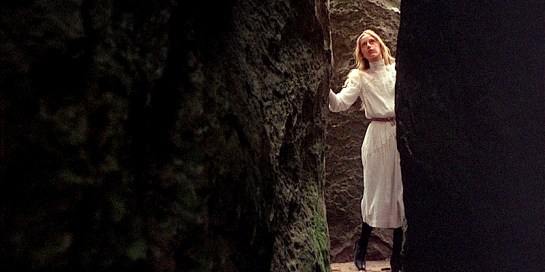
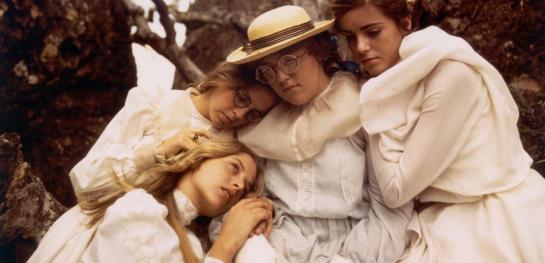
While at Hanging Rock a group of girls go exploring. They are lead by the beautiful and adventurous Miranda (Anne-Louise Lambert). Much like Hanging Rock itself, there is an ethereal aura that surrounds her – an almost heavenly suggestion that contrasts with the ominous foreboding geological formation. Mlle. de Poitiers taps into her mystery when she says “Now I know. I know that Miranda is a Botticelli angel”. It’s a cryptic reference to Italian Renaissance painter Sandro Botticelli. She says this as the curious girls disappear from her sight. They do not return.
PICNIC2

From there the film shifts to the search for the missing girls and the ripple effect it has throughout the school and community. What happened to them? Do some people know more than they are telling? Through this transition we get to know a young Englishman named Michael (Dominic Guard) who grows obsessed with the disappearance. He was among the last to see the group which raises suspicions and adds to the growing concerns of the local authorities.

The intentional ambiguity of the book certainly carries over to the film. When the novel first released it stirred quite the response. The movie rekindled it to a degree. The sheer mystery of the disappearance and the search for answers is fundamental, but Weir makes the emotional aftermath just as compelling. And whether it’s through his camera or Cliff Green’s script, the movie had me in its clutches. I fell into this beautiful nightmare and now I understand why the film is so revered.

VERDICT – 4 STARS

4-stars

REVIEW: “The Guardians” (2018)

GuardiansPoster

As Frenchmen fought on the blood-soaked battlefields of World War I women were often left to maintain their family’s farm and ultimately their livelihood. To do so required backbreaking work tending to cattle, plowing fields and harvesting crops. “The Guardians” is a female-driven French drama offering a fresh wartime story of one such family.

Writer/director Xavier Beauvois highlights the strength and fortitude of a group of women toiling over their family’s farmland from 1915 to 1920. Renowned French actress Nathalie Baye plays Hortense. She’s the matriarch, fearing for her two sons and son-in-law on the battlefront but suppressing her concerns through arduous farm work. By her side is her daughter Solange played by Baye’s real-life daughter Laura Smet.

Guardian1

With the harvest season approaching Hortense and Solange search their local village for a farmhand. The only person they manage to find is 20-year-old Francine (earnestly played by newcomer Iris Bry). She’s quiet and unassuming but a capable and hard-working young woman looking for a semblance of ‘home’. Francine settles in and quickly earns the trust of her employers.

Beauvois puts an emphasis on the labor and the quiet determination with which these women work. This is one of several places where the period detail shines. Every chore, every tool, every technique looks and feels of its time. The same could be said with the way Beauvois visualizes the rural French countryside. Resembling Impressionistic brushstrokes he captures one stunning image after another. Yet despite the portrait-like beauty, there is still no doubt that it is a rugged land.

Guardians2

At first their strenuous day-to-day routine is only interrupted when one of the boys return on furlough. While the brief reunions are joyous, the scars of war are evident and each man has been changed by it. The effects begin to linger even after the men head back to the front making things tougher for Hortense, Solange, and even Francine, with everyone embracing the idea that “everything will be better after the war” but slowing losing their faith in those words.

The slow observant rhythms of “The Guardians” may catch some viewers off guard but hats off to Beauvois for not cutting corners throughout his 140 minutes. Based on Ernest Pérochon’s 1924 novel, the film is a canvas rich with painterly beauty thanks to cinematographer Caroline Champetier. It’s also a stirring World War I era story bathed in humanity and told through great performances, emotive faces and quiet communication. And then there is the subtly tragic story of Francine – the beating heart of the film and proof of an emotional narrative punch that may not be noticeable at first glance.

VERDICT – 4.5 STARS

4-5-stars

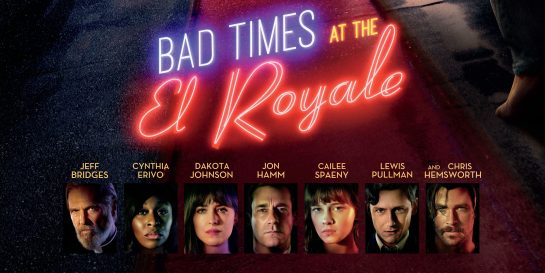
REVIEW: “Bad Times at the El Royale”

EL Royale poster

It’s hard to watch Drew Goddard’s new neo-noir crime-thriller and not think of Quentin Tarantino. For better or for worse “Bad Times at the El Royale” plays like a Tarantino picture. It leans heavily on its style, its characters are a shady lot, violence comes in bloody bursts, and the whole thing is a bit gonzo. But while QT’s unshakable dedication to his brand can often push things over the top, Goddard dials it back. It turns out to be both a strength of the film and perhaps a weakness.

“El Royale” is built almost entirely around secrets and revelation. Goddard (serving as both writer and director) crafts a story thick with plot and every person we encounter is a mystery to be unpacked. He does that through a series of chapters, each focused on a particular character, that tells their backstory and connects them to the main narrative.

El Royale 1

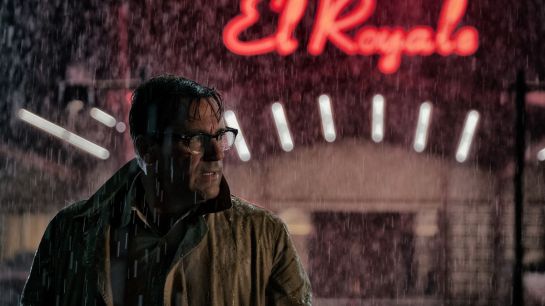
The film is set in 1969 at the El Royale Hotel, a once hopping motor lodge not far from Lake Tahoe. The end-of-the-road property straddles the California/Nevada border with a set of rooms in each state. Upon checking in, the guest can choose between the “warmth and sunshine” of a California room or the “hope and opportunity” on the Nevada side. The lone employee is a less-than-motivated concierge named Miles (Lewis Pullman). But don’t let the bright welcoming neon sign fool you. The El Royale has just as many secrets as the characters we encounter.

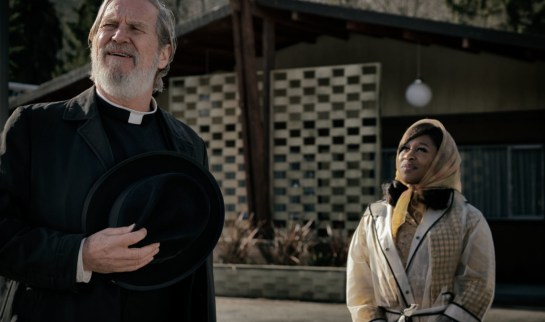
The first person we meet is Darlene Sweet (Cynthia Erivo) a struggling nightclub singer on her way to a show in Reno. There is also Father Daniel Flynn (Jeff Bridges), a priest from Indiana heading to visit his brother. In the lobby they both meet an obnoxious and prattling vacuum cleaner salesman Laramie Seymour Sullivan (John Hamm). The final piece of this twisted human puzzle to arrive is an attitude-rich hippie named Emily Summerspring (Dakota Johnson).

Miles is caught off guard by actual guests and after listening to his scripted spiel they all head off to their rooms. Revealing much more past that would be doing a disservice especially considering how dependent the film is on twists and surprises. What was most surprising was Goddard’s patience before showing all his cards. There are far more dialogue-driven character moments than I ever expected. This undeniably adds to the rather long 141-minute running time (which many have criticized). In some instances they slow things down, but I found these moments worked far more often than not.

El Royale2

It’s hard to say anything bad about Goddard’s presentation. “El Royale” looks fantastic and the camera is constantly doing cool things with angles, shadows and perspectives. Almost every frame is showing off some level of pulpy noir style. Goddard’s past work (“Cloverfield” and “The Cabin in the Woods”) has shown a flair for utilizing evocative imagery. He pushes it further here, really digging into his setting. And he never passes up an opportunity to slip in some 60’s tunes (from Motown to Deep Purple).

“El Royale” is a movie I found to be kind of fascinating. Goddard deftly maneuvers his unconventional narrative while playing with time, tinkering with points of view, and tossing in a MacGuffin or two. At the same time he constantly offers his ensemble cast plenty of meaty moments. And things only get crazier once Chris Hemsworth shows up (I’ll let you figure him out on your own). There is no doubt the movie has a couple of slow spots and its best scenes are during its early ambiguity. But I still had a ton of fun with this weirdly delicious concoction.

VERDICT – 4 STARS
4-stars

REVIEW: “Apostle” (2018)

ApostleBIG

Exploring the world of Netflix Originals can be a fascinating experience. You never quite know what you’re going to get. That especially holds true for their forays into the horror genre. Their new film “Apostle” definitely lands among the stronger titles in their Originals spectrum. Not only that, but it offers up something the horror genre has been in desperate need of – originality.

“Apostle” is written and directed by Gareth Evans best known for his Indonesian martial arts film “The Raid” and its sequel. “Apostle” is a much different venture, not just in terms of genre but with its setting and narrative style. Evans builds his story slowly while constantly giving us small bites of revelation. When the veil is finally dropped and the dots begin to connect, Evans lets loose his Victorian-era horror which is both gruesome and unpredictable.

Apostle1

The film opens with one of the most striking shots I’ve seen all year as a train curls around a large body of water. The camera moves across the surface before resting at the edge of the tracks just as the train speeds by. Aboard is Thomas Richardson (Dan Stevens), a disillusioned and tortured ex-missionary whose opium addiction is all that keeps his sanity intact.

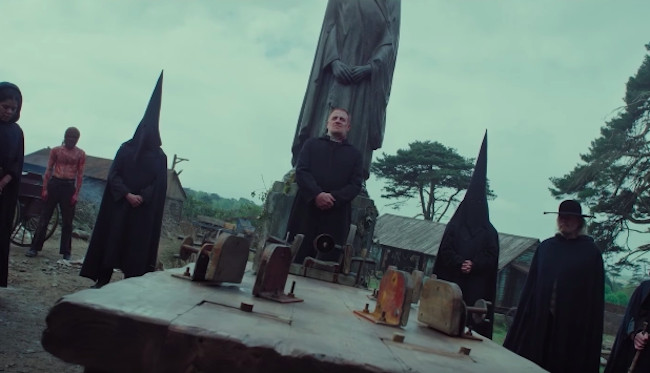
Through a troubling letter Thomas gets word that his sister has been kidnapped by a mysterious cult demanding a ransom. He secretly infiltrates the cult’s ranks to discover his sister’s whereabouts. Even before he sets foot in the isolated island commune led by the charismatic ‘prophet’ Malcolm (Michael Sheen) we get the sense that something is not quite right. This dark and unsettling cloud looms over the entire film.

Stevens’ signature intensity and perpetual razor-sharp focus makes him a good fit for both phases of this story. The first being his arrival on the island and his subsequent investigation. The second which sends things plummeting into the macabre. Stevens gives an uneasy and off-kilter portrayal of a nervously determined man facing darkness both inside and out. It’s a role with a physical and psychological edge to it.

Apostle2

The film’s visual composition is rich with indelible imagery ranging from beautiful to bleak. Evans and cinematographer Matt Flannery use the camera to accentuate the wickedly tense tone while carefully capturing a good sense of period and place. And rarely has a camera better captured a sense of terror. It is only enhanced when teamed up with Fajar Yusekemal and Aria Prayogi’s nerve-shredding score (perhaps the most evocative I’ve heard this year).

“Apostle” is an enthralling and imaginative slice of folk horror that exchanges cheap jump scares for an unrelenting dread. It should be said that this is not a film for the squeamish. The deeper we get into Evans’ fascinating mythology the more brutal and gory things become. The blood-soaked and metaphorically charged second half is sure to leave some squirming in their seats. But it’s fitting in this examination of oppression under the guise of religion and the costs of misguided faith. It also reveals that it is man who often shows himself to be the cruelest among all creatures.

VERDICT – 4.5 STARS

4-5-stars

REVIEW: “The Hate U Give”

hateposter

There seems to be a new wave of movies dealing with one of the hot button social issues of our day – police brutality. It’s an important issue but one often caught up in the mire of politics and emotion. Strong feelings on both sides often lead to the conversation spiraling away from the meat of the matter and into frivolous side debates.

Sometimes what we need is a pointed yet levelheaded examination. For the most part that is what we get in director George Tillman Jr’s “The Hate U Give”, a film adapted from Angie Thomas’ young adult novel of the same name. Without question “The Hate U Give” is looking at its issues from a specific point of view, but that doesn’t undercut the relevance of what it has to say nor does it negate the power with which it says it.

hate2

In what should be a star-making performance, Amandla Stenberg plays Starr Carter. She’s a bit of a chameleon, taking on different personas in the two worlds she occupies. During the day she is one of the only African-American kids in her mostly white private prep school. While there she hides anything that may hint at where she is from. And where is she from? The lower income and predominantly black neighborhood of Garden Heights where she back-pockets and keeps quiet about her school life especially her white boy friend Chris (KJ Apa).

Keeping her two worlds apart is the easiest thing for Starr, but it’s not without complications. A portion of the movie deals with her bouncing between cultures and finding it hard to fit into either. For Starr it becomes about putting off the facades, discovering who she is, and finding her own distinct voice. Unfortunately the catalyst for Starr’s evolution is a senseless act of violence.

Hate3

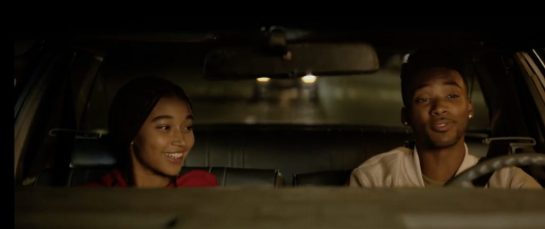
At a late night party in Garden Heights Starr bumps into childhood friend and first crush Khalil (Algee Smith). After gunfire rings out, Kahlil helps Starr out of the party and drives her home. On the way they are pulled over by a patrolman for a lane violation. Minutes later the cop panics, an unarmed Khalil lay shot to death, and Starr is the lone witness.

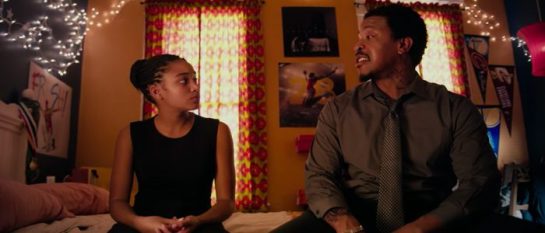
News of the tragedy reverberates throughout the community, the city, and eventually the nation. Starr’s father Maverick (a terrific Russell Hornsby) wants her to use her voice regardless of her apprehensions. Starr’s mother (an equally good Regina Hall) wants her to stay quiet fearing the repercussions of the spotlight. As Starr is torn between defending her friend and protecting her family, others unknowingly treat her like a pawn for their own agendas. It makes finding her voice even more of a struggle.

Hate4

While police brutality is the film’s central topic, it explores a host of other racial and socioeconomic issues. It looks at urban poverty, profiling, drug dealing, protesting, among several other things. Screenwriter Audrey Wells (who sadly died earlier this month) leans on her big lot of characters to explore these subjects. The characters are a strength and even the smallest are authentic and believable pieces of the story. There are a couple exceptions. Her white friends from school often come across as clichés intended to move the narrative in certain directions. And I loved Anthony Mackie as a local gang leader and drug pusher. He is intense and menacing but too often relegated to giving intimidating stares from a distance.

George Tillman Jr. works with a lot of moving parts and manages them with an able hand. He tells a good story while only occasionally dipping too far into melodrama. His movie is very open about about its feelings which is to its credit. At the same time its earnestness occasionally leads the film to paint in broad strokes and dabble in generalizations. But those instances are rare. Ultimately “The Hate U Give” is a film that speaks its mind but does so with optimism. The filmmakers want to make a difference and they truly believe their film can help do so.

VERDICT – 4 STARS

4-stars

REVIEW: “First Man”

FirstPostersmall

As “La La Land” showed us Ryan Gosling and Damien Chazelle have a pretty strong actor/director chemistry. They attempt to tap into it once again with “First Man”, a biopic of the late Neil Armstrong, the first man to walk on the moon. The film has received critical acclaim throughout the festival circuit but also faced a bit of undeserved controversy over the decision to not show the iconic planting of the American flag on the moon’s surface.

The film is an adaptation of James Hanson’s 2005 biography “First Man: The Life of Neil A. Armstrong”. Clint Eastwood was the first to show interest in making the movie, planning to both produce and direct the film for Warner Bros. But it soon fell into ‘development hell’ before being resuscitated by Universal and Dreamworks. Screenwriter Josh Singer (who won the Best Original Screenplay Oscar for “Spotlight”) writes the script with Chazelle directing. Talk about an exciting combination.

First Man

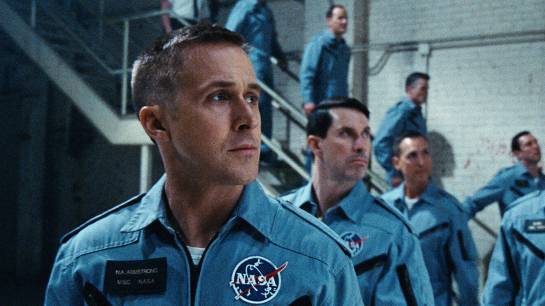
“First Man” comes at Neil Armstrong’s life from an interesting angle. It covers roughly 8 years, from his time as a NASA test pilot to his historic Apollo 11 moon landing. But the film’s main focus is on the man himself and it views most things through a very personal lens. And even though we get a look into Armstrong’s life, by the end of the film he remains a bit of an enigma although an intensely sympathetic one. I loved that about the movie.

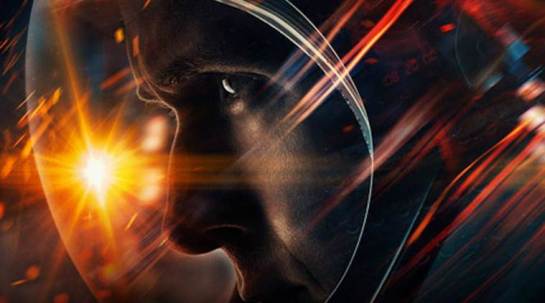
I’ve always found there to be a dryness to Ryan Gosling’s acting and it’s the material that often dictates the effectiveness of his performances. He turns out to be a perfect fit for Neil Armstrong, portrayed here as a humble man of few words who feels as distant and unexplored as the space outside our atmosphere. Gosling’s consistent restraint only adds to his character’s complexity. It’s through Chazelle’s camera (often in tight closeups of Gosling’s face) that we get clues to what Armstrong is feeling. Meaningful subtleties in Gosling’s expressions portray grief, fear, determination, even exhilaration.

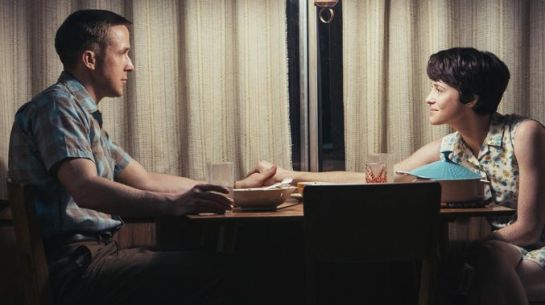
Chazelle has shown a fascination with the idea of obsession. In “Whiplash” it was with drumming. In “La La Land” is was with jazz. Armstrong’s obsession is with his work but it’s rooted in something deeper. Very early in the film Neil and his wife Janet (a terrific Claire Foy) lose their 2-year-old daughter Karen to cancer. That shadow looms over the entire film as Neil buries himself in his work to keep from dealing with his loss. It’s what drives his determination.

First2

At the same time it adds an undeserved burden on Janet. A huge chunk of the film looks at the domestic side of Armstrong’s life. These scenes are far more than emotional filler. They show us the flip-side of Neil’s sorrow-fueled obsession. Foy is nothing short of superb here – showing Janet as supportive of her husband but slowly losing patience with his detachment. At the same time she lives under the constant fear that her husband could die on any given day.

In one of my favorite choices, Chazelle shoots the space sequences almost exclusively from the astronaut’s perspectives, avoiding the grand effects-driven spectacles we might expect. These scenes are sensory experiences, relying on movement, sound, and a camera that is mostly inside the tight confined cockpits with the astronauts. These scenes are intensely claustrophobic and relay the sense of tension and danger.

Look no further than the incredible opening sequence. During a test flight Neil finds his X-15 “bouncing off the earth’s atmosphere” before bursting back through and landing in the Mojave Desert. It’s a pulse-pounding scene of roaring engines, whirling gauges and fiercely vibrating metal. The mix of sound and close-quartered cameras is a good primer for the bigger sequences to come.

First3

Of course one of those scenes the film’s big finale. In one of the biggest non-spoiler spoilers Neil Armstrong does indeed walk on the moon. The brilliant final 20 minutes features the same stressful ferocity but also a striking use of silence. The scene is the closest the film comes to giving us an emotional release and offers new meaning to Neil’s iconic first steps on the moon. Chazelle doesn’t romanticize these moments. They are intimate and personal which I believe invalidates the entire flag “controversy”. But for those still unconvinced, we do get shots of the flag on the moon and in numerous other places around the movie.

While Gosling and Foy are the stars there is a wonderful supporting cast that help fill out their story – Jason Clarke, Kyle Chandler, Corey Stoll, Pablo Schreiber, Lukas Haas, Shea Whigham, Ciarán Hinds and a host of other recognizable faces and good performances.

There are so many other things I love about “First Man”. I love Chazelle-faithful Justin Hurwitz’s score which truly came alive after a second viewing. I love that the film doesn’t feel the need to hold our hand and explain every detail of the science or technology. I love that this reluctant hero is portrayed as a human being and not a pop culture icon. I love its apolitical focus which seems consistent with the astronauts who isolated themselves from the culture to focus on their missions. But most of all I love that it makes its own rules when it comes to storytelling. This is what happens when a biopic doesn’t cater to formula or expectations. The results are magnificent.

VERDICT – 4.5 STARS

4-5-stars