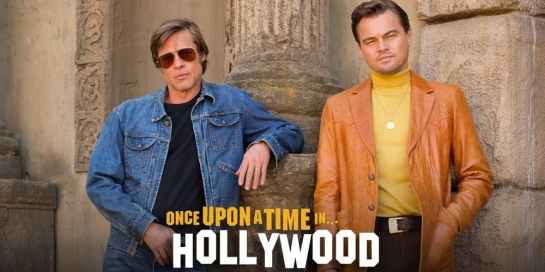
SPOILER WARNING: If you haven’t seen “Once Upon a Time in Hollywood” be warned.
Quentin Tarantino movies are no strangers to controversy and you could say the notorious filmmaker has courted that kind of attention throughout his career. Sometimes his provocations are potent and edgy. Other times they are rooted in ridiculous amounts of excess and overindulgence. So the fact that people are talking about his new film is no surprise.
What does surprise me is the sheer volume of outrage sparked by “Once Upon a Time in Hollywood”, a movie I stand by as Tarantino’s tamest, most mature, and (shockingly) most compassionate film to date. Yet the accusations are serious, troublesome, and (if true) cause for serious concern. Some have branded the film racist, misogynistic, even deeply conservative (gasp). Others have went as far as to say it condones/defends violence against women while pointing fingers at the ‘whiteness’ and ‘maleness’ not only the lead characters but also of those who defend the film (my wife loved it too, so there’s that).
These accusations are weighty enough to warrant respectful consideration especially considering Tarantino’s not-so-spotless track record. So I’m not into berating different opinions or other readings of his latest movie. But I do profoundly disagree with the majority of these particular criticisms, not because I’m a white male whose thought process is defined and controlled by those characteristics. But because I believe the movie itself offers some significantly different readings of its ‘controversies’. Here are some of them…
FINAL SPOILER WARNING: Plot details ahead……
Sharon Tate: Complaints about Sharon Tate’s inclusion in the film were almost immediate. Many felt it was insensitive but over time the issues have evolved. Now most of the criticism is in how little dialogue Margot Robbie is given and how “pointless” Tate is to the story, both things rooted in Tarantino’s chauvinism. Actually Tate’s role is far from pointless and her sparse dialogue makes sense considering (1) This isn’t a movie about Sharon Tate and (2) Her character has a very unique (and I would argue beguiling) role to play in the film.
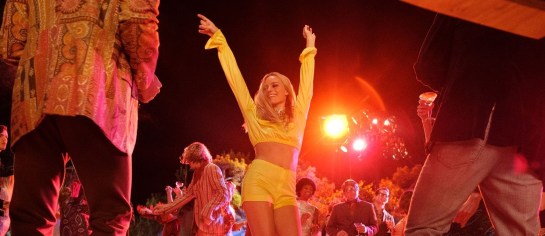
Not to rehash my review, but Sharon Tate is as much of a symbol as a character. In the film Tate represents innocence, goodness, and compassion. She is a constant ray of light and Tarantino shoots her with an ever-present glow. I found Robbie to be very effective in conveying these ideas. Interestingly, her vitality and optimism stands in sharp contrast to the darkening societal backdrop. And there is a looming sense of dread as history tells us where her story is heading. And about that…
The Ending: There are so many elements to Tarantino’s ending that I love. First, it’s essential to know that so many of his movies take place in alternate realities. These worlds he creates look like ours and often function like ours, but they are hardly beholden to our rules. And Tarantino has shown an affection for taking dark points in history and turning the tables. In “Django Unchained” the slave bests the slave owners. In “Inglourious Basterds” the Jewish-American militia bests Hitler and his generals.
He employs the same idea in “Once Upon a Time in Hollywood”. In this world the Manson family members (one male, two females) are brutally beaten and burned before ever reaching a pregnant Sharon Tate and her friends. It’s an intensely graphic sequence with a dash of absurdist comedy tossed in. Yes, it was at the hands of two men, but for me this wasn’t Tarantino flipping his nose at violence towards women. It’s an alternate take on what was in reality the savage and unrepentant slaughter of five innocent people. It’s the Tarantino twist of really bad people getting their comeuppance.
One of the sweetest things about this ending is how it attempts to distance Sharon Tate from what culture always associates her with – victimhood. In Tarantino’s timeline Tate isn’t forever connected with the Manson family. She still has a future, a career, a baby to give birth to and raise. Again, she is a symbol of hope and this film hope doesn’t die on the Manson family’s blade. And that final crane shot showing Sharon and her friends coming out to meet Rick really drives this home.
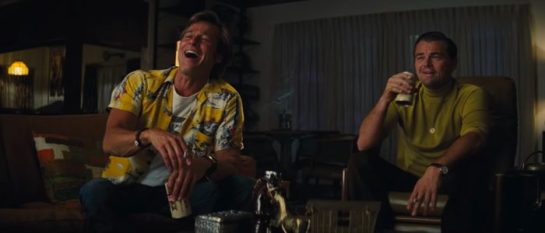
Cliff Booth: For me, Brad Pitt absolutely steals the show and I found his Cliff Booth character to be the most intriguing of all. But some see him as yet another example of the film’s misogyny. Much of that comes from a single question the movie doesn’t clearly answers – did Cliff kill his wife?
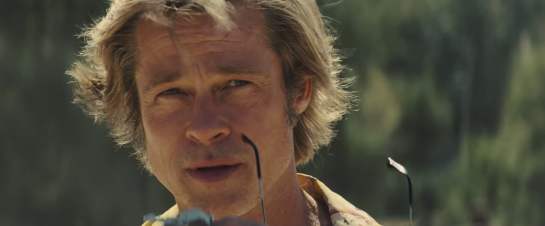
Tarantino sets his audience up to draw their own conclusions. If you buy that Cliff is a cold-blooded killer then naturally the character and how he is depicted will be problematic. But the movie doesn’t offer definitive proof. In fact, I would say it offers more reasons to believe that things aren’t so black-and-white. Does the movie exonerate him? No it doesn’t. But it doesn’t convict him either. His angle could just as easily be about Hollywood gossip, blacklisting, etc.
And think of his other actions throughout the film that would seem to clash with those of a cold, calloused murderer. He’s friendly, laid-back, and easy-going. He’s loyal to his friend, ever content, and a constant encourager. He turns down the sexual advances of an attractive minor. He cares enough to check on an elderly friend who may be in trouble at Spahn Movie Ranch. Once again, you could view it all through a misogynistic lens, but for me it’s tough to reconcile that reading with the character we get on screen.
Bruce Lee: I have to admit this one surprised me a bit. The movie has been called insensitive, disrespectful, and in some cases racist for a particularly funny scene between Cliff and Bruce Lee (remarkably played by Mike Moh). In the sequence we see a cocky Lee holding court on a studio backlot. Cliff calls him out and the two engage in a silly hand-to-hand challenge. It ends in a draw and the whole thing plays out as a big gag. But some have taken Lee’s depiction in the film seriously. Respectfully this includes his daughter Sharon.
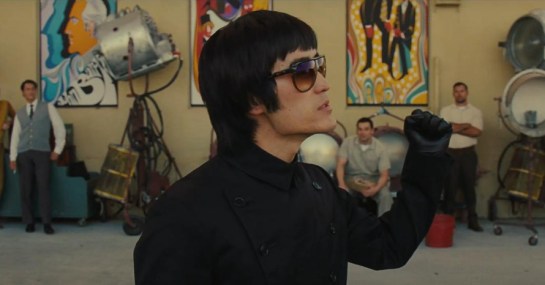
First, it’s key to recognize that the entire scene is framed as a recollection. Sure, it’s meant to show that Cliff could hold his own with one of the greatest, but it’s still his recollection of the encounter from his point of view. Second, this isn’t the only time we see Bruce Lee in the film. There is a brief but tender moment between him and Sharon Tate that shows a side of the martial arts star dramatically different from what we see in Cliff’s memory. So it makes sense that one scene is a guy’s silly memory to the time he duked it out with Bruce Lee while the other shows a truer and more compassionate representation of who he really was.
Once again Tarantino is a filmmaker who too often provokes these types of conversations. It’s a shame because I do believe “Once Upon a Time in Hollywood” is a truly great film. And I’m no Tarantino apologist (as followers of this site certainly know). But his latest movie has stoked a fascinating array of interpretations. For what they’re worth, these are mine. Nothing more, nothing less. So, what say you?

 Keith & the Movies