(CLICK HERE to read the full essay in the Arkansas Democrat-Gazette)
TIME magazine called it “The Spielberg Summer”. 40 years ago this month, the acclaimed director of such hits as “Jaws”, “Close Encounters of the Third Kind” and “Raiders of the Lost Ark”, released two big movies one week apart. “Poltergeist” hit theaters June 4th and “E.T. the Extra-Terrestrial” followed close behind on June 11th. Both films were critical and box office successes and further cemented Steven Spielberg as the king of the Hollywood blockbuster.
“Poltergeist” ended up being the highest grossing horror film of 1982 and the year’s eighth highest grossing movie overall. It also earned three Academy Award nominations (Original Score, Sound Effects Editing, Visual Effects), losing all of them to Spielberg’s other film, “E.T.”. A global phenomenon, “E.T.” became the highest grossing film of all-time (toppling “Star Wars”), a distinction it held for eleven years until another Spielberg film, “Jurassic Park” took the honor. Still, “E.T.” left a major mark, earning nine Oscar nominations of its own, including one for Best Picture.
These days we’ve grown accustomed to franchises and tent-pole blockbusters. They’re what drive the current box office. But in 1982 it was a pretty big deal, especially coming from a filmmaker of Spielberg’s caliber. Back then more people held the big screen experience in high regard, and trips to the movie theater really meant something for many of us. In addition to the immersive and communal qualities of watching a movie in a dark room with a group of total strangers, theaters provided our only access to new films. There was no internet meaning there were no streaming services. And the video rental boom was near but it hadn’t fully bloomed yet. So we went to the theater. It was special.
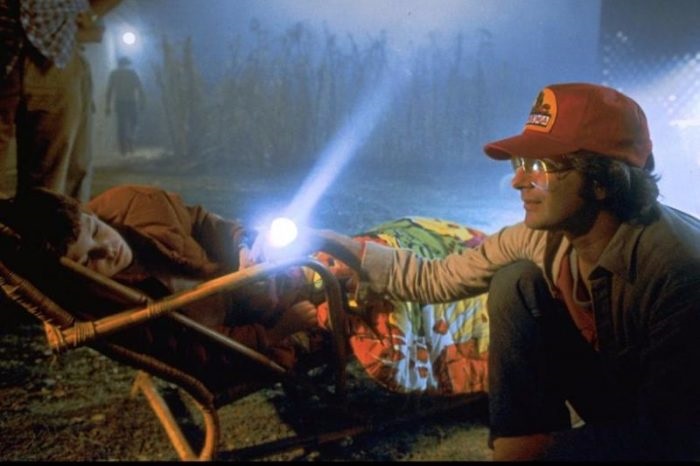
“Poltergeist” is considered a Steven Spielberg film although the level of his involvement has been debated for decades. Spielberg conceived the story, co-wrote the script, and co-produced. But he was already at work making “E.T.” and a clause in his contract forbid him from directing another film while still in production. So Tobe Hooper (“The Texas Chainsaw Massacre”) was brought on to direct. Accounts vary on who had creative control with some going as far as proclaiming Spielberg as co-director. Co-producer Frank Marshall insisted Spielberg was “the creative force of the movie” while in a 2012 interview several cast and crew members credited Hooper.
Controversy aside, “Poltergeist” has Spielberg’s fingerprints all over it. It’s perhaps best known for a chillingly calm five-year-old Heather O’Rourke standing in front of a snowy television screen uttering the words “They’re heeeere.” But watching it again I was reminded of its many strengths that go beyond its fun but somewhat dated special effects. There’s the mischievous jolt it gave to the old-fashioned ghost story. There’s its hefty focus on developing a genuine and relatable family. There’s the terrific Zelda Rubinstein as an eccentric clairvoyant who brings a wonderful energy and kookiness to the film’s second half.
“Poltergeist” was well received by audiences at the time and has won over numerous skeptics in the decades that have followed. Generally speaking, critics also liked it although there were a few notable exceptions (Pauline Kael notoriously dismissed it as a “dumb concoction” and “entertaining hash“). And while it made good money, its box office numbers could have been even higher if not for the movie that came just one week later.
“E.T. the Extra-Terrestrial” was conceived, directed and co-produced by Spielberg, and its creative control was never in question. Despite claims he had plagiarized the film from an unproduced script by Indian filmmaker Satyajit Ray, Spielberg maintained that “E.T.” was inspired by the childhood imaginary friend he invented following his parents’ divorce. Whichever is true, “E.T.” was an instant hit. Including its two re-releases, the film has grossed just under $800 million.
Its massive popularity led to “E.T.” becoming a merchandising goldmine. Plush toys, storybooks, breakfast cereal, lunchboxes – the film generated over $1 billion in merchandising alone. Yet one reason “E.T.” remains one of Spielberg’s most beloved movies is that it wasn’t made just for kids. He gave audiences more than a suburban fairy tale about a young boy who befriends a homesick alien. He gave them a touching portrait of youth that kids of all ages could relate to.
As “Poltergeist” and “E.T.” turn 40-years-old, I can’t help but look back at June, 1982 with a particular sense of longing. Don’t get me wrong, I still enjoy many of today’s blockbusters, and I can get caught up in the near rabid excitement that surrounds certain high-profile releases. But this is a more homogenized era where blockbusters more often than not revolve around sequels and franchise-building. That’s why it’s easy to reflect on “The Spielberg Summer” with such fondness. It reminds me of a time when big summer movies and our first experiences with them were truly memorable. But then again, maybe I’m just old.






 Keith & the Movies