
REVIEW: “Alice, Darling” (2022)

The new film “Alice, Darling” sets out to shine an honest and earnest light on the issue of psychological and emotional abuse. In her feature directorial debut, Mary Nighy takes this undeniable potent subject matter and examines it from a distance, yet with remarkable clarity. Along the way, she also looks at the bond of friendship and the importance of having supportive people in your life who you can trust unconditionally outside of your partner.

Written by Alanna Francis, “Alice, Darling” takes a strategic and ultimately impactful approach to its central subject. Rather than concentrating on the actual abuse and showing it as it happens, the film reveals more through its effects, namely on a young woman named Alice. The crippling anxiety, the loss of all self-confidence, the physical self-harm – just some of the signs shown that paint a vivid picture of what a victim may sometimes endure. It’s tricky material, but Nighy handles it well by showing restraint and (mostly) avoiding the dramatics.

The film stars Anna Kendrick, a steady hard worker who has put out at least one movie a year for most of her 20-year career. She’s an interesting actress who often plays somewhat similar characters despite the kind of movie she’s in. And while much of her work has been related to comedy, she has taken on some more serious roles, mostly in supporting turns (she received an Oscar nomination for 2009’s “Up in the Air”).
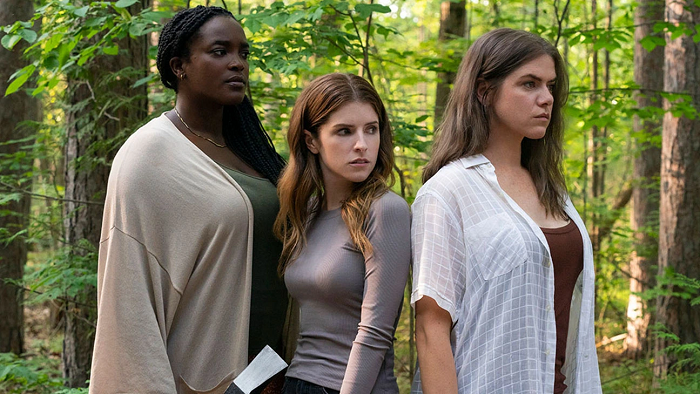
Image Courtesy of Lionsgate

Here, Kendrick is given her heftiest dramatic role playing Alice, a psychologically battered young woman who tries her best to mask the emotional distress brought on by her relationship with her obsessive and controlling boyfriend, Simon (Charlie Carrick). He’s an up and coming artist whose entire world revolves around his wants and needs. He puts on a good show, but he’s a much different person when not hobnobbing with potential backers.

Simon’s abuse isn’t the out-and-open kind. It’s hidden under a veil of sincerity. He tells Alice how much she means to him. He buys her nice things. He proudly introduces her to all his art world friends. In some ways Simon is self-deluded enough to think those things alone make him a good partner. But as the movie progresses, we get a better sense of his unbridled self-absorption and smothering control. He routinely shames and manipulates Alice, exploiting her vulnerability and stripping her of all self-esteem. And we see it taking its toll.

It all comes to a head after Alice is invited to join her friends Sophie (Wunmi Mosaku) and Tess (Kaniehtiio Horn) for a week-long lake house getaway. Rather than tell Simon where she’s going, Alice makes up a fake business trip story and heads off with her pals. She puts on a good face and keeps the ruse hidden. But she can’t fully hide her troubled state of mind. Her friends suspect something is wrong and try to get her to open up. But Alice keeps everything bottled up to the point where she starts to unravel.
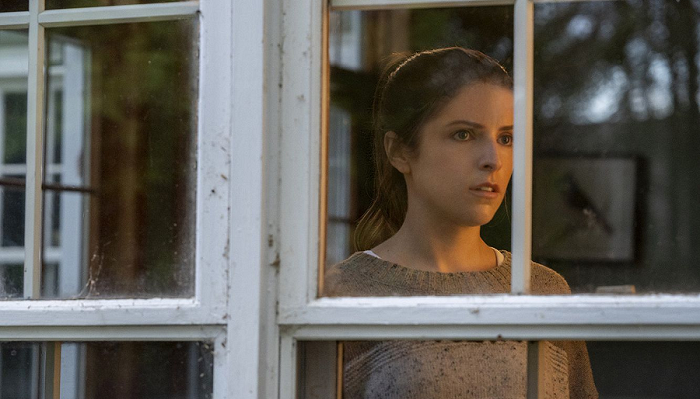
Image Courtesy of Lionsgate

Nighy does a good job exploring the dynamic between Alice and her friends. Sophie and Tess can see through Alice’s front, and it’s easy to tell she’s not the same person she used to be. They attempt to break through to her, pointing out her disconnection and questioning the obsessive way Simon texts her and tries to guilt her into coming home. Overall it’s an eye-opening look at friendships; more specifically the supportive systems often found within them. And Nighy uses the dramatically different personalities of Sophie and Tess to show the different sides of such vital relationships.

But so much comes back to Kendrick and her performance which feels rooted in a personal lived experience (In fact it was. Kendrick recently revealed to PEOPLE magazine that she was inspired to do the movie following her own experience in an emotionally and psychologically abusive relationship). It’s a surprisingly subtle portrayal of a woman crumbling, with Kendrick never overplaying it yet vividly conveying the lasting impact of abuse.

While the story starts to come unglued in the final 15 minutes, the most notable misstep is a needless tacked-on subplot involving a missing girl. The metaphor is glaringly obvious, but it’s the idea of using a missing girl that is problematic. It’s not the most tasteful choice. It certainly doesn’t undermine what is otherwise an honest and insightful drama. But it does routinely pull us away from the many things the movie does well. “Alice, Darling” is now showing in select theaters.

VERDICT – 3 STARS

SUNDANCE REVIEW: “A Little Prayer” (2023)

The always terrific David Strathairn stars in the equally terrific “A Little Prayer”, a low-key Southern melodrama that premiered at the Sundance Film Festival before being picked up by Sony Pictures Classics. This delightful and warm-hearted ensemble film is a beautifully sketched family portrait that doesn’t gloss over the imperfections that make us human. In fact, writer-director Angus MacLachlan (who penned 2005’s “Junebug”) embraces those imperfections and the results are honest and deeply affecting.

Set and shot in his hometown of Winston-Salem, North Carolina, “A Little Prayer” is clearly a personal endeavor for MacLachlin. His affections, sensibilities, and experiences can be seen and felt in every frame, character, and story turn. His story revolves around a seemingly average Southern family who live in a cozy and quiet neighborhood accented by tweeting songbirds and tall oak trees. But once you get past the idyllic charms, MacLachlin reveals a troubled family and a patriarch’s well-meaning attempts to hold it together.

Strathairn plays Bill Brass, the owner of a local sheet metal company which he runs with his son David (Will Pullen). Both are war vets (Bill served in Vietnam; David in Afghanistan), a detail that subtly plays into the story later on. Bill finds himself more and more preoccupied with the problems of his two adult children. David is an alcoholic and all signs point to him having an affair with their company’s bookkeeper Narcedalia (Dascha Polanco). Bill’s crude deadbeat daughter Patti (Anna Camp) shows up unannounced with her daughter Hadley (Billie Roy) needing a place to stay after leaving her opioid-addicted boyfriend for the umpteenth time.

You can tell Bill’s concern for his kids is weighing on him. But a ray of light comes in his relationship with his daughter-in-law Tammy (a sublime Jane Levy). The two are kindred spirits from different generations, and there’s such warmth and trust in the connection they share. Like a father, Bill sees Tammy as one of his own and he relishes their closeness – something he doesn’t have with his own kids. For Tammy, Bill is a tender father figure – something she lacked in her abusive childhood household in Kentucky.

One of my favorite touches involves a mysterious reoccurring voice that pierces the otherwise peaceful morning air. It’s the voice of a woman singing old gospel hymns in the distance. Bill and Tammy find it soothing and are enchanted by it. They even go out one morning to see which neighborhood house it’s coming from. Certain others in the family mock the heartfelt spirituals and find it obnoxious. The different reactions tell us a lot, as does the voice’s sudden absence at very specific points in the film.

While Strathairn and Levy have an exquisite father-in-law and daughter-in-law chemistry, other characters add a richness to MacLachlin’s story. None are better than the endearing Celia Weston as Bill’s wife, Venida. Weston steals scene after scene playing a straight-shooting but tender-hearted Southern woman who will have you laughing out loud in one scene and breaking your heart in another. Polanco shines in a crucial scene that breaks her character out of the typical side-dish mold. And Camp nails Patti, a veritable whirlwind of irreverent and self-destructive chaos.

As individual secrets are brought into the light, Bill comes to the painful realization that he can’t mend every fence or control every outcome. And no matter how much it hurts, there’s a point where he may have to let go. Meanwhile, we learn that there’s a quiet strength underneath Tammy’s meek and modest exterior. She knows more than she shares, and she’s willing to make difficult choices – some that could weigh on her for the rest of her life.

While pulling back the many layers of family drama, MacLachlan keeps things fittingly understated throughout. Some of the reveals could have easily sent the film spiraling. But MacLachlan maintains a remarkable and steady control, never allowing his story to cross over into soapy sentiment. It’s obvious he trusts his script, and it doesn’t hurt to have such a top-to-bottom terrific ensemble led by David Strathairn. He could make combing his hair in front of a mirror compelling. And he brings that signature authenticity to a character and a movie that I was in tune with from its open frame to the closing credits.

VERDICT – 4.5 STARS

REVIEW: “American Murderer” (2022)

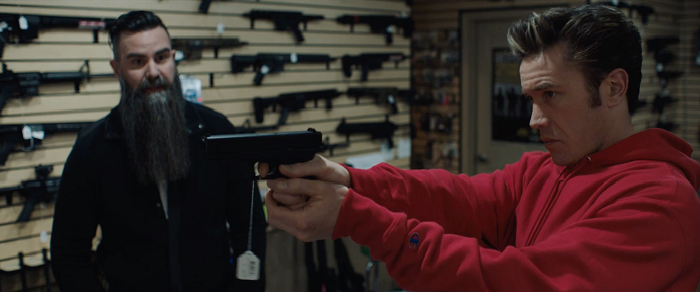
For fans of true crime, writer-director Matthew Gentile’s feature film debut “American Murderer” makes for a sturdy genre entry. It’s a crime thriller based on the true story of Jason Derek Brown, a crafty and charismatic conman who became one of the most wanted fugitives in the United States. In 2007 he was placed on the FBI’s Ten Most Wanted List where he remained until September of last year. Despite years of countless tips and the Bureau’s efforts, Brown has yet to be captured.

On November 29, 2004 a gunman believed to be James Derek Brown shot and killed a 24-year-old armored car guard outside of a Phoenix movie theater. At approximately 10 AM, Robert Keith Palomares walked out of the theater with $56,000 in weekend deposits. He was immediately ambushed by a hooded Brown who shot Palomares five times in the head before fleeing with the bag of money. Eyewitnesses and security cameras helped authorities to pinpoint Brown as their suspect.

Gentile uses a fractured timeline structure to tell Brown’s story, nimbly moving us from one point to the next through the investigation of a dogged FBI agent named Lance Leising (Ryan Phillippe). We follow Leising as he interviews those close to James who may have information he can use. During the interviews, we’re treated to a series of flashbacks that give us a better picture of James Derek Brown. In them he’s played with a wicked allure by Tom Pelphrey.

Pelphrey’s convincing portrayal reveals to us a narcissistic sociopath who is able to conceal his devilish true self behind a facade of sensitivity and charm. We watch as Brown, with no conscience and no remorse, lies, scams, and steals in an effort to maintain his lavish yet spurious lifestyle. Along the way, those he cons range from a trusting single mom (Idina Menzel) and a low-rung street hood (Moisés Arias) to his very own sister (Shantel VanSanten) and mother (Jacki Weaver).

Despite knowing it all culminates in a cold-blooded murder, it’s mostly through his interactions with the above characters that we realize the depths of Brown’s depravity. In one sense it’s a fascinating watch – seeing how systematically he goes along with his ruse and observing his callous disregard for his victims. There are a couple of brief breaks where we do see what looks like genuine compassion, mainly towards his sister. But even those moments are tainted by his shameless self-regard.

But in another sense, it would be nice to know the other side of James Derek Brown – from before he became hopelessly irredeemable. In fairness, “American Murderer” is focused on a specific time frame in Brown’s life. It seeks to show the immediate events leading up to him brutally murdering Robert Keith Palomares. But it feels like we’re missing so much of his story. There are a couple of childhood flashbacks and we hear allusions to who he used to be. But it’s never quite enough to give us a well-rounded perspective.

Yet Gentile does a terrific job of keeping us invested, straight through to the broad daylight, execution styled murder. Much of it is due to his keen direction, more specifically his efficient pacing and the methodical way he builds towards the story’s fatal crescendo. And he’s helped by all-around good performances, especially from Pelphrey who loses himself in a truly diabolical role. I still wish I had a better grasp of his character, but there’s no denying that Pelphrey delivers one of the most seductively vile villains you’ll see on screen. “American Murderer” played in select theaters and is now available on VOD.

VERDICT – 3.5 STARS

REVIEW: “A Man Called Otto” (2022)

Tom Hanks teams with director Marc Forster for “A Man Called Otto”, the second film adaptation of Fredrik Backman’s 2012 novel “A Man Called Ove”. I loved its first big screen treatment from Hannes Holm. It’s a witty dark comedy but with a warm and tender center. That 2015 Swedish movie would go on to receive a Best Foreign Language Film nomination at the 89th Academy Awards. So Forster is following in some pretty big footsteps.

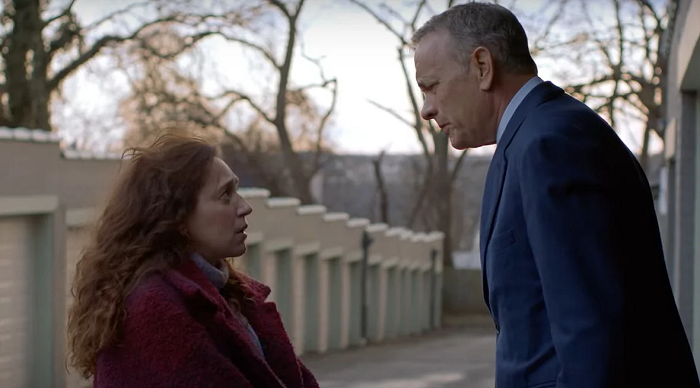
Hanks plays the titular character, Otto Anderson, a crusty old curmudgeon who we first meet reaming out two young associates at a hardware store. It’s the perfect introduction cranky and perpetually unpleasant 60-year-old Otto. He lives in a modest gated community where he runs things with an iron fist, despite having no real authority. He’s constantly annoyed by the “idiots” in his neighborhood who mostly take his griping with a grain of salt. He also clashes with the reps of a rich land development company who are trying hard to push him and the other residents out.

Image Courtesy of Columbia Pictures

Adding to his soured view on life, Otto was recently forced to retire from a job he’s been at for 40 years. But what has affected him the most is the recent death of his beloved wife Sonya. Unable to fully cope with her loss, Otto decides to take his own life. Yet despite his determination, he discovers that killing himself is no easy task, in large part thanks to his new neighbors, Marisol (a very good Mariana Treviño), her kind but inept husband (Manuel Garcia-Rulfo), and their two adorable young daughters, who unknowingly interrupt every attempt he makes.

As you can tell, there’s definitely a black comedy element that I honestly expected to be sanitized in this American version of the story. But Forster and screenwriter David Magee (“Life of Pi”) stay faithful and the movie is better for it. Watching Otto buy rope, call to cancel his utilities, lay visqueen across his floor, and dress up in his best suit one last time is both sad and solemn. But Forster never lets things get too dour. The young and vibrant new family next door routinely inject a timely dose of heart and humor. To Forster’s credit, he does a nice job balancing both elements.

There are several other supporting characters who weave in and out of the movie. Some add warmth, some are there simply to serve Otto’s redemption, and some feel like well-intended but tacked-on attempts at updating the story. The plot-lines work much the same, with some adding good laughs and feel-good moments while others seem thrown in for one effect or another. This is where the movie can come off as a bit uneven.

Image Courtesy of Columbia Pictures

But it all revolves around Hanks and his effortlessly good performance. The ever likable actor does a good job selling himself as an irritable grouch, even though we know the movie is about him softening up over time. He also has some good chemistry with Treviño who has an inherent sweetness that eventually melts Otto’s stony heart. Hanks sells his transformation too, never getting too schmaltzy or over-the-top with it. The material occasionally handcuffs him (such as his sudden undercooked relationship with one of his wife’s former students), but Hanks keeps things afloat, earning a few chuckles and our empathy along the way.

“The Man Called Otto” doesn’t quite have the edge or the oomph of Holm’s 2015 film, but it has more than enough to win over some audiences. It’s a fairly effective crowdpleaser that admittedly might have caused this old leathery film critic to mist up a time or two. And with the always enjoyable (and bankable) Tom Hanks as its lead, you would figure it should grab some attention. But it is releasing in what has become known as the January movie wasteland, so how it will do is anyone’s guess. “A Man Called Ottot” opens in theaters January 6th.

VERDICT – 3.5 STARS

REVIEW: “Avatar: The Way of Water” (2022)

In 2009, the world of movies was forever changed by “Avatar”, a science fiction epic born from the mind of James Cameron. The movie was a box office phenomenon, and it remains the highest grossing film of all-time. Technically, “Avatar” was a groundbreaking film that pushed visual effects to entirely new heights. It also reintroduced 3D to the big screen, using it in the most dazzling and immersive way ever seen. Of course the 3D craze didn’t last, mainly because no one could match what Cameron was able to do with it.

But while “Avatar” was a technical marvel, its story was a letdown. It was basically ripped straight from “Dances with Wolves” but with a futuristic sci-fi angle rather than a historical one. It also suffered from Cameron’s heavy-handed sermonizing on everything from the environment to corporate America to the military. It wasn’t that he had a message. It was that he pounded us over the head without an ounce of nuance or subtlety.

After thirteen years, James Cameron is back on Pandora with “Avatar: The Way of Water”, a nearly $400 million sequel that once again pushes the art of movie special effects to the proverbial next level. It’s a jaw-dropping motion picture spectacle unlike anything I’ve seen on the big screen before. Not only does it demand to be seen in the theater, it once again sees Cameron doing things with 3D technology that no one else has ever done. Not to sound hyperbolic, but you have to see it to believe it.

Image Courtesy of 20th Century Studios

On the flip-side, Cameron isn’t best known for seamless storytelling and “Way of the Water” has its issues there. But the story is considerably better this time around, with Cameron getting away from the on-the-nose preachiness and giving us something that’s more intimate and that does a good job progressing the characters and their stories. I’m an admitted sucker for movies about family, and that theme resonates all throughout “The Way of the Water”. There’s also an overarching theme of empathy that plays out through multiple relationships.

Sam Worthington returns as Jake Sully, a former human and now full-on Na’vi. Over a decade has passed since the first film, and Jake is now chief of the Omaticaya forest tribe. There he and his wife Neytiri (Zoe Saldaña) happily raise their family which includes their oldest son Neteyam (Jamie Flatters), their headstrong second son Lo’ak (Britain Dalton), their youngest child Tuk (Trinity Jo-Li Bliss), their adopted teenage daughter Kiri (Sigourney Weaver), and their adopted human son Spider (Jack Champion) who was born of Pandora and rescued by Jake and Neytiri.

While Jake’s life seems ideal, he has long feared the return of the “sky people”, aka the Resources Development Administration from planet Earth. In the first film, the RDA came in the form of a science mission and a mining operation. But within the first few minutes of the sequel they make their return, scorching a huge section of the forest to build their massive base of operations. Rather than being accompanied by a small but aggressive security team, this time the RDA have brought a bigger military presence. And rather than mine, they’ve come to colonize – to find a new home for humanity after depleting their own world’s resources. Their first step – pacify the natives.

Leading the charge is the film’s main antagonist, Colonel Miles Quaritch (Stephen Lang), killed in the first movie but cloned as a Na’vi complete with all of his old uploaded memories. Quaritch is tasked with leading a unit of fellow recombinants to find and eliminate Jake Sully. Initially Jake, Neytiri and the Omaticaya fight back. But realizing the danger he brings to his family and people, Jake and Neytiri take their children and flee far away from the forest, eventually finding refuge with a water tribe called the Metkayina led by Chief Tonowari (Cliff Curtis) and his wife Ronal (Kate Winslet). But to no surprise, the ruthless and dogged Quaritch stays hot on their trail.

Image courtesy of 20th Century Studios

At a hefty three hours and twelve minutes, Cameron’s story covers a lot of ground. He spends a big chunk of his time on world-building, introducing his audience to a whole new part of Pandora. The Metkayina tribe make their home on a giant reef that’s full of exotic aquatic plant and animal life. Cameron and his creative teams go all out designing and visualizing this vivid underwater ecosystem with just as much time put into exploring the Metkayina culture. The movie does slow down a tad during this long middle stretch, but there’s always something new and often jaw-dropping to take in.

In addition to shooting in state-of-the-art 3D, the film also features underwater performance capture, an incredibly impressive feat requiring its own newly developed tech. Then there was the decision to shoot at a higher frame rate. There are several instances where Cameron bumps the standard 24 frames-per-second up to 48 fps, giving the film a more crisp and realistic appearance. It’s a choice that won’t be for everyone, and its clarity and quality may depend the theater screen you see it on. Personally, I loved the higher frame rate.

Of course “The Way of the Water” is also full of big eye-popping action which is something James Cameron knows a lot about. The set pieces are as thrilling as they are massive, and the above-mentioned technology really shines in them. The performances are also good with both Worthington and Saldaña especially shining. As for Lang, he’s mercifully dialed back and less hammy this time around, and the movie does some interesting things with his character. Again, the story may stumble in a few spots. But it’s still an exciting step up from the first movie. And as an experience, visiting Pandora has never felt so exciting and full of life. “Avatar: The Way of Water” is in theaters now.

VERDICT – 4.5 STARS

REVIEW: “The Ambush” (2022)

Based on an actual event, “The Ambush” tells a remarkable story of heroism, sacrifice, and survival through a harrowing encounter in war-torn Yemen. Directed by Pierre Morel (“Taken”), the film first released on November 25, 2021 in the United Arab Emirates. Since, it has gone on to become the country’s highest grossing Emirati film ever made. With its setting, intensity, and overall quality, “The Ambush” is a solid entry into the war film catalog.

For context, in 2015 following years of civil unrest, the foreign backed Al Houthi Militia overthrew the government of Yeman and seized control of the vast majority of the country. As a war broke out between rebels and loyalists, innocent civilians paid a heavy price. The instability strengthened many terrorist groups in the region leading Yemini President Hadi to reach out to his international allies for help. As part of a gulf coalition, members of the UAE military were deployed with many patrolling the area and providing much-needed aid to civilians. After three years, the coalition was still trying to help stabilize the ravaged region.

Image Courtesy of Well Go USA Entertainment

The film opens with the obligatory introduction to the UAE soldiers we’ll be spending most of our time with. At Mocha Base in Southern Yemen, Ali (Marwan Abdulla Saleh), Bilal (Khalifa Al Saadi), and Hindasi (Mohammed Ahmed) are only one week away from getting to go home to their families (rarely a good sign at the start of a war movie). While out on one of their final patrols the three learn about possible insurgent activity in some nearby foothills just off their normal patrol route. After delivering some supplies to a local settlement, they decide to check it out.

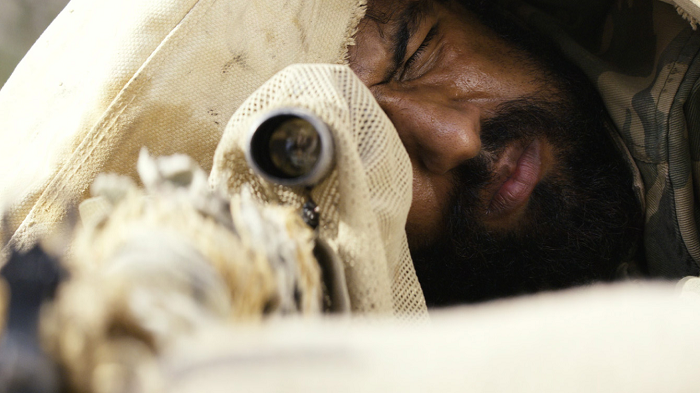
As they drive through a rocky jagged canyon, they’re suddenly hit by an RPG rocket. And then another one. Before long they’re taking a hail of small arms fire as insurgents descend into the valley and surround their disabled armored vehicle. Inside, Ali, Bilal, and Hindasi radio for back-up. Mocha Base immediately deploys a rescue team, but it will be at least an hour before reinforcements, led by a determined Colonel Mazrouie (Abdulla Saeed Bin Haider), can reach the incapacitated soldiers. That leaves Ali, Bilal, and Hindasi to survive the calculated ambush on their own until help arrives.

There are two facets of the story that plays out over the remaining runtime. Early on, most attention is given to the three soldiers trapped within the armored hull as enemy forces gather. Later it becomes about the rescue itself with Mazrouie and his team arriving and being met with heavy resistance. Both are thrilling and inevitably come together in the film’s final act. Morel both shoots and paces the action well which gives us a realistic sense of what these soldiers endured.

Image Courtesy of Well Go USA Entertainment

At the same time he does get a little carried away in an extended sequence near the end of the film. It’s a visually arresting 15 minutes or so, but it goes a little too heavy on the smoke and slow-motion. It’s simply a case of drawing a scene out longer than he needs to. Otherwise, the film’s gritty and grounded visuals (shot by veteran cinematographer Thierry Arbogast) do a good job enhancing the realism and immersing the audience.

The movie also does good remembering the human element, although admittedly it does lean into some pretty familiar war movie tropes. Still, it never crosses a line, and we get just enough character development for us to care about the troops and root for their survival. Then you get some added potency from just knowing the film is based on a real account. It’s all harnessed in what is a satisfying war movie. It doesn’t get lost in the history or politics of the region. Instead, it shows us the soldier’s perspective. And that alone makes it a story worth telling. “The Ambush” is out now on VOD.

VERDICT – 4 STARS