REVIEW: “A Man Called Otto” (2022)

Tom Hanks teams with director Marc Forster for “A Man Called Otto”, the second film adaptation of Fredrik Backman’s 2012 novel “A Man Called Ove”. I loved its first big screen treatment from Hannes Holm. It’s a witty dark comedy but with a warm and tender center. That 2015 Swedish movie would go on to receive a Best Foreign Language Film nomination at the 89th Academy Awards. So Forster is following in some pretty big footsteps.

Hanks plays the titular character, Otto Anderson, a crusty old curmudgeon who we first meet reaming out two young associates at a hardware store. It’s the perfect introduction cranky and perpetually unpleasant 60-year-old Otto. He lives in a modest gated community where he runs things with an iron fist, despite having no real authority. He’s constantly annoyed by the “idiots” in his neighborhood who mostly take his griping with a grain of salt. He also clashes with the reps of a rich land development company who are trying hard to push him and the other residents out.

Image Courtesy of Columbia Pictures

Adding to his soured view on life, Otto was recently forced to retire from a job he’s been at for 40 years. But what has affected him the most is the recent death of his beloved wife Sonya. Unable to fully cope with her loss, Otto decides to take his own life. Yet despite his determination, he discovers that killing himself is no easy task, in large part thanks to his new neighbors, Marisol (a very good Mariana Treviño), her kind but inept husband (Manuel Garcia-Rulfo), and their two adorable young daughters, who unknowingly interrupt every attempt he makes.

As you can tell, there’s definitely a black comedy element that I honestly expected to be sanitized in this American version of the story. But Forster and screenwriter David Magee (“Life of Pi”) stay faithful and the movie is better for it. Watching Otto buy rope, call to cancel his utilities, lay visqueen across his floor, and dress up in his best suit one last time is both sad and solemn. But Forster never lets things get too dour. The young and vibrant new family next door routinely inject a timely dose of heart and humor. To Forster’s credit, he does a nice job balancing both elements.

There are several other supporting characters who weave in and out of the movie. Some add warmth, some are there simply to serve Otto’s redemption, and some feel like well-intended but tacked-on attempts at updating the story. The plot-lines work much the same, with some adding good laughs and feel-good moments while others seem thrown in for one effect or another. This is where the movie can come off as a bit uneven.
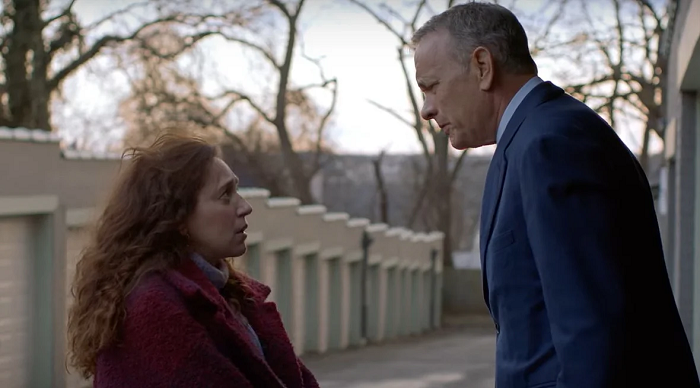
Image Courtesy of Columbia Pictures

But it all revolves around Hanks and his effortlessly good performance. The ever likable actor does a good job selling himself as an irritable grouch, even though we know the movie is about him softening up over time. He also has some good chemistry with Treviño who has an inherent sweetness that eventually melts Otto’s stony heart. Hanks sells his transformation too, never getting too schmaltzy or over-the-top with it. The material occasionally handcuffs him (such as his sudden undercooked relationship with one of his wife’s former students), but Hanks keeps things afloat, earning a few chuckles and our empathy along the way.

“The Man Called Otto” doesn’t quite have the edge or the oomph of Holm’s 2015 film, but it has more than enough to win over some audiences. It’s a fairly effective crowdpleaser that admittedly might have caused this old leathery film critic to mist up a time or two. And with the always enjoyable (and bankable) Tom Hanks as its lead, you would figure it should grab some attention. But it is releasing in what has become known as the January movie wasteland, so how it will do is anyone’s guess. “A Man Called Ottot” opens in theaters January 6th.

VERDICT – 3.5 STARS

REVIEW: “Avatar: The Way of Water” (2022)

In 2009, the world of movies was forever changed by “Avatar”, a science fiction epic born from the mind of James Cameron. The movie was a box office phenomenon, and it remains the highest grossing film of all-time. Technically, “Avatar” was a groundbreaking film that pushed visual effects to entirely new heights. It also reintroduced 3D to the big screen, using it in the most dazzling and immersive way ever seen. Of course the 3D craze didn’t last, mainly because no one could match what Cameron was able to do with it.

But while “Avatar” was a technical marvel, its story was a letdown. It was basically ripped straight from “Dances with Wolves” but with a futuristic sci-fi angle rather than a historical one. It also suffered from Cameron’s heavy-handed sermonizing on everything from the environment to corporate America to the military. It wasn’t that he had a message. It was that he pounded us over the head without an ounce of nuance or subtlety.

After thirteen years, James Cameron is back on Pandora with “Avatar: The Way of Water”, a nearly $400 million sequel that once again pushes the art of movie special effects to the proverbial next level. It’s a jaw-dropping motion picture spectacle unlike anything I’ve seen on the big screen before. Not only does it demand to be seen in the theater, it once again sees Cameron doing things with 3D technology that no one else has ever done. Not to sound hyperbolic, but you have to see it to believe it.

Image Courtesy of 20th Century Studios

On the flip-side, Cameron isn’t best known for seamless storytelling and “Way of the Water” has its issues there. But the story is considerably better this time around, with Cameron getting away from the on-the-nose preachiness and giving us something that’s more intimate and that does a good job progressing the characters and their stories. I’m an admitted sucker for movies about family, and that theme resonates all throughout “The Way of the Water”. There’s also an overarching theme of empathy that plays out through multiple relationships.

Sam Worthington returns as Jake Sully, a former human and now full-on Na’vi. Over a decade has passed since the first film, and Jake is now chief of the Omaticaya forest tribe. There he and his wife Neytiri (Zoe Saldaña) happily raise their family which includes their oldest son Neteyam (Jamie Flatters), their headstrong second son Lo’ak (Britain Dalton), their youngest child Tuk (Trinity Jo-Li Bliss), their adopted teenage daughter Kiri (Sigourney Weaver), and their adopted human son Spider (Jack Champion) who was born of Pandora and rescued by Jake and Neytiri.

While Jake’s life seems ideal, he has long feared the return of the “sky people”, aka the Resources Development Administration from planet Earth. In the first film, the RDA came in the form of a science mission and a mining operation. But within the first few minutes of the sequel they make their return, scorching a huge section of the forest to build their massive base of operations. Rather than being accompanied by a small but aggressive security team, this time the RDA have brought a bigger military presence. And rather than mine, they’ve come to colonize – to find a new home for humanity after depleting their own world’s resources. Their first step – pacify the natives.

Leading the charge is the film’s main antagonist, Colonel Miles Quaritch (Stephen Lang), killed in the first movie but cloned as a Na’vi complete with all of his old uploaded memories. Quaritch is tasked with leading a unit of fellow recombinants to find and eliminate Jake Sully. Initially Jake, Neytiri and the Omaticaya fight back. But realizing the danger he brings to his family and people, Jake and Neytiri take their children and flee far away from the forest, eventually finding refuge with a water tribe called the Metkayina led by Chief Tonowari (Cliff Curtis) and his wife Ronal (Kate Winslet). But to no surprise, the ruthless and dogged Quaritch stays hot on their trail.

Image courtesy of 20th Century Studios

At a hefty three hours and twelve minutes, Cameron’s story covers a lot of ground. He spends a big chunk of his time on world-building, introducing his audience to a whole new part of Pandora. The Metkayina tribe make their home on a giant reef that’s full of exotic aquatic plant and animal life. Cameron and his creative teams go all out designing and visualizing this vivid underwater ecosystem with just as much time put into exploring the Metkayina culture. The movie does slow down a tad during this long middle stretch, but there’s always something new and often jaw-dropping to take in.

In addition to shooting in state-of-the-art 3D, the film also features underwater performance capture, an incredibly impressive feat requiring its own newly developed tech. Then there was the decision to shoot at a higher frame rate. There are several instances where Cameron bumps the standard 24 frames-per-second up to 48 fps, giving the film a more crisp and realistic appearance. It’s a choice that won’t be for everyone, and its clarity and quality may depend the theater screen you see it on. Personally, I loved the higher frame rate.

Of course “The Way of the Water” is also full of big eye-popping action which is something James Cameron knows a lot about. The set pieces are as thrilling as they are massive, and the above-mentioned technology really shines in them. The performances are also good with both Worthington and Saldaña especially shining. As for Lang, he’s mercifully dialed back and less hammy this time around, and the movie does some interesting things with his character. Again, the story may stumble in a few spots. But it’s still an exciting step up from the first movie. And as an experience, visiting Pandora has never felt so exciting and full of life. “Avatar: The Way of Water” is in theaters now.

VERDICT – 4.5 STARS

REVIEW: “The Ambush” (2022)

Based on an actual event, “The Ambush” tells a remarkable story of heroism, sacrifice, and survival through a harrowing encounter in war-torn Yemen. Directed by Pierre Morel (“Taken”), the film first released on November 25, 2021 in the United Arab Emirates. Since, it has gone on to become the country’s highest grossing Emirati film ever made. With its setting, intensity, and overall quality, “The Ambush” is a solid entry into the war film catalog.

For context, in 2015 following years of civil unrest, the foreign backed Al Houthi Militia overthrew the government of Yeman and seized control of the vast majority of the country. As a war broke out between rebels and loyalists, innocent civilians paid a heavy price. The instability strengthened many terrorist groups in the region leading Yemini President Hadi to reach out to his international allies for help. As part of a gulf coalition, members of the UAE military were deployed with many patrolling the area and providing much-needed aid to civilians. After three years, the coalition was still trying to help stabilize the ravaged region.

Image Courtesy of Well Go USA Entertainment

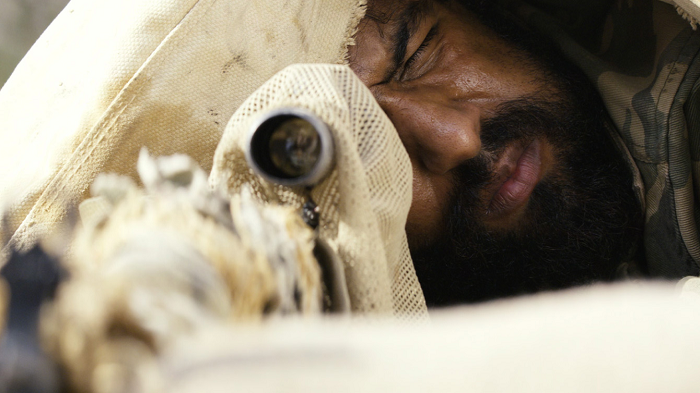
The film opens with the obligatory introduction to the UAE soldiers we’ll be spending most of our time with. At Mocha Base in Southern Yemen, Ali (Marwan Abdulla Saleh), Bilal (Khalifa Al Saadi), and Hindasi (Mohammed Ahmed) are only one week away from getting to go home to their families (rarely a good sign at the start of a war movie). While out on one of their final patrols the three learn about possible insurgent activity in some nearby foothills just off their normal patrol route. After delivering some supplies to a local settlement, they decide to check it out.

As they drive through a rocky jagged canyon, they’re suddenly hit by an RPG rocket. And then another one. Before long they’re taking a hail of small arms fire as insurgents descend into the valley and surround their disabled armored vehicle. Inside, Ali, Bilal, and Hindasi radio for back-up. Mocha Base immediately deploys a rescue team, but it will be at least an hour before reinforcements, led by a determined Colonel Mazrouie (Abdulla Saeed Bin Haider), can reach the incapacitated soldiers. That leaves Ali, Bilal, and Hindasi to survive the calculated ambush on their own until help arrives.

There are two facets of the story that plays out over the remaining runtime. Early on, most attention is given to the three soldiers trapped within the armored hull as enemy forces gather. Later it becomes about the rescue itself with Mazrouie and his team arriving and being met with heavy resistance. Both are thrilling and inevitably come together in the film’s final act. Morel both shoots and paces the action well which gives us a realistic sense of what these soldiers endured.

Image Courtesy of Well Go USA Entertainment

At the same time he does get a little carried away in an extended sequence near the end of the film. It’s a visually arresting 15 minutes or so, but it goes a little too heavy on the smoke and slow-motion. It’s simply a case of drawing a scene out longer than he needs to. Otherwise, the film’s gritty and grounded visuals (shot by veteran cinematographer Thierry Arbogast) do a good job enhancing the realism and immersing the audience.

The movie also does good remembering the human element, although admittedly it does lean into some pretty familiar war movie tropes. Still, it never crosses a line, and we get just enough character development for us to care about the troops and root for their survival. Then you get some added potency from just knowing the film is based on a real account. It’s all harnessed in what is a satisfying war movie. It doesn’t get lost in the history or politics of the region. Instead, it shows us the soldier’s perspective. And that alone makes it a story worth telling. “The Ambush” is out now on VOD.

VERDICT – 4 STARS

REVIEW: “A Christmas Story Christmas” (2022)

Our family loves Christmas time. And like many families, we have our favorite holiday traditions. Among them is watching Christmas movies. Promptly starting the Friday after Thanksgiving, we kick off our Christmas movie watching season. Of course we have our favorites, from silly yuletide romps like “Elf” and “National Lampoon’s Christmas Vacatiom” to perennial classics like “Miracle on 34th Street” and “It’s a Wonderful Life”. We adore them.

But we always save one of our very favorites to last. A movie we’ve seen too many times to count. One that’s infinitely quotable and hilarious from start to finish. One with so many terrific characters who you learn and love by name, and just as many endearing moments that make the movie memorable. I’m talking about Bob Clark’s delightful 1983 treasure, “A Christmas Story”. Loaded with charm, humor, heart, and tons of holiday cheer, “A Christmas Story” has only grown in popularity over the years. And now, nearly 40 years later, the movie is getting a proper follow-up.

My immediate reaction to the news of a sequel was “Gulp”. Is this something we really need? Do we really want them tinkering with something many of us love so much? As it turns out, “A Christmas Story Christmas” (not the easiest title to recite) is its own little treat. Is it as good as the 1983 film? Of course not, nowhere close. But that’s an unfair comparison. It’s not aiming to equal its predecessor. Instead, director and co-writer Clay Kaytis sets out to honor “A Christmas Story” by tapping into the characters, style, and tone which made that film great.

Image Courtesy of Warner Bros. Pictures

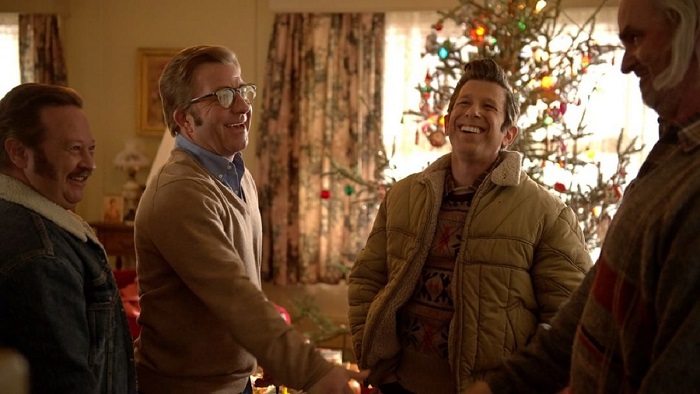
Without question “A Christmas Story Christmas” is made for fans of the original film, and you can tell it from the very start, as the old classic Warner Bros. logo fades away and we’re greeted by the familiar chimes of “We Wish You a Merry Christmas“. There’s the exact same opening credits fonts, and of course that signature narration (a different voice of course, but later it’ll make sense why). Fans will immediately recognize these callbacks, and there will be countless others in the forms of locations, lines of dialogue, and of course the characters. One of the biggest treats is seeing nearly all of the original cast return to their roles.

The story is set in December of 1973. When we last saw Ralphie Parker he was a bespectacled young boy from Hohman, Indiana who had just received the greatest Christmas gift he would ever receive – “an official Red Ryder Carbine Action 200-shot Range Model air rifle”. Years later, Ralph (a returning Peter Billingsley) lives in Chicago with his wife Sandy (Erinn Hayes), son Mark (River Drosche), and daughter Julie (Julianna Layne). He’s spent the last year writing what he believes is “the next great American novel”, but he’s set himself a deadline. He made a deal with Sandy that he has to be published by the end of the year or he would pack up his dream and re-enter the rat race.

Unfortunately things aren’t looking good for Ralph. He has sent his 2,000-page manuscript (yes, you read that right) to 16 publishers and 15 have said “no thanks”. But his writing takes a backseat after he gets a phone call no one wants to receive. It’s his mother who tells him his father (unforgettably played in the 1983 film by the late Darren McGavin) has passed away. Ralph is crushed. So he and his family load up in their ’66 Plymouth and head for Hohman. Upon arriving they’re greeted by the warm welcome of Ralph’s mom (Julie Hagerty, taking over for Melinda Dillon who retired from acting 15 years ago).

Image Courtesy of Warner Bros. Pictures

Ralphie expects to help his mother make funeral arrangements, but she has something else in mind. Reminding him how much his father loved Christmas, she decides to delay his funeral until after the holiday. She tasks Ralph with making sure this is the best Christmas ever – a most fitting way for them to honor his Old Man. Here’s the thing, he only has five days to pull it off. But ever the daydreamer, Ralph finds inspiration and is determined to give his family the kind of Christmas that would make his dad proud.

As the story scoots along we’re reintroduced to several familiar faces. Of course there’s Ralph’s kid brother Randy (Ian Petrella) who’s a traveling businessman and a bit of a flake. And who can forget his best buddies, Flick (Scott Schwartz), who now runs a bar passed down from his dad, and Schwartz (R.D. Robb), who still lives with his mom and spends most of his time running up its tab at Flick’s Tavern. We even get some moments with those pesky hillbilly neighbors the Bumpass family. So many other things bring fun memories gushing back, such as the familiar details of Ralph’s old Cleveland Street house and the “tinkling display of mechanized, electronic joy” in the window at Higbie’s Department Store.

But what makes the movie more than a simple nostalgia trip is how it repeatedly returns to its emotional core. Namely, the loss of a beloved father and a son trying to cope. This really comes to light after Ralph’s mom asks him to write his father’s obituary. Yes, Kaytis and company unashamedly taps into what people love about “A Christmas Story”. But it also has a heart of its own. It makes for a truly enjoyable mix. And if people will avoid the temptation to needlessly compare the two, they’ll find this to be a pretty irresistible sequel and quite the “Christmas Story” companion piece. “A Christmas Story Christmas” premieres November 17th on HBO MAX.

VERDICT – 4 STARS

REVIEW: “Armageddon Time” (2022)

(CLICK HERE to read my full review in the Arkansas Democrat-Gazette)

One of the biggest satisfactions from James Gray’s new coming-of-age drama “Armageddon Time” is unpacking it afterwards – peeling back the layers and sorting through the various memories the filmmaker attempts to explore. If only watching the movie carried the same sense of fulfillment. Despite being a deeply personal film for Gray, it doesn’t always feel like it. Some scenes unquestionably bear the filmmaker’s mark. Others have an overly familiar studio product feel. Still, it does have its saving graces.

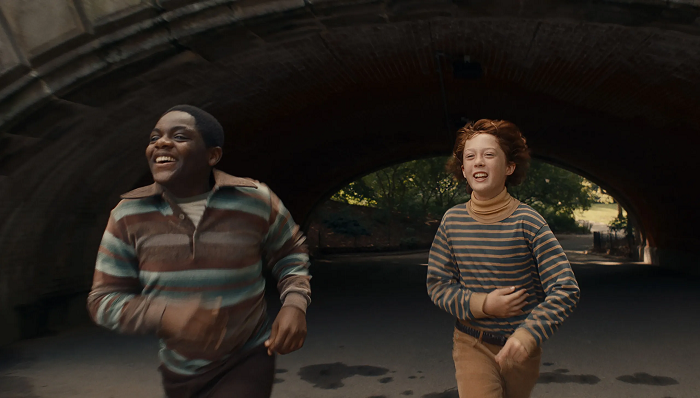
“Armageddon Time” is heavily influenced from Gray’s childhood growing up in Queens, and he does a good job recreating that time and place. Opening in 1980, this memoir of sorts begins in a public classroom on the first day of school. Paul Graff (Banks Repeta), an 11-year-old aspiring artist and class clown, meets and befriends his new classmate Johnny (Jaylin Webb), a fellow disruptor working on his second year in sixth grade.

The two boys have an interesting dynamic. Paul is Jewish-American and comes from a fairly stable working class family. Johnny is one of the few Black kids in the school and lives with his ailing grandmother. The roots of their mischievousness is dramatically different, yet both find a partner in crime in each other. But that doesn’t mean they’re good together which leads to a nagging conflict within the movie.

Image Courtesy of Focus Features

Gray has a hard time balancing our sympathy with the boys’ delinquency. We feel for them whenever we’re shown the harsher side of their upbringing. But their blatant disrespect and troublemaking (which steadily worsens whenever they’re together) doesn’t exactly have the effect Gray is shooting for. The most compelling aspect of their relationship is in how differently the two are treated for their misbehavior, whether it’s by their teacher, Mr. Turkeltaub (Andrew Polk) or the cops. This is where the film’s sometimes shaky racial politics is its most effective.

The scenes at Paul’s home play like a tapestry of memories that Gray has passionately stitched together. Paul’s family are proud but insular Jewish liberals who happily take snide shots at Ronald Reagan every time he pops up on the television, yet are blind to their own racism that surfaces whenever they talk about “the blacks.” His uptight mother, Esther (Anne Hathaway) is the president of the PTA and absorbed in her desire to run for the school board. His hard-shelled father, Irving (Jeremy Strong) is a repairman with a notable bad temper but who may be a good guy underneath (It’s hard to tell. He’s haphazardly written and more of a sketch than a portrait). Then there’s Paul’s one-note jerk of an older brother Ted (Ryan Sell) who attends a private high school and does nothing more than antagonize.

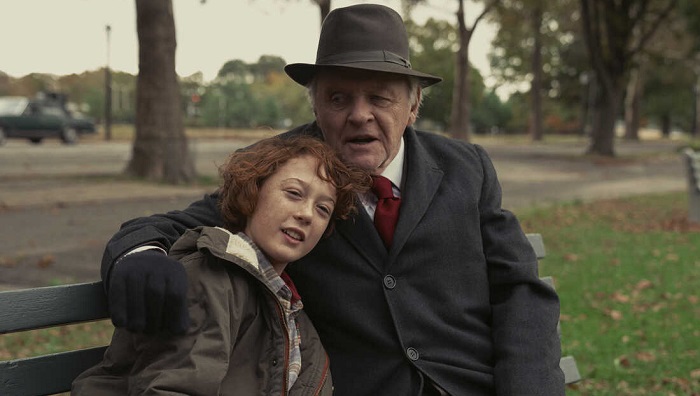
While Paul is cold to his mother (something vaguely explained but not in a satisfying way) and fearful of his father (which is realized through one particularly harrowing scene), the lone family member he’s closest to is his grandfather, Aaron (Anthony Hopkins). Paul is honest and open with his grandpa. And much like the boy, we light up whenever Hopkins shows up on screen. The film’s most tender and heartfelt moments feature Hopkins and his signature blend of charisma and warmth. And Aaron may be the movie’s most interesting character, with wisdom and perspective shaped by his family’s history with the Holocaust.

Image Courtesy of Focus Features

The film’s flaws are more pronounced in the second half as Johnny’s story fades to the background, and Gray ventures off into other thematic weeds. A chunk of it follows Paul as he’s sent to the uppity Kew-Forest prep-school, where businessman Fred Trump (John Diehl) sent his children, future president Donald and US Appellate Judge Maryanne (played briefly by Jessica Chastain). Gray uses these scenes to highlight the era’s class and race clash, attempting to connect it to the Reagan years and more lazily the Trump presidency. But it’s more vague assertions than thoughtful consideration.

It culminates in an unfortunate final scene that’s well-intended but ends up making Johnny’s entire story a means to give Paul (and perhaps Gray himself) this big moment of self-congratulatory clarity. It’s a sour note to end on, and one that leaves you reconsidering some of the weightier stuff that came before it, particularly in its dealings with race.

In the end, Gray simply has too much on his mind and gets trapped in between reflecting on his childhood and offering a politically-charged critique. There’s some material there for each, but not enough to juggle both. It’s hard to stay connected emotionally, despite another sterling and impactful performance from Anthony Hopkins. And in terms of its messaging, “Armageddon Time” remains surprisingly inert, and no amount of shallow sermonizing and self-implication can give it the heft it’s so desperately after. “Armageddon Time” is now showing in select theaters.

VERDICT – 2 STARS

REVIEW: “All Quiet on the Western Front” (2022)

(CLICK HERE for my full review in the Arkansas Democrat-Gazette)

Erich Maria Remarque’s 1929 German novel “All Quiet on the Western Front” and Lewis Milestone’s 1930 landmark American film adaptation remain among the most defining anti-war treatments to date. Neither the book or the movie were vague about their ‘war in hell’ message, and both sought to depict it realistically and truthfully.

Now 92 years later we revisit “All Quiet on the Western Front” through the lens of German filmmaker Edward Berger. As far as feature films, this is the first attempt at taking on Remarque’s weighty material since 1930 and (obviously) the first ever German film adaptation. Berger’s epic-scaled polemic brandishes the same scathing anti-war messaging. But he and DP James Friend utilize today’s technology to deliver powerful imagery both on the battlefield and on the faces of the young soldiers sent there.

Much like Remarque’s novel and Milestone’s film, there is nothing patriotic or partisan about Berger’s movie. There are no depictions of glory on the battlefield, and you won’t find a single scene that could be reasonably perceived as propaganda. Rather this is a relentlessly bleak and unflinching account; one that emphasizes the brutality and inhumanity of war, resulting in some of the grittiest and most visceral battle sequences ever put to film. Yet the human cost always remains its focus.

Image Courtesy of Netflix

The story begins with a shattering prologue that not only sets the tone, but lays out the film’s message with startling clarity. A young German soldier named Heinrich, not even 20-years-old, stands in a muddy trench with what’s left of his regiment as the call goes out to charge. Terrified, Heinrich musters what courage he can and climbs out of the trench with his fellow soldiers, rushing towards the enemy gunfire. Bullets scream by, artillery rounds gash the earth, gnarled bodies cover the battlefield.

After cutting to the title card, the film comes back to show a lifeless Heinrich laying in a truck full of dead soldiers. We watch as the uniforms are stripped from the corpses and sent off to be washed and mended. They’re then given to the next batch of starry-eyed recruits who proudly celebrate their fresh ‘new’ duds. It’s a heart-wrenching sequence of events filmed and edited with such brutal authenticity. It gives the audience a good sense of what they’re in for.

Among the new recruits is Paul Bäumer (Felix Kammerer) who lies about his age in order to join his military bound childhood chums Albert (Aaron Hilmer), Franz (Moritz Klaus), and Ludwig (Adrian Grunewald). The four friends join a room full of other elated young man who have all been sold the same lie. A German officer rouses them with promises of fabled glory, but it’s nothing more than a devious sales pitch. There’s no glory awaiting them on the frontlines. We understand that. It won’t be long before the boys understand it too.

But all we can do is watch as this company of new troops – giddy and naïve – joyously sing as they march towards hell, oblivious to what truly awaits them on the Western Front. But once they step foot in the muddy and blood-soaked trenches and peer cross the ravaged wasteland, every romanticized notion of war crumbles. Berger wastes no time shattering their illusion, immediately thrusting the four friends (and us) into the savagery of World War I combat. Cutting no corners and sparing no details, Berger and Friend not only visualize the horror, but they make us feel a part of it. One especially intense and magnificently captured battle scene was more terrifying than anything I’ve seen from the horror genre all year.

Image Courtesy of Netflix

The bulk of the film is shown through Paul’s eyes and plays like a coming-of-age tragedy. Kammerer’s sublime performance is key, channeling Paul’s descent from wide-eyed and enthusiastic to scared and shell-shocked to cold and deadened. Along the way we’re given some much-needed breathers as Berger pulls Paul away from the frontline, allowing him and his buddies to develop their friendships. He has especially good camaraderie with Kat (an excellent Albrecht Schuch), a seasoned older soldier who he first meets in the trenches.

Berger also spends time highlighting the vivid contrast between those orchestrating the war and those fighting it. French and German decision-makers debate and barter in the comforts of lush country estates and elegant train cars. Meanwhile young men die horrific deaths at a sickening pace. Working towards peace was real-life German official Matthias Erzberger (the always solid Daniel Bruhl) who’s tasked with negotiating a surrender that would appease the prideful Prussian generals and allow Germany to bow out with its dignity. Of course history tells us France’s desire to humiliate its enemy set the table for Adolph Hitler and World War II.

With “All Quiet on the Western Front”, Edward Berger hasn’t just remade an old classic. He’s given us an eye-opening anti-war treatise that speaks to both history and modern day. He’s also made one of best movies of the year. The craftsmanship alone is outstanding. But then you add the deeper themes which culminate in a final shot underscoring the war’s heart-breaking cycle of death. It makes for an experience that can be hard to endure and even harder to shake. But those aren’t bad things. Especially with a movie and a message this potent. “All Quiet on the Western Front” premieres today on Netflix.

VERDICT – 5 STARS