REVIEW: “A Complete Unknown” (2024)

Upon first hearing that Timothée Chalamet was set the play Bob Dylan in an upcoming biopic, I admit to thinking they could have found someone better. But after seeing him in the role of the legendary American singer-songwriter, I wondered who could have played Dylan better. Chalamet delivers a knock-out performance in James Mangold’s “A Complete Unknown”, a beguiling biography based on Elijah Wald’s 2015 book “Dylan Goes Electric! Newport, Seeger, Dylan, and the Night That Split the Sixties.”

Chalamet tirelessly prepared for the role, learning how to play guitar and the harmonica while immersing himself into Dylan’s iconic lyrics and singing style. Mangold certainly put the actor’s training to good use. It’s said that Chalamet performed an astonishing 40 songs for the film. But here’s the best part – he surprisingly nails them which not only enhances his performance but strips away any hint of artifice. For 141 minutes Timothée Chalamet is Bob Dylan and we never doubt it for a second.

Among the many good choices that make “A Complete Unknown” work is Mangold’s decision to hone in on one segment of Dylan’s fascinating life. This is no cradle-to-grave biopic. Rather it’s an ensemble movie that traces Dylan’s musical journey from his arrival in New York City to his unforgettable 1965 performance at the Newport Folk Festival which sparked controversy after he took the stage with an electric guitar much to the dismay of his devoted folk music fans. 

Image Courtesy of Searchlight Pictures

The film opens in 1961 with a 19-year-old Bob arriving in New York City after hitching a ride from Minnesota. He has made the trek in order to visit his idol, Woody Guthrie (Scoot McNairy) who was committed to Greystone Park Psychiatric Hospital. While visiting Woody, Bob meets the beloved folk singer Pete Seeger (Edward Norton) who immediately takes a liking to the young aspiring singer. Pete is even more smitten with Bob’s songwriting and begins introducing him around the New York City folk scene.

From there Mangold and his co-writer Jay Cocks chronicle Bob’s rise to fame mostly through the relationships that helped pave his path. One of his earliest is with Sylvie Russo (Elle Fanning), a character based on Suze Rotolo. Sylvie is more than just a love interest. She’s key in opening Bob’s eyes up to the troubled real world which would inspire so many of his hit songs. And more than anyone else, she encouraged him to sing his own songs after his manager Albert Grossman (Dan Fogler) gets him a record deal with Capitol Records.

The film also explores Dylan’s connection with fellow folk singer Joan Baez who is wonderfully played by rising star Monica Barbaro. Baez was already established when she first met Bob Dylan and she was one of the first to record some of his original songs which helped to put him on the map. Barbaro and Chalamet are terrific together, capturing the creative magic conjured whenever Baez and Dylan sang together while touching on the pair’s more tumultuous personal relationship.

Image Courtesy of Searchlight Pictures

The most fun of the supporting cast is Boyd Holbrook playing the great Johnny Cash. He doesn’t get many scenes but he steals every one he’s in through a performance that’s bursting with charisma. Holbrook gloriously channels Cash’s energy and swagger while adding a little flavor of his own to the character. Now I want another Johnny Cash movie with Boyd Holbrook playing ‘The Man in Black’.

While Mangold spends plenty of time delving into the personal life of Bob Dylan, he also takes us on a tour of American music history. Not only does “A Complete Unknown” honor traditional folk music and its impact on American culture, but it also shows how music was changing alongside that very same culture. That culminates in the film’s kinetic recreation of the 1965 Newport Folk Festival where Dylan shocked fans and angered festival heads by playing electric rather than acoustic. His brief set has been called a watershed moment for both folk and rock music.

While “A Complete Unknown” sweeps you away with its focused storytelling, timeless music, and phenomenal performances, it’s also strengthened by its period-perfect production design and costumes as well as rich cinematography from Phedon Papamichael. But it’s James Mangold’s clear passion that brings it all together. It seeps from every pore of his movie. And while fans of the music may find more to enjoy, there’s so much else to love that transcends mere musical tastes. It’s a transporting musical journey and one of the year’s best movies.

VERDICT – 4.5 STARS

REVIEW: “A Real Pain” (2024)

Writer, director, producer, and star Jesse Eisenberg has made a splash with “A Real Pain”, an emotionally rich and organically funny dramedy that follows two Jewish cousins on a trip to better understand their late grandmother’s past. In the process, the two end up learning more about themselves and each other. It may sound like a fairly conventional premise. But Eisenberg infuses his film with such humanity that he has no trouble earning our empathy.

The film opens with the two cousins meeting at the airport in New York City. Within seconds its easy to see that they couldn’t be more different. First is David (Eisenberg), an buttoned-up and tightly wound digital advertising specialist who lives in a comfy Manhattan brownstone with his wife and young son. And then there is Benji (Kieran Culkin), a crass but naturally charming free spirit who flies by the seat of his pants and has no problem sharing whatever is on his mind.

Image Courtesy of Searchlight Pictures

Like many cousins, David and Benji grew up close but drifted apart as their lives took different paths. But they’re brought back together by the recent passing of their grandmother. Both loved her very much, but we learn she had an especially close relationship with Benji. Now they are coming together to fulfill their grandmother’s dying wish – to take money she left them and travel to Poland to learn about where she came from.

After the pair reunite in New York, they fly to Warsaw where they join a small but intimate tour group led by a knowledgeable British guide named James (Will Sharpe). Filling out the group is a recently divorced middle-aged New Yorker named Marcia (Jennifer Grey) who is there to honor her mother, an African-born Jewish convert named Eloge (Kurt Egyiawan) who survived the Ruwandan genocide and now seeks to better connect to his faith, and a somewhat stuffy retired couple, Mark (Daniel Oreskes) and Diane (Liza Sadovy).

Image Courtesy of Searchlight Pictures

One of the film’s biggest strengths lies in Eisenberg’s impressive ability to balance the heaviness of his movie’s themes with moments of levity. Culkin’s Benji brings an irreverent and rambunctious energy to the Holocaust tour group. And while that may sound incredibly insensitive, Eisenberg’s humanizing touch ensures sensitivity and pathos. The humor is organic to the characters and it compliments their arcs while helping to better define them.

“A Real Pain” has received a lot of buzz since premiering earlier this year at Sundance. In that time Culkin has garnered most of the attention and he certainly earns it. But his character (and by extension his performance) wouldn’t have the impact without the sturdy and on-point Eisenberg as his foil. Together they get to the heart of the movie which turns out to have more on its mind than just remembrance. It’s also a movie about reconnection, understanding, and finding your way forward. It asks several questions that have no easy answers. But it leaves us thinking about them which testifies to Eisenberg’s prowess.

VERDICT – 4 STARS

REVIEW: “Armor” (2024)

Regardless of the decade, most movie lovers have a soft spot for the films they grew up on. And they often have a similar soft spot for the actors and actresses who starred in them. That’s certainly the case for me, a proud kid of the 1980s. Sitting among the many names for me is Sylvester Stallone and Jason Patric. Both starred in several movies that I still love from the 1980s and beyond. And while their careers followed different paths, it’s great to seem them still making movies.

Stallone and Patric co-star in “Armor”, a new action-thriller from director Justin Routt. It’s a movie built on a simple and straightforward premise that’s ripe with old school action movie potential. Unfortunately “Armor” never hits its stride or builds the kind of excitement that it needs. And while they try, neither Routt or screenwriters Cory Todd Hughes and Adrian Speckert can generate enough depth to fill its light 88 minutes.

Patric tries to add some character playing James Brody, a man struggling with alcohol since the tragic death of his wife. James puts up a good front. He has everyone around him convinced he’s six years sober. He even goes as far with his ruse as to host regular AA meetings at a local church. In reality he hasn’t stopped drinking; he’s just gotten good at hiding it.

Image Courtesy of Lionsgate

“Armor” is set during a sweltering hot Mississippi summer where James works as a security guard and driver for an armored truck company. He works alongside his son Casey (Josh Wiggins) who over time has grown bored with their job’s mundane routine. “I’d kill for some action”, the misguided young Casey says. If there ever was a kiss of death in an action movie it’s a statement like that.

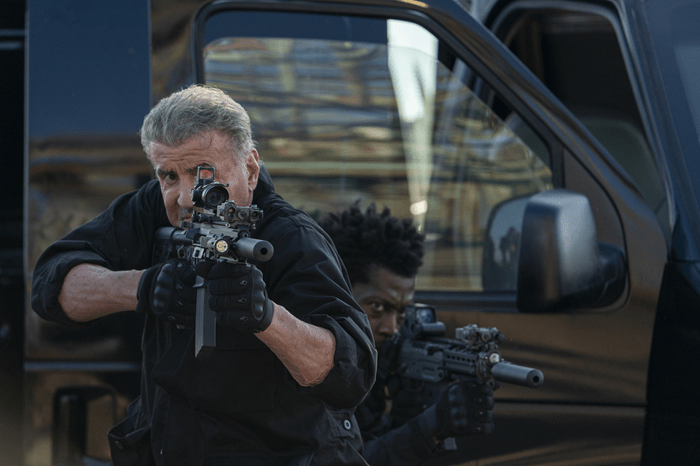
Elsewhere we’re introduced to Rook (Stallone), the leader of a team of thieves who we see loading up automatic weapons, putting on bulletproof vests, and ironing out the final details of an upcoming heist. There’s nothing at all memorable about the underdeveloped team. Rook only stands out because he’s played by Sly. The rest of crew consists of a small variety of uninteresting archetypes.

While making a routine stop at a local credit union, James discovers an extra box to be picked up that’s not on their ledger. At first he declines to take it. But after the obnoxious bank president threatens to expose him for holding AA meetings on company time, James breaks protocol and sets out with the extra cargo. Bad idea.

Image Courtesy of Lionsgate

Just outside of town, their truck is rammed by a black van that diverts them off route and across a closed rural Mississippi River bridge where another van waits on the other end. James and Casey find themselves blocked on both sides with nowhere to go as Rook and his heavily armed entourage converge. The majority of the film consists of a low stakes chess match between James and Casey in the back of the armored truck and a frustrated Rook who’s trying to get inside.

Despite its ripe scenario, “Armor” has a hard time mustering much excitement. Much of the time is spent with the two sides verbally jousting. We get a few pauses as Rook inexplicably steps back for stretches that only exist so that James and Casey can have some much needed father-son reconciliation time inside the truck. We do get a little tension within Rook’s crew, namely from the wildly over-the-top psycho named Smoke (Dash Mihok). But it’s a predictable angle with an obvious end.

“Armor” does deliver a couple of decent action scenes that make the most of the film’s obvious budget constraints. And screen vets Patric and Stallone do the best they can amid the hackneyed plot contrivances, room temperature family drama, and cheesy music drops. But try as they may, neither can energize the movie to the point of overcoming its frustrating flaws. “Armor” opens November 22nd in select theaters and on VOD.

VERDICT – 2 STARS

REVIEW: “Anora” (2024)

Sean Baker’s “Anora” premiered with a bang, winning the prestigious Palme d’Or at this year’s Cannes Film Festival. Surprisingly it’s the first American film to do so since Terrence Malick’s sublime 2011 masterpiece “The Tree of Life”. Unfortunately “Anora” falls well short of that lofty masterpiece status. Instead it’s a draining exercise in indulgent filmmaking that puts its focus on most of the wrong things.

“Anora” sees Baker gravitating towards the same problems that plagued his previous feature, 2021’s “Red Rocket”. His films set out to be raw, gloss-free windows into overlooked American subcultures and that’s a good thing. But too often his tawdry obsessions come at the expense of much-needed attention to his characters and/or their relationships. Never has that been more true than in “Anora” – one of the loudest and longest 140 minutes you’ll endure.

“Anora” is a blaring example of what a lack of restraint can do to a movie. Baker’s inability to know when to ease off the gas and let his characters breathe becomes one of the film’s biggest problems. We’re left with surface-level treatments rather than any meaningful development. And good luck finding an emotional core amid the endless yelling, constant arguing, and (at times) brain-melting dialogue.

Image Courtesy of NEON

The film’s star Mikey Madison is the biggest victim playing Anora, a 23-year-old lap dancer at a high-end New York City strip club. Much like Emma Stone for Yorgos Lanthimos, Madison lays bare and fully commits to her male director’s vision. But despite routinely stripping down and screaming on demand, Baker never gives her the material she needs to stretch her role beyond rank exhibitionism. Yet in a weird way it fits with the aggressive amorality of Baker’s crass and cranked-up world.

Madison’s Anora, who goes by Ani, works at Club HQ making her money fulfilling the 15-minute fantasies of her diverse clientele. One evening she dances for a rich and pampered young Russian named Vanya (Mark Eidelshtein) – an easy frontrunner for the most obnoxious movie character of the year. He’s immediately attracted to Ani, showering her with C-notes and inviting her to his family’s modernistic mansion for some sex work on the side. It’s a proposition Ani happily accepts.

Ani is framed as a savvy young woman who understands the ins-and-outs of the game she plays. She uses manipulation like a scalpel, shrewdly seducing customers by catering to their desires for her own self-interests. But her supposed agency and acumen are unintentionally undermined by her relationship with Vanya. Her tough and confident persona takes a “Pretty Woman” turn after she accepts $15,000 to be his girlfriend for a week.

Following six days of rampant sex, drugs, and partying (which Baker numbingly depicts for what seems like an eternity), Ani and Vanya fly to Vegas on a whim and get married. Nothing about their sudden nuptials makes sense mostly because the pair spend too much time in a haze of debauchery to develop any believable emotional attachment.

Image Courtesy of NEON

Or maybe Ani is just in it for the money. But that makes us question everything we thought we knew about her. How could she not see through the patently flighty and profligate Vanya? We certainly can. The problem is we don’t really know because so much screentime is wasted on superfluous things that we never get a good sense of Ani’s true feelings, sensibilities, or even her motivations.

In reality the marriage is little more than a device used to turn the second act of “Anora” into a half-baked screwball romp across New York City. After word of Vanya’s exploits reaches his wealthy parents back in Russia, they send their son’s Brooklyn-based handler, Toros (Karren Karagulian) and his two bumbling goons, Igor (Yuriy Borisov) and Garnick (Vache Tovmasyan) to get the marriage annulled. But once they arrive at the family estate Vanya splits, leaving the angry Ani to join the three inept tough guys in their citywide search for him.

As “Anora” takes its dramatic turn it only gets more narratively and tonally chaotic. The one consistent throughline is the incessant yelling, ranting and raving which is so prevalent that it feels like a running joke I must not get. Meanwhile the world Baker recreates has a striking air of accuracy due to his choice to shoot on location. It’s too bad his characters don’t possess the same authenticity. Instead they find themselves trapped within a proudly profane yet frustratingly hollow construct that gives the appearance of something raw and dazzling but is actually a repetitive and exhausting grind.

VERDICT – 1.5 STARS

REVIEW: “Absolution” (2024)

Liam Neeson thrillers have become as common as day and night and we’ve grown accustomed to getting at least one a year. They usually follow a pretty familiar blueprint and each generally adheres to the same narrative formula although with slight variations (and I say that as a fan). But lately many of his thrillers have shifted from light and easy genre fare to grittier and more serious-minded. That trend continues with his latest, “Absolution”.

In “Absolution”, Neeson reunites with director Hans Petter Moland (the two worked together in 2019’s “Cold Pursuit”). While their previous collaboration had a pitch-black comedy element to it, “Absolution” is more of a tragedy. Screenwriter Tony Gayton puts together a sturdy crime thriller framework. But his interests lie deeper and are more human. And as its “Everyone Pays in the End” tagline foretells, not even the film’s damaged protagonist will remain unscathed.

Image Courtesy of Samuel Goldwyn Films

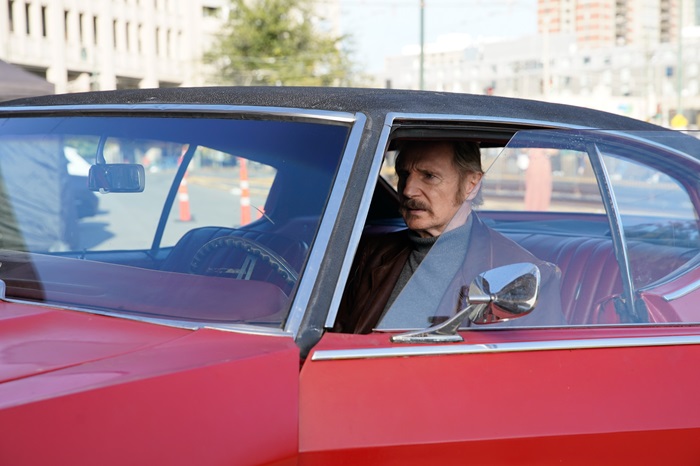
In “Absolution” Nesson is in top form and his signature gravitas is one of the film’s biggest assets. He puts off distinct Charles Bronson vibes with his late ’70s fashion sense, thick mustache, and steely tough-as-nails intensity. He plays Thug, a former boxer and hardened gangster who has loyally worked under a Boston crime boss (Ron Perlman) for thirty years. Though still deadly and efficient, some see Thug as a relic. This comes out most in some early scenes where he’s asked to work alongside the boss’s inexperienced and reckless son (Daniel Diemer).

But Thug has other concerns, mainly his reoccurring headaches and bouts with memory loss. He sometimes forgets names and directions, and even where he lives. He finally sees a doctor and is diagnosed with CTE (Chronic Traumatic Encephalopathy), a neurodegenerative disease directly linked to repeated head trauma. He’s told to expect a sharp decline over the next couple of years which inspires him to make amends for the life he has lived.

Thug reaches out to his estranged and rightfully bitter daughter Daisy (Frankie Shaw), a struggling single mother who reluctantly introduces him to his grandson, Dre (Terrence Pulliam). Moland and Gayton tease what looks to be a conventional reconciliation story. But for Thug, reconnecting proves difficult. And no matter how hard he tries, he can only keep his condition a secret for so long – from his understandably leery daughter; from the kind-hearted and filterless prostitute he begins seeing on the side (Yolonda Ross); and from his suspicious boss.

Image Courtesy of Samuel Goldwyn Films

Neeson shrewdly embodies every facet of his character, from the grizzled tough-guy to the broken shell of a man fighting to keep his mind intact. It’s a measured and textured performance that pulls from the often underappreciated screen veteran’s acting arsenal. Both Shaw and Ross add compelling pieces while Perlman is a sturdy presence in a small but impactful role.

Not everything in the film clicks into place. There are a couple of well-meaning but out of tune dream sequences that don’t quite pack the emotion punch they’re going for. And there’s Thug’s sudden soft spot for a captive sex worker that desperately needs more attention. Yet “Absolution” remains a gripping slow-burn that offers Liam Neeson a meatier and more contemplative role while giving him the chance to knock off a few goons for old times’ sake. “Absolution” opens in theaters this Friday.

VERDICT – 3.5 STARS

REVIEW: “The Apprentice” (2024)

We live in a day where there is no shortage of big screen biopics. That’s because deep down most of us are drawn to human stories of all kinds. Combine that with our love for the art of cinema and it’s no surprise that we get so many. But biopics are susceptible to a number of traps. An overreliance on formula, representing fiction as facts, or as in the case of “The Apprentice”, letting personal crusades mar what could have been a piercing and insightful study.

In a nutshell, “The Apprentice” is a movie that works so hard to demonize its subject that it forgets to make him human. Director Ali Abbasi’s politically driven misfire seeks to paint New York businessman and former President Donald J. Trump as unflattering as possible. His more rabid detractors will consider that a strength and embrace the movie despite its glaring issues. The overly sensitive Trump acolytes will hate it and immediately cry foul over the timing of its release. As for the more grounded viewer, it’s not hard to see through the film’s flimsy facade.

In reality, Donald Trump has provided plenty of real-life material worth dissecting in his business, personal, and political lives. But Abbasi adds too many fictional twists to serve his film’s message. He paints a wildly one-sided portrait that barely registers a human pulse. It’s a shame considering how ripe the subject matter is for exploration. But instead, “The Apprentice” comes across as misguided, lazy, and self-important.

Image Courtesy of Briarcliff Entertainment

Trump is played by a firmly committed Sebastian Stan who often looks as if he’s trapped in a prolonged Saturday Night Live sketch. He’s adorned in an assortment of glaringly bad wigs that he’s always primping. And outside of the occasional intonation, his voice rarely sounds like the real thing. Getting past these distractions can be a chore.

Written with more purpose than principle by Gabriel Sherman, “The Apprentice” hones in on Trump’s rise as a New York City real estate developer. The story kicks off in 1973 with Trump meeting attorney Roy Cohn (brilliantly played with cold precision by Jeremy Strong). Cohn is revealed to be a New York power-player who uses a variety of legal and illegal tactics to bend the system to his will. His list of clients includes politicians, media moguls, and mob bosses. With Trump facing prosecution for violating the Fair Housing Act, Cohn agrees to take his case.

From there Cohn takes the young businessman under his wing, serving as the mentor and father figure Trump never had with his dad, Fred (Martin Donovan). But Cohn also gives Trump a crash-course in using the system, basing it on three ruthless principles that Trump later adopts as his own. Their relationship is the centerpiece for much of the film, moving from mutually beneficial to something genuinely personal.

Image Courtesy of Briarcliff Entertainment

But as Cohn’s villainy is well established in the film’s first half, Abassi and Sherman want their audience to know that Donald Trump is much worse. This really comes through in the final act where the filmmakers seem to lose any sense of restraint. They pack in every negative claim whether substantiated or not. From more troubling accusations such as Trump raping his wife Ivana (played by an underused Maria Bakalova) to more petty jabs such as alleged liposuction, scalp reduction surgery, and erectile dysfunction. These things again expose motives that consistently derail the movie.

As mentioned, Donald Trump is not beyond critique and the film is at its most compelling when examining his place within the corrupt New York City system of the 70s and 80s. But the movie can’t stay on track. It can’t sustain any drama nor build any suspense. Most of the supporting characters are mere sketches and even Stan’s Trump veers into caricature, especially during the film’s near farcical final half-hour.

“The Apprentice” is a movie that seems at odds with itself from the get-go. It wants to be serious-minded and candid, but it also has a very clear position it wants to advance at any cost. That leaves us wondering what’s true and what isn’t. The filmmakers aren’t much help with Abassi telling The Wrap that his movie “is very much fact-based and fact-checked” while Sherman tells The Hollywood ReporterThis is a work of art. It’s fiction.” Whatever you call it, “The Apprentice” fumbles what could have been a captivating and pertinent biopic. I’m sure it will please the one political camp and infuriate the other. For everyone else, it’s nowhere near as provocative or illuminating as its creators believe it to be.

VERDICT – 1.5 STARS