REVIEW: “The Apprentice” (2024)

We live in a day where there is no shortage of big screen biopics. That’s because deep down most of us are drawn to human stories of all kinds. Combine that with our love for the art of cinema and it’s no surprise that we get so many. But biopics are susceptible to a number of traps. An overreliance on formula, representing fiction as facts, or as in the case of “The Apprentice”, letting personal crusades mar what could have been a piercing and insightful study.

In a nutshell, “The Apprentice” is a movie that works so hard to demonize its subject that it forgets to make him human. Director Ali Abbasi’s politically driven misfire seeks to paint New York businessman and former President Donald J. Trump as unflattering as possible. His more rabid detractors will consider that a strength and embrace the movie despite its glaring issues. The overly sensitive Trump acolytes will hate it and immediately cry foul over the timing of its release. As for the more grounded viewer, it’s not hard to see through the film’s flimsy facade.

In reality, Donald Trump has provided plenty of real-life material worth dissecting in his business, personal, and political lives. But Abbasi adds too many fictional twists to serve his film’s message. He paints a wildly one-sided portrait that barely registers a human pulse. It’s a shame considering how ripe the subject matter is for exploration. But instead, “The Apprentice” comes across as misguided, lazy, and self-important.

Image Courtesy of Briarcliff Entertainment

Trump is played by a firmly committed Sebastian Stan who often looks as if he’s trapped in a prolonged Saturday Night Live sketch. He’s adorned in an assortment of glaringly bad wigs that he’s always primping. And outside of the occasional intonation, his voice rarely sounds like the real thing. Getting past these distractions can be a chore.

Written with more purpose than principle by Gabriel Sherman, “The Apprentice” hones in on Trump’s rise as a New York City real estate developer. The story kicks off in 1973 with Trump meeting attorney Roy Cohn (brilliantly played with cold precision by Jeremy Strong). Cohn is revealed to be a New York power-player who uses a variety of legal and illegal tactics to bend the system to his will. His list of clients includes politicians, media moguls, and mob bosses. With Trump facing prosecution for violating the Fair Housing Act, Cohn agrees to take his case.

From there Cohn takes the young businessman under his wing, serving as the mentor and father figure Trump never had with his dad, Fred (Martin Donovan). But Cohn also gives Trump a crash-course in using the system, basing it on three ruthless principles that Trump later adopts as his own. Their relationship is the centerpiece for much of the film, moving from mutually beneficial to something genuinely personal.

Image Courtesy of Briarcliff Entertainment

But as Cohn’s villainy is well established in the film’s first half, Abassi and Sherman want their audience to know that Donald Trump is much worse. This really comes through in the final act where the filmmakers seem to lose any sense of restraint. They pack in every negative claim whether substantiated or not. From more troubling accusations such as Trump raping his wife Ivana (played by an underused Maria Bakalova) to more petty jabs such as alleged liposuction, scalp reduction surgery, and erectile dysfunction. These things again expose motives that consistently derail the movie.

As mentioned, Donald Trump is not beyond critique and the film is at its most compelling when examining his place within the corrupt New York City system of the 70s and 80s. But the movie can’t stay on track. It can’t sustain any drama nor build any suspense. Most of the supporting characters are mere sketches and even Stan’s Trump veers into caricature, especially during the film’s near farcical final half-hour.

“The Apprentice” is a movie that seems at odds with itself from the get-go. It wants to be serious-minded and candid, but it also has a very clear position it wants to advance at any cost. That leaves us wondering what’s true and what isn’t. The filmmakers aren’t much help with Abassi telling The Wrap that his movie “is very much fact-based and fact-checked” while Sherman tells The Hollywood ReporterThis is a work of art. It’s fiction.” Whatever you call it, “The Apprentice” fumbles what could have been a captivating and pertinent biopic. I’m sure it will please the one political camp and infuriate the other. For everyone else, it’s nowhere near as provocative or illuminating as its creators believe it to be.

VERDICT – 1.5 STARS
REVIEW: “Apartment 7A” (2024)

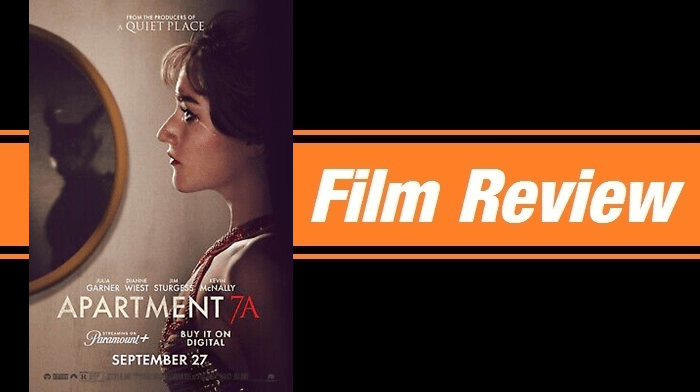
With “Apartment 7A”, director Natalie Erika James makes an ambitious attempt at delivering a prequel to Roman Polanski’s highly regarded “Rosemary’s Baby”. This psychological horror thriller takes an interesting approach to the 1968 film and Ira Levin’s original 1967 novel. It works best as a compelling appendix that fills in holes rather than expand the lore. And it does more to pay homage to Polanski’s classic than plow new ground.

Those familiar with “Rosemary’s Baby” may have a good idea of what to expect after hearing one name – Terry Gionoffrio. She’s a young woman who has a small but memorable role in Polanski’s earlier film and is the centerpiece of James’ prequel. Set in 1965, Terry (capably played by Julia Garner), is an aspiring dancer who came to New York City from Nebraska with big dreams of one day seeing her name in lights. Her career seems to be taking off, but she has a gruesome setback after breaking her ankle during a live performance.

Image Courtesy of Paramount Pictures

Terry is forced to endure a lengthy and painful recovery leading her to start popping pain meds. She attends several casting calls but loses out due to her noticeably weak ankle. But good fortune (or misfortune) comes her way after Terry meets the kindly Castevets, Minnie (Dianne Wiest) and Roman (Kevin McNally). They’re a wealthy elderly couple who live in The Bramford, a Renaissance Revival apartment building in Manhattan.

The Castevets explain to Terry that they have no children of their own. They like to help struggling young people get on their feet, so they offer to let her stay rent-free in their neighboring apartment. Things immediately start turning around for Terry. One of her new neighbors, Mrs. Gardenia (Tina Gray) gives her an herbal home remedy that fully heals her ankle. And after a blurry evening with another tenant, Alan Marchand (Jim Sturgess), she’s hired to be on the chorus line of a musical he’s producing.

But Terry soon learns that her big breaks are too good to be true. The Castevets go from sweet to weird to all-out intrusive. Strange sores begin to appear on her body. And more questions arise about her night with Alan. Of course with this being a direct prequel, the first film has already set the table and served the full meal. That ends up stripping “Apartment 7A” of its mystery and suspense. We know where things are going and have a good idea of how they get there.

Image Courtesy of Paramount Pictures

Yet James makes several good choices and adds her own unique touches that keeps us interested. Thematically she maintains a fascinating balance in depicting a young woman’s obsession with fame. Terry may have put herself in a bad position, but she’s unquestionably a victim. Garner artfully manages these tricky tensions, showing us ambition that leads to regret and later vulnerability that gives way to resilience.

Among James’ creative flourishes are two dramatically different but equally potent dance scenes. One is an elaborately staged musical number and the other a more intimate and calculated dance sequence. Both come from very different places and have significantly different purposes. But they’re part of what energizes this unavoidably predictable yet well-made, well-paced, and well-acted “Rosemary’s Baby” companion piece. “Apartment 7A” is now streaming on Paramount+.

VERDICT – 3.5 STARS

REVIEW: “Across the River and Into the Trees” (2024)

Ernest Hemingway’s “Across the River and Into the Trees” is rarely mentioned among the American writer’s more celebrated works. But it’s one I hold a special affection for. The work was first serialized in 1950 for Cosmopolitan magazine before being published as a novel later that year. Despite being met with negative reviews from the press, “Across the River” would become Hemingway’s only novel to top the New York Time’s bestseller’s list. As is often the case, literary critics and scholars have been more receptive of the work over time.

Director Paula Ortiz, working from a script by Peter Flannery, brings “Across the River and Into the Trees” to the screen in an adaptation that seeks to explore the DNA of Hemingway’s beguiling treatise on facing death, the prospect of love, and the emotional ravages of war. Their updated and safer spin first premiered at Idaho’s Sun Valley Film Festival back in March of 2022, and now it will be available for more people to wrestle with. And as with Hemingway’s novel, the reactions should be interesting.

Image Courtesy of Level 33 Entertainment

Those familiar with the novel will immediately notice the movie’s streamlined approach to setting up the story. Flannery’s script bypasses many of the book’s early details and makes some pretty significant narrative alterations. It still revolves around a complicated protagonist, the grizzled and truculent Colonel Richard Cantwell (played by Liev Schreiber). He’s a 51-year-old American Army officer and renowned hero of both World Wars stationed in Italy.

In many ways the Colonel is a quintessential Hemingway protagonist – world-weary and cynical in spirit. His ice-cold granite demeanor conceals more than the terminal illness he was recently diagnosed with. It also hides a lost soul deeply scarred by sorrow and trauma. The Colonel is a self-destructive man who drinks like a fish, is a heavy smoker, and pops nitroglycerin pills to keep his heart from exploding. Yet there’s a poorly veiled romantic side to the man which really comes out in his love for the city of Venice.

Ignoring the warnings of his concerned friend and physician Captain Wes O’Neill (Danny Huston in a small but effective role), the stubborn Colonel is determined to travel to Venice for a weekend duck hunt. O’Neill relents but assigns him a driver, the chatty Private Jackson (Josh Hutcherson). It doesn’t take long for the Colonel to shake his escort and hitch a boat ride into the city with an arresting young woman named Renata Contarini (Matilda De Angelis). He’s instantly fascinated by her which distracts him from his real reason for being in Venice.

In what feels like fate, the Colonel and Renata meet again and spend the night walking around the city marked by its beautiful sites and winding canals. It’s revealed that Renata is a countess from a once affluent family. She’s now unhappily engaged to a wealthy aristocrat named Antonio (Giulio Berruti) more to satisfy her ambitious mother than out of any feeing of true love. There’s a hint of Linklater as the two walk and talk across the alluring Italian città. But here the charm is shadowed by a looming sense of despair. It’s what makes the film both enchanting and tragic.

Image Courtesy of Level 33 Entertainment

Ortiz makes great use of her locations which are exquisitely shot by DP Javier Aguirresarobe. The film is a visual feast but in a self-restrained way that keeps it from becoming just a pretty travelogue. The camera serves the characters and their emotional pilgrimage. Venice is undoubtedly a key character, but at its heart “Across the River” is conversational and thoughtful. Flannery’s dialogue is organic and revealing; occasionally uneven but mostly authentic to the spirit of Hemingway’s prose.

With a title derived from the last words uttered by Confederate General Thomas “Stonewall” Jackson, “Across the River and Through the Trees” offers a bittersweet examination of love while emphasizing the toll war can take on the human spirit. Not all of the film’s liberties work, but Ortiz shows good instincts in keeping her film character-focused, and she captures the era’s post-war sensibilities which is a crucial element to the story. Add in a solid performance from the sturdy Schreiber and you have a warm yet haunting film that adds its own spin to one of Hemingway’s most underappreciated works. “Across the River and Into the Trees” releases in select theaters on August 30th.

VERDICT – 3.5 STARS

REVIEW: “The Arctic Convoy” (2024)

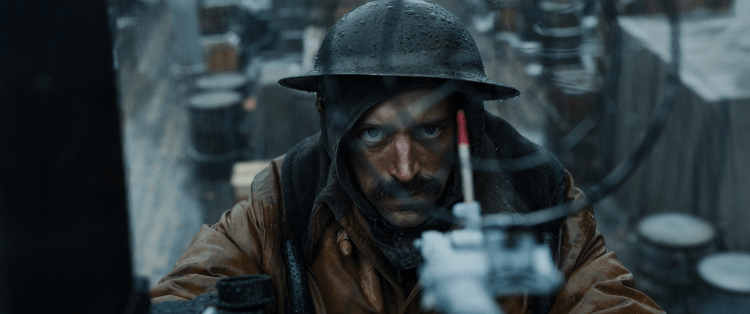
From director Henrik Martin Dahlsbakken, the Norwegian wartime thriller “The Arctic Convoy” tells yet another compelling story inspired by real events during World War II. Throughout the nearly 80 years since its end, there have been countless movies of all shapes, sizes, and subjects made about the Second World War. Yet there has been no shortage of captivating true stories of bravery, heroism, savagery and suffering, told through perspectives from all across the world. Add “The Arctic Convoy” to that list.

Dahlsbakken’s film sheds light on the Allied Arctic convoys that ran from 1941 until 1945. Consisting of merchant ships and their military escorts, the convoys traveled from Allied ports to the northern ports in the Soviet Union, carrying vital military supplies to Russian soldiers battling the Nazis on the Eastern Front. The icy journeys were perilous. Not only were they threatened by the merciless Arctic seas, but the ships were frequently targeted by German planes, battleships and U-boats.

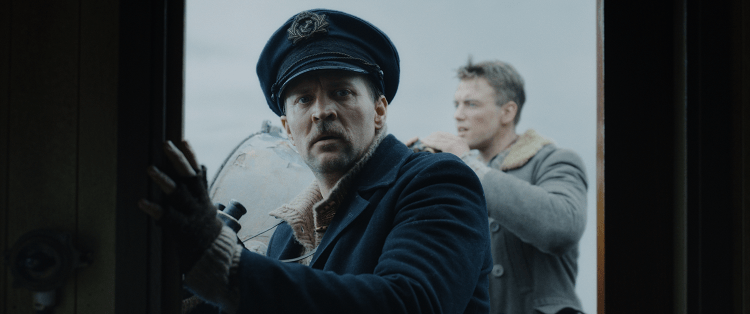
Written by the trio of Christian Siebenherz, Harald Rosenløw-Eeg, and Lars Gudmestad, the film’s story is inspired by convoy PQ 17. In the summer of 1942, 35 civilian merchant ships and their British Royal Navy escort left Iceland en route to the port city of Murmansk. We spend the entire film onboard the lead vessel, a Norwegian freighter captained by a seasoned seaman named Skar (Anders Baasmo).

Image Courtesy of Magnet Releasing

Over the course of the journey the filmmakers put time and effort into familiarizing us with the crew. Along with Skar, there is his chief radio operator Ragnhild (Heidi Ruud Ellingsen), his antsy new first mate Mørk (Tobias Santelmann), the ship’s gunner Johan (Adam Lundgren), the sea-weary engineer Erik (Olav Waastad) and others who give the film its human pulse.

The drama kicks in with the arrival of an alarming coded message seven days into their journey. They learn that their British escort has been ordered to withdraw and the convoy is to disperse and scatter. They get no explanation beyond that, and due to strict radio silence they’re unable to reach out for clarity. Is the withdrawal because the British forces are needed elsewhere? Or are they fleeing an imminent and substantial German attack that they’re ill-prepared to defend?

With all the other ships going their own ways, Skar is left with a critical decision. Does he and his crew turn around and return to Iceland, leaving the soldiers without their critical supplies? Or do they push forward to Murmansk and fulfill their mission, navigating potential enemy-infested waters with no military support whatsoever? It’s not hard to guess the choice he makes. But the suspense that comes from that choice only builds, especially once distress signals start coming in from the other vessels who are being picked off one by one.

Image Courtesy of Magnet Releasing

Rather than being action-filled and spectacle-driven, “The Arctic Convoys” relies on the human drama rather than big eye-popping set pieces. There’s a heavy focus on the sailors working under intensifying pressure and the psychological toll it inevitably takes. Second guessing leads to conflict, especially between Skar and Mørk. Yet there is an overarching sense of duty that drives even the most distraught crew members to give their all.

That’s not to say there’s no action. The film’s biggest sequence comes around the halfway mark and features the ship’s harrowing encounter with two German fighter planes. Brilliantly shot and edited, the scene cuts back and forth between all areas of the ship, giving us a variety of perspectives while generating some nail-biting in-the-moment tension. Everything from the exhilarating buildup to Dahlsbakken’s artful execution works.

“The Arctic Convoy” succeeds in sharing yet another little-known true story from the many still yet to be told from World War II. Strong performances and a character-driven focus adds some unexpected layers to this riveting, edge-of-your-seat nautical drama. Those itching for more spectacle might struggle with the film’s approach. But that doesn’t make it any less thrilling and it turns out to be a strength that drives this gripping war drama. “The Arctic Convoy” opens July 26th in select theaters and on VOD.

VERDICT – 4.5 STARS

REVIEW: “A Quiet Place: Day One” (2024)

John Krasinski created something pretty special in 2018 with his apocalyptic horror film “A Quiet Place” – a small budgeted but brilliantly executed project based on a story by the duo of Scott Beck and Bryan Woods. Two years later, Krasinski would return with a direct sequel, “A Quiet Place Part II”. Both films were successes with critics as well as at the box office.

Now the series is back with a third installment, “A Quiet Place: Day One”. Krasinski steps away from the director’s chair but stayed on as producer and helped conceive the story. Jeff Nichols was originally slated to write and direct, getting as far as submitting a finished script to the studio. But he left the film and was replaced by Michael Sarnoski. I’m still very interested in what a Jeff Nichols Quiet Place movie would be, but Sarnoski has made something of his own that fits well within this series.

Image Courtesy of Paramount Pictures

As its name suggests, “Day One” is a prequel as well as a spin-off. It takes place in New York City at the onset of the alien invasion that would ravage the planet and kill most of the human population (the first two films are set in the aftermath). The story mostly focuses on new characters but there are some welcomed connections to earlier players in this compelling universe.

One of several things that makes these movies resonate is the humanity at their core. It’s no different with “Day One”. Themes of fatherhood and motherhood (among others things) were central in the first two films. Here it’s something much different yet equally affecting. A perfectly cast Lupita Nyong’o plays Sam, an accomplished but terminally ill poet living in an upstate New York hospice facility with her beloved service cat, Frodo. From the very start, her character offers a new perspective to the genre.

Sam’s discouragement and self-isolation fuels much of the film’s emotional undercurrent. She is ever conscious of her own mortality and the cruel and lingering inevitability of her fate weighs heavily on her. She (mostly) keeps her emotions pent-up which worries her well-meaning nurse, Reuben (Alex Wolff). After much swaying, he convinces her to go with the group on a day trip into the city. But while in Manhattan, the sky is suddenly filled with meteor-like objects plunging to the earth. Soon after, hostile alien creatures begin attacking and killing people, plummeting the city into fear and chaos.

Sam is knocked unconscious and awakens inside a theater with a group of frightened survivors. She learns what we already know – that the deadly alien creatures are blind but have extremely heightened hearing. The movie follows her journey of survival which is impacted by the various people she encounters along the way. One such person is Eric (Joseph Quinn), a law school student from England who barely survives a flooded subway. While still in shock, he’s approached by Frodo who leads him to Sam. An unexpected friendship forms between Sam and Eric despite the two having very different aims and outlooks.

Image Courtesy of Paramount Pictures

While the film’s emotional beats hit their marks, “Day One” is also visually impressive. it begins with Sarnoski’s capturing of New York City. He keenly conveys the Big Apple’s sights, ambiance, and textures in rich detail both before and after the alien invasion. He also shows great judgment when shooting the action. The aliens are shown just enough and the camera makes them a truly terrifying threat. But they’re just as scary when not on screen thanks to Sarnoski’s shrewd use of sound and the performances.

“A Quiet Place: Day One” may be a prequel, but it still doesn’t answer the numerous lingering questions that hang over this series. Don’t expect much in terms of world-building as Sarnoski and Krasinski rely mostly on what we already know from the first two films (which isn’t a lot). But while “Day One” follows a somewhat similar blueprint as its predecessors, the human element really has an impact. Nyong’o is the essential piece, adding a very different dynamic to the horror movie protagonist. And for the record, I’m starting my campaign to give Frodo the cat all the Oscars. “A Quiet Place: Day One” is in theaters now.

VERDICT – 4 STARS

REVIEW: “A Family Affair” (2024)

Joey King, Nicole Kidman, and Zac Efron play the three leads in “A Family Affair”, a somewhat romantic comedy from director Richard LaGravenese. Written by Carrie Solomon, this light and frothy Netflix Original follows some well-traveled rom-com routes while squeezing everything it can out of its star power. The results are a film that starts promising but loses itself in a haze of soapy silliness that gets harder to endure the more it lathers.

King plays Zara, a 24-year-old personal assistant to a petulant, high-maintenance Hollywood movie star named Chris Cole (Efron). Known for his lucrative superhero movie franchise “Icarus Rush”, Chris is a worldwide star. But no one sees (and endures) his spoiled side quite like Zara does. After humiliating her with another childish tirade, Zara finally reaches her breaking point and quits. She immediately seeks encouragement from her mother Brooke (Kidman) who worries about her daughter’s lack of direction.

As for Brooke, she’s a seasoned novelist who’s writing her first book since the death of her husband Charlie eleven years earlier. She sat aside her dreams to focus on raising Zara who was having her own set of struggles while coping with her father’s death. Now Brooke is finding it hard to pick back up doing what she once loved so much. And then she meets Chris for the first time and the movie takes a sharp downward turn.

Image Courtesy of Netflix

It only takes a couple shots of tequila and about two minutes of screen time together before Brooke and Chris are in bed (and trust me, I’m not exaggerating). Zara walks in on them and the movie’s central conflict takes form. Zara doesn’t want them together, but they secretly start seeing each other. What could possibly go wrong? Well, as it turns out, a lot. And not just for the characters, but for we the audience also.

There are a number of problems that ultimately sink the movie. High on the list is that nothing about Chris and Brooke’s relationship feels organic. From their quick lusty hop into the sack to Chris’ sudden character transformation from insufferable man-child to adorable gentleman. It doesn’t help that their romantic angle follows the all too familiar blueprint. Tell me if you’ve seen this before: An unexpected romance springs up. Our two lovebirds are on top of the world until something happens and all seems lost. But love (as it always does) prevails in the end.

Making matters worse is the utter lack of romantic chemistry between Kidman and Efron. No matter how hard they try, there isn’t the slightest spark between them, making buying their characters as a couple nearly impossible. The woeful script doesn’t do them any favors, filling their mouths with corny dialogue and setting their story on the most predictable trajectory imaginable. Not even the always enjoyable Kathy Bates can keep this sadly unremarkable romantic comedy from flatlining. “A Family Affair” premieres this Friday on Netflix.

VERDICT – 2 STARS