REVIEW: “The Banshees of Inisherin” (2022)

(CLICK HERE to read my full review in the Arkansas Democrat-Gazette)

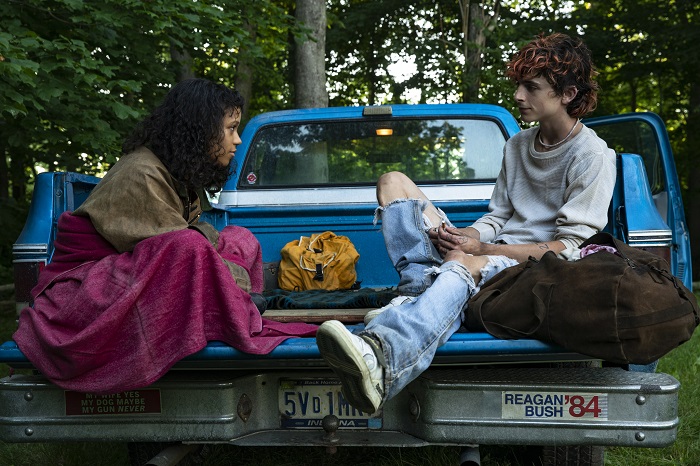
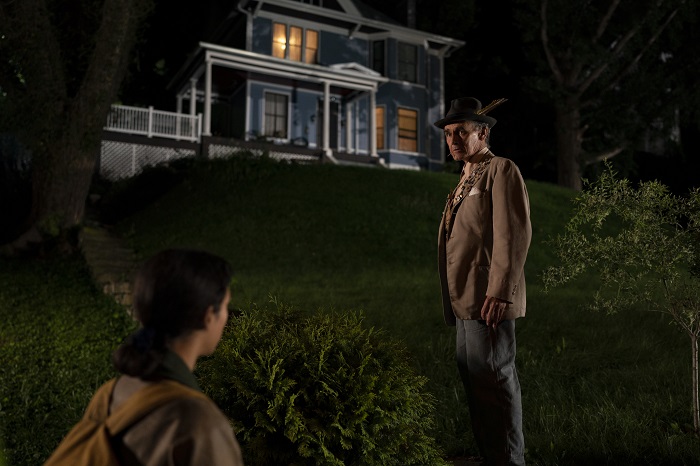
While I may be a little iffy when it comes to the films of Martin McDonagh, his latest, “The Banshees of Inisherin” is pretty great and my favorite film of his to date. It’s McDonagh’s most intimate, most soulful, and most mature movie, yet it still features many of the trademarks his fans (and critics) will look for. It’s built on the back of one of the best screenplays of the year – one that ushers us down a dark and twisted path, yet has us laughing every step of the way.

McDonagh reteams with two of his favorites, a sublime Colin Farrell (what a year he’s had) and Brendan Gleeson, one of the most reliably great actors working today. The two stars were a fantastic pair in McDonagh’s 2008 hoot “In Bruges”. Together again, they make for another captivating duo in “Banshees” and once again they’re in perfect sync with McDonagh’s mordant sensibility.

“Banshees” is a movie that lives and breathes in the mundanity of life. It examines humanity through petty grievances. It pits the desire to be alone against the need for companionship. It asks the strangely fascinating question – what’s more important, being nice or being remembered? Why not be both, you ask? That’s a question never posed on Inisherin, a small fictional isle sitting close enough to the Irish mainland to see and hear the sounds of civil war, yet sits far enough away to feel like a world all its own.

Image Courtesy of Searchlight Pictures

Set in 1923, McDonagh greets us with a stunner of an opener as his camera introduces us to Inisherin, with its lush green grass, jagged cliffs, long sandy beaches, endless stone fencing, and handful of cozy rustic cottages. And of course there’s the hub of all social activity – the local pub, where everything can be celebrated, mourned, or hashed out over a pint of Guinness. Well, almost everything.

In this small, tight-knit, and delightfully eccentric community, Pádraic Súilleabháin (Farrell) and Colm Doherty (Gleeson) have long been best friends. But something has changed, quite literally overnight. Colm comes to the conclusion that he no longer wants to be friends with Pádraic. “I just don’t like ya no more,” is the only explanation he gives. But that’s not enough for Pádraic, an all-around nice guy who’s perfectly content with his simple, unremarkable life on the island (so much so that he’s earned the reputation of being a bit dull).

But the older Colm has found himself in an existential malaise. Convinced he hasn’t much time left (12 years to be exact), Colm has dreams that reach beyond Inisherin – not far beyond, but beyond nonetheless. He wants to do something people will remember, and sitting around listening to Pádraic ramble on about donkey manure isn’t helping him reach that goal. So he ends their friendship and trades his best friend for his fiddle.

But the earnest and genuinely perplexed Pádraic keeps coming around, sure that his former friend will eventually snap out of his funk. Fed up, Colm does what any of us would do if we existed in a Martin McDonagh film. He warns that every time Pádraic bothers him, he’ll hack off one of his own fingers. You’d think that would be a deterrent, but (again) this is a Martin McDonagh film. So the story takes a darker turn, and what started as simple spat soon spirals completely out of control.

Image Courtesy of Searchlight Pictures

Pádraic tries to fill his best friend vacancy by hanging out with Dominic (a perfectly cast Barry Keoghan), the simple, girl-crazy village outcast. He’s been tossed aside by the townsfolk, yet he may be the most honest of the bunch. Keoghan’s line delivery and mannerisms are so precise they make Dominic one of the funniest, definitely the saddest, and in many ways the most tragic figure in the film.

Another key player is Pádraic’s loving yet long-suffering sister, Siobhán (a stellar Kerry Condon). She lives with her brother and his miniature donkey named Jenny, looking after him and taking up for him. Empowered by Condon’s warmth and vigor, Siobhán’s motherly bond with Pádraic is both sweet and constraining. Opportunities for a richer life are calling her from the mainland. But how does she leave behind her dear brother and only sibling?

There are so many other quirky and colorful community members who’ll show up from time to time. But it all comes back to Pádraic, Colm, and the two Oscar-worthy performances behind them. Farrell with his perpetually furrowed brow, sad eyes, and whimsical charm. Gleeson with his world-wearied face, stoic gruffness, and melancholy gaze. They have a beguiling chemistry, and together they imbue this proudly Irish production with an acerbic wit and a firm gut punch that you’ll be feeling for days after. “The Banshees of Inisherin” is now showing in select theaters.

VERDICT – 4.5 STARS

REVIEW: “Black Adam” (2022)

While the Marvel Cinematic Universe veers off in countless strange and indulgent directions, the DC Extended Universe sits suffering from a glaring identity crisis. What exactly is the DCEU? Who’s running the DC ship? Is there a roadmap? Which movies and what characters are a part of it? There was a time when I could answer those questions, but not these days. It’s all so convoluted and confusing, which is frustrating considering the iconic characters in their catalog.

Zack Snyder had a well defined blueprint he was following. Unfortunately, his vision was “too dark”, “too gloomy”, and “too serious” for many who cut their teeth on the MCU. That, along with the Joss Whedon debacle and a considerable amount of studio meddling, insured that Snyder’s vision would never be fulfilled. So here we are, still wondering where they go from here. Sure, DC Films has put out some incredible movies (“The Batman”, “Joker”, etc.) that aren’t connected to their extended universe. But what about the DCEU?

Enter Dwayne Johnson and “Black Adam”, a pairing that attempts to bring balance and (more importantly) direction to the DCEU. The engrossing superhero epic “Zack Snyder’s Justice League” aside, “Black Adam” is the first DCEU film since 2018’s “Aquaman” that genuinely feels a part of something bigger. I’m not knocking smaller and more individual projects, but a sprawling universe needs interconnectivity and continuity. With “Black Adam”, it looks like the DCEU is finally ready to deliver that once again.

Image Courtesy of Warner Bros. Pictures

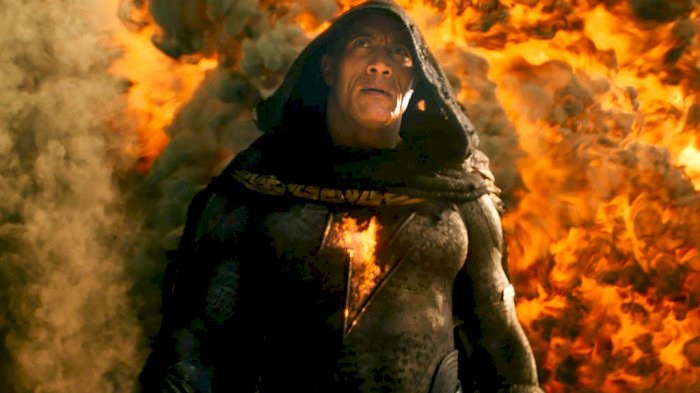
One of the film’s biggest strengths was also one of its biggest question marks – Dwayne Johnson. The wrestler turned movie star brings loads of influence and notoriety to whatever film he’s in. But he also has a truly larger-than-life personality which begs the question: would we be able to see beyond Dwayne Johnson to see Black Adam? The answer turns out to be a resounding “Yes”, and it’s in large part due to Johnson himself who gives a lights-out performance. He’s surprisingly restrained, intense and menacing, and slyly funny in some good moments of levity.

Directed by Jaume Collet-Serra and written by the trio of Adam Sztykiel, Rory Haines, and Sohrab Noshirvani, “Black Adam” quite intentionally avoids heavy exposition within its origin story framework. The most we get comes in a prologue where we’re taken back to 2600 BC. In the country of Kahndaq, a despot named Anh-Kot enslaves his own people, forcing them to mine for a mysterious metal called Eternium. The corrupt king wants the metal to forge the powerful Crown of Sabbac, but the people revolt. Legend says a champion named Teth-Adam was granted the power of Shazam which he used to kill Anh-Kot and free Kahndaq.

In the present day, Kahndaq is oppressed by a high-tech organized crime syndicate called Intergang who are seeking the location of Crown of Sabbac. Knowing the dangers if Intergang gets its hand on the Crown, archaeologist Adrianna Tomaz (Sarah Shahi) tracks the artifact to a secret chamber deep in a mountain. It also happens to be the tomb of Teth-Adam. When she and her team are ambushed by a squad of Intergang soldiers, Adrianna recites an inscription that summons Teth-Adam himself (Johnson), an incredibly powerful being who immediately slaughters all of the Intergang soldiers.

With Adam’s arrival, the people of Kahndaq believe they have finally found their champion. But his powerful presence is discovered by Amanda Waller (Viola Davis), a ruthless government official who dispatches the Justice Society of America to apprehend him. With a team consisting of the Nth metal empowered Hawkman (Aldis Hodge), a master sorcerer Dr. Fate (Pierce Brosnan), the wind controlling Cyclone (Quintessa Swindell), and Atom Smasher (Noah Centineo), who can grow enormous heights by manipulating his molecular structure, the JSA set out for Kahndaq.

Image Courtesy of Warner Bros. Pictures

A big chunk of the movie operates within an interesting moral gray space as it wrestles with the questions: is Adam the hero longed for by the people of Kahndaq, or is he a dangerous villain who needs to be taken into custody? They’re questions that shape the very battles between the JSA and Adam as well as their inevitable team-up later on, once a more sinister threat arises. The movie offers no easy answers. Adam’s willingness to brutally kill his enemies clearly poses a problem for the JSA who are much more by-the-book. But where were the JSA and earth’s other heroes during Kahndaq’s centuries of oppression? This opens up some of the film’s deeper themes. And things only get more complicated as facts of Adam’s past come to light.

All of that makes for the kind of compelling dynamic that superhero movies rarely engage these days. But make no mistake, this is a popcorn genre film through-and-through. “Black Adam” is the epitome of ‘action-packed’ with Collet-Serra putting together several terrific set pieces. Every character gets their moment to shine, with Hodge’s Hawkman and Brosnan’s Dr. Fate making intriguing new additions. But this is Black Adam’s show. Johnson energizes things with his magnetic antihero grit and gnarly kills which push the PG-13 rating, yet are still very much in tune with his character.

In its noble effort to avoid the usual origin story trappings, “Black Adam” bypasses a lot of meaningful backstory, leaving us with a few too many questions. I was hungry to know about the Justice Society, and what is Waller’s connection to them? That said, “Black Adam” does a admirable job introducing new pieces and charting new courses for the DCEU, all within a mostly self-contained story. Obviously those quick to roll their eyes at franchise-building or DCEU movies in general will find plenty to nitpick. But “Black Adam” accomplishes everything it needs to. It offers big action and cracking new characters. It puts its own unique stamp on the superhero origin story. And it sets the DCEU on an exciting new trajectory. “Black Adam” is now showing in theaters.

VERDICT – 4 STARS

REVIEW: “Bandit” (2022)

Don’t let its bland title fool you. “Bandit”, from Canadian director Allan Ungar, is a nimble and multi-faceted heist movie built around a genuinely outrageous true story. The film is an adaptation of Ed Arnold and Robert Knuckle’s 1996 book about the real-life story of Gilbert Galvan Jr. aka The Flying Bandit. Galvan Jr. was a criminal who robbed a total off 59 banks and jewelry stores across Canada over a three year period. He holds the record for the most consecutive successful robberies in Canadian history (I guess the keep stats for those things).

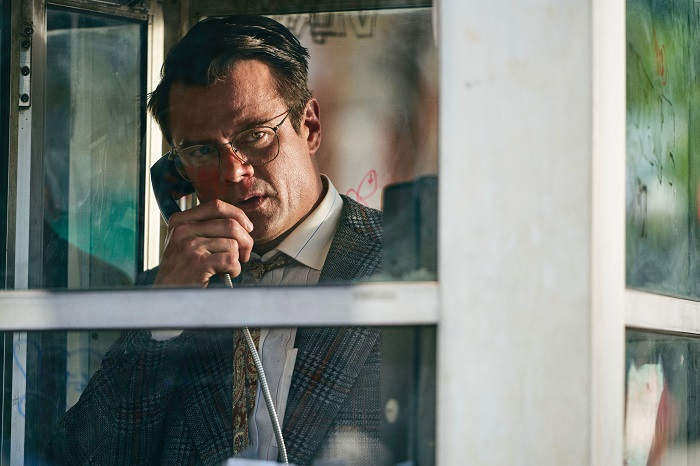
From a script by Kraig Wenman, “Bandit” is a fascinating stew of genres. It’s a biographical drama, a lighthearted crime caper, a straight heist film, and even a heartfelt love story all wrapped into one surprisingly cohesive whole. And it’s led by Josh Duhamel who is finally given some material that lets him show what he can do.

Image Courtesy of Quiver Distribution

The movie opens with Gilbert Galvan Jr. (Duhamel) setting up his own story which plays out during the shifting 1980s. Through narration and a little self-aware fourth wall breaking, the good-natured Galvan ends up sentenced to 18 months in a Michigan prison for check fraud. Six months into his sentence he busts out and makes his way across the border into Canada.

Once in Ottawa, Galvan assumes the name Robert Whiteman and even entertains going straight. He gets a low-paying job selling ice cream and even hits it off with a beautiful young woman named Andrea (Elisha Cuthbert) who works at a church-ran hostel. But in this particular story, once a criminal always a criminal. Galvan/Robert begins casing area banks, noting their small staffs and lax security. Inevitably robbing them comes next, and it proves to be something Robert is really good at.

But he can’t just keep hitting the same local banks, so Robert looks to take his gig nationwide. To do so he needs some backing. He connects with Ottawa’s biggest crime boss, Tommy Kay (Mel Gibson) who fronts Robert with the initial cash (for a small cut of each score of course). From there Gilbert Galvan Jr./ Robert Wiseman begins flying all across Canada, successfully pulling bank jobs and taking in loads of cash. During this time he and Andrea move in together. He tells her he’s gotten a job as a traveling “security analyst”. Actually he’s on his way to becoming the most prolific bank robber in Canada’s history.

Robert’s association with Tommy eventually puts him on the radar of a frustrated police detective named John Snydes (Néstor Carbonell). He runs an underfunded task force called Project Café that’s focused on taking down Tommy’s enterprise. With all of his key pieces on the board, Ungar begins moving them around at a breezy pace, keeping us engaged mostly through the charm-soaked performance of its star, Duhamel.

Image Courtesy of Quiver Distribution

While this is certainly a crime story, “Bandit” is sure to surprise people with its heart and almost kid-like playfulness. Take the dashes of good humor sprinkled all throughout the movie. They’re seen mostly during the heist sequences, from Robert’s numerous zany disguises to his innate congeniality (he routinely encourages bank tellers with a soft-spoken and heartfelt “You did great”). These scenes sell because of the good-looking, easy-going Duhamel who not only makes you laugh, but slyly has us rooting for him as well.

As normal for stories like this, things begin to tense up in the final act. It’s one of those cases where you see the ending coming from a mile away, yet Ungar’s crisp direction keeps us engaged. The lone issue is with Galvan/Robert as a character. Yes he’s charming, witty, and whip-smart. But we never really get to know him. Aside from his genuine love for Andrea, our connection to him is always surface-level. It’s a nagging problem that keeps the movie from being as compelling as it otherwise might have been. Yet, much like the character he plays, Duhamel has a way of drawing us in with his infectious charisma. “Bandit” opens tomorrow in select theaters and on VOD.

VERDICT – 3.5 STARS

REVIEW: “Blonde” (2022)

We’ve seen several attempts at bringing at least some portion of Marilyn Monroe‘s complicated and ultimately tragic life to the big screen. The latest comes from writer-director Andrew Dominik who has chosen to go with a fictionalized take on the life of the iconic American actress, somewhat similar to what Pablo Larraín did with Diana, Princess of Wales in last year’s “Spencer”. What we end up with here is a dour and depressing 2 hours and 45 minutes of misery and despair.

“Blonde” is a problematic psychological drama that’s adapted from the 2000 novel of the same name by Joyce Carol Oates. It’s far from a plot driven movie, instead playing like a pieced together series of imagery and vignettes. And while its intent may be to put us inside Marilyn’s skin so that we can experience her life the way she did, the movie remains so intensely focused on her suffering that key aspects of her humanity never make it to the screen. These missing pieces ensure that we never get a clear picture of who Marilyn Monroe truly was.

Because of Dominik’s approach, we don’t really learn anything new about Marilyn. Instead we’re forced to watch pain and exploitation that we already knew existed. So rather than giving Norma Jeane a deserved respite, “Blonde” just runs her through the wringer yet again. I certainly don’t think that’s Dominik’s intent. He has bigger themes on his mind. But his film comes across as cold and endlessly cruel to a woman whose life has often been defined by cruelty. And if my count is right, Dominik only gives her one lone scene in the entire overly long 166 minutes that features any semblance of true happiness.

Image Courtesy of Netflix

The film’s star Ana de Armas deserves a lot of credit for exquisitely capturing Marilyn Monroe’s glamor and her vulnerability. But sadly the script doesn’t go much further than that. Dominik only seems interested in honing in on her unraveling life. We see Monroe’s anxiety, her fraying mental health, her descent into drugs and alcohol. We’re shown misogyny, sexual assault, and physical abuse. Through it all, de Armas disappears into her character, and we never doubt it’s Marilyn Monroe we’re seeing on screen. Unfortunately she’s confined to Dominik’s strict vision.

Beginning in 1933 Los Angeles, Dominik establishes how the trajectory of Marilyn’s life was shaped by her traumatic childhood. She was born Norma Jeane Mortenson and grew up with an abusive mother (a really good Julianne Nicholson) who was a paranoid schizophrenic and an absent father who haunts Marilyn throughout the film. But the bulk of the story takes place through the 1950s as Norma Jeane Mortenson transforms from magazine and calendar cover-girl to the biggest celebrity in all of Hollywood.

But once again, Dominik isn’t really interested in Marilyn’s rise to fame. He doesn’t seem to care about her qualities as an actress or even a woman. Instead “Blonde” is all about chronicling her decline in depressing detail by stitching together scene after scene of mental and/or physical anguish. There are some standout moments such as when we see the real Norma Jeane expressing her feelings about her studio-made Marilyn Monroe persona. And there are numerous sequences that, on their own, are impactful. If only the movie was more cohesive and worked better as a whole.

In fairness, it’s completely true that “Blonde” is all about the dehumanization of Marilyn Monroe by the industry, the public, and everyone in between. That’s why it’s so grim and torturous. But that doesn’t erase the film’s missteps, nor does it excuse its own decisions, many of which do nothing but drag Monroe through the mud. I’m talking about bizarre inventions of its own, such as Marilyn being involved in a throuple with the party-going sons of Charlie Chaplin (Xavier Samuel) and Edward G. Robinson (Evan Williams). As if documenting her own sins and consequences weren’t enough, the choice was made to needlessly add some new ones.

Image Courtesy of Netflix

And what of the film’s much talked about NC-17 rating? The push to make “Blonde” racier does more to draw attention to the movie than bring anything meaningful to Marilyn Monroe’s story or the bigger themes Dominik is interested in. The most explicit scenes simply adds to the long list of indignities the movie puts the troubled Hollywood star through.

One thing you can’t knock is the craft behind the movie. Dominik has an incredible eye for framing shots, capturing emotion through his lens, and creating images that are both beautiful and hard to watch at the same time. There are several techniques that enhance the film, such as Dominik’s use of different aspect ratios. And there is his choice of oscillating between color and black-and-white. It’s something I could never get in sync with, but it does offer some visually impressive transitions from one scene to the next.

Without question “Blonde” works best as an examination of celebrity status, exploitation, and self-destruction rather than an actual treatment on the life of Marilyn Monroe. It can’t be stressed enough – this is no biopic. It’s a work of fiction milking from the fame of a fallen Hollywood star. But by using Marilyn Monroe’s name, likeness, and troubled history to explore its own themes, you could say “Blonde” is doing the very thing it’s critiquing, just in a slyly different way. And that turns out to be a hurdle the movie can never quite clear. “Blonde” hits Netflix September 28th.

VERDICT – 2 STARS

REVIEW: “Brahmāstra: Part One – Shiva” (2022)

Without question, one of the most audacious cinematic undertakings in recent history begins with the new film “Brahmāstra: Part One – Shiva”. From the creative mind of Ayan Mukerji, this Hindi-language epic is the first film of a sprawling blockbuster trilogy and the first installment in Mukerji’s vast extended cinematic universe known as the Astraverse. The filmmaker poured six years into crafting this original story and expects to spend ten years making his trilogy. Part One certainly gets things off on the right foot.

In more ways than one, “Brahmāstra” closely resembles a classic superhero origin story. And unlike the current state of the West’s biggest shared universe, the MCU, “Brahmāstra” gets back to larger-than-life storytelling, openly embracing the crazy and fantastical, and piquing our imaginations while Mukerji impresses us with his. The results are often thrilling, highly entertaining, a little cheesy, but always fun.

Image Courtesy of Star Studios

With Part One of his trilogy, Mukerji serves us a delicious cocktail of fantasy, action, and the supernatural. He builds his story on some rich mythology which he created from scratch – a mythology full of magic and mystique. But as with every origin story, we’re bound to certain inevitabilities such character introductions, rule-making, and exposition. In “Brahmāstra: Part One” we get a ton of each which makes sense considering what Mukerji is building. It’s a necessary convention, but a convention nonetheless.

But I have to admit, I didn’t mind it as much in “Brahmāstra” as I expected to. That’s because I often found myself enamored with the sheer creativity behind what Mukerji was piecing together. It’s undeniably silly, and it doesn’t always make sense. And its firm adherence to certain Bollywood formulas inevitably leaves a few segments feeling hopelessly contrived. But here’s the thing, that same Bollywood formula adds to the film’s charm. And when incorporated with Mukerji’s story, we get something that I found more exciting than redundant.

The backstory is too deep to fully explain here, but here’s the CliffsNotes version: There exists a secret society of empowered sages called the Brahmānsh who for generations have protected supernatural weapons known as astras. These astras draw from various energy sources from the earth (wind, water, fire, etc.), and they each endow wielders with unique superpowers. The most powerful among the astras is the Brahmāstra, a divine weapon capable of destroying the universe, which the Brahmānsh secretly keep hidden to this day.

Image Courtesy of Star Studios

As the movie’s title hints, “Brahmāstra: Part One” centers on a DJ named Shiva (Ranbir Kapoor) who falls for the beautiful Isha (Alia Bhatt). But what’s begins as a fairytale love story quickly turns after Shiva begins have distressing visions. Combined with his strange connection to fire, it becomes evident that a great power is awakening within him. After receiving a premonition of an impending danger, Shiva and Isha set out on an epic adventure that leads them to a hidden ashram in the foothills of the Himalayas. There they meet Guru (Amitabh Bachchan), the leader of the Brahmānsha who introduces Shiva to the secret world of astras.

Meanwhile a powerful dark force named Brahm-Dev has sent out his disciple Junoon (Mouni Roy) to seek out and obtain three fragments which when joined together will unleash the Brahmāstra. Junoon is a really fun villain (she would be right at home in the Mortal Kombat universe), yet her motivations are too opaque. Why does she follow Brahm-Dev? What’s in it for her? Despite her lack of detail, Junoon along with her two super-powered henchman, Zor (Saurav Gurjar) and Raftaar (Rohollah Ghazi), are key parts of the film’s very best action sequences.

One knock against the movie is the central romance. For clarity, there’s nothing wrong with Kapoor or Bhatt. Their performances are solid, and there is some genuinely good chemistry between them. But the buildup is incredibly shallow. Essentially, it’s your garden-variety ‘love at first sight’ scenario. He sees her across the dance floor, they eventually meet, and in a snap they’re in love.

Image Courtesy of Star Studios

The only potential tension between the young couple is their economic status. We’re told she’s rich, but we never really see it. We’re told he’s poor, but he certainly doesn’t look it. Of course, we do eventually learn more about Shiva’s past. After all, his self-discovery is a big part of the movie. But Isha isn’t given the same courtesy. We learn practically nothing about her. Bhatt makes Isha a character we enjoy rooting for, but a little more attention and detail would have helped tremendously.

Still, our first foray into Ayan Mukerji’s ambitious Astraverse turns out to be a truly fun-filled experience. The filmmaker introduces us to an inspired world full of imagination and heart. The visual effects are terrific; the action scenes are stylish and full of energy (especially the wild opening and a rousing chase sequence on a treacherous Himalayan Mountain road). And of course there’s always time for a musical number or two, with their impressive production and not-so-impressive lip-syncing. Together, it all gels into this pretty incredible adventure full of Bollywood flavor. And while it might stumble on some of the simpler things, Mukerji’s enormous vision left me dazzled and hungry for Part Two. “Brahmāstra: Part One – Shiva” is now showing in select theaters.

VERDICT – 4 STARS

REVIEW: “Barbarian” (2022)

Nothing about the trailer for “Barbarian” indicated anything unique or fresh. In fact, in many ways the trailer felt incredibly generic, milking countless horror movie tropes that have been used ad nauseam throughout the genre’s history. Yet I’m tempted to call the trailer genius, not because of what’s in it but because of what’s left out. To its credit, “Barbarian” can’t really be labeled as generic thanks to its handful of unexpected twists and gonzo turns. And its straightforward commentary shows it has things on its mind.

But simply jolting the audience with a crazy turn or two doesn’t make for a good horror movie. And simply having themes in your film isn’t the same as doing something meaningful with them. And that leads to what makes “Barbarian” an unfortunate disappointment. There’s no shortage of good ideas in the movie we’re given, yet the payoffs range from underwhelming to preposterous. Then there’s the film’s social messaging, much of which focuses on bad men and their various shades of misogyny. Yet despite some compelling early exchanges, the movie is content with a surface-level treatment of its themes and squanders some real potential.

Yet even if the twists led to great payoffs and the film’s themes were explored deeply and with savvy, “Barbarian” would still be a tough sell. That’s because the sheer stupidity of the characters and their actions plague the entire movie. And no amount of effort put into suspending disbelief could help me to look past the steady stream of dumb character decisions. It’s so obvious that you’d almost swear “Barbarian” was a parody. But it’s not, and as things get sillier, it gets harder to find anything resembling a fright aside from the occasional lazy jump scare. There’s a ludicrous gross-out moment and a couple of scenes of cheap B-movie gore. But nothing I would categorize as scary.

Image Courtesy of 20th Century Studios

“Barbarian” is the feature film debut for writer-director Zach Cregger. What he gives us is essentially a three-act movie that connects three very different people from three very different places to one very specific house with some pretty twisted secrets. It’s an audacious story structure that begins on a dark and rainy night in a dilapidated Detroit neighborhood. Tess (Georgina Campbell), who’s in town for a job interview, pulls up to the Airbnb she has booked for the evening. But to her surprise she finds the house is occupied by a man named Keith (Bill Skarsgård) who rented the place himself from another online agency.

Keith is a little awkward but seems nice enough, even inviting Tess to come in out of the rain. After neither can reach their booking agencies, Keith asks Tess if she would like to stay the night and sort out their mess in the morning. He offers her the bedroom while he takes the couch. After very little hesitation, she agrees.

By this point, our protagonist’s ‘horrible decision’ count is already at about 5. And again, that would be okay if this were a spoof (something like the Geico commercial where kids running from a maniacal killer hide in a shed full of chainsaws rather than get in the running car). But it’s not. Tess is an otherwise intelligent and capable young woman which Campbell’s performance conveys far more effectively than the writing. But the dumb choices really start to rack up once Tess ventures into the house’s basement, discovers a secret door, and can’t resist the urge to explore what’s behind it.

Image Courtesy of 20th Century Studios

I won’t say much more because (supposedly) the film works best if you go in blind. But Justin Long shows up in a borderline cartoonish second act that sees the movie suddenly reaching for laughs despite introducing some rather serious subject matter. I’m still not sure if Long‘s character is meant to be taken seriously or if he’s just an obnoxious stooge. Either way, he provides us with more stupid character decisions which eventually lead to a film’s final act. It’s here that “Barbarian” gets points for going bonkers, yet it’s ending is undone by a really dumb final ten minutes that features even more dimwitted character choices and a laughable final scene that had several people at my screening snickering.

Cregger does some really good things when it comes to atmosphere, especially in the film’s first act. The movie is also helped by a strong performance from Campbell who works hard to give Tess credibility even as the script is constantly undermining her. Then there’s the story structure which is notably unconventional but hardly revolutionary. By the midway point of the second act you have a good idea what it’s going for. And then you have its themes which many other movies are also exploring. Here they’re simply present rather than tackled.

“Barbarian” has a good premise and a willingness to go off the rails. But it’s hampered by its vacuous characters and the movie’s unfortunate reliance on their routinely dopey decisions. Some may be able to overlook it. After all, horror movies are notorious for characters making dumb choices. But here it’s one after another. At times you can almost sense Cregger’s awareness, yet he double-downs on it. And for a movie sporting such big ideas, it’s a shame to see it lean so heavy on the conventional. “Barbarian” is now showing in theaters.

VERDICT – 2 STARS