Anytime I see Hirokazu Kore-eda’s name attached to a project you can bet I’ll be watching. The 60-year-old Japanese auteur’s last film was 2019’s “The Truth”, a terrific drama not near enough people talked about. It was Kore-eda’s first movie set outside of his native Japan and not in his native tongue. His latest, “Broker”, sees him once again venturing outside his home country, this time to South Korea. Yet it remains a Hirokazu Kore-eda film through and through.
In “Broker” (written and directed by Kore-eda), the story revolves around a band of outcasts brought together through an unusual series of circumstances and who have all kinds of odds stacked against them. As you would expect from a Kore-eda film, we once again see him plowing that fertile ground of family, both the conventional and (more so in this case) the unconventional kinds. And, as he so often does, Kore-eda tells his story with a heartfelt humanistic touch, ushering his characters (and us) across some morally thorny ground, yet always finding ways to earn our empathy.
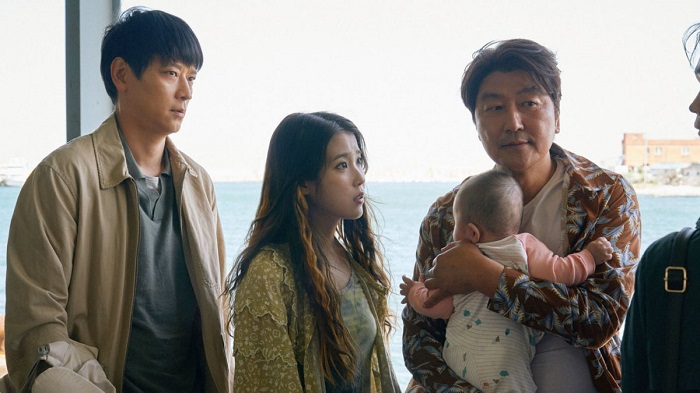
Another way you know you are watching a Kore-eda film is by the richness of his visuals. “Broker” is no exception. You can always sense the trust Kore-eda has in his actors by the way he shoots them. So often the camera will sit still, strategically framing a shot in a way that both captures our eye and let’s the performances carry a good portion of the load. And usually when there is movement, it will be slow and steady pans that stay intently focused on the characters. Then you have the incredible detail squeezed into nearly every frame, whether he’s shooting a wider area like a neighborhood street or a small intimate space like a single room. There’s always something compelling to take in.
As for the story, Kore-eda begins with some important table-setting. On a dark and rainy night, a young mother leaves her infant child on the cold concrete in front of Busan Family Church and then scurries off. Watching from a nearby car are two police detectives, Soo-jin (Bae Doona) and Lee (Lee Joo-young). Lee follows the young mother while Soo-jin picks up the well-wrapped child and places it in the church’s “baby box” (it’s like a drop box for infants). Soo-jin then hurries back to her car to avoid being noticed.
Inside, Dong-soo (Gang Dong-won), a part-time employee at the church, retrieves the baby boy from the box and gives him to Ha Sang-hyeon (Song Kang-ho). They erase the security camera footage and any evidence that the child was dropped off. Sang-hyeon then takes the child to his ragtag laundromat which is really just a front for their equally ragtag two-man child trafficking operation. They defend their practice by claiming they’re saving children from the inevitability of growing up in an orphanage. Instead, they find the babies a home, allowing potential parents to bypass the country’s broken adoption process. Of course they do expect a “modest payment” for their services. So as the title intimates, they are brokers, but of a more sordid kind.
But what they didn’t expect was for the mother, Moon Sun-ah (Lee Ji-eun) to show up the next day looking for her son. Before long, she has joined Sang-hyeon and Dong-soo on a long road-trip to meet a couple who are interested in buying her child. Meanwhile the two detectives follow the oddball trio plus one baby, watching from a distance with hopes of arresting them in the act.

It certainly makes for an offbeat scenario – one that could easily veer off into into several directions, either super-serious or farcical. But in the hands of Kore-eda, the film never loses its plausibility despite how crazy the circumstances get. And while fairly serious, the story makes time for more light-hearted moments and even dashes of black comedy. Meanwhile the characters, as morally suspect as they may be, earn and maintain our empathy. Kore-eda guides us past their flaws and urges us to see them in a different light.
There are times when Kore-eda drives close to melodrama, but he never lets his film cross over the line. He keeps things grounded and character-focused, making it easy for us to relate despite the on-screen actions we’re witnessing. At the same time, Kore-eda also poses some thoughtful questions through his characters as they’re forced to face difficult choices, no-win scenarios, and unavoidable consequences. Just more pieces that enhance this technically, narratively, and emotionally savvy journey. Altogether “Broker” is a beautifully composed and constructed character study wrapped in Kore-eda’s signature warmth and grace. “Broker” hits select theaters on December 26th.
VERDICT – 4.5 STARS