REVIEW: “Blue Jay”

blue-poster

Mark Duplass has found himself in an enviable position. He’s making the films he wants to make with complete creative control. And he’s doing so not by making it big in Hollywood. Instead he signed a four-picture deal with Netflix that offers him artistic freedom while also ensuring the financial backing that many independent filmmakers struggle with.

For the most part Duplass has steered clear of Hollywood’s courting, instead making small intimate films with miniscule budgets. His first movie for Netflix certainly fits that description. “Blue Jay” is Duplass completely in his element and it gives us a good idea of the creative leeway he has been given. It’s shot in black-and-white, it stars essentially a two-person cast, it took only seven days to film, and it was green-lit by Netflix without seeing a script. That’s a trusting partnership.

jay1

Duplass not only writes the screenplay but stars in “Blue Jay”. He plays Jim, a 40-ish bachelor who returns to his small California hometown to renovate the house left behind by his late mother. While in the grocery store Jim bumps into his old high school sweetheart Amanda (Sarah Paulson) who happens to be back in town to visit her sister. Their meeting is bit awkward but a cup of coffee at the town’s diner loosens things up and before long they are reminiscing about the good old days.

We learn all we need to know about these two characters through their conversations and recollections. As we slowly piece together their deep connection it becomes clear that their entire lives have been effected by the past they shared. There’s also this neat bit of early 90s nostalgia that shows itself in the scenes where Jim and Amanda cast aside their present-day cares and playfully immerse themselves in their history together. But their memories aren’t wound-free which becomes evident the more time we spend with them.

blue2

Director Alex Lehmann wisely keeps himself in the background and allows his two actors to carry the load. Duplass and Paulson have a convincing chemistry and there is an organic flowing rhythm to their dialogue. Much of it is due to a considerable amount of improvisation in place of a conventional script. While Duplass is a natural fit for his character, Paulson is the true highlight. Watching her navigate her character’s many emotional layers left me wondering why she doesn’t get more of these roles.

“Blue Jay” manages to be funny and playful while also taking an honest look at the insecurity and fragility of its characters. Later on it does get a touch melodramatic but it always remains truthful and feels plucked from real life experiences. The wonderful choice to soak the film in black and white adds a wonderful layer of nostalgia and melancholy. It’s a bold choice for a 2016 character drama, but again it demonstrates the audacity filmmakers can show when given creative liberties. That’s why I’m excited for what else this Duplass/Netflix partnership will deliver.

VERDICT – 4 STARS

4-stars

REVIEW: “The Birth of a Nation” (2016)

birthposter

I’m not sure if any 2016 movie has drawn a more complex range of discussion than Nate Parker’s “The Birth of a Nation”. Right out of Sundance, many instantly christened it the next Best Picture Oscar winner and a direct answer to the #OscarsSoWhite controversy. Some have placed the entire weight of the Hollywood diversity cause on its shoulders. Such high expectations are hardly fair.

Adding another layer was the resurfacing of a 1999 Penn State rape charge. Parker and close friend Jean McGianni Celestin (who is given a story credit in the film) were accused of raping a fellow student. Charges against Parker were dropped but information about his defense (namely his definition of “consent”) and acts of intimidation towards the victim haven’t shed him in the most positive light. Celestin was convicted but the charges were eventually dropped on a technicality. The victim committed suicide in 2012.

Essentially this renews the age-old debate of separating the art from the artist, something I’m usually able to do (Roman Polanski’s “The Pianist” remains a favorite of mine). But I don’t dismiss those who struggle with Parker and his film mainly because a brutal rape plays a big part in the story. Ultimately your experience with “The Birth of a Nation” could very well be influenced by how these events speak to you.

birth2

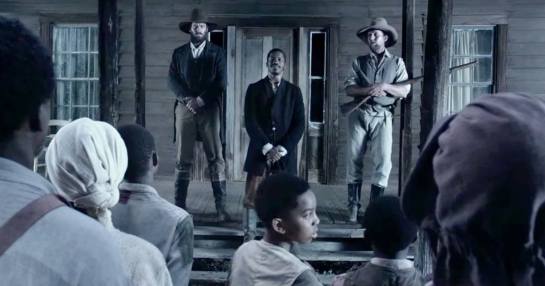
Personally I feel better equipped to examine the movie on its own merits. Controversy aside, there is a powerful story at the center of Parker’s film – a melding of fact and fiction. It’s based on the life of Nat Turner, a slave in Southhampton County, Virginia who led an uprising against white slave owners in 1831. Many have viewed Turner’s rebellion as a heroic and justified act which is clearly the perspective Parker takes. But in doing so he softens the edges of Turner’s actions which misses out on some of the more fascinating complexities of his story.

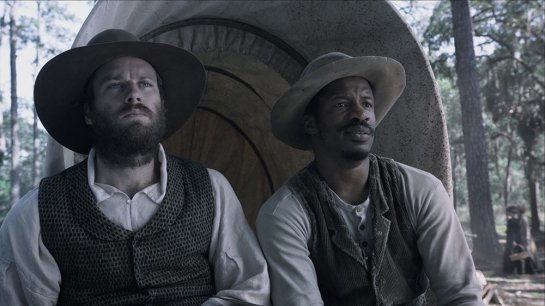
Parker (who wrote, directed, and starred in the film) first reveals Nat Turner as a young boy. A self-taught reader, Nat is given a Bible by the matriarch of his slave owning family (Penelope Ann Miller). Years pass and Nat becomes a preacher to his fellow slaves on the plantation which is now ran by Samuel Turner (Armie Hammer). When a local white minister (played in a near cartoonish fashion by Mark Boone Junior) notices Samuel’s slaves are “well behaved”, he suggests that Samuel take Nate to other plantations to preach calming messages to their slaves (for a price of course).

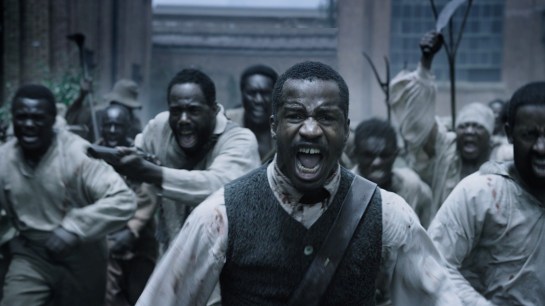
As Nat visits other plantations the true brutality of slavery is brought into focus and he realizes he is simply a tool of the slave owners. This directly challenges his view of Scripture and soon causes him read the Bible in a new way. Feeling inspiration from God, Nat puts together a violent rebellion in hopes of freeing his people and pouring out judgement on their oppressors.

birth4

“The Birth of a Nation” is told almost exclusivity from the slave’s perspective (mainly Nat’s) which offers some truly powerful moments. This allows for the ugliness to be seen without any (intentional or unintentional) gloss. At the same time Parker’s direction and storytelling is all over the map.

The early parts feel as though Parker is simply checking off plot points. There is little narrative flow. Once the film gets to where Parker wants it to be, he slows it down and more thoughtfully maneuvers from scene to scene. There are also these unusual bursts of otherworldly imagery which seem to be portraying Nat as a mythological spiritual figure of sorts. It’s an interesting idea but Parker doesn’t let it flow naturally from the story. It’s more or less forced upon us through much more conventional techniques.

There are several compelling things Parker touches on that I wish had been explored more. There is an undeniable spiritual element particularly when Nat begins to see Scripture through a different lens. I would have loved to see more of his struggle with interpretation since it eventually birthed his inspiration for the rebellion. Instead it (and several other story threads) feels terribly shortchanged.

birth1

Then there is the rebellion itself. The uprising began with a surprise killing of 50+ slave owners. Parker doesn’t hold back on the graphic brutality, but in his version Nat and his fellow slaves targeted the male slavers who we see throughout the film doing all sorts of vile acts. In reality women and children were also killed. This fact could have subverted what Parker is going for, but the inner moral conflict it surely brought would have been fascinating to explore.

While several things would have made this better, that in no way means this film is without value. Again, there is a powerful story at its core, and while sometimes conventional, several of Parker’s images and scenes are indelibly etched in my mind. But perhaps its biggest strength is how it serves as a profound reminder of a nation’s past transgressions. From start to finish “Birth” keeps you locked in and focused. Parker never loses the potency of his subject matter.

It’s no accident Parker chose “The Birth of a Nation” as his title. It’s taken directly from D.W. Griffith’s 1915 silent epic – a film praised for its groundbreaking approach to filmmaking and excoriated for its depictions of African Americans and the KKK. Parker has “reclaimed” the title and attached it to a much different picture – not a perfect one, for sure. Its uneven direction, messy script, and some heavy-handedness of its own are legitimate frustrations and while “The Birth of a Nation” strives for greatness it falls just short. Yet despite its shortcomings, there is still important and thought-provoking material here, material that deserves to be seen and talked about.

VERDICT – 3 STARS

3 Stars

REVIEW: “Bonjour Tristesse”

BONJOUR poster

While writing an upcoming blog piece I was compelled to revisit the morally murky waters of “Bonjour Tristesse”. Otto Preminger’s crafty 1958 British-American drama was based on the popular novel by Françoise Sagan. At the time the film danced precariously close to the edge of early cinema standards, causing censors plenty of headaches and heartburn.

In some ways “Bonjour Tristesse” was ahead of its time. Its style of storytelling, its willingness to look at taboo subjects, its nonjudgemental perspectives. All of these were things that would begin showing up more in films shortly after. Upon release critics didn’t necessarily see it that way and the film wasn’t particularly well received. But one of its early champions was none other than Jean-Luc Godard who two years later would make his pivotal French New Wave classic “Breathless”, a film that in some ways found inspiration in “Bonjour Tristesse”.

Preminger loves to play with contrasts. Look no further than to the story itself. It swings back and forth between present day and the events of a recent two-week vacation. Both periods are told from the perspective of a young teen named Cécile (Jean Seberg). In the present we spend an evening with her and her wealthy playboy father Raymond (David Niven) as they hop from one expensive nightclub to another. With them is Raymond’s blonde flavor of the evening and several different suitors vying for Cécile’s attention. All of these scenes are presented in black and white.

BONJOUR1

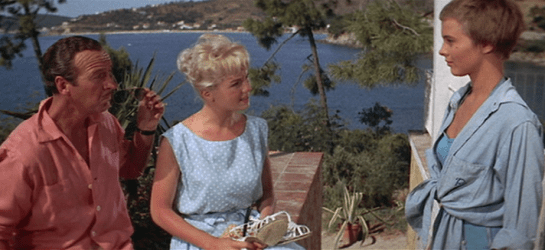
Contrast that with the vivid, bright colors of the vacation flashbacks. The beautiful French Riviera setting is where we get the meat of the story. Cécile and her father are staying at their oceanside villa with his latest fling – a younger, spacey beauty named Elsa (Mylene Demongeot). Their time of fun and frolicking gets a bit complicated when the cultured and proper Anne (Deborah Kerr) arrives. Ever the libertine, Raymond doesn’t hide his attraction to Anne. Meanwhile Cécile grows frustrated with the strict and starchy authority Anne imposes. The various conflicts that follow work together like clever, revelatory puzzle pieces.

The bright, colorful vacation sequences are nice to look at, but they offer more than just beautiful scenery. Through them we learn the reasons for Cécile’s obvious melancholy in the present day scenes. Hiding behind the façade of riches, parties, and the perfect vacation spot lies a subtle repugnancy and an undeniable sadness that slowly simmers to the surface as the movie moves along. Cécile’s emotions are the focus. In fact, the color and black-and-white contrast is directly tied to Cécile’s changed emotional state.

BONJOUR2

“Bonjour Tristesse” takes the audience down several winding narrative paths. There are no jarring twists or sudden diversions. Instead it deliberately and patiently unfolds. Several of the characters take on slow, chameleon-like transformations. The characters are hard to read and various actions change our perception of them sometimes more than once throughout the film. The script lays this out nicely but the performances are just as important.

David Niven is solid as always, effectively selling us his hedonism. He will often carouse about seemingly unaware of his selfishness or the effects of it. We see it in his throwaway attitudes towards his mistresses as well as the oddly affectionate relationship with his daughter. Deborah Kerr is brilliant and her performance provides a pivotal shift in tone and narrative. But it is Seberg whose light shines brightest. She is magnificent as she maneuvers from an innocent, playful pixie to a jaded young woman drowning in disappointment and melancholy. Much like the movie at the time, there were several criticisms about her performance. Personally I feel they are failing to see her performance as a deliberate and cohesive whole.

It would be a mere two years before Seberg would set the French New Wave on fire, but in “Bonjour Tristesse” she and Preminger were playing with several elements that the New Wave filmmakers would take to new levels. It meanders a bit and at times feels a little soapy, but its intelligence, craftiness, and style can’t be denied. “Bonjour Tristesse” is an undervalued and underappreciated film. It holds up magnificently and its influence alone shows the value that many often overlook.

VERDICT – 4 STARS

4 Stars

REVIEW: “The BFG”

BFGposter

Some movies can’t be made until technology catches up to the concepts. I fully believe the “The BFG” is a prime example. Certainly attempts could have been made. CGI and motion-capture have been around long enough to bring some wobbly form of Roald Dahl’s children’s book to the big screen. But Steven Spielberg’s latest fantasy endeavor proved that now was the right time.

I won’t say “The BFG” is without a stumble here or there, but it is far more charming and delightful than I anticipated. That’s because Spielberg and screenwriter Melissa Mathison (who sadly passed away last November) have a very clear idea of how they want to tell this story. The two first collaborated on “E.T.” which released in 1982, the same year “The BFG” book was published. Here they’ve pruned certain elements of Dahl’s story and made a lighter, relationship-focused fantasy adventure.

BFG1

The key ingredient to the film’s success is Mark Rylance. Spielberg has called Rylance “transformational”. Last year they made “Bridge of Spies” which netted the stage veteran the Supporting Actor Oscar. They have two more films together coming soon. The two clearly have a creative chemistry which “The BFG” uses to its fullest advantage.

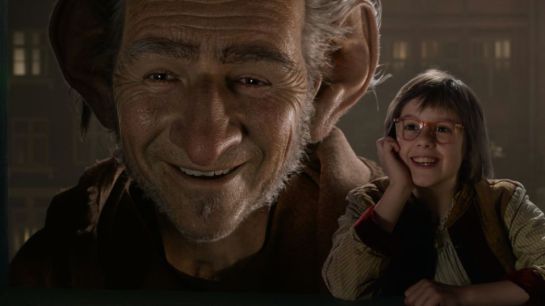
Rylance’s performance is sublime. You simply can’t turn away from what he is doing. And this is more than just motion-capture. Yes Rylance went through the process of wearing a black bodysuit covered with sensors that captured his every movement. But much like the very best Andy Serkis work, this truly visualizes a full performance. The amazing representation of this 24 foot tall gentle giant is equally due to the sensational visual artistry and the impeccable performance delivered by Rylance.

bfg2

We also get a fine performance from young Ruby Barnhill who plays a orphan girl named Sophie. Late one night Sophie looks out her window and sees Rylance’s Big Friendly Giant sneaking around her street. Fearing she will tell others of his existence, BFG plucks Sophie from the orphanage and takes her to his home in Giant Country.

Despite their glaringly obvious differences, the two develop an unlikely friendship and find they have much in common. Both are lonely and have no friends. Both struggle with a sense of belonging. Each fill a significant void in the other’s life. But things are complicated by the nine child-eating giants who also live in Giant Country. The nine, who feature such names as Childchewer and  Gizzardgulper, constantly bully BFG. But things get even worse when their leader Fleshlumpeater (Jemaine Clement) gets a whiff of young Sophie (if you know what I mean).

BFG3

The film occasionally flirts with the conventional, but it never fully falls into that trap. It doesn’t drown its story with silly slapstick. It doesn’t dumb itself down. It doesn’t numb your senses with hyperactive pacing. For the most part it steers clear of common clichés found in kids/family movies. I liked the slow build and the attention to character. I also thought it was very funny at times (although why do you find fart jokes in 99% of these things).

There are a handful of meandering moments and a few obvious gaps in narrative logic. But as a whole “The BFG” is a delightfully heartwarming movie that may push away those looking to have their senses set ablaze by nonstop action and rampant silliness. But for those looking for an intelligent and engaging experience, “The BFG” more than delivers. And if nothing else it’s worth seeing for Mark Rylance’s nomination-worthy performance.

VERDICT – 4 STARS

4 Stars

REVIEW: “The Boy Next Door”

boy poster

There is a moment in “The Boy Next Door” (albeit a brief one) where I asked myself “Could this actually be a good movie?” It’s early in the film and despite its visible cracks the movie appears to be laying some fairly entertaining groundwork. But it didn’t take long before I had the answer to my question. It didn’t take long for me to realize that this was another silly, cliche-ridden, Lifetime caliber effort with seemingly no unique identity of its own.

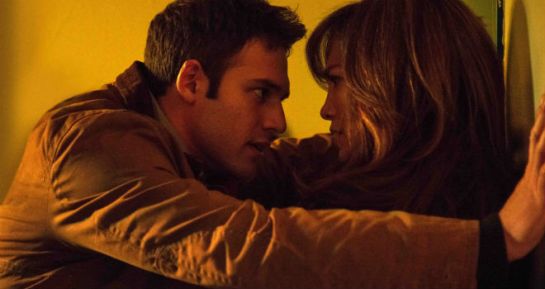
Now some may disagree, but Jennifer Lopez is not a bad actress. You certainly wouldn’t know that by many of her movie choices. Why she attached herself to this film is beyond me. In it she plays Claire Peterson, a high school teacher who has recently separated from her cheating husband (John Corbett). She meets a teenager (going on 30) Noah Sandborn played by Ryan Guzman. He has just moved in next door with his disabled uncle following the death of his parents. Noah looks fresh out of a GQ shoot, flashes a million dollar smile, and knows how to fix a garage door opener. What a winning combination!

Boy1

Noah begins impressing Claire by befriending her 16-year old son Kevin (Ian Nelson). Noah helps Kevin talk to the ‘prettiest girl in school’ and deal with some obnoxious bullies (doesn’t that sound familiar). He teaches Kevin how to box and change out an alternator in a truck. How can Claire not like this guy? Of course we know where this is heading from the very first time they meet. Director Rob Cohen doesn’t allow us to wonder. Instead he bombards us with awkward smiles, googly eye contact,  and glaringly obvious perspective shots where his camera sits and lustily gazes. There isn’t an ounce of mystery.

The obvious happens and the two hook up. Afterwards Claire immediately knows she has made a mistake. The film portrays it as an act of vulnerability, but that’s really hard to buy into. The movie does a poor job of selling us a vulnerable Claire. After all, she is cutting eyes at this guy every time he walks into her house. Regardless, Claire tells Noah it was a mistake and (in an equally predictable turn) Noah suddenly turns from the perfect all-American guy to an obsessed raving lunatic. Of course clues to his instability suddenly pop up everywhere and soon Claire has a full-blown stalker situation on her hands.

Boy2

The script for this thing was written by a criminal lawyer named Barbara Curry. Her story was originally centered around Noah pulling Kevin away from his family and a determined mother fighting to get her son back. That idea offers a lot more potential than what we end up with. Instead we get an unoriginal stalker thriller that literally hits you with one overused cliché after another. The story gets wackier leading to an ending that flies completely off the rails and that leaves a number of loose ends when the credits roll that will have you shaking your head in disbelief.

“The Boy Next Door” is too unconsciously goofy to be taken seriously and it takes itself too seriously to be good campy fun. Lopez gives it a good go but you can only do so much with bad material. The story hasn’t an original  thought and it’s hard to buy into anything we see. Complicate that with a laughably bad ending with enough loose threads to knit a sweater. Perhaps some may find enough to qualify this as a guilty pleasure. Me, I just felt guilty.

VERDICT – 1.5 STARS

1.5 stars

REVIEW: “Brooklyn”

Brooklyn poster

Saoirse Ronan has quietly put together a fine acting career. For almost ten years she has steadily delivered one good performance after another. In 2007 she became one of the youngest actresses to ever receive an Academy Award nomination. But what is truly surprising is the fact that Ronan is only 21 years-old and with each new film she continues to mature as an actress. That has never been more evident than in her new picture “Brooklyn”.

This beautiful period drama is from director John Crowley and scripted by Nick Hornby. It’s based on Colm Tóibín’s novel about a quiet Irish girl given an opportunity to make a better life for herself overseas in 1952 Brooklyn, New York. There is nothing cagey or complex about the story, but it’s simplicity is part of its charm and it works mainly due to a captivating lead performance.

Saoirse Ronan in Brooklyn

Ronan plays Eilis, an Irish girl whose life is dictated by the people and practices in her County Wexford village. She’s quiet and cordial even when working for her cuss of a boss at a local general store. Her older sister Rose (Fiona Glasscott) knows there is nothing for Eilis in the village so with the help of a priest named Father Flood (Jim Broadbent in a superb bit of casting), she arranges for Eilise to travel to New York to create a new and better life for herself.

There is one key thing I appreciate about the story itself and Crowley’s direction. There are several opportunities for the movie to wander down a conventional and cliché path. When Eilise first arrives in Brooklyn she is clearly in a new world. But it doesn’t turn into your standard ‘fish out of water’ story. Her struggles, her loneliness, her homesickness – it is all handled and presented in a way that is thoughtful and genuine. But most importantly it serves the character without drowning the audience in overwrought depictions of her circumstances.

Her struggles ease a bit when she meets a nice, hard-working Italian plumber named Tony (Emory Cohen). Again, the movie could have ventured off into a number of directions including the predictable Irish/Italian relationship complications. Thankfully it does not. That’s not the story it wants to tell. Instead it unfolds into a sweet love story that allows us to see a number of new sides to Eilise. She becomes more comfortable and more confident. The longing for home slowly subsides and takes on a new form. We see a new and different young woman.

Brooklyn2

The idea of ‘home’ becomes one of the film’s central themes. Eilise is faced with a predicament that causes her to question where her true home is. Other people have no problems defining ‘home’ for her. The question becomes will she throw aside her newly found self-confidence to once again allow her life to be determined by the wishes of others? Or will she take the reins and define her ‘home’ and her life for herself?

“Brooklyn” maneuvers through a minefield of too much melodrama and sentimentality at times coming dangerously close to both. But it never overdoes it. Instead it focuses on its main character and everything works towards telling her story. And it is a lovely story. There is a rhythmic beauty to the storytelling and Crowley’s camera helps convey it. There are so many gorgeous shots that stuck with me well after the movie was over.

While the story is sweet and alluring and the film looks fantastic, this is mainly a sparkling showcase for Saoirse Ronan. I don’t know if there was a more sublimely expressive or emotionally earnest performance this year. I can’t imagine anyone else playing this role any better and Ronan deserves all the attention that is certain to come her way. This is her movie and she makes it one of the year’s finest.

VERDICT – 4.5 STARS

4.5 STARS