I’m not sure if any 2016 movie has drawn a more complex range of discussion than Nate Parker’s “The Birth of a Nation”. Right out of Sundance, many instantly christened it the next Best Picture Oscar winner and a direct answer to the #OscarsSoWhite controversy. Some have placed the entire weight of the Hollywood diversity cause on its shoulders. Such high expectations are hardly fair.
Adding another layer was the resurfacing of a 1999 Penn State rape charge. Parker and close friend Jean McGianni Celestin (who is given a story credit in the film) were accused of raping a fellow student. Charges against Parker were dropped but information about his defense (namely his definition of “consent”) and acts of intimidation towards the victim haven’t shed him in the most positive light. Celestin was convicted but the charges were eventually dropped on a technicality. The victim committed suicide in 2012.
Essentially this renews the age-old debate of separating the art from the artist, something I’m usually able to do (Roman Polanski’s “The Pianist” remains a favorite of mine). But I don’t dismiss those who struggle with Parker and his film mainly because a brutal rape plays a big part in the story. Ultimately your experience with “The Birth of a Nation” could very well be influenced by how these events speak to you.
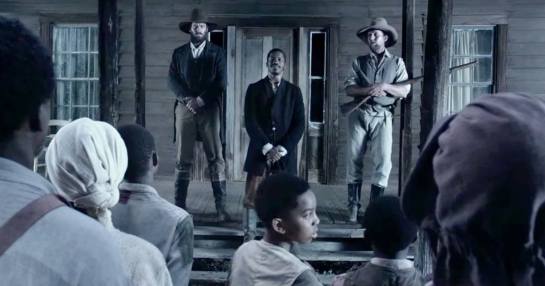
Personally I feel better equipped to examine the movie on its own merits. Controversy aside, there is a powerful story at the center of Parker’s film – a melding of fact and fiction. It’s based on the life of Nat Turner, a slave in Southhampton County, Virginia who led an uprising against white slave owners in 1831. Many have viewed Turner’s rebellion as a heroic and justified act which is clearly the perspective Parker takes. But in doing so he softens the edges of Turner’s actions which misses out on some of the more fascinating complexities of his story.
Parker (who wrote, directed, and starred in the film) first reveals Nat Turner as a young boy. A self-taught reader, Nat is given a Bible by the matriarch of his slave owning family (Penelope Ann Miller). Years pass and Nat becomes a preacher to his fellow slaves on the plantation which is now ran by Samuel Turner (Armie Hammer). When a local white minister (played in a near cartoonish fashion by Mark Boone Junior) notices Samuel’s slaves are “well behaved”, he suggests that Samuel take Nate to other plantations to preach calming messages to their slaves (for a price of course).
As Nat visits other plantations the true brutality of slavery is brought into focus and he realizes he is simply a tool of the slave owners. This directly challenges his view of Scripture and soon causes him read the Bible in a new way. Feeling inspiration from God, Nat puts together a violent rebellion in hopes of freeing his people and pouring out judgement on their oppressors.
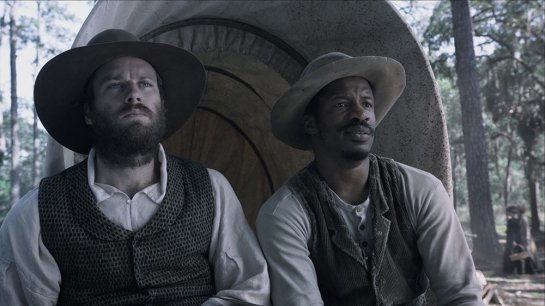
“The Birth of a Nation” is told almost exclusivity from the slave’s perspective (mainly Nat’s) which offers some truly powerful moments. This allows for the ugliness to be seen without any (intentional or unintentional) gloss. At the same time Parker’s direction and storytelling is all over the map.
The early parts feel as though Parker is simply checking off plot points. There is little narrative flow. Once the film gets to where Parker wants it to be, he slows it down and more thoughtfully maneuvers from scene to scene. There are also these unusual bursts of otherworldly imagery which seem to be portraying Nat as a mythological spiritual figure of sorts. It’s an interesting idea but Parker doesn’t let it flow naturally from the story. It’s more or less forced upon us through much more conventional techniques.
There are several compelling things Parker touches on that I wish had been explored more. There is an undeniable spiritual element particularly when Nat begins to see Scripture through a different lens. I would have loved to see more of his struggle with interpretation since it eventually birthed his inspiration for the rebellion. Instead it (and several other story threads) feels terribly shortchanged.
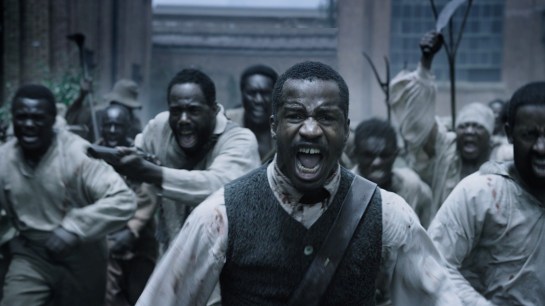
Then there is the rebellion itself. The uprising began with a surprise killing of 50+ slave owners. Parker doesn’t hold back on the graphic brutality, but in his version Nat and his fellow slaves targeted the male slavers who we see throughout the film doing all sorts of vile acts. In reality women and children were also killed. This fact could have subverted what Parker is going for, but the inner moral conflict it surely brought would have been fascinating to explore.
While several things would have made this better, that in no way means this film is without value. Again, there is a powerful story at its core, and while sometimes conventional, several of Parker’s images and scenes are indelibly etched in my mind. But perhaps its biggest strength is how it serves as a profound reminder of a nation’s past transgressions. From start to finish “Birth” keeps you locked in and focused. Parker never loses the potency of his subject matter.
It’s no accident Parker chose “The Birth of a Nation” as his title. It’s taken directly from D.W. Griffith’s 1915 silent epic – a film praised for its groundbreaking approach to filmmaking and excoriated for its depictions of African Americans and the KKK. Parker has “reclaimed” the title and attached it to a much different picture – not a perfect one, for sure. Its uneven direction, messy script, and some heavy-handedness of its own are legitimate frustrations and while “The Birth of a Nation” strives for greatness it falls just short. Yet despite its shortcomings, there is still important and thought-provoking material here, material that deserves to be seen and talked about.
VERDICT – 3 STARS