REVIEW: “Brats” (2024)

Love them or hate them, anyone who enjoyed movies during the 1980s knew of the Brat Pack. It was a nickname given to a specific group of young actors and actresses in their early twenties who would often appear together in popular coming-of-age movies throughout the decade. The name was play on Rat Pack which was an earlier Hollywood A-list group that had various iterations between the 1940s, 1950s, and 1960s.

The Brat Pack name was coined by David Blum in his 1985 cover story for New York magazine. The group (which most prominently consisted of Emilio Estevez, Rob Lowe, Demi More, Molly Ringwald, Anthony Michael Hall, Judd Nelson, Andrew McCarthy, and Ally Sheedy) hated the label and felt betrayed by Blum who they had briefly let into their inner circle. Even today, Blum has no regrets and views the people impacted by his story as little more than “collateral damage”.

“Brats” is a documentary directed by Brat Pack member Andrew McCarthy and it sets out to explore the careers and relationships of the young stars both before and after they were branded by Blum’s article. McCarthy approaches it with his own insider perspective but also reaches out to other former members including Estevez, Lowe, Sheedy, and Moore. Unfortunately Ringwald, Nelson, and Hall all declined to participate.

The film follows McCarthy as he seeks out the other Brat Pack members and those connected to the group in hopes of hearing their experiences and discovering what the name means to them some four decades later. Some he hasn’t spoken to in thirty or more years, as they went from making movies together to avoiding each other like a plague. Others have outside perspectives that offer some interesting insight. Many saw the Brat Pack label as insulting, reductive, and derogatory. But there were those who found benefits in the fame it brought.

As we watch it becomes clear that making the film was a therapeutic journey for McCarthy – an opportunity for him to finally reckon with this dark cloud that has followed him for so many years. It offers him the opportunity to wrestle with what the Brat Pack means to him today as opposed to in the 1980s. It’s an interesting element yet one that feels more personal to him than relatable for us.

Throughout the documentary’s brisk 92 minutes we’re treated to some insightful and revealing conversations. We also get lots of great archive footage of old interviews, movie clips, and behind the scenes video. It makes for an interesting and nostalgic retrospective for those of us who grew up in the Brat Pack era. And that’s who this film will ultimately resonate with. It’ll be a tougher sell for those without at least some attachment or familiarity. But for me, from my early crush on Demi Moore to my endless VHS rewatches of “The Breakfast Club” and “Sixteen Candles”, I’m very much the film’s target audience. “Brats” is now streaming on Hulu.

VERDICT – 3.5 STARS

REVIEW: “Beverly Hills Cop: Axel F” (2024)

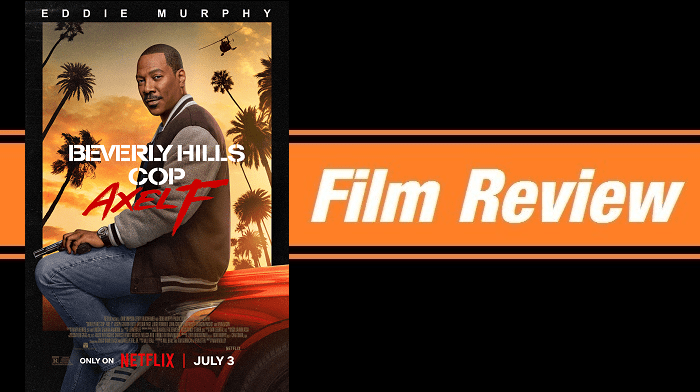
So this was the big question for me – was Netflix’s new Beverly Hills Cop installment going to be more like the entertaining first two movies (yes, I have a soft spot for “Beverly Hills Cop II”) or closer to the abysmal third film? Well call me a fence-straddler, but the oddly titled “Beverly Hills Cop: Axel F” falls somewhere in between. It’s certainly not as high-energy or whip-smart as the beloved original. At the same time, it does scratch that nostalgic itch for fans and unleashes Eddie Murphy to deliver the kind of comedic chaos that made him famous.

It has been 30 years since the last Beverly Hills Cop movie, and it’s kinda strange that we’re getting one after all this time. It’s even more unusual that it’s premiering on a streaming service rather than the big screen (welcome to movie watching in the year 2024). But that doesn’t mean they took shortcuts. Produced by Murphy and Jerry Bruckheimer, “Axel F” has a budget of around $150 million. And a lot of that money and effort has gone into recapturing the spirit and tone of the original.

Image Courtesy of Netflix

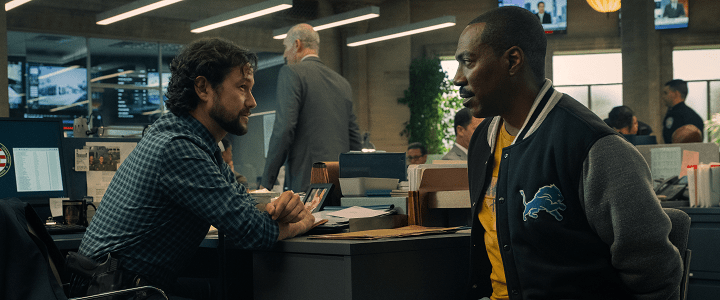
Murphy slips back into the Aididas sneakers and Detroit Lions letterman jacket of Axel Foley, a wise-cracking, street-smart police officer from Detroit. This time around his return to Beverly Hills is more personal – it’s to see his estranged daughter, Jane Saunders (Taylour Paige). She’s a successful criminal defense attorney working for a big Beverly Hills law firm. Her current case has her defending an accused cop killer which hasn’t sat well with the local police department.

After Axel learns Jane’s life may be in danger, he sets out on his own investigation. It leads to numerous discoveries as well as run-ins with the local law. Axel does have a strong ally in his old friend John Taggart (John Ashton) who is now the cranky Chief of Police. As for Taggart’s former partner, Billy Rosewood (Judge Reinhold), Axel learns he has disappeared while investigating a lead potentially linked to Jane’s case. So is an Axel, Billy, and Taggart reunion inevitable? I’ll let you figure that one out.

Adding some new blood to the franchise is Joseph Gordon-Levitt who plays Bobby Abbott. He’s a detective with the Beverly Hills Police Department who happens to be Jane’s ex-boyfriend. We also get the always welcomed Kevin Bacon as Cade Grant, an officer who runs the department’s narcotics task force. But it’s Paige who makes the biggest impression out of the newcomers. She and Murphy have good father-daughter chemistry and her snarkiness nearly matches his scene-for-scene.

Image Courtesy of Netflix

The Beverly Hills Cop films have always been equal parts action and comedy and this one is no different. The gags are frequent and aplenty, with many coming from Murphy’s often hilarious improvisations. Others come from the writing trio of Will Beall, Tom Gormican, and Kevin Etten who deliver several good zingers (a favorite of mine is a subtle yet funny shot at the notoriously bad third film). As for the action, it’s obvious that Murphy has lost a step (haven’t we all). But he brings such a madcap energy to the scenes. And while director Mark Molloy shoots them well, it’s the infusion of Murphy’s humor that makes them fun.

As far as any mystery or suspense, there’s nothing in the story that will surprise you. Pretty much everything is laid out in the first 30 minutes or so and it’s easy to predict where things are going. But truth be told, most people will go into “Axel F” to watch Eddie Murphy doing the act which made him a household name. And while his latest doesn’t hold a candle to his best, there is still enough vintage Murphy to bring this long dormant franchise back to life. “Beverly Hills Cop: Axel F” premieres July 3rd on Netflix.

VERDICT – 3.5 STARS

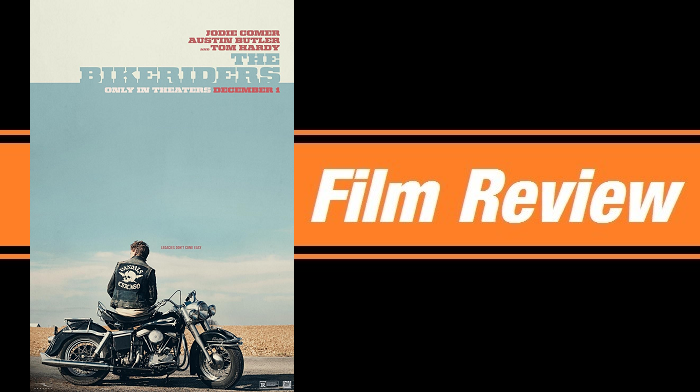
REVIEW: “The Bikeriders” (2024)

Filmland, an annual celebration of filmmaking from Arkansas and beyond, has played an important part in the Arkansas Cinema Society’s work to grow and nurture a passionate local film culture. Throughout its seven years, one of the anchors of Filmland has been director, screenwriter, and ACS co-founderJeff Nichols. An Arkansas native, Nichols’ investment in growing his home state’s film community has been invaluable.

As a filmmaker, Nichols has several notable signatures that give his movies their particular appeal. His stories tend to have a distinctly southern flavor and shrewdly represent a region of the country he knows very well. He also has a knack for writing characters who feel incredibly organic to the worlds they exist in. These things are only enhanced by the fact that Nichols is a natural storyteller.

Among the highlights of last year’s Filmland was Nichols’ new movie “The Bikeriders”. It’s his first feature since 2016’s “Loving” and his biggest film in terms of budget and ambition. It’s inspired by photojournalist Danny Lyon’s 1968 book of the same name that explored the members and firsthand stories of the Chicago Outlaws Motorcycle Club. The book featured a collection of Lyon’s photography and interviews captured during his time as a member of the Outlaws in the mid sixties.

Image Courtesy of 20th Century Studios

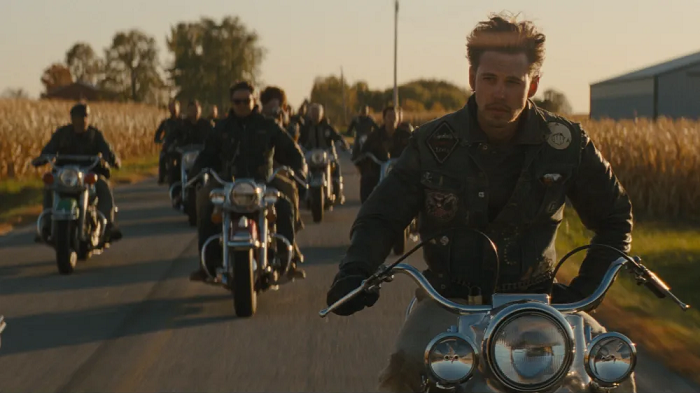
Much like Lyon’s book, Nichols sets out to deconstruct the somewhat romanticized view of this 1960s motorcycle subculture. At the same time he doesn’t shy away from the nostalgic allure of the time. Instead he embraces it, creating a near longing for a bygone era while also viewing it as something best left to a very specific period in American history. His film is an incredible balance of gritty realism and heartfelt sentimentality.

Merely inspired by Lyon’s work, Nichols takes several ideas from the book and then builds his own fictional story. He frames it through a series of interviews that Danny Lyon (played by Mike Faist) conducts with a woman named Kathy (a sublime Jodie Comer). Through three meetings spanning nearly a decade, Kathy talks about her time with the Vandals, a Chicago based motorcycle club that rode to prominence during the 1960s.

The meat of the story follows the club’s rise from a close-knit brotherhood to a vast mob-like menace. Over the course of the movie, what starts as a small pack of local outcasts emulating Marlon Brando’s “The Wild Ones” morphs into a violent network of riders from different cities across the country. It’s a fascinating evolution that in many ways is shaped by the shifting social and political landscapes of the time.

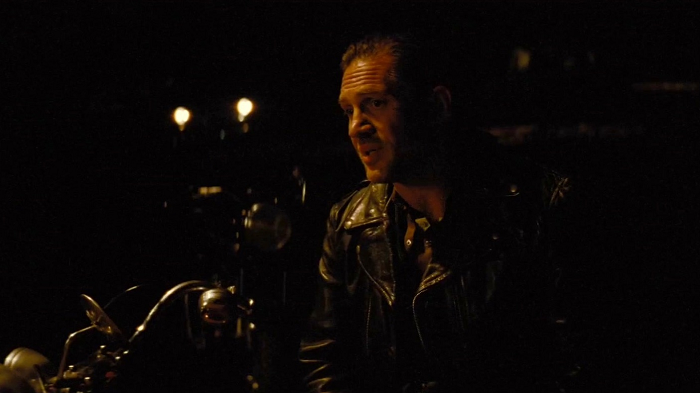
At the very heart of “The Bikeriders” is a captivating trio of characters whose interconnected relationships humanize the story and shape the drama. Tom Hardy is a force of nature playing Johnny, the founder and leader of the Vandals. There’s no doubting Johnny is in charge, but he’s well respected by the members. His idea is that one day his kid brother Benny (Austin Butler) will take his place. The problem is Benny is a wild card – loyal but volatile. Butler is magnetic, embodying a smoldering bad boy image that you can’t turn away from.

And then there’s Kathy who finds herself stuck within this testosterone driven coterie. She sees the Vandals for what they are and often pushes back against their macho codes and rituals. Yet there’s a part of her that’s fascinated and drawn to their world – at least early on. She’s especially enchanted with Benny who she meets in a bar and then marries five weeks later.

Image Courtesy of 20th Century Studios

Benny’s bond with his brother is every bit as strong as his bond with Kathy which inevitably leads to tension between all three. It’s only amplified in the second half as the club starts to grow and the once intimate camaraderie starts to crumble. It’s here that the story takes a darker turn, becoming a “Goodfellas” type of mob drama but with a biker movie bend. The violence ratchets up and the romanticism of the early scenes all but vanishes.

While the three central performances shine brightest, Nichols amasses a superb supporting cast who play an assortment of colorful characters, many based on actual photos from Lyon’s book. There’s Michael Shannon as Zipco, Boyd Holbrook as Cal, Norman Reedus as Funny Sonny, Damon Harriman as Brucie, and Emory Cohen as Cockroach, just to name a few. They fill out the world well (though some disappear for stretches), but it’s Nichols’ interest in their psychologies that make them so individually compelling.

While it’s technically more Midwestern than Southern, there are still several wonderful similarities between “The Bikeriders” and other stories Jeff Nichols has told. The big difference here is that Nichols has opened a window to a notoriously private world. His presentation is strikingly authentic, highlighted by incredible sound, cinematography, costume design, and a cracking 60’s flavored soundtrack. It all helps to create a transporting experience – one that lures you in with its infectious cool before hitting you hard with the grim and violent reality. “The Bikeriders” opens in theaters June 21st.

VERDICT – 4.5 STARS

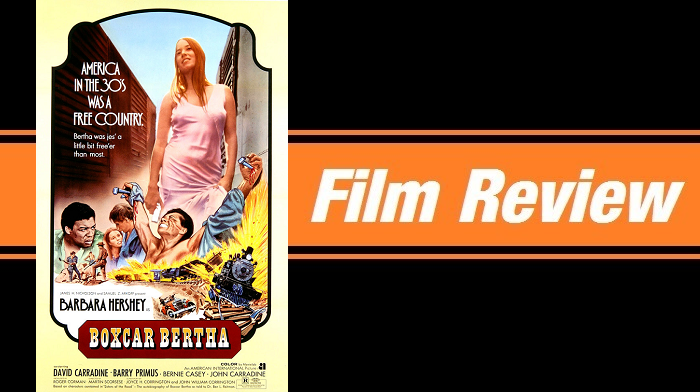
RETRO REVIEW: “Boxcar Bertha” (1972)

In my recent review of 1975’s “Death Race 2000”, I took some time to talk about the film’s producer, the legendary Roger Corman who just recently passed away at the age of 98. I shared how the independent cinema icon had been instrumental in launching the careers of numerous high profile filmmakers. Among them was none other than the ten-time Oscar nominated director, Martin Scorsese.

Roger Corman was hungry for another female gangster movie and was drawn to Ben Reitman’s 1937 novel “Sister of the Road: The Autobiography of Boxcar Bertha”. A script was written by the husband and wife duo of John William and Joyce Corrington and Martin Scorsese was hired to direct after impressing Corman with his debut feature, “Who’s That Knocking at My Door”.

“Boxcar Bertha” has many of the usual markings that accompany the majority of Corman’s early exploitation flicks. But the crafty Scorsese brought his own gritty sensibility which made it feel a little different. Regardless of what you call it, you can see the fingerprints of the director that Scorsese would quickly become. His specific attention to detail, his knack for immersing the audience into his well-drawn setting, his fluid use of the camera – it’s all on display and in many ways saves the movie from itself.

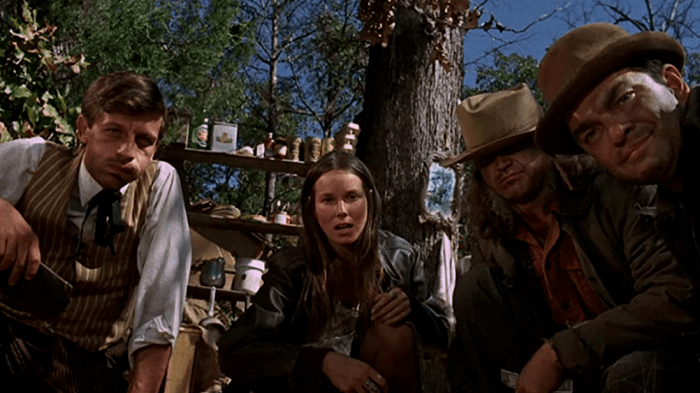
Set in the Depression era South, “Boxcar Bertha” follows an orphaned and dirt-poor young girl named Bertha Thompson (Barbara Hershey) who begins trainhopping after her father is killed in a cropdusting accident. A couple years later Bertha crosses paths and falls in love with a down-on-his-luck union organizer Big Bill Shelly (David Carradine). The couple are later joined by Rake Brown (Barry Primus), a slick but cowardly gambler who Bertha saves at a poker table, and by Von Morton (Bernie Casey), an old family friend who worked for Bertha’s father.

The group tries the ‘straight and narrow’ path, but in such hard times our foursome has to resort to robbing banks and passenger trains just to get by. They eventually accept that they’re criminals which ends up putting them in the crosshairs of a powerful railroad magnate (played David Carradine’s real-life father, John). Soon the press is covering their antics – embellishing their hardened status for big headlines. But much like in “Bonnie and Clyde” (a clear inspiration for Corman), the attention eventually catches up to them.

Though bound by the exploitative tropes of bare flesh and blood (a Corman dictum that even Martin Scorsese couldn’t escape), there was still room for the director to take a few of his own swings. Not all of them hit their marks. Take the handful of messy cuts and quick camera pans. And a couple of woefully unconvincing fight scenes that look even more dated that usual for that era of movie history. But then you have his deft handling of his performers along with the detail he pours into his rich Southern setting. And unlike many of Corman’s exploitation films, there’s no glamour in the violence. It’s rough, crude, and abrupt.

Through it all Bertha remains the centerpiece, wonderfully played by Hershey who guides the character from naive to streetwise, always adapting to survive yet maintaining a level of vulnerability that earns our empathy. Her performance can’t fully cover the handful of glaring flaws, and those with a distaste for Corman’s brand of exploitation will likely struggle to get past his obvious influence. But watching Scorsese at such an early stage of his career, playing around with formula, exploring techniques, and finding his cinematic form makes it worth watching on its own.

VERDICT – 3 STARS

REVIEW: “The Bad Batch” Season 3

Expectations were high heading into the third and final season of “The Bad Batch”. Creator and showrunner Dave Filoni along with the wizards at LucasFilm Animation had set the bar high after two strong seasons. To no surprise Season 3 didn’t disappoint. That doesn’t mean we aren’t left with questions. In fact, I could write a lengthy essay focused solely on the many things left to ponder following the show’s final episode. But to be honest, that’s a big part of the fun when it comes to Star Wars.

Set shortly after the events of the feature film “Revenge of the Sith”, the Bad Batch set out to take a deeper look at the clone soldiers who were created solely to fight for Emperor Palpatine and his fledgling Empire. The series explores what happened to the clones once Palpatine deemed them to be expendable and took his cloning experiments to more sinister depths. And it’s all brought to life through the eyes of Clone Force 99, a small squad of defective yet genetically altered clones, each with their own unique combat specialties.

Clone Force 99, or the “Bad Batch” as they were affectionately known, found themselves on the the run from the Empire after rescuing and taking in Omega, a young unaltered clone from the top-secret laboratory deep inside Mount Tantiss. Omega proved to be an invaluable piece to the well-hidden experiments happening under the direction of Palpatine’s chief scientist Royce Hemlock. On their journey, the Bad Batch and Omega experienced their share of danger and loss which all helped set the table for the third season.

Taking place in the wake of the sinister Order 66, the Bad Batch’s story has offered all kinds of connecting tissue that helps bring the post-prequel trilogy story together. Season three goes even further, not only filling in gaps from the past but reaching ahead to the sequel trilogy. But at its core, the story revolves around the growing connection between Omega and her brothers/father figures. Every episode feeds on their relationships and the writers do an incredible job nurturing it as the season progresses.

Once again, the animation is spectacular throughout. And with a couple of exceptions, the episodic storytelling is terrific. But you can’t talk about The Bad Batch, especially Season 3, and not mention the extraordinary voice work. A special industry award should be made just for Dee Bradley Baker. He voices every Bad Butch member, imbuing Hunter, Wrecker, Echo, and Crosshair with their own unique personalities and qualities. And if that wasn’t enough, he also voices nearly every other clone in the series, much as he did in ”The Clone Wars”. It’s truly mind-boggling talent.

But also good is Michelle Ang as the voice of Omega. Throughout the series Ang chronicles Omega’s journey through various stages of her life. She brings such warmth and sincerity while capturing the qualities that make Omega such a joy. Season 3 sees Omega’s early naïveté replaced by a maturity forged from her ever-changing and often perilous circumstances. At the same time, Ang’s performance brings out the empathy in Omega which proves to be a crucial part of the character.

In addition to the main cast, Season 3 brings back a number of Star Wars favorites. They include Tarkin (once again voiced by the superb Stephen Stanton), the notorious bounty hunter Cad Bane (Corey Burton), the cool and calculated Fennec Shand (the indomitable Ming-Na Wen) and the mysterious yet deadly Asajj Ventress (a returning Nika Futterman). This is just a sample-size of the many heroes, villains, and in-betweens who pop up and add heft to Season 3.

Helmed by the directing trio of Saul Ruiz, Nate Villanueva, and Steward Lee, “The Bad Batch” Season 3 does an exceptional job bringing this highly entertaining and unexpectedly moving Star Wars story to a close. LucasFilm Animation once again raises the bar in visual storytelling while Dave Filoni and his team of creators continue to expand the galaxy far, far away in exciting new ways. Star Wars remains in capable hands. And for fans who love the franchise’s ever-growing mythos, “The Bad Batch” is a satisfying three-season entry full of warmth, thrills, and plenty of surprises. “The Bad Batch” is streaming exclusively on Disney+.

VERDICT – 4.5 STARS

REVIEW: “Boy Kills World” (2024)

Moritz Mohr goes for the jugular in “Boy Kills World”, an action-driven fever dream that marks his directorial debut. Mohr conceived the idea with Arend Remmers and pitched it to Sam Raimi who subsequently signed on to produce. After navigating through the COVID-19 pandemic, production finally began will Bill Skarsgård cast as its lead. After premiering at last year’s Toronto International Film Festival, it’s finally set to hit theaters.

When watching “Boy Kills World” you’ll have no trouble identifying the long list of inspirations that have their place in the film’s DNA. Kung-fu cinema, video games, anime, and graphic novels are just some of the influences behind Mohr’s go-for-broke vision. Its story is primarily a revenge tale, written for the screen by Remmers and Tyler Burton Smith. But both the visual and narrative style turns it into a delightfully bonkers and blood-drenched extravaganza that you’d swear was plucked straight from the pages of a comic book.

Image Courtesy of Lionsgate

Set in a near-future dystopia, a chiseled Skarsgård plays the story’s deaf-mute protagonist who’s known only as Boy. We learn through a smattering of flashbacks that Boy’s family was murdered right in front of him by a totalitarian dictator named Hilda van der Koy (Famke Janssen). Though just a child, Boy managed to escape but remained emotionally scarred and thirsty for revenge. We’re told how he sought the help of a Shaman (Yayan Ruhian) who for years has been training him to become the “ultimate warrior”.

As Boy’s rigorous and often agonizing training continues, Hilda and her power-mad family rule the unnamed city with a brutal iron fist. Nowhere is this more evident than in their annual event called “The Culling”. It’s essentially televised mass murderer as the fascist family gathers twelve citizens from the poor side of town and make examples out of them in front of a live studio audience. While gathering victims for the new year’s show, Boy witnesses acts of unspeakable violence by Hilda’s inept husband Glen (Sharlto Copley). He decides that enough is enough and sets off on his revenge-fueled campaign.

Skarsgård’s performance is an electric mix of physicality and expression, but he isn’t alone in depicting Boy. Acclaimed voice actor H. Jon Benjamin plays Boy’s inner voice who’s constantly letting us know what’s going in his mind. Benjamin makes for a great compliment to Skarsgård and Mohr is able to fuse them both into one fascinating and fun lead character.

Image Courtesy of Lionsgate

Meanwhile the film features an assembly of colorful supporting characters energized by a wonderful ensemble cast. In addition to Janssen, Ruhian, and Copley we also get Michelle Dockery as Hilda’s wicked sister Melanie and Brett Gelman as her unreliable brother Gideon. Young Quinn Copeland frequently pops up as Mina, the ghost of Boy’s murdered little sister. And Isaiah Mustafa and Andrew Koji are a lot of fun as the two-man self-identified “Resistance”. But tops on the list is the fiercely intense Jessica Rothe playing the family’s top enforcer. It’s a dramatically different kind of role for Rothe and she kills it.

“Boy Kills World” is a wild and zany mashup that can be outrageously funny one second and ferociously ultraviolent the next. While the humor is a welcomed ingredient, its the action that drives the movie. Choreographer David Szatarski unleashes some truly spectacular fight sequences. They’re savage, bloody, and stylishly in tune with the film’s spirited tone. There’s not a lot of depth to the story but there are some surprising twists. And Skarsgård gives us a rooting interest that we’re happy to follow to the very end. “Boy Kills World” opens in theaters this Friday.

VERDICT – 3.5 STARS