REVIEW: “Black Bag” (2025)

Two Steven Soderbergh movies on the big screen in less than two months – we cinema lovers are eating good. And while it’s true that I didn’t fully go for his January release, “Presence”, Soderbergh always has something compelling to offer. And when he hits his mark the results can be pretty magical. Such is the case with “Black Bag”, a tight and taut spy thriller that has the flavor of an old school genre film yet a freshness all its own.

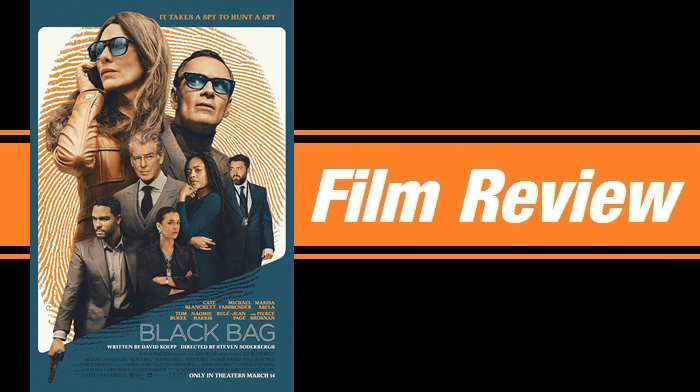
“Black Bag” could sell itself on its two brilliant leads alone – Cate Blanchett and Michael Fassbender. Both are supremely talented and endlessly versatile while oozing charisma out of every pore. But then you add in Soderbergh whose signature style and precision energizes every facet of the storytelling, from his deft handling of the narrative to his striking visual approach. It all clicks into place with “Black Bag”.

Image Courtesy of Focus Features

Written for the screen by David Koepp, “Black Bag” follows Kathryn St. Jean (Blanchett) and George Woodhouse (Fassbender), a happily married and deeply devoted couple who both happen to be high-level intelligence agents. Soderbergh wastes no time getting the story underway, sucking us in with a killer opening tracking shot of George entering a night club to meet with a contact. We learn there is a traitor in their agency and George is given a list of five potential suspects, one of which is Kathryn.

From there the movie follows George’s investigation of the five suspects with most of his attention aimed at Kathryn, especially as clues implicating her begin to mount. As the mystery unfolds, two key questions emerge. Is Kathryn guilty of treason and where do George’s loyalties ultimately lie – to his marriage or to his country? Soderbergh and Koepp have us studying the screen, hanging on every word and measuring every reaction in hopes of finding answers.

One of the biggest treats in “Black Bag” is its heavy reliance on character over action. And it all starts with George and Kathryn. He is intensely focused, detail obsessed, and has a very specific disdain for lying. She is disarmingly suave, both captivating and beguiling, and impossible to read, even for an agent as seasoned as her husband. To no surprise Fassbender and Blanchett have an electric chemistry and Soderbergh smartly utilizes it to the nth degree.

Image Courtesy of Focus Features

The four other suspects within the agency all get their due as well. They’re introduced to us during a superbly executed dinner party scene at George and Kathryn’s home. James Stokes (Regé-Jean Page), Zoe Vaughan (Naomie Harris), Clarissa Dubose (Marisa Abela), and Freddie Smalls (Tom Burke) all think they have been invited over for a casual get-together. Instead they’re unknowingly a part of George’s investigation which turns the evening into something completely unexpected.

From there, all of the characters impact the story in interesting ways. Koepp’s sizzling dialogue and Soderbergh’s crisp pacing keep things gripping for the duration of the film’s compact 94 minutes. And while once again serving as his own cinematographer, Soderbergh surrounds this tightly plotted thriller with the kind of visual craftsmanship that has become a hallmark of his movies. Toss in the delectable Fassbender and Blanchett, and you have one of the best films of this young movie year.

VERDICT – 4.5 STARS

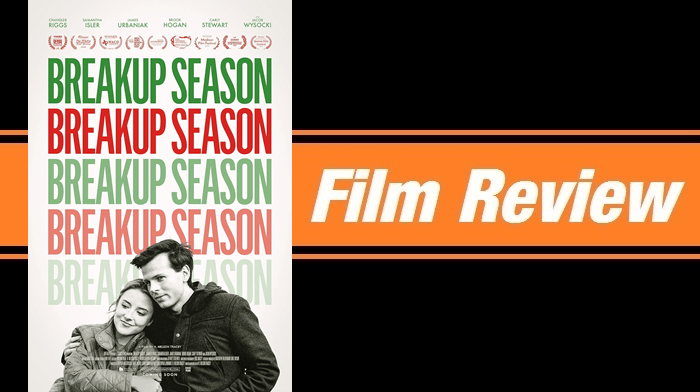
EDFF 2025 REVIEW: “Breakup Season”

Set during what the late, great Andy Williams christened as “The Most Wonderful Time of the Year”, writer-director H. Nelson Tracey’s “Breakup Season” is a hard movie to categorize (which is actually a strength). At times you’ll swear you’re watching a romantic comedy. Other times it plays like a sensitive domestic drama. And it’s all festively wrapped as a holiday movie. It just screened at the 2025 El Dorado Film Festival and earned quite a reaction from an enthusiastic audience who were all onboard with what Tracey was going for.

Ben (Chandler Riggs) has big holiday plans with his girlfriend Cassie (Samantha Insler). He has made the decision to take her to his hometown of La Grande, Oregon to meet his family for the first time. Their plans are to stay seven days with his colorful crew which consists of his parents, Mia (Brook Hogan) and Kirby (James Urbaniak), and his two siblings, his older brother Gordon (Jacob Wysocki) who recently moved back in with his folks after his own messy breakup, and his younger sister Liz (Carly Stewart) who is a rabid social media maven.

The initial greetings go well despite Cassie seeming a bit detached. But things sour at the dinner table as blowhard Gordon relentlessly hounds Cassie over being a vegetarian. But the big turn comes later than night when Cassie informs Ben that she wants to break up. Her plans are to stay the night and then book a flight to Portland first thing in the morning. But those plans are squashed after a snowstorm forces road closures and shuts down all flights.

And that sets up the bulk of the story as Cassie is snowed in with the guy she just broke up with and his family who she hardly knows. While she begins to bond in unexpected ways with Ben’s folks, she grows more irritated with him. On one hand, Cassie is opaque to a fault and not really able to explain to Ben why she wants to split up. “It just feels like clockwork,” is the best she can come up with. Meanwhile a well-meaning Ben is oblivious to the point of smothering Cassie. His constant badgering only pushes her further away.

Ben’s family adds energy and personality to the story while playing their own specific roles. For example, Gordon and Liz are mostly there to add some welcomed comic relief. As for Mia and Kirby, they’re always around to speak truth whenever things get heavy. Yet while they play the parts the story needs them to, these aren’t one-dimensional characters. Tracey gives each of them their own distinct identities which helps create an entertaining and organic family dynamic.

As for Ben and Cassie, Tracey strikes a good balance of sympathy and frustration. At times I found myself put out with Cassie and sympathetic towards Ben. Later I might be annoyed at Ben while having sympathy for Cassie. Neither are villainized and by the end we recognize them both as ordinary people navigating a tough situation the best way they know how. That said, I did find myself slightly siding with one more than the other. But it could be different for someone else which speaks to the genius of how they’re written.

“Breakup Season” boasts a superb cast, a smart and assured script, and a savvy director who avoids the many traps that can come with this kind of material. Tracey sticks with his convictions rather than go a more conventional route. His film takes breakups seriously, showing them as messy, painful, and often hard to sort out. Add in a healthy helping of humor and you have a movie that tells a poignant relationship story while making us laugh along the way.

VERDICT – 4 STARS

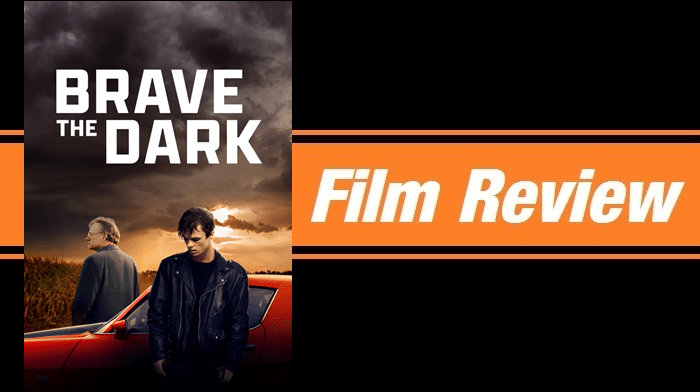
REVIEW: “Brave the Dark” (2025)

It’s a family affair in “Brave the Dark”, an inspirational new drama featuring the impressive talents of three British brothers – the sons of screen legend Richard Harris. The movie is directed and co-written by Damian Harris. It stars Jared Harris who’s well known from film, television, and theater. And it co-stars Jamie Harris who has worked with the likes of Terrence Malick, Christopher Nolan, and Steven Spielberg.

“Brave the Dark” originally screened in 2023 at the Heartland International Film Festival in Indianapolis, Indiana. But it’s just now making its way to theaters courtesy of Angel Studios. The film’s true story is based on the real-life relationship between a troubled student and a teacher who refused to let him slip through the cracks. Along the way Harris delves into weighty themes such as childhood trauma, mentorship, and second chances among others.

Image Courtesy of Angel Studios

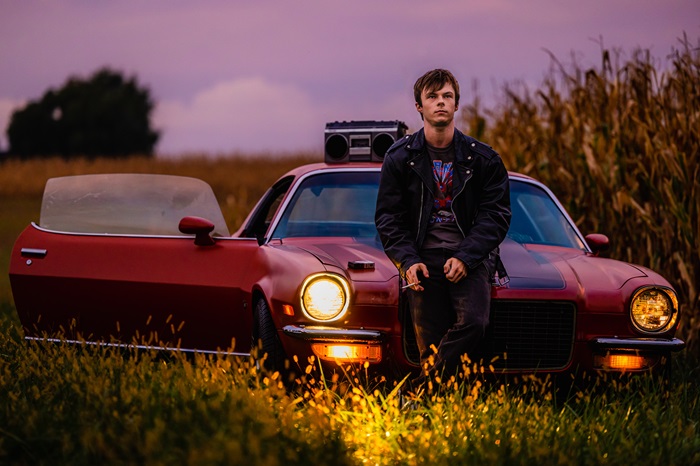
Set in 1986, Nicholas Hamilton plays Nate Williams, a senior at Garden Spot High School in Lancaster County, Pennsylvania. Nate is a bright student who runs track, has an affection for photography, and is crazy about his girlfriend Tina (Sasha Bhasin). But Nate also has several secrets. Most of them stem from his traumatic childhood which the film slowly unwraps as it moves forward. He keeps hidden that he spent eight years in an orphanage and that he’s been living out of his car for two years.

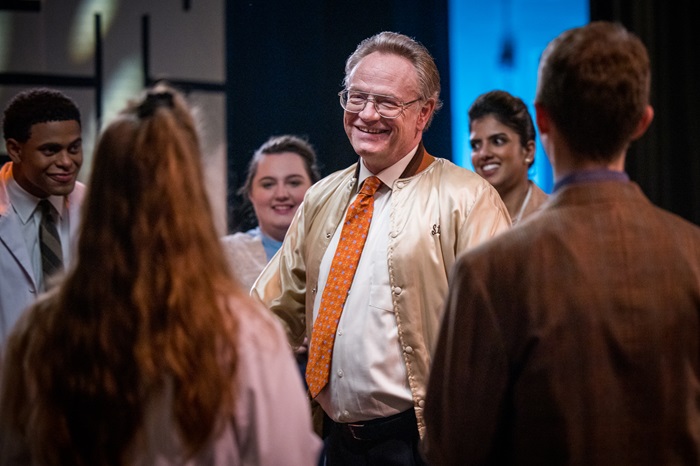
But his already fragile life takes another hit after his ill-advised decision to rob an appliance shop. He is arrested while on campus which gets the attention of the school’s beloved English and drama teacher, Mr. Stan Deen (Jared Harris). While most of the faculty are quick to write off Nate, the goodhearted Mr. Deen is determined to help. The well-respected teacher uses his many connections around town to get Nate out of prison and back in school.

It all sounds like a fairly conventional setup. But Nate’s story has its fair share of obstacles including his damaged relationship with his estranged grandparents and his inability to trust anyone including Mr. Deen who goes as far as letting Nate move in with him while he finishes high school. But his biggest hurdle is dealing with the pent-up trauma that has haunted him since he was a child. And it may take the help of his fellow lost soul Mr. Deen to finally move forward.

Image Courtesy of Angel Studios

There are several personal touches that help ground the movie in real life including Nathaniel Williams Deen himself serving as a co-writer. Adding to it, Harris chose to shoot at several true-to-life locations such as the actual Garden Spot High School in Lancaster County as well as Stan Deen’s house where he and Nate lived together. They may be insignificant on the surface, but they’re choices that testify to the movie’s sincerity and heart.

“Brave the Dark” doesn’t break the inspirational movie mold. More specifically, it sticks pretty close to the by-the-book storytelling we usually get with these kinds of movies. And while it may hit a few dramatic speed bumps, this poignant and powerful drama remains authentic, driven by a heartfelt true account that’s honest but never heavy-handed and patient enough to let the relationships grow organically. Even when exploring the darker elements of the story, nothing ever feels overstated or sensationalized. It’s that kind of control, both from Harris and his cast, that makes “Brave the Dark” resonate.

VERDICT – 3.5 STARS

REVIEW: “Babygirl” (2024)

Writer-director Halina Reijn attempts to make a bold statement but quickly loses her voice in “Babygirl”, an erotic thriller that’s neither erotic or thrilling. This baffling misfire seeks to say something about sexual freedom and power dynamics. But rather than speak anything profound, it loses itself in what plays like a carnal romp that only occasionally considers such things as ramifications and consequences. And it squanders three really good performances in the process.

Nicole Kidman bares all and does everything she’s asked playing Romy Mathis, the successful CEO of a robotics company named Tensile. Romy has the same comfortable life as most one-percenters. She lives in a lavish home with her loyal and loving husband Jacob (Antonio Banderes) and their two daughters. But Romy is hiding something. She has a kinky side that manifests itself in ways that go from uncomfortable to downright bizarre as the story pushes forward.

Image Courtesy of A24

That’s clearly not the interpretation Reijn is looking for, and a more insightful movie might be able to challenge conventional thinking on such things. But “Babygirl” offers such a shallow examination that it’s hard to see beyond its clunky messaging and unintentional contradictions. It tries to avoid any sleazy tags by pointing accusatory fingers in a number of directions. And those efforts lead to an ending that couldn’t feel more undeserved.

Romy’s sordid fantasies begin blending with reality after she meets Samuel (Harris Dickinson), an aggressively flirty new intern at her company. It doesn’t take long for the Yale educated, business savvy executive to begin making a series of boneheaded decisions to satiate her lust. From there Reijn chronicles Romy and Samuel’s illicit affair which starts as a psychosexual cat-and-mouse game of seduction before abruptly giving way to a number of prurient trysts.

As they attempt (sometimes rather loosely) to keep their affair under wraps, Romy shows passing concerns over consequences, mostly regarding her job and occasionally her family. But Reijn works hard to exonerate Romy of any wrongdoing. Instead, her movie’s sentiment is best encapsulated in what Samuel smugly deems to be “an outdated idea about sexuality”. In “Babygirl”, the fault lies with society. It’s the stigmas; the moral codes; even Jacob subtly gets some of the blame.

Image Courtesy of A24

With such talent as Nicole Kidman, Harris Dickinson, and Antonio Banderes, “Babygirl” had the ingredients to be an incisive and thought-provoking erotic thriller. Instead, it takes an unoriginal premise and offers up a one-dimensional examination of sexual liberation. There is some undeniable simmer between Kidman and Dickinson. But their chemistry fizzles once the steaminess turns to schlock. Again, it’s a shame considering the quality of talent on screen.

Yet the movie’s biggest problem lies in how woefully underdeveloped everything is. The characters, the relationships, the motivations, even the themes – it all feels so flimsy. And from a movie that borderlines on haughty in its convictions and its indictments. A more shrewd and well-rounded treatment could have made us think. “Babygirl” wants to be that movie. But it’s more like those $.99 rentals that once sat on the back shelf at your local video store.

VERDICT – 1.5 STARS

REVIEW: “The Brutalist” (2024)

It’s always interesting when a movie arrives on the scene to immeasurable praise. Your anticipation builds and your expectations rise. And then you see the film and you get to see for yourself if the product warranted the enormous hype. That has certainly happened with “The Brutalist”, a 215-minute arthouse epic that has been heralded as a “masterpiece” by more than a few enthusiastic early viewers.

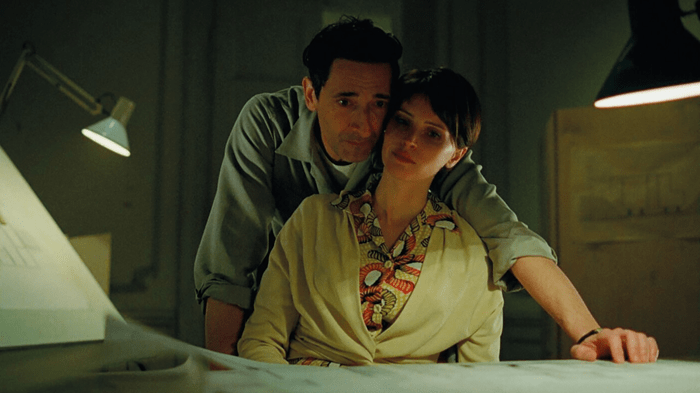
“The Brutalist” certainly had my attention with Academy Award winner Adrien Brody in the lead role and the criminally underappreciated Guy Pearce getting a meaty supporting part. I loved the idea of a immigrant saga beginning in the latter days of World War II and spanning several decades. And I loved that it would attempt to examine the post-war Jewish experience through a fresh and compelling lens.

All of those things speak to the strengths of “The Brutalist”, and for a while they were working in such harmony that I wondered if I too would be throwing out the “m” word to describe director Brady Corbet’s work. But over time you begin to notice that its brilliance is too often dimmed by his ambitions. There’s no denying the excellence of “The Brutalist” when Corbet is working in rhythm, which he does for most of the film. At the same time, there are nagging issues that he just can’t shake. More on those in a second.

Image Courtesy of A24

Beginning in 1947, Brody plays László Tóth, a Hungarian-Jewish architect and Holocaust survivor who manages to escape his home country and emigrate to the United States. Once established there, he hopes to find and bring over his wife, Erzsébet (Felicity Jones) and his niece Zsófia (Raffey Cassidy) who he was forcibly separated from during the Nazi roundups.

After arriving in New York City, László takes a bus to Philadelphia where he’s put up and given a job by his immigrant cousin Attila (Alessandro Nivola) who runs a furniture store with his American wife Audrey (Emma Laird). Lázsló gets his first real chance to show his architectural skills after the pampered children of a wealthy industrialist, Harrison Lee Van Buren (Pearce) hire him to turn their father’s dated study into a modernized library. László’s renovation is phenomenal, yet the job doesn’t go as planned and he’s forced to head out on his own.

Years pass and László is living in a homeless shelter and working whatever jobs he can get. That’s when he gets a surprise visit from Harrison whose new library has been making the rounds in popular architecture magazines. It prompted Harrison to do some research where he discovered László’s renowned work while in Budapest. Now the enamored Harrison wants to hire László to build a community center on his property in the small borough of Doylestown. He will be well compensated and allowed to stay in the guesthouse on the grounds. László accepts the offer and immediately gets to work.

Jump ahead to 1953. The construction of the community center is slowly consuming László. But he gets a reprieve when Erzsébet and Zsófia arrive in Philly. Their reunion is sweet, but before long László is back focused on his work. Meanwhile his growing addiction to heroin is becoming hard to keep secret. It all points towards an inevitable collision, but the road to it is slowed by narrative potholes. It’s as if Corbet and his co-writer Mona Fastvold have built two avenues of self-destruction that rarely intersect.

Image Courtesy of A24

This speaks to one of the movie’s most frustrating issues. It feels as if we’re navigating two different movies telling two different stories. One is a captivating feature film about a Jewish immigrant crushed under the weight of an unforgiving new country and his own ambition. The other is an erratic short film about a man’s drug-fueled psychosexual foray into prostitution and pornography. If you squint hard enough you can find connections. But they’re too threadbare to have any impact.

Regardless, the performances from Brody and Pearce never falter and both should be shoo-ins for Oscar nominations. Brody powerfully emanates a similar raw humanity as he did in “The Pianist” while Pearce convincingly balances ego and charm, right up until an out-of-the-blue action jarringly strips away anything resembling nuance. Jones doesn’t fare as well. She is handcuffed by a one-note role that leaves her frustrated and victimized despite being the most clear-eyed of the bunch.

“The Brutalist” is the latest in the parade of films aimed at demythologizing the American Dream. When Corbet is his most focused, it’s an utterly captivating feature. It’s a visually engrossing film with many of cinematographer Lol Crawley’s images leaving you in awe even as some are glaringly on-point. And Daniel Blumberg’s score is rich and resonating. But Corbet’s efforts at making something momentous becomes an impediment. Though brilliant in lengthy stretches, his storytelling suffers, from László’s clashing storylines to the flimsy ending that fails to give characters the send-offs they’ve earned.

VERDICT – 3.5 STARS

REVIEW: “Blitz” (2024)

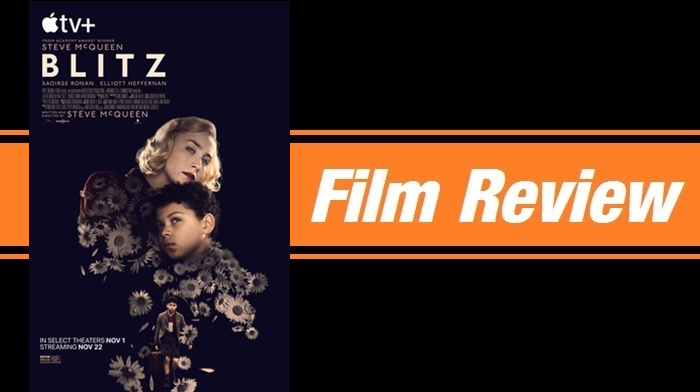
Director, writer, and producer Steve McQueen brings his incisive real-world filmmaking back to his home city of London in “Blitz”, an impeccably well-made historical drama set in the early days of World War II during what many called “The Blitz”. Named after Germany’s Blitzkrieg, The Blitz was an eight-month period when Hitler’s Air Force unleashed a major bombing campaign over British cities. During that time over 1.2 million people were evacuated from ravaged British targets with more than half being children.

That bit of history sets the table for McQueen’s heart-rending story. After a truly harrowing four-minute opening that features firefighters battling raging infernos caused by German bombs, we’re introduced to the film’s two main characters, a devoted mother named Rita (Saoirse Ronan) and her good-hearted 9-year-old biracial son, George (Elliott Heffernan). Their unshakable bond is the emotional linchpin that secures McQueen’s story.

Image Courtesy of Apple Studios

McQueen drops us into September of 1940. It’s only one year into World War II, but the impact of Hitler’s aggression is being felt all across England. Rita and George live in a London flat with her piano-playing father, Gerald (Paul Weller) who has a strong attachment to his dear grandson. But outside of their small but loving home is a much harsher and troubled world.

As the Nazi bombings intensify, Rita is convinced to send George to the countryside on a train full of other kids being evacuated. The two don’t part on the best of terms as the frustrated George shuts out his heartbroken mother. But as the train nears its destination, a remorseful George jumps off and heads off on an ill-advised adventure back to London in hopes of reconciling with his mother.

The majority of the story follows George’s dangerous journey which opens his young eyes to the terrible realities of his world. He meets an assortment of people along the way, some vile and opportunistic while others show much needed compassion. McQueen shows us both sides through George’s naive and innocent eyes which offers a raw and forthright perspective. Young Heffernan (making his feature film debut) is terrific, quietly conveying everything we need to understand what George is feeling. It’s a potent first performance.

Image Courtesy of Apple Studios

As George tries to find his way home, Rita goes to work in a factory making bombs for the war effort. She also volunteers at a shelter for displaced locals. But once she gets word that George didn’t arrive with the other children, she sets out on her own mission to find her son. Ronan has always possessed a near effortless grace. Here she combines it with a fraught motherly intensity resulting in a warm yet steely performance that’s crucial to McQueen’s vision.

As “Blitz” moves forward, flashbacks offer some needed context and depth especially involving George’s father, Marcus (CJ Beckford). They’re well done and informative though not particularly original in where they go. And as McQueen is known to do, his film takes moments to examine racial prejudice. Some of the scenes are powerful while others feel framed for the audience rather than organic to the story. They can be a little too on-the-nose and even clumsy at times, lacking the storytelling finesse we’ve come to expect from the filmmaker.

But those are such small quibbles for a movie this stirring, heartfelt, and well crafted. Steve McQueen remains a fascinating filmmaker. With “Blitz” he embraces an old-fashioned classicism yet isn’t afraid to add his own creative flavor. His film is very much a lavish wartime drama, illuminated through the period-piece lensing of DP Yorick Le Saux. But as with most of McQueen’s projects, it’s a human drama at its core. There are moments of inspiration but even more that shatter us. And then McQueen hits us with something like the film’s Café de Paris nightclub sequence – the kind of technically brilliant and emotionally sobering scene that makes his movies must-see experiences.

VERDICT – 4 STARS