REVIEW: “Can You Ever Forgive Me?”

forgiveposter

“I’m a 51-year-old who likes cats better than people.” That’s how Lee Israel describes herself in Marielle Heller’s film “Can You Ever Forgive Me?” It’s a biopic with Israel as its subject and an adaptation of her 2008 memoir of the same name. It follows her experience as a struggling writer who ends up making ends meet by forging coveted letters from famous deceased authors.

Melissa McCarthy makes a welcomed dramatic turn playing Lee Israel who has fallen on hard times after her writing career stalls. She’s a depressed and cash-strapped alcoholic who can’t keep a job and owes months of back-rent on her filthy Manhattan apartment. She can’t get an advance for a new book because she has burned every bridge her agent (a wonderful Jane Curtin) has laid down for her.

forgive2

You know where things go from here. A desperate Lee begins forging old letters and selling them to bookstores around the city. The true story goes that she sold over 400 documents, a remarkable crime streak that would seem impossible to pull off. The real Lee Israel was an unrepentant sham and the film definitely captures that. But Heller makes an obvious attempt to lace Israel’s story with sympathy.

McCarthy gives a good performance although it doesn’t require as much range as it may seem. She burrows down into Israel’s unlikability and isn’t asked to go much further. She still manages to give us an good character with several interesting layers. Take what is probably her deepest character flaw – the near arrogant insistence that she is a great writer and everyone needs to recognize it. At one point she states “I’m a better Dorothy Parker than Dorothy Parker”. And the film offers no grand transformation. She maintains this stance to the very end even finding a way to use it to rationalize her crimes.

forgive1

Richard E. Grant is getting a lot of attention for playing Lee’s only non-feline friend Jack. Grant is effortlessly good in what is a flamboyant and pretty showy performance. Jack is a fellow boozer and much like Lee he’s far from the most likable person. McCarthy and Grant have really nice chemistry and that makes for some entertaining back-and-forths between two otherwise shady people. Unfortunately I began to sour on their banter after a while.

Even though we know how things are going to end, Heller along with screenwriters Nicole Holofcener and Jeff Whitty give us enough to sink our teeth into. But it’s McCarthy who pulls off the impossible. She not only has us caring (to some degree) about such an unpleasant curmudgeon but also (in one way or another) she has us relating to her as well. That can’t be an easy task and it’s just enough to carry the film over the finish line.

VERDICT – 3 STARS

3-stars

REVIEW: “Crazy Rich Asians”

Crazyposter

When I first saw the title “Crazy Rich Asians” I couldn’t figure out if it was an ill-advised (and cringe-worthy) attempt at racial humor or an inside joke aimed at those within the culture. Turns out I was overthinking things and neither are entirely true. “Crazy Rich Asians” is based on Kevin Kwan’s 2013 novel of the same name. Kwan told Daily Beast “I wanted to introduce a contemporary Asia to a North American audience.” Short, simple and sweet.

This surprise hit of the summer is directed by John Chu from a screenplay written by Peter Chiarelli and Adele Lim. At its core “Crazy Rich Asians” is a satirical basting of the culture of excess and decadence. Chu doesn’t hold back in highlighting the lavish lifestyles of his subjects. It is extravagance to the extreme. But at the same time the movie sports a ton of something I wasn’t expecting – heart.

Crazy2

Things start fast and a little shaky. Within just a couple of scenes we are introduced to an New York University economics professor named Rachel (Constance Wu) who is invited by her longtime boyfriend Nick (Henry Golding) to travel to Singapore to attend a wedding and meet his family. When they board the plane and are ushered to the swanky first class section, Rachel learns Nick’s big secret. He comes from a very wealthy family. And I mean they are loaded.

“Crazy Rich Asians” feels pretty familiar right out of the gate. As Rachel is introduced to Nick’s broad assortment of pampered family members and friends we see the movie bend towards some rather routine romantic comedy tropes and character types. A couple of supporting characters dance dangerously close to overkill in their roles as comic relief.

But there is a subtle shift after the opening act that moves the film into more dramatic territory while maintaining a measured sense of humor. This is where my perception of “Crazy Rich Asians” changed and it began to reel me in. While romance is at its heart, it also deals with class-based and cultural biases, traditionalism, etc. Much of this is channeled through Nick’s mother Eleanor (Michelle Yeoh). She could easily be portrayed as a paper-thin codger, but she has actual depth and her cold-hearted obstinance is rooted in personal experiences from her past.

Crazy3

Several other supporting characters bring different perspectives to the story. Gemma Chan plays Astrid, a close cousin of Nick’s, quiet and proper but with her own set of upper-class troubles. One the other end of the spectrum is Peik Lin (played by Awkwafina). She’s an old friend of Rachel’s who lives with her parents in Singapore. Her goofy and eccentric personality is almost too much but she is dialed back at just the right time.

“Crazy Rich Asians” is a Cinderella story of sorts but with a cruel edge to it. Amid its unbridled opulence and glamorous eye-candy is a nasty center which gives the movie a bite. Rachel faces pretty harsh backlash from some of Nick’s more unaccepting kin. She’s targeted for her social status, meager upbringing, and nationality among other things. Chu deftly handles these various shades of bigotry, never allowing them to swallow up the fun and humor while giving them the sting they should have. It’s one of several things the film offers that you rarely see out of this genre.

Crazy1

“Crazy Rich Asians” doesn’t reinvent the romantic comedy or stretch it in any new directions. The ‘fish out of water’, ‘meet the parents’, and ‘rags meets riches’ story elements have been done many times before. This film simply does them better. The fashion porn, food porn, jewelry porn, real estate porn, party porn, it’s all fun. The eye-popping Singapore skylines are beautifully shot. But what sets this movie apart is its heart and the undeniable human element it never loses sight of.

The all-Asian cast has been a huge point of praise and it’s definitely a stride forward for Hollywood. But what does it say about American moviegoers? There are many great movies with all-Asian casts. They simply require us to look beyond our self-made boundaries to discover them. So just maybe “Crazy Rich Asians” will not only inspire a change in Hollywood, but also with the way some audiences watch movies.

VERDICT – 4 STARS

4-stars

REVIEW: “Come Morning”

COME poster

The very existence of “Come Morning” is a testimony to a love of cinema that transcends the routine Hollywood formula. It’s the same deep appreciation for film and process that independent filmmakers have been showcasing for decades as they plow their own paths to tell their own stories. For writer, director, cinematographer, and editor Derrick Sims that love for the form oozes out of every frame of his movie.

The film’s production is an inspiring story in itself. It was shot in just twelve days and with a crew of only ten people, many of whom tackled multiple roles. Sims shot on location near his childhood home of Kingsland, Arkansas during a chilly early winter and with the bulk of the scenes taking place at night. Yet despite the limitations of an extremely tight budget, Sims never allows for himself to be handcuffed creatively.

COME1

This Deep South suspense thriller is set in 1973 rural Arkansas. Frank (Michael Ray Davis) prepares to take his grandson D (Thor Wahlestedt) out for an afternoon hunt amid the cryptic protests of his concerned wife (Elise Rovinsky). It’s clear to us that her worries are rooted in something deeper than an old man and a young boy going hunting. But Sims doesn’t tell us everything. Instead he wisely allows up to pick up bits of information along the way.

As we stubborn men tend to do, Frank ignores the pleas of his wife and takes D to their spot in the woods. Believing they have shot a deer, the pair discover they have accidentally killed Marion Mitchell (Thomas Moore), a trespassing neighbor with the volatile history with Frank’s family. D wants to call the police, but Frank decides to hide the body deeper into the woods, one of several complex moral decisions with hefty consequences.

As the story pulls Frank and D further from home a sense of dread settles over the film. We know things are not going to go well. As with before, Sims doesn’t spell everything out for us. Instead the backstory takes form through small pieces of conversations and a handful of flashbacks, some more effective than others. And as things steadily grow darker, we watch young D’s innocence being chiseled away in one scene after another.

Come2

Adding to our overall unease is how Sims deftly creates atmosphere and tension. Much of it is through the arresting cinematography. Again, the bulk of the film takes place at night yet despite that potential hurdle Sims is able to create a convincing sense of place. It is especially seen in the landscapes which are visualized in such a way as to be both beautiful and foreboding. And when accompanied by Justin Slaughter’s striking and understated score, it’s all the more effective.

“Come Morning” tells a simple yet compelling story while pulling us into a place shrewdly realized through Sims’ camera. And despite being patient with its reveals, the film maintains a crisp and economical pace throughout within its taut 80 minute frame. There are instances where the money constraints can be felt, but the film shows that even miniscule budgets can’t overthrow a good story especially when it lies in the hands of a confident filmmaker with a clear vision.

“Come Morning” is available on Amazon Prime. Give it a look and tell me what you think.

VERDICT – 4 STARS

4-stars

REVIEW: “Chappaquiddick”

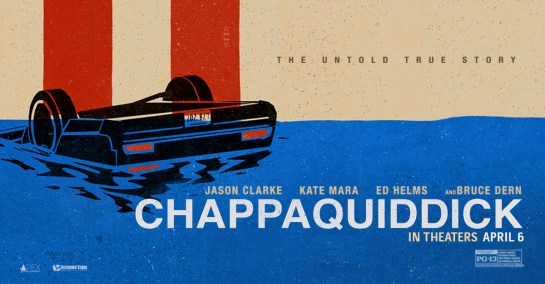
ChappPoster

On July 18, 1969, Massachusetts Senator Edward “Ted” Kennedy left a party on  Chappaquiddick Island with Mary Jo Kopechne. A short time later Kennedy drove his mother’s 1967 Oldsmobile off Dike Bridge and into Poucha Pond. Kennedy escaped but Kopechne was trapped in the submerged vehicle. Kennedy would leave the scene and not report the accident until the next morning after the car and Kopechne’s dead body had been discovered.

“Chappaquiddick” from director John Curran is the latest look into the scandal that was forever a stain on the legacy of Ted Kennedy. Writers Taylor Allen and Tyler Logan scoured over transcripts featuring key players including Kennedy himself speaking under oath. Leaning heavily on court records and testimonies along with the indisputable facts of the case allowed for their script to be more than conspiracy theories and character assassination as a few have claimed.

Chapp1

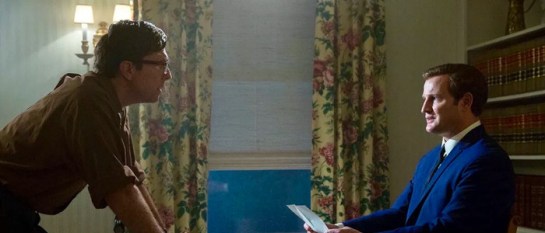
Jason Clarke gives not only one of the best performances of the year but one of the most surprising as Ted Kennedy. You immediately notice how distinctly in tune he is with his character. He manages a very measured performance, playing Kennedy in a way that never projects judgement. He portrays Kennedy as a complex man. At times immature and naive. Other times self-serving and calculated. But in the few moments where he is forced to emotionally reckon with what’s happened Clarke doesn’t spell out the genuineness of the remorse.

Curran moves the story along at a good pace, quickly getting to the infamous Chappaquiddick incident then navigating the decisions that immediately followed. You could call Ed Helms the moral conscious of the film. He plays Kennedy’s cousin Joe Gargan who along with US Attorney General and Kennedy confident Joe Markham (Jim Gaffigan) are the first people Teddy contacts after the wreck. They push Kennedy to report the accident to authorities, something history informs us never happened until the next day.

A big hunk of the film focuses on the aftermath, specifically political damage control. As Kennedy wages an internal struggle with telling the truth, or at least their “version of it”, an entourage of lawyers and analysts diligently work to quell any public outrage and protect the family name. There are some really good scenes as they hammer out strategies and navigating Kennedy’s sketchy timeline of events.

Chapp2

Attempts at empathy can be found in the few scenes of Kennedy family drama but unfortunately these are easily the movie’s weakest moments. Bruce Dern dials it up as Kennedy patriarch Joseph P. Kennedy Sr. who was paralyzed and wheelchair bound following a severe stroke. The filmmakers leave no ambiguity in Kennedy Sr’s lack of confidence in his son and they present the strained relationship as a heavy weight Teddy’s neck. But where most of the film comes across as strikingly authentic, the handful of scenes between Clarke and Dern feel too contrived. One line early in the film is broader but more effective at conveying the tension. An interviewer asks Ted “What’s it like walking in a shadow?” He promptly ends the interview and walks away.

The true cleverness of “Chappaquiddick” is seen in how it moves with Kennedy’s evolving story in a way that by the end of the film we are still unclear on what’s the truth. It also presents a slice of the Kennedy mystique within American culture. When the partygoers on Chappaquiddick Island are told about the accident the next morning and about the death of their friend and colleague, the first words of response are “What do we need to do now? What do we need to do to help the Senator?” It’s as if Mary Jo Kopechne lost out to the Kennedy family name. In a very perceptive way this movie finally gives her a voice.

VERDICT – 4 STARS

4-stars

REVIEW: “The Cloverfield Paradox”

clove poster - Copy

Paradox: (noun) a statement or proposition that seems self-contradictory or absurd but in reality expresses a possible truth.

Cloverfield: (noun-ish) a kooky yet cool concoction from J.J. Abrams featuring a series of movies seemingly revolving around the same cataclysmic event. Kind of. But not really.

What started in 2008 as a simple yet effective found-footage horror movie has blossomed into a surprisingly successful feature film franchise. The original “Cloverfield” was followed by 2016’s “10 Cloverfield Lane”. Now two years later we get a third installment, “The Cloverfield Paradox” and a fourth is due out in October.

One of the fascinating things about these movies are how each (so far) are from different horror movie sub-genres. “Cloverfield” was a monster horror movie while the second film was a psychological thriller. “The Cloverfield Paradox” is a straight science fiction horror movie taking place mostly in space. All three are openly influenced by other films but are unique within their franchise. But defining the franchise as a whole, well that’s a bit tricky.

GDP-08575.raf

“The Cloverfield Paradox” takes place in 2028 which immediately separates it from the previous movies. The earth has been crippled by a global energy crisis and nations have joined together to launch the Cloverfield space station. The station is manned by a multinational crew of technicians and scientists who are preparing for an experiment which could lead to an infinite energy supply for the entire planet. But tin-foil hatters warn that the experiment could rip a hole in the space-time continuum allowing all sorts of bad things to happen.

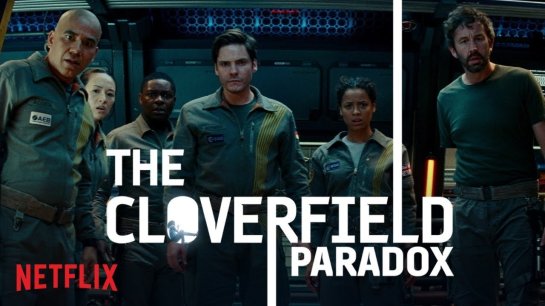
On earth, communications officer Ava Hamilton (Guga Mbatha-Raw) reluctantly leaves behind her husband Michael (Roger Davies) to join the Cloverfield mission. The station’s crew consists of several good faces: Daniel Oyelowo, Daniel Brühl, Zhang Ziyi, Chris O’Dowd, John Ortiz, and Aksel Hennie. Each come from different backgrounds and have their own perspectives about the mission and the chaos down on earth. Sometimes the planetside political tensions bleed over onto the station and the film smartly explores that dynamic. Perhaps not as much as it could have.

Needless to say the experiment doesn’t go exactly as planned and the crew begin noticing a series of creepy anomalies. At the same time officials on earth have lost contact with the Cloverfield and the situation on the ground has worsened. The film tries to juggle time on the space station with Michael’s time on earth, but it’s Michael’s side that feels a little underserved. For the crew it turns into a survival horror story as they try to undue what their experiment has done.

CLOVE2

“Paradox” operates much differently than its predecessors. At the same time its story rhythms and some of the character treatments lean heavily on the movies that inspired it. You can’t help but notice it. There are times when the familiarity and predictability are a bit much. Also you can see potential in some of the story threads they begin but do little with. Still, I tend to have a soft spot for these types of genre pieces so the issues weren’t hard to get past especially considering all the movie does well. It stocks a good cast and the performances hit there marks. The production design and special effects are impressive and Bear McCreary’s score hearkens back to 90’s era adventures – big and persistent but fitting. Most importantly, “Paradox” sprinkles in some clever clues as to how it is connected to the overall “Cloverfield” franchise.

Director Julius Onah and writer Oren Uziel have been attached to the project since 2012 when it used the developmental title of “God Particle”. It was eventually confirmed to be the next Cloverfield film but faced numerous delays. The true stroke of advertising genius (and guts) came February 4, 2018, Super Bowl Sunday. A teaser trailer debuted proclaiming the movie would be available immediately following the big game. No press tour or pre-release trailer campaign. It marked a new attention-getting approach for the industry.

So where does “The Cloverfield Paradox” fit in? Let’s just say you could call it a prequel. That’s my take on it and I enjoyed how this film brought me to that conclusion. But many people have left it with a much different reaction and with their critical guns have been blazing. Sure, it’s a traditional sci-fi horror picture that doesn’t break new ground outside of its slick advertising trick. But is it really trying to break new ground? I would argue it’s trying to make a fun, intriguing “Cloverfield” installment. Speaking for myself, mission accomplished.

VERDICT – 3.5 STARS

REVIEW: “The Commuter”

COMMUNTER POSTER

I must admit, I do find some enjoyment in these January/February Liam Neeson action-thrillers. They are rarely great but almost always entertaining (to varying degrees). These things started with 2009’s “Taken” which reinvigorated Neeson’s career and made him an unexpected action star. Multiple films have followed (most with the same familiar flavor) and most do pretty well at the box office.

The latest addition is “The Commuter” which sees Neeson playing a 60 year-old ex-cop turned insurance salesman named Michael MacCauley. Each day he takes the same train into the city with many of the same fellow commuters. His daily routine is shattered when out of the blue he is laid off from his job. Now unemployed with a son heading to college and a mortgage due, Michael boards his train for the ride home to break the news to his wife.

COMMUNTER1

As he takes his seat an unusually inquisitive woman played by Vera Farmiga sits opposite of him. Turns out she and the people she works for know a lot about Michael. The mystery lady tells him of $25,000 hidden in the train’s bathroom. If Michael takes the money they will consider him working for them. All he has to do is identify a passenger who goes by the name of Prynne before the train’s final stop. If he does that an additional $75,000 is his. The woman hops off and the train leaves the station.

The financially desperate Michael finds the money in the bathroom but quickly learns the task isn’t as easy or as innocent as it sounds. The people pulling his strings prove to be bad news and they will do anything to get the job done including hurting Michael’s family. From their the film becomes a cross between Michael identifying Prynne while also finding a way out of the mystery group’s clutches.

Commuter2

As the train speeds along the track it’s the story that flirts with derailment. The further it goes the more intense and absurd it becomes. But that’s part of what I like about these things. Plus I enjoy watching Neeson who by now can do this role in his sleep. I also like the always good Vera Farmiga and Patrick Wilson who pops up playing Michael’s sympathetic friend and ex-partner (sorry, no Ed and Lorraine Warren shared universe stuff). But it’s Neeson who keeps the story rolling which isn’t the easiest of tasks.

“The Commuter” marks Neeson’s fourth collaboration with Spanish director Jaume Collet-Serra. All four of their ‘race against the clock’ thrillers feature the same basic framework with a few narrative differences. In other words you know what to expect – a fast pace, good action, that Neeson growl, and some amusing corniness. If you don’t like their previous movies this one won’t change your mind. But if you’re like me and get a kick out of these things “The Commuter” will give you what it promises. Nothing more, nothing less.

VERDICT – 3 STARS

3-stars