REVIEW: “Cuckoo” (2024)

Rarely has a title fit a movie quite as well as “Cuckoo”. This bizarre yet original horror-thriller comes from the imagination of its writer and director, Tilman Singer. Reactions to this crazy concoction will probably be all over the map and understandably so. It’s undeniably fun and bonkers in ways that only horror movies can be. But narratively it’s a bit of a mess, and almost undone by an unsatisfying ending that leaves far too many unanswered questions and dangling loose ends.

Hunter Schafer plays Gretchen, a 17-year-old still grieving the recent death of her mother. As a result, she leaves America and moves to the Bavarian Alps to live with her father, Luis (Marton Csokas), his new wife Beth (Jessica Henwick), and their mute daughter Alma (Mila Lieu). With little in terms of explanation, Luis moves them to a vaguely defined mountain resort that’s ran by the enigmatic Herr König (Dan Stevens). But the change of scenery doesn’t help Gretchen. The only thing that offers her solace is leaving voicemails on her late mother’s answering machine.

Image Courtesy of NEON

As the family settles into their new home, König offers Gretchen a job as a receptionist at his hotel in an effort to help her adapt. But then weird things start to happen. There are the eerie screeches coming from the nearby forest. There are the unresponsive guests seen vomiting around the hotel. And what’s with the weird time loops (a question I’m still asking myself). Most concerning of all are Alma’s sudden seizures. Of course we learn quick that there is more going on at König’s “resort”.

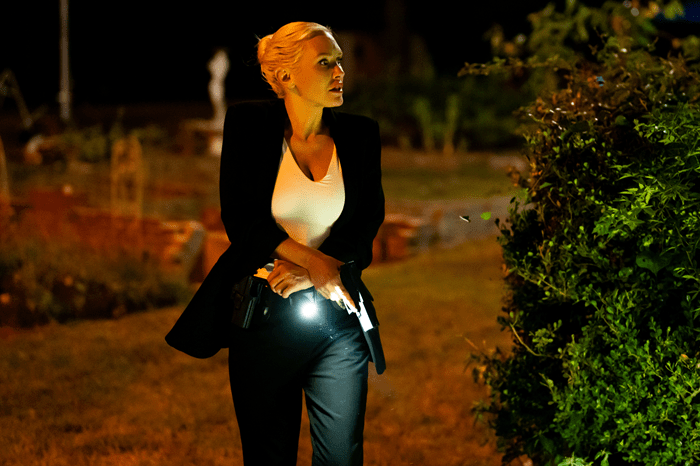
From there the movie hits us with one deliriously demented turn after another. There are several gnarly pieces to Singer’s twisted puzzle including König himself, whose slipperiness makes it clear that he’s hiding something. You have the terrifying blonde-haired woman in a long trench coat, with glowing red eyes that she hides behind large gaudy sunglasses. And then there’s the appearance of Henry (Jan Bluthardt), a police investigator who knows more than he’s letting on. He convinces Gretchen to join his secret investigation to stop whatever König is up to.

While the gonzo and sometimes grisly horror elements are a lot of fun, not everything in the story gets as much attention. For example, Gretchen makes several knee-jerk choices that seem out of the blue. None are bigger than her seemingly random attraction to a free-spirited guest named Ed (Àstrid Bergès-Frisbey). Their actions that follow have no weight because their connection is too thinly drawn. It’s the same with Luis and Beth and some of their unexplained motivations.

Image Courtesy of NEON

But where the movie disappoints most is in its ending. Singer begins pulling back the veil on his twisted and macabre mystery leading to a bloody final showdown that attempts to put a cap on all he has revealed. Interestingly, it’s the resort’s crazy cryptic mystery with all of its deranged moving parts that comes together best (not seamlessly, but best). But outside of it, too much is left unresolved from character arcs to plot logic.

“Cuckoo” succeeds at luring you in and keeping you anticipating the next wacky turn it takes. But by the time the end credits roll, it’s hard to shake the feeling of being shortchanged. Still that doesn’t disqualify Tilman Singer as being an exciting emerging voice. Dan Stevens delivers another deliciously creepy and slyly hilarious performance (I dare you not to laugh when he pulls out his wooden flute). Meanwhile Schafer is a sturdy enough lead to guide us through the film’s big ideas and its hole-riddled storytelling. “Cuckoo” is in theaters now.

VERDICT – 3 STARS

REVIEW: “Coup de Chance” (2024)

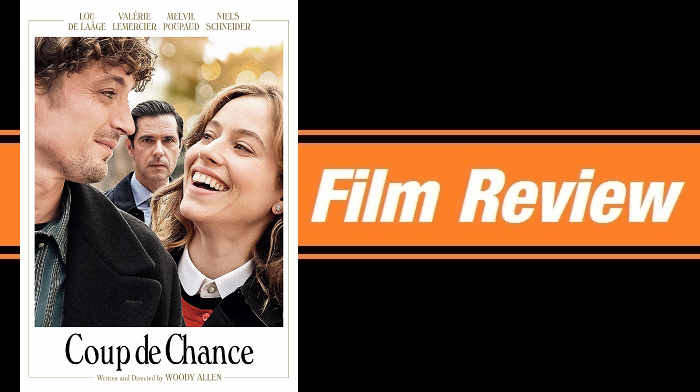
Woody Allen’s 50th film, “Coup de Chance” made a pretty good impression after premiering at last year’s Venice International Film Festival and then in France a short time later. Since then it has been finding its way to screens including here in the States courtesy of MPI Media Group. It’s Allen’s first French-language feature. And while it may not be a landmark achievement for the 88-year-old filmmaker, “Coup de Chance” is his best movie in a decade, and maybe since 2011’s fabulous “Midnight in Paris”.

It goes without saying, but a ‘Woody Allen movie’ doesn’t have the same draw as it once did following the resurfacing of a decades-old sexual abuse allegation made by his ex-wife Mia Farrow which Allen has consistently and vehemently denied. Yet Allen has continued to make movies. Maybe not with the one-a-year cadence that many of us had grown accustomed to, but he’s still writing and directing. And as “Coup de Chance” reminds us, there’s a lot to enjoy when he hits his marks.

“Coup de Chance” (translated “Stroke of Luck”) is very much a Woody Allen picture from the familiar fonts during the credits, to the snappy jazz score, to the dense, rich, and effervescent dialogue. Yet while classic Allen hallmarks can be seen throughout, “Coup de Chance” also emanates a beguiling freshness that not only distinguishes it from the filmmaker’s recent efforts, but from much of what passes for adult dramedies today.

Image Courtesy of MPI Media Group

An absolutely captivating Lou de Laâge plays Fanny Fournier. She and her husband Jean (Melvil Poupaud) have the appearance of the ideal upper-crust couple. Fanny works at a high-end auction gallery while Jean is a successful (and possible shady) financial advisor who loves to shower his wife with lavish gifts and put on a show for his high society Parisian peers. But underneath his big spending, gregarious demeanor, and smooth self-promotion is a jealous and possessive man who is oblivious to his own condescension. Jean loves Fanny, but only through the lens of his expectations.

As for Fanny, she enjoys the pampered life of privilege and she’s comfortable with Jean, even poking fun at his hobnobbing with the dull and superficial elites. But Fanny isn’t driven by riches or status, nor is she concerned with impressing his rich acquaintances. Their relationship is perhaps best embodied in their frequent weekend trips to a posh exclusive hunting lodge. Jean loves schmoozing with the fellow one-percenters and he eats up the attention he gets in return. Fanny would rather stay in Paris but reluctantly goes along, mostly hanging around at the lodge while Jean and his affluent chums are out and about.

Allen does a great job defining their marriage which adds weight to Fanny’s life-altering chance encounter with an old high school friend, Alain (Niels Schneider). He’s a writer who is in Paris to work on his novel. One morning the two pass each other on the street and quickly strike up a conversation. Greetings give way to small talk which turns into reminiscing. Alain casually mentions that he’s always had a crush on her which Fanny lets slide by, quietly flattered but suppressing any sign of such reaction. The two part ways but not before agreeing to have lunch soon. That one lunch quickly turns into many.

Image Courtesy of MPI Media Group

As they walk around the city and share sandwiches in the parks, the two inevitably grow closer. Alain is a bohemian open-book, quick to share his feelings and not shy about posing whatever questions come to mind. Fanny is a little more subdued yet utterly charmed by Alain and his genuine interests in her – something she doesn’t get from Jean. Their conversations grow more honest and open, and soon longing gives way to a love affair. But once Jean gets suspicious, the movie takes an unexpected yet still distinctly Woody Allen turn.

As his story unfolds, Allen once again leans on the luminous cinematography of the great Vittorio Storaro. He shoots much of the film in a sumptuous autumn hue that adds beauty and allure without drawing too much attention to itself. Allen’s affection for France, and particularly Paris, vividly comes through Vittorio’s camera. And there’s an elegance to how he frames and follows the characters that adds to the tone Allen is going for.

Then you have the overall strong performances from the seasoned French cast led by Lou de Laâge. She has a magnetic presence, deftly conveying Fanny’s confidence and strength but also her vulnerability. Yet Allen’s ace in the hole may be Valérie Lemercier. She plays Fanny’s mother Camille, a small character at first who ends up playing a significant role. “Coup de Chance” may not be a comedy per se, but it has humor, most of which comes from Lemercier. She brings charm and levity to a film that is part romance, part drama, part thriller, and all Woody Allen. “Coup de Chance” is available now on Blu-ray and is streaming on VOD.

VERDICT – 4 STARS

REVIEW: “Challengers” (2024)

The enigmatic Luca Guadagnino revisits many of his usual preoccupations in “Challengers”, his new film set within the world of competitive tennis. Of course you could say tennis is just a device in the Italian filmmaker’s latest swing at provocatively exploring such favorite subjects as sensuality, desire, and obsession. Whether it’s cannibalistic lovers, a coven of witches, or in this case sweaty tennis stars, his films rarely veer too far away from such themes. So you often know what’s underneath the dressing of a Luca Guadagnino film.

Those very fixations can sometimes hinder Guadagnino’s storytelling and that’s once again the case with “Challengers”, a slickly and stylishly made drama that teases a lot more than it delivers. But it’s not just a case of getting too hung up on your own interests. Guadagnino surprisingly pours much more into showing off his stylish filmmaking than offering any incisive and relatable access to his characters. As a result the tennis matches look spectacular but the trio at the story’s center come across as half-written and more contrived than organic.

“Challengers” sees Zendaya playing yet another icy brooding character. This time she stars as Tashi Duncan (Zendaya), a tennis prodigy who decides to go to Stanford rather than turn pro. While there she meets Patrick Zweig (Josh O’Connor) and Art Donaldson (Mike Faist), two childhood friends and fellow tennis players. Patrick is cocky and straightforward while Art is more earnest and sensitive. Both instantly fall for Tashi, turning into slobbering puppy dogs for no reason other than she’s “hot”. And so the competition begins.

The film’s surface level love triangle comes to light late one evening in a cramped messy hotel room as Tashi, Art, and Patrick gather after a party. It’s where we witness the two seemingly intelligent young men fully devolve into simpleminded saps, to the point of being putty in the hands of the Tashi who we’re to believe is an all-controlling force of nature. It culminates in a scene meant to unveil passion and desire but that isn’t nearly as revealing as it wants to be.

From there Guadagnino needlessly bops back-and-forth across his timeline, a choice that feels considerably more showy than necessary. It all coalesces into a story (written by Justin Kuritzkes) that’s content with following its three main characters rather than fleshing them out. So we’re left with incredibly shallow people and superficial relationships, all fueled by the power of desire and not much else. For Guadagnino that’s enough. For anyone wanting characters who feel real, it may not be.

After their lusty encounter in the hotel, we skip forward in time to where Tashi and Patrick are dating while she’s playing tennis at Stanford. But everything changes after a devastating on-court injury ends her playing career. Jump ahead thirteen years where Tashi has married Art and they have a 5-year-old daughter together. She’s also his coach, leading him to several major championships and making them a veritable power couple in the world of professional tennis. But Art’s current losing streak has put a damper on their high-profile life together. Meanwhile Patrick has fallen on hard times, living out of his car and forced to play on the Challenger Tour for money.

With the prestigious U.S. Open on the horizon, a concerned Tashi schedules the depressed Art in a Challenger tournament as a confidence booster. But wouldn’t you know it, in a stroke of bad luck (and narrative convenience), Patrick is set to play in the same tourney. It forces the former best friends to once again come face-to-face. And of course Patrick has never gotten over Tashi which complicates matters even more. Guadagnino works hard to patch it all together and he’s mostly successful. But it takes a lot of effort to make his nonlinear story cohesive – effort that could have been spent in areas that needed more attention.

As for the performances, all three young stars fully commit and try their best to make each character work. Zendaya’s star power is undeniable and Guadagnino leans heavily on it. But she can only do so much in a role that she doesn’t always seem right for. She spends the vast majority of the film sour and stone-faced. And through no fault of her own, she’s not always the convincing centerpiece Guadagnino desperately needs her to be. Faist and O’Conner are much better fits, but both are shackled to characters whose actions and emotions rarely go beyond skin-deep.

Cleverly shot through the lens of DP Sayombhu Mukdeeprom, the tennis scenes portray the sport as almost animalistic in its ferocity. The on-court battles mirror the off-court acrimony and it’s pretty impressive early on. But even it falls apart in the film’s laughably silly finish where we’re hit with countless editing and camera tricks that convey little more than a filmmaker indulging himself (there’s enough slow motion to make Zack Snyder giddy).

It’s not hard to see what Luca Guadagnino is going for with “Challengers”, a sports movie that works hard to not be a sports movie. He treats his story like a tennis match, fueling it with sexual tension and making winning the ultimate objective. Unfortunately his characters suffer. Aside from a shared love for their sport and their warped views of relationships, there’s little else to glean from the thinly sketched trio. Sadly the same can be said for the movie itself. And no amount of pseudo-sexy gloss can change that. “Challengers” is in theaters now.

VERDICT – 2 STARS

REVIEW: “Civil War” (2024)

Filmmaker Alex Garland has provoked a wide range of responses with his latest film “Civil War”. In partnership with A24, Garland’s dystopian war film has prompted some to say he goes too far while others say he doesn’t go far enough. Some have called him irresponsible for releasing such a film at such a precarious time while others have proclaimed this as exactly the kind of movie we need right now. Some believe it will open eyes yet others say it will only further divide.

As with most opinions colored (at least in part) by personal politics, it’s hard to gauge the truth in some of the reactions that are out there. So as is often the case, it’s best to go to the movie itself and make up your own mind. In doing so, I found that “Civil War” falls somewhere in the middle which is sure to frustrate the two unforgiving extremes. The movie’s politics are vague enough so that all sides might listen, pay attention, and perhaps consider the path our country is on.

But at times even that feels deeper than writer-director Garland wants to go. Through much of “Civil War” he seems more interested in examining the heroism yet murky ethics of wartime journalists. And I’m guessing that has fueled many of the frustrations. After all, if you’re opening up such potent ideas during what many perceive to be a tinderbox era of American history, wouldn’t you take some kind of position? I’m sure Garland has his beliefs, but he’s more interested in ours. He trusts that we’ll use those beliefs to define things for ourselves. He’s merely showing us the potential consequences and issuing a warning that every side should heed.

Image Courtesy of A24

The story takes place in a dystopian near future where the United States isn’t so united. The current President (played by Nick Offerman) is a dictator who’s currently serving his third term. He has seen America fracture under his watch with a number of militant groups forming across the country. The most powerful of the rebel factions are the Western Forces – a coalition formed between California and Texas. The escalating tensions between the President’s regime and the WF eventually ignites a second Civil War.

An intensely captivating Kirsten Dunst stars as Lee Miller, a renowned war photographer who has grown cold and callous from the countless conflicts she has covered. This comes through clearly in the film’s opening scene where she and her colleague Joel (Wagner Moura) are shooting a riot in New York City. After a suicide bomber detonates herself in a huge crowd of people, Lee’s first impulse is to take pictures rather than check for survivors. She does manage to save the life of a young aspiring war photographer and fangirl named Jessie (a terrific Cailee Spaeny).

With Joel scheduled for an extremely rare one-on-one interview with the President, he and Lee prepare to set out to Washington DC. Lee agrees to let veteran journalist and mentor Sammy (Stephen McKinley Henderson) hitch a ride against Joel’s wishes and Joel agrees to let Jessie tag along against Lee’s. The four take off on a perilous road trip, avoiding the war-ravaged bigger cities for the unknowns of the lawless rural areas which prove to be far more dangerous than the group were prepared for.

Image Courtesy of A24

Along the way Garland hits us with some truly disquieting imagery. Teaming again with cinematographer Rob Hardy, Garland paints a disturbingly vivid portrait of a collapsed American society. The visuals are searing, brutal, and necessarily uncomfortable. At the same time, Garland’s simmering pacing maintains a steady feeling of unease. Regardless of where they stop, there’s never a sense that his four protagonists are out of danger.

It all culminates in a fierce and stunningly shot warfare sequence that brings everything we’ve seen to a violent and unsettling finish. It’s an ending that could be called grossly irresponsible IF there was ever a sense that Garland was conveying a sense of triumph. Instead the final shots leave you with the sickening feeling that things are only going to get worse. If it doesn’t, there’s a good chance you’ve missed the real genius behind Garland’s film.

Calling “Civil War” apolitical (as some have done) is a bit of a stretch. In fact it’s pretty obvious where Garland takes some of his cues. But he doesn’t get bogged down in the polarizing whys. He knows we will bring those to the table ourselves. Rather he wants us to think about the possible consequences of today’s contempt-driven division and consider our roles in it. And he examines it all through the lenses of war photographers, a sadly essential profession that can often miss the humanity for that one perfect shot. “Civil War” is in theaters now.

VERDICT – 4 STARS

REVIEW: “Cabrini” (2024)

Director Alejandro Monteverde follows up last year’s surprise box office hit “Sound of Freedom” with “Cabrini”, a gripping period epic that shares the profoundly moving story of famed Catholic missionary and future saint Francesca Cabrini. This biographical drama (penned by Rod Barr) follows Cabrini’s charity efforts on behalf of immigrant children in Five Points, New York City, while facing rampant bigotry, misogyny, and corruption from the local government as well as the church.

Born in 1850 near Milan, Francesca was the youngest of thirteen children and one of only four who lived past adolescence. She was born premature and remained in questionable health for the majority of her life. Yet she overcame countless obstacles beyond her health to help marginalized communities on her way to becoming the first American canonized by the Catholic Church. “Cabrini” powerfully portrays a slice of this remarkable life through Monteverde’s impressive direction, an array of technical savvy, and a stirring lead performance from Cristiana Dell’Anna.

Image Courtesy of Angel Studios

Dell’Anna’s dauntless yet empathetic portrayal of Mother Cabrini begins with her leading a small group of fellow nuns in Codogno, Italy. From there she travels to the Vatican after the latest of her many petitions to start a network of orphanages in China has been denied. After being brushed off yet again, she takes her case straight to Pope Leo XIII (a terrific Giancarlo Giannini).

It takes some lengthy persuading, but Mother Cabrini finally convinces Pope Leo to make her the first woman to lead an overseas mission for the church. But he has one condition. Rather than China, he wants her to go to New York City where waves of Italians have been immigrating. Poor, often illiterate, and rarely speaking English, the immigrants immediately face an uphill battle in their unwelcoming new country. Adding to the pressure of her mission, the Pope is quick to remind her that the entire church will be looking to her for proof of what women in her position can or cannot accomplish.

The frail but driven Mother Cabrini along with a small group of loyal nuns arrive in New York in 1889, ready to take over an orphanage in Five Points from a disillusioned Father Morelli (Giampiero Judica). What they find is an impoverished neighborhood riddled with disease, crime, and debauchery. The sisters immediately begin renovating the rundown orphanage before setting out to find homeless children and bringing them into their fold.

Image Courtesy of Angel Studios

It’s hard to see Mother Cabrini’s actions as anything but virtuous and noble. Yet she quickly finds herself running into all kinds of barriers. Some are placed by the local Archbishop Michael Corrigan (David Morse) who is terrified of ruffling the feathers of the area bigwigs. Others are placed by the racist, anti-immigrant Mayor Gould (John Lithgow) whose chief concern is maintaining his elitist vision of New York City.

Despite her failing health, Mother Cabrini fights for her mission, persistently seeking help from government officials, church leaders, press members, and even entertainers. Every hint of progress is met with resistance. Yet she pushes onward, determined to realize her “Empire of Hope”. Along the way she makes some valuable allies such as a former prostitute named Vittoria (Romana Maggiora Vergano) and a benevolent Irish doctor named Murphy (Patch Darragh).

The story of Mother Cabrini’s courage and commitment is inherently inspirational and affecting. Similarly the depictions of the countless roadblocks meant to deter her are unfathomable and infuriating. Monteverde artfully conveys it all while avoiding cliches, overwrought sentiment, and lazy histrionics. He’s aided by DP Gorka Gómez Andreu’s elegant yet uncompromising cinematography as well as the period-rich production and costume design. Then there’s the transporting score of Gene Back. His music walks us through a range of emotional highs and lows without ever feeling manipulative. And there are moments where his swells hearken back to classic big screen epics of old.

Image Courtesy of Angel Studios

Just as vital is Dell’Anna and her ability to relay so much through what remains a powerful yet subdued performance. Rather than a fiery tempest, Dell’Anna focuses on Mother Cabrini’s quiet determination and resolve to great effect. And it helps that she is surrounded a superb supporting cast most notably Judica, Morse, Lithgow, and Vergano. All fit incredibly well with their characters and are given good material to work with.

Obviously “Cabrini” is a movie about a religious figure. But it’s not what some would qualify as a “religious movie” – a label full of connotations that people like to project. It’s an enlightening historical biography. It’s a story of a fearless woman overcoming multiple patriarchal systems. It’s an uplifting testimony to the resilience of the human spirit. Despite the film’s lengthy 140-minute runtime, the ending feels a bit rushed. But other than that, there’s little fault to be found in this emotionally stirring and skillfully made feature. “Cabrini” hits theaters March 8th.

VERDICT – 4.5 STARS

REVIEW: “The Color Purple” (2023)

Director Blitz Bazawule and screenwriter Marcus Gardley team up to give us the second big screen adaption of Alice Walker’s 1982 novel “The Color Purple”. The first movie released in 1985 and was directed by Steven Spielberg. He returns alongside Quincy Jones, Oprah Winfrey, and Scott Sanders to produce this enchanting but flawed update that is heavily inspired by the long-running, Tony award-winning musical.

At its heart “The Color Purple” is a moving coming-of-age period drama and Bazawule captures that essence most impressively in the film’s first half. From its sweeping opening to the story’s midway point, the movie simmers with powerful storytelling and spectacular musical numbers. Sadly it stumbles in the second half. The rousing and heartfelt tunes are still there, but the storytelling feels rushed, even patched together in spots. Certain character arcs get shortchanged and there is one particular redemption angle that doesn’t feel earned at all.

Image Courtesy of Warner Bros. Pictures

The story of “The Color Purple” begins in the early 1900s and spans over several decades. In a small African-American community near the Georgia coast lives 14-year-old Celie (Phylicia Pearl Mpasi) and her sister Nettie (Halle Bailey). The two are inseparable and have a joyous relationship. But the sisters live with a dark secret. Their vile and abusive father (Deon Cole) rapes Celie and has impregnated her twice. He then took her two babies and traded them off for the best deal.

A couple of years pass and Celie’s father sells her to the cruel and ruthless Albert “Mister” Johnson (a chilling Colman Domingo). He’s a banjo plucking farmer who immediately puts her to work cleaning his house and raising his kids. Mister is as violent as her father, and the physical abuse is only outdone by the psychological torment. Nettie moves in for a bit which offers Celie a welcomed respite. But when she’s forced to fight off Mister’s sexual advances, he throws her out leading Nettie to go far away.

As years go by Celie (now played by former American Idol winner Fantasia Barrino in her feature film debut) remains trapped under Mister’s rule with no real means of escape. Several more characters are thrown into the mix including Mister’s weak-minded son Harpo (Corey Hawkins), the great Louis Gossett Jr. as Mister’s crusty father, the scene-steaming firecracker Sofia (Danielle Brooks), and even David Allen Grier as a singing preacher.

And then Shug Avery (Taraji P. Henson) comes to town, a rowdy and popular blues singer who happens to be Mister’s former mistress. He’s still smitten with her despite claiming Celie as his wife. Yet rather than become rivals, Celie and Shug form a bond than only intensifies after Celie reveals the years of abuse she has endured from Mister. Shug is a striking presence but she sucks out most of the air from every scene she’s in. It’s not Henson’s fault, she’s quite good in the role. It’s more the writing and direction that at times can make her such an overpowering force.

Image Courtesy of Warner Bros. Pictures

Over time I found myself less interested in Shug’s role and much more compelled by several other characters. Take Danielle Brooks’ Sofia, a veritable powder keg of righteous energy. It’s a big character and Brooks gives an equally big performance. But she steals so many scenes and belts out some of the film’s very best songs. I also wanted more of Squeak (played by R&B singer H.E.R.), Harpo’s second wife who has her own compelling story although most of it is left offscreen.

That leads (again) to the films’s biggest problem – it leaves too much off the screen specifically in the second half. That’s where Bazawule and Gardley seem to lose focus before rushing everything to a conclusion. Things like the above mentioned redemption angle that’s too thinly sketched and hurried to believe. Or Shug’s tense relationship with her father that’s mentioned several times but is barely explored. Perhaps 30 more minutes would have allowed time to fill in its holes. As it is “The Color Purple” is a frustrating tale of two halves – one half that’s among the very best cinema I’ve seen all year and the other half that can’t see it through to the end. “The Color Purple” hits theaters December 25th.

VERDICT – 3 STARS