(Click here to read my full review from Friday’s Arkansas Democrat-Gazette)
South African filmmaker Neill Blomkamp made quite the memorable splash with his 2009 debut film “District 9”. The heady and perceptive sci-fi thriller set itself in an alternate 1982 and explored themes of xenophobia, class and income inequality. In addition to being a box office success, “District 9” was well-received by critics and it went on to earn four Academy Award nominations. His next two films weren’t quite as engaging, but both had big ideas to explore.
Now Blomkamp is back with “Demonic”, his first feature film in six years and one that sees him dipping his toes into a new genre. This low-budget and self-financed horror project was written in two months and shot over 24 days in the middle of the COVID-19 pandemic. You have to appreciate the filmmaker’s ambition in crafting his own unique vision and bringing it to life on screen.
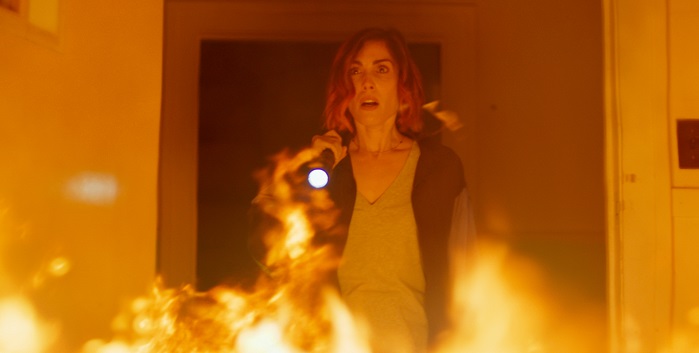
Unfortunately “Demonic” ends up being a dry and toothless horror experience; one that’s never as captivating as it could be or as chilling as it needs to be. The mostly scare-free story introduces plenty of fun and crazy ideas, but it never fully embraces the sheer nuttiness that it teases. So we end up with a movie that can’t quite muster the frights and that isn’t willing to let loose and go full gonzo.
The story centers around Carly (Carly Pope), a woman haunted by nightmares of her incarcerated mother Angela (Nathalie Boltt) who she hasn’t spoken to in nearly two decades. Out of the blue, Carly is contacted by her former best friend Martin (Chris William Martin) who wants to meet up. Martin is a bit of a crackpot; the kind of guy who pushes all kinds of nutty conspiracies. He reveals to Carly that her estranged mother is in a coma and is part of an experimental study ran by a medical company called Therapol. Carly visits the company where an ambiguous “physician” named Michael (Micheal J. Rogers) and the head researcher Daniel (Terry Chen) let her in on the cutting-edge work they’re doing.
It turns out Therapol has developed a technology that allows them to enter a comatose person’s subconscious and communicate with them. During their recent simulations, Angela has been calling for her daughter. So they convince Carly to let them send her into Angela’s mind where she quickly learns that it may not be her tortured mom doing the calling. It might be something demonic.
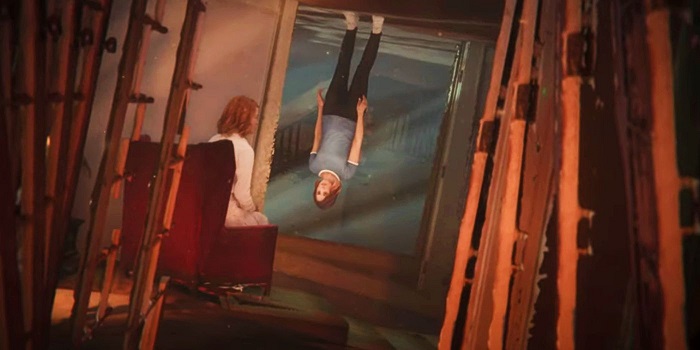
The film’s budget constraints are hard to miss both inside and outside of the simulation. It’s especially noticeable in the final act. Aside from some clever lighting, we’re ushered through the surprisingly unremarkable finale without a single eye-catching visual touches to speak of. It’s much the same with the fizzling story as Blomkamp tries to bring everything to an exciting crescendo but instead lands it with an uneventful thud.
So what we’re left with is a bewildering movie – one with demons and possessions but not a scare to be found. One with goofy stuff like militarized Catholic exorcism squads and an ancient weapon called “The Holy Lance” yet it can’t squeeze out a single laugh. It’s really a shame because “Demonic” is the kind of movie you want to root for – a small independent film made outside of the big studio machine. But there is only so much you can look past and “Demonic” never delivers on its early promises. “Demonic” is in select theaters now.
VERDICT – 1.5 STARS