

There was a time when the inspirational new teacher trope found its way into a lot of movies. “Stand and Deliver”, “Lean on Me”, “Mr. Holland’s Opus”, “Dangerous Minds” are all films that came out within the same window. Add to that group Peter Weir’s “Dead Poets Society”, an Oscar-winning drama about self-discovery, free-thinking, and the unfortunate costs that sometimes comes with them.
The story comes from screenwriter Tom Schulman and earned him the Best Original Screenplay Oscar. It’s set in 1959 Vermont at the fictional Welton Academy, a prestigious private prep school for boys. The film stars a restrained Robin Williams (who nabbed an Oscar nomination) and a cast of relative newcomers, most notably a young, baby-faced Ethan Hawke.
Williams gets top billing playing John Keating, the academy’s charismatic new literature teacher and a Welton graduate himself. His eccentric nature and unorthodox teaching grabs the attention of his students (and a few faculty heads). Rapid quoting Whitman, Tennyson, and Thoreau. Holding class in the hallways, the courtyard, or on a soccer field. Urging the boys to focus on feeling rather than form. Keating’s methods invigorate his students while rubbing some of his colleagues the wrong way.
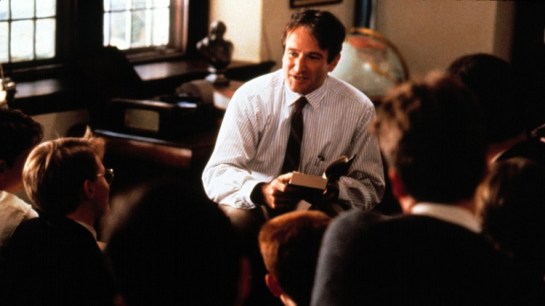
Photo Courtesy Buena Vista Pictures
While Williams is the bigger name, the movie is really about the boys and their thirst for individuality. Mr. Keating may trumpet the mantra “carpe diem: seize the day”, but it’s the boys search for its meaning that drives the story forward. For Todd (Hawke) it’s in finding his voice. For Knox (Josh Charles) it’s in winning the heart of a local girl. For Neil (Robert Sean Leonard) it’s in following his own dream and not the one defined for him by his rigid authoritarian father (Kurtwood Smith).
The boys learn that Mr. Keating was a bit of a free spirit during his student days and was a member of the Dead Poets Society. It was a clandestine club that met in a cave just off campus where members would take turns reading excepts from classic poets. Using Thoreau, Mr. Keating described it as a bunch of romantics “Sucking the marrow out of life“. Naturally the boys put together their own secret version of the Dead Poets Society. But poetry soon takes a back seat to newfound self-expression and their budding desires to take life by the horns.
The acting is delightful throughout, especially from Williams who puts aside his frantic, quip-a-second routine for a much more contained performance. He quietly embodies a character full of empathy and compassion. The one shortcoming is that he is essentially a blank page outside of the classroom. Schulman’s script doesn’t seem as interested in him as Weir’s camera so we’re left with only tidbits of information about who he really is. But it reenforces that the story is truly about his students.
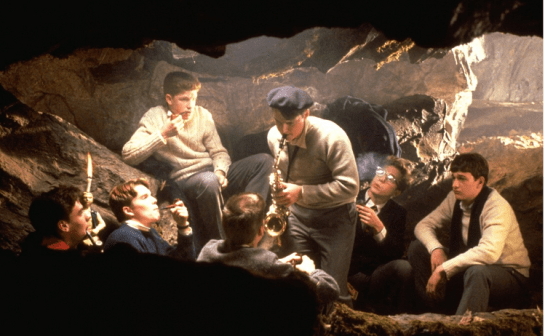
Photo Courtesy Buena Vista Pictures
Hawke is fun to rewatch especially in 2020 now that he is an established star. In “Dead Poets” you can see an up-and-comer with some real chops. But I was just as impressed with the other young actors who mostly avoid the pitfalls that often accompany these roles. Leonard is especially strong, playing the character with the most complexity and layers. Neil is the definition of the dutiful son, inescapably tethered to his father’s strict vision for the future. Leonard really sells us a young man repressed and pained despite his happy facade.
Weir and his cinematographer John Seale use their camera to portray a stuffy, buttoned up New England campus but a beautiful one nonetheless. There is an ever-present taste of autumn as golden leaves tumble across the sidewalks and the gorgeous stone masonwork feels plucked out of time. But there are also those Weir flourishes like the stunning wide shots of the boys, barely more than silhouettes, heading off to their secret cave. Or when his camera spirals up a staircase as noisy students cascade down.
There’s a good chance “Dead Poets Society” won’t satisfy those looking for a deeper dive into poetry or a more in-depth representation of classroom education. But that’s not what Weir and company are going for. This is about seven boys coming of age just as the world is about to get a lot more complicated. Yes things start to get a little predictable and I do wish Mr. Keating had more outside-the-classroom depth. But for the most part “Dead Poets” hits its target and it still leaves an impression some twenty-five years since I last saw it.
VERDICT – 4 STARS













 Keith & the Movies