It’s always nice when Netflix surprises you with something you weren’t expecting. Such is the case with the Sam Raimi produced “Don’t Move”, the platform’s recently released feature, co-directed by Adam Schindler and Brian Netto and co-written by TJ Cimfel and David White. Set mostly in the California wilderness, “Don’t Move” meshes together psychological and survival elements into a taut and high-stakes thriller.
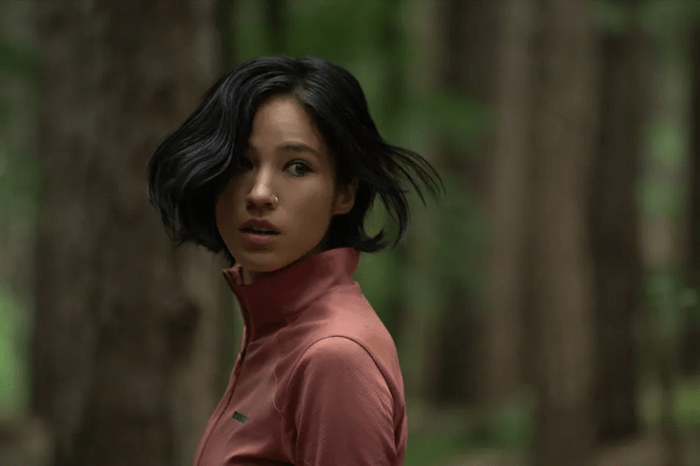
Kelsey Asbille (“Yellowstone”) plays Iris, a grieving young mother who recently lost her son Mateo in a tragic hiking accident. One morning she wakes up and slips away into the California mountains to the site of her son’s death with the intent of taking her own life. But while there she’s surprised by a stranger named Richard (Finn Wittrock) who quite literally talks her off a ledge.
Image Courtesy of Netflix
But Richard’s kindness turns to malice after he suddenly attacks and injects Iris with a strong paralytic. He informs her that her body will quickly shut down and she’ll be temporarily paralyzed. But Iris is able to escape through the woods with Richard leisurely following behind. But the farther she goes the more she begins to lose her body’s functions which sets up a key part of the movie’s suspense. How does she survive all alone, off the grid, and with no use of her body?
Asbille gets a role that’s light on dialogue, but she does a stellar job selling Iris’ dread through her physicality and ability to express. Meanwhile Wittrock is convincing as a misogynistic charmer who’s barely able to conceal his sociopathic desires. A couple of well-acted side characters (played by Moray Treadwell and Daniel Francis respectively) pop up mainly to help ratchet up the tension and build Richard’s cold-blooded pathology.
Handsomely shot by cinematographer Zach Kuperstein, propulsively directed by Schindler and Netto, and fiercely acted by Asbille and Wittrock, “Don’t Move” makes for a thoroughly satisfying watch-at-home escape. Its simple and straightforward story arc follows a fairly obvious course so it’s easy to guess where it’s going. But there’s enough along the way to keep you on the edge of your seat and glued to the screen. “Don’t Move” is now streaming on Netflix.
On the surface, “Die Alone” has all the markings of a standard-issue zombie flick: a deadly virus, a global outbreak, a society in ruin, the dead coming back to life as ravenous flesh-eaters. But “Die Alone” is a different kind of zombie movie. Yes, it proudly embraces a number of familiar horror sub-genre tropes. But it puts its own spin on them resulting in a surprisingly fresh and creative feature.
In unveiling his earthen dystopia, Canadian writer-director Lowell Dean reveals many facets of his world that sparks our interest, yet he intentionally keeps several things vague. Beyond that, he does what many before him have done. Dean focuses on the living people in his world more than the walking dead. It’s those people who prove to be the rays of hope and the most ominous threats.
Image Courtesy of Quiver Distribution
In “Die Alone”, the planet has been decimated by a plant-based virus. It not only kills those infected but reanimates them into deadly flesh-munching zombies who over time become more plant than people. We never get a full explanation of the virus, what caused it, or if there is any sign of a cure. But Dean does throw in some compelling hints in the form of conspiracy theories and hypotheses. One idea is that it’s nature purging itself of the destructive parasite known as mankind.
It’s in this world that we meet Ethan (Douglas Smith) and his girlfriend Emma (Kimberly-Sue Murray) who are driving to their remote lakeside cabin in hopes of waiting out the global catastrophe. But on their way they have a violent car wreck. When Ethan wakes up he discovers Emma is gone. Blood stains show signs of injury, but she’s nowhere to be found. So the injured yet determined Ethan sets out to find her.
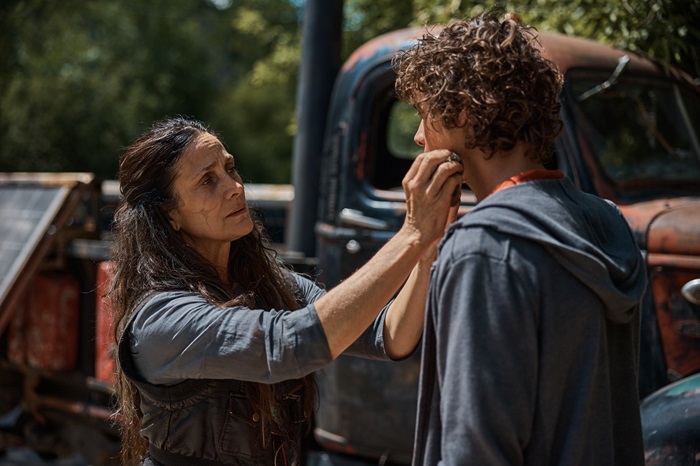
As Ethan searches the husk of a vacant town, he’s attacked by a group of armed ruffians. But he’s saved by a mysterious survivor named Mae (a terrific Carrie-Anne Moss) who takes him to her remote farmhouse. It’s revealed than Ethan has amnesia and struggles to remember anything other than the car crash and Emma. He’s haunted by fragmented memories of her that compels him to continue his search. But Mae seems determined to keep him from leaving.
Image Courtesy of Quiver Distribution
As the story progresses is becomes clearer that “Die Alone” has interests that extend beyond the normal zombie fare. Dean uses the cryptic relationship between the younger addled Ethan and the older enigmatic Mae to dig into some of his meatier themes (I’ll let you discover them in order to avoid spoilers). Along the way they encounter a number of people who help define their relationship including a band of dubious drifters, a single mother and her son, and even Frank Grillo playing a protective husband and father.
“Die Alone” steadily builds itself towards a walloping twist that immediately encourages a second viewing. It’s a turn that causes us to reevaluate much of what we have seen and heard while sending the film towards an unexpected conclusion. And that’s what makes “Die Alone” stand out. It may seem somewhat conventional at first, but Dean patiently begins to chip away at our expectations before landing his refreshingly subversive ending. “Die Alone” is now available on VOD.
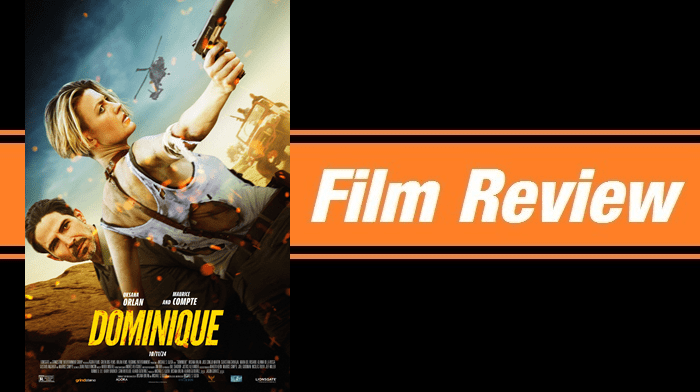
Oksana Orlan cements herself as an action movie force of nature in “Dominique”, a ferocious pulse-pounding thrill ride that sees her reteaming with director Michael S. Ojeda. The two previously worked together on the 2018 horror thriller “The Russian Bride”. Their latest collaboration is a pure action spectacle, shaped by Ojeda’s assured style and driven by Orlan’s steely charisma and commanding presence.
Written, directed, and edited by Ojeda, “Dominique” takes a fairly familiar formula and energizes it with its reverence for its setting, the power of its performances, and its ruthless willingness to push the envelope. While the action is undoubtedly the main course, Ojeda puts time and effort into establishing relationships which raise the stakes, especially in the film’s unflinching final act.
Image Courtesy of Lionsgate
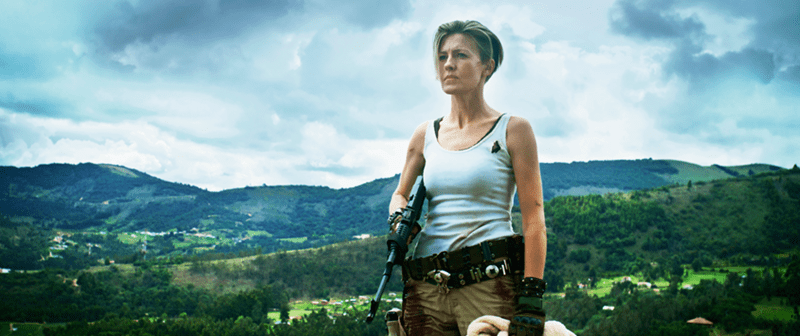
Orlan plays the title character, Dominique, a hardened Ukrainian assassin attempting to flee her violent past. Her hopes are to begin a new life off the radar in South America. But while flying over Columbia’s La Guajira desert, her plane is shot down by the local De La Cruz cartel. After crash landing and offing some gun-toting thugs, Orlan travels to the small town of San Lucas where she meets a kindly local named Julio (Sebastian Carvajal).
Julio has looked after his pregnant sister Paulina (Maria del Rosario) and her three children since her husband tragically died of heart attack. He’s also a San Lucas police officer working under the brutally sadistic Chief Santiago (Maurice Compte). Santiago is on the payroll of the cartel and has terrorized the city at the behest of the gang’s matriarch, Gabriela de la Cruz (Marcela Benjumea). Sickened by the department’s savagery, the upright Julio notifies internal affairs to help bring the murderous Santiago to justice.
Julio and his family give Dominique a place to stay until she can secure some wheels which allows Ojeda the time to establish these characters and their circumstances. It’s a crucial ingredient for the story. The kind and hospitable family are fascinated by this statuesque and stoic “gringa”. Meanwhile, despite her best efforts, Dominique develops an attachment to her welcoming hosts. And that puts her on a collision course with Santiago who puts the family in his crosshairs after discovering Julio is working undercover.
Image Courtesy of Lionsgate
Ojeda pulls no punches in depicting Santiago’s brutality, revealing a man who will stop at nothing to get what he wants. That realization sets up a jolting mid-point twist that forces Dominique to make a difficult decision. Does she take off before things heat up or does she stay and defend this vulnerable family. You probably know the answer.
The action that follows is kinetic and at times harrowing as Orlan unleashes her fierce physicality to go along with her steel-plated intensity. In many ways her character fits the common one-man-army stereotype. But the actress gives us just enough of a glimpse inside of Dominique’s tough exterior to make her more than a copy-and-paste protagonist. Overall “Dominique” is a terrific showcase for Orlan, from its furious opening to its a bold and gutsy finish. “Dominique” is out now on VOD.
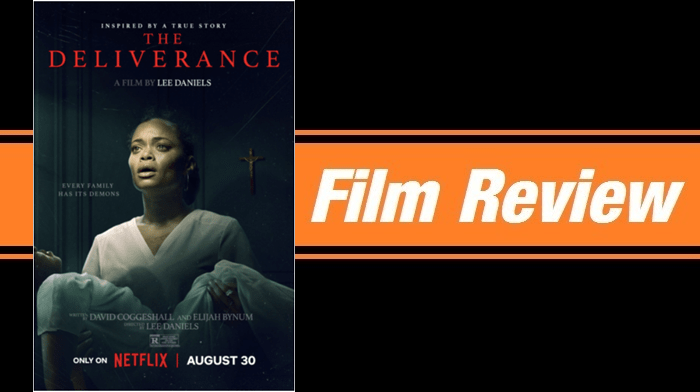
Looking for a much-needed fresh start, a struggling single mother named Ebony Jackson (Andra Day) moves her three children to a new house in Pittsburgh. That opens up the story of “The Deliverance”, the latest film from director Lee Daniels that happens to be one of most baffling movies of the year. What starts out as a sincere dysfunctional family drama turns into a hokey supernatural horror thriller that erodes any chance of us taking it seriously.
The film is based on the real-life case of LaToya Ammons, an Indiana mother who claimed her house was haunted by demonic spirits who eventually possessed her children. Mercifully, that messy element of the story doesn’t kick into gear until the final act. We get several supernatural hints sprinkled throughout, but the bulk of the movie focuses on the family as they attempt to navigate their domestic conflicts and social challenges. That’s when “The Deliverance” is at its best.
Image Courtesy of Netflix
A solid cast brings the movie credibility. Andra Day plays Ebony, a well-meaning but troubled single mother whose life is a reflection of her own violent childhood. She recently moved into a house in Pittsburgh with her oldest son Nate (Caleb McLaughlin), middle daughter Shante (Demi Singleton), and youngest child Andre (Anthony B. Jenkins). Ebony’s struggle with her past unfortunately manifests itself in her own abuse against her children. And her resurfacing alcoholism only makes things worse.
Ebony’s overbearing mother Alberta (Glen Close) agrees to move in and help with the kids which adds a whole new layer to the story. To make things more stressful, they’re constantly under watch by the state and paid visits by a dogged social worker named Cynthia (Mo’Nique). Nate is routinely roughed up by a neighborhood bully, Shante desperately misses her father, and Andre is his happiest hanging out with his imaginary friend Trey. That’s a lot of drama, but through it Daniels, along with co-writers David Coggeshall and Elijah Bynum, give us a grounded portrait of a family in crisis.
Image Courtesy of Netflix
But looming is the story’s unfortunate horror component. It starts with strange odors from the basement and buzzing flies around its door. We get the usual loud bangs and doors mysteriously opening. Then there is Andre’s peculiar behavior including his concerning conversations with Trey. And what’s with the strange woman (Aunjanue Ellis-Taylor) who keeps showing up outside their house?
It all culminates in a trope-riddled final act that goes full Exorcist mode. Ebony faces demonic voices, body contortions, levitations, and even a stigmata as her motherly instincts kick in and she fights for the souls of her children. There seems to be some admirable allegorical intent. Sadly it’s all but lost as the movie turns into a generic copy-and-paste possession flick. The final 30 minutes end up clashing with nearly everything that came before it while wasting a fierce performance from Andra Day along the way. “The Deliverance” premieres on Netflix August 30th.
Filmland is the Arkansas Cinema Society’s curated celebration of local, national, and international cinema. In it’s seven year history, the annual event has hosted an impressive array of industry guests that includes Richard Linklater, Jessica Chastain, Adam Driver, Michael Shannon, Joel Edgerton, Chloé Zhao, Will Forte, and many others. Filmland 2024 is no different.
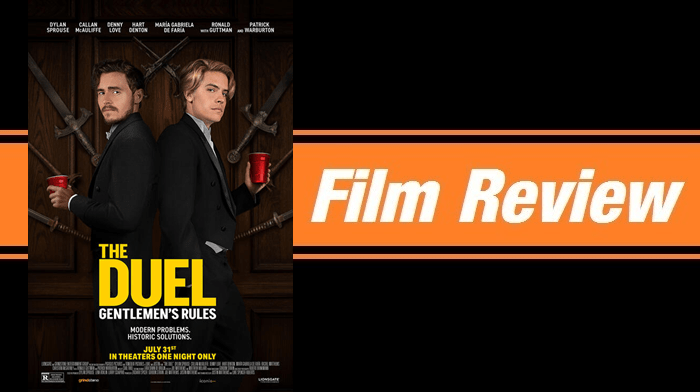
This year’s festivities kicked off with a special screening of “The Duel”, the debut feature film from co-directors Luke Spencer Roberts and Justin Matthews. This uneven yet somewhat contagious dark comedy stars Dylan Sprouse and Callan McAuliffe as former best friends who decide to resolve their differences the way most of us would – with an old-fashioned duel, complete with vintage pistols, ten paces, the works.
Taken as a whole, “The Duel” is a mishmash of ideas, several of which work well and others that don’t. It’s as if you plucked ingredients from “The Hangover”, “A Midsummer Night’s Dream”, and Ridley Scott’s “The Duellists” and threw them into a pot. Unfortunately some of those ingredients overpower the others. In this case it’s the film’s crude buddy comedy aspirations. If you plow down deep enough you’ll find what resembles a thematic core. But it’s buried under banter and antics that only seem there to get an R rating.
Roberts and Matthews don’t waste much time kicking things off. We learn that Colin (Sprouse) and Woody (McAuliffe) were once best of friends. But that changed when Colin secretly started sleeping with Woody’s girlfriend. To pay his ex-friend back, Woody took Colin’s cherished surfboard, the last thing made for him by his late father, and burned it. With no hopes of reconciliation, the two decide to handle things the gentlemanly way – with a duel.
In case you’re wondering, the movie is indeed set in our current day which makes the film’s premise even more outlandish. But that’s also one of the movie’s strengths. It’s completely aware of how silly it is and everyone involved is in on the joke. That doesn’t mean all the humor works (more on that in a second), but it makes the absurdity not only easier to digest but also easier to embrace.
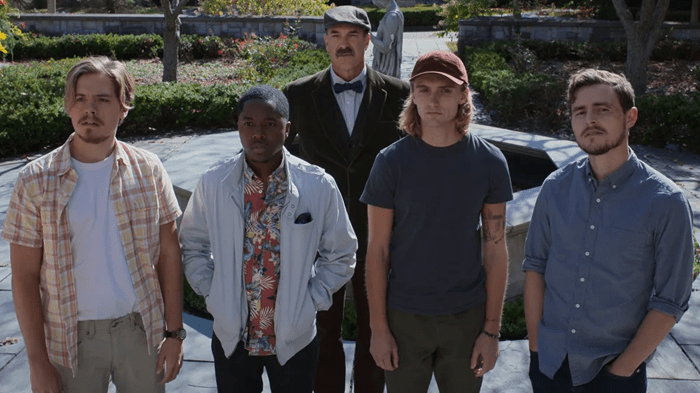
Stuck with the two friends-turned-enemies are their other pals, Kevin (Hart Denton) and Sam (Denny Love). Both have taken different sides in the dispute but agree that Colin and Woody are taking things too far. So they tag along like good movie sidekicks as their stubbornly furious friends meet with the mysterious Christof (a scene-stealing Patrick Warburton) who looks, speaks, and acts as if he stepped out of a time machine.
Christoff is a seller of antiquities who not-so-secretly moonlights as an organizer of one-on-one duels. He immediately begins laying out the rules which includes the proper way of challenging, maintaining gentlemanly behavior, and choosing your “Field of Honor” (aka where to duel will take place). That last rule falls on Kevin and Sam for no plausible reason other than to give the characters something to do.
Kevin and Sam have a chance meeting with a coked-up Joey (Christian McGaffney) who connects them to Rudolpho (Ronald Guttman), a wealthy drug baron and duel enthusiast in Mexico. Rudolpho invites the uncouth foursome and Christoff to use his lavish estate for their showdown. They agree, but before any shooting is done there has to be a time of reflection, a big feast, and several other time-spenders meant to give characters opportunities to hammer things out.
The woman in the middle is Abbie (Rachel Matthews). She would have been a welcomed addition to the story if she had been given anything resembling a character arc. Instead Abbie is never seen until later. She pops up at Rudopho’s mansion to give a number of stilted speeches in an effort to talk some sense into her two battling beaus. She’s obviously right about what they’re doing, but her sudden moral clarity rings hollow because we haven’t had any time with her.
To Rogers and Matthews’ credit, “The Duel” wraps up with a gutsy finish that’s also the only way it could end without selling out. And it’s an ending that comes closest to hitting home the film’s deeper theme. The performances are roundly solid and there are funny lines scattered all through it. But certain characters make no sense outside of serving up punchlines. And the film’s fixation on earning an R rating robs it of time and attention that could have been better spent. “The Duel” is available now on VOD.
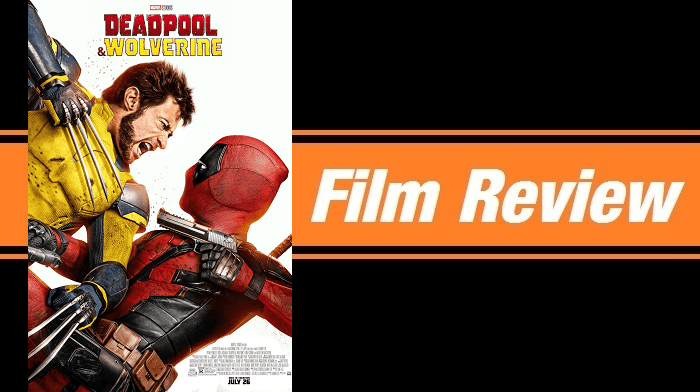
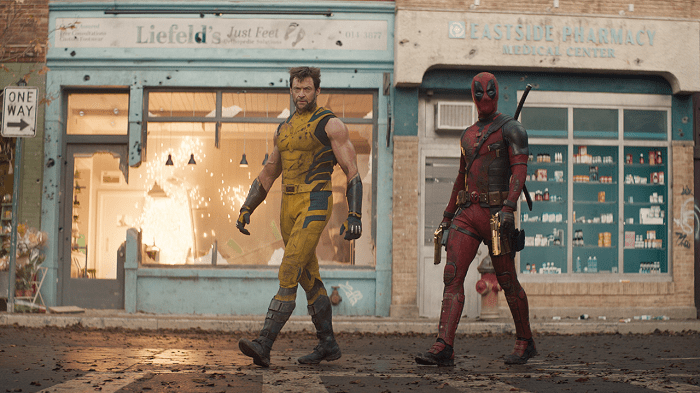
By all indications “Deadpool & Wolverine” looks to be the massive moneymaking blockbuster the laboring Marvel Cinematic Universe desperately needs. After a run of big budget flops in theaters and on streaming, Kevin Feige and Disney have looked to a movie that caters to the easiest targets. And from the looks of things their not-so-risky “gamble” is about to pay huge dividends.
“Deadpool & Wolverine” is a movie filled to the brim with fan service which it uses, along with an assortment of gimmicks, to draw in a variety of fans. There are those who love Ryan Reynolds’ schtick. They get plenty of it here. There are others who are giddy for more R-rated superhero movies. This one works REALLY hard to earn its R rating. And of course there is the ultimate act of fan service – paying Hugh Jackman a boatload of money to return as Wolverine. But that only scratches the surface of this movie’s pandering for reactions.
I’m not knocking anyone who is drawn to those things. But for me, Reynolds’ routine can be exhausting and a little of it goes a long way. And I don’t think I’ve ever rooted for a movie to have a specific rating (whatever fits the film). But since its beginning, many have embraced the Deadpool series for its R rating as much as anything else. As for Wolverine, Jackman’s character arc reached a perfect conclusion in 2017’s “Logan”. Yet the MCU creatives play the cheap multiverse card to bring him back (and more importantly, to sell more tickets).
Then there’s Deadpool. I’ll always prefer the early version of the character that existed before Marvel Comics started using the crutch of “mature content” to sell his books. The movies have leaned heavily into the ultra-silly and endlessly foul-mouthed version and it’s no different in “Deadpool & Wolverine”. New director Shawn Levy (who recently worked with Reynolds on “Free Guy” and “The Adam Project”) teams up with a total of five (!!!) screenwriters. What they give us is a series of Deadpool skits, stitched together by yet another bad MCU story.
Image Courtesy of Walt Disney Studios
From the very beginning the filmmakers go for the nostalgia jugular, hitting us with endless waves of meta gags, surprise appearances, and absurd needle-drops. There are countless callbacks to Fox’s Marvelera. And of course it spends a ton of time lampooning superheroes, superhero movies, and pretty much anything else that comes to mind. In essence it’s the same Deadpool movie formula, only cranked up to 11 and now with MCU baggage to lug around.
Yes, Deadpool is now part of the MCU, grafted in through yet another multiverse convenience. I have no idea how such an exaggerated and self-aware character will fit with the other Marvel films. But since “Avengers: Endgame”, I’m not sure the MCU heads have put much thought into things like continuity or cohesion. And as this movie proves, there’s not much interest in plot either.
Good storytelling was never a strength of the first two Deadpool movies. But there was a semi-intimacy between Wade Wilson and his friends that at least kept their stories focused. “Deadpool & Wolverine” is hampered by one of the laziest scripts I’ve seen in a superhero movie. So much of the story feels patched together. Things routinely happen with no real explanation, and the quintet of writers seem perfectly content with skating by on comic mayhem and the buddy chemistry between Reynolds and Jackman.
After a silly but funny opening credits scene, Levy waste no time throwing us into Marvel’s multiverse, almost immediately bogging the movie down with vaguely defined and uninteresting mumbo-jumbo about the Sacred Timeline, plot contrivances such as “anchor beings” and a contraption called the “Time Ripper”, and so on. It’s almost as if there are two movies fighting for time – an obsessively bloody and vulgar Deadpool rehash and another messy MCU post-“Endgame” misfire.
Image Courtesy of Walt Disney Studios
While celebrating his birthday with his friends, Wade Wilson (Reynolds) is apprehended by the Time Variance Authority (TVA) who take him to their leader, Mr. Paradox (Matthew Macfadyen). Paradox informs Wade that his timeline is rapidly deteriorating. Why is it deteriorating you ask? Because the timeline’s “anchor being” has died and apparently timelines die as a result (don’t ask any questions because the movie doesn’t offer many answers). It turns out that the “anchor being” who died from Wade’s timeline was Logan aka Wolverine.
Desperate to save his friends, Wade swipes a gadget that lets him travel the multiverse. His plan: find and retrieve a suitable replacement Logan from another timeline and bring him back to his world. He settles for a grizzled drunken Wolverine (Jackman) and returns to the TVA only to discover that he has broken a few rules. As a result, Paradox (who has nefarious yet paper-thin plans of his own) banishes them to a place called the Void. Once there, Wade and Logan fight, we get some cameos, they fight again, we get more cameos, and so on.
This time around, Reynolds pushes his wisecracking semi-sociopathic anti-hero farther, mechanically churning out one-liners and on-the-nose profanity in nearly every breath. Jackman falls in line. Chiseled, moody, and forced to drop f-bombs on cue, he brings a certain grit and gravitas the movie needs. It’s too bad he spends so much time being the straight man to the scene-gorging Reynolds. Even worse, it’s tough to see the supporting cast from the previous Deadpool films relegated to the sidelines – replaced by attention-getting cameos and new less interesting characters.
We do get one particularly fun surprise appearance, a couple of good though nonsensical action sequences, and occasionally a joke will hit its mark. But much of it starts to feel like recycled material. Meanwhile the story is clearly a secondary concern. We get no menacing villains, absolutely no suspense, scenes of boring exposition that don’t say much, and plot holes that are impossible to miss for anyone slightly looking. It eventually leaves “Deadpool & Wolverine” resembling a fan service cash grab from a cinematic universe in desperate need of a big box office hit. Well, it looks like Disney has one.















 Keith & the Movies