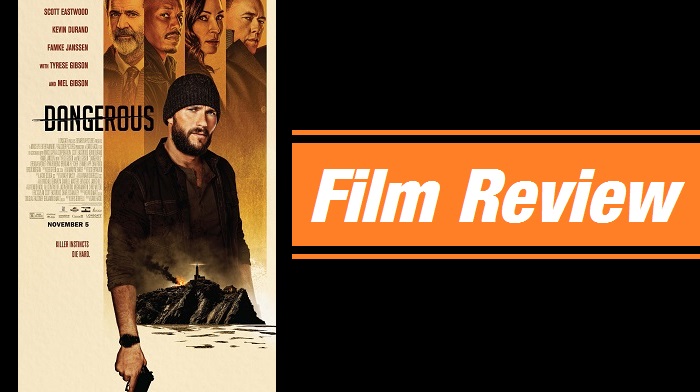
Production designer turned director David Hackl helms the new film “Dangerous”, a kooky action thriller that starts with some real promise. But the story (written by Chris Borrelli) quickly comes unglued and ventures into territory too silly to take seriously. It takes an appealing cast and gives them unappealing characters, leaving them with the unenviable task of moving the audience to actually care about what we’re seeing. Sadly, we never do.
Scott Eastwood plays Dylan Forrester, a former Navy SEAL on parole for murder. He’s also a sociopath who pops lithium like TicTacs and frequently calls his lush of a therapist Dr. Alderwood (Mel Gibson) to talk him through his unwholesome urges. Eastwood borrows his legendary father’s cold and terse screen delivery to portray a character unable to feel emotion or have empathy. And while his meds keep his impulses (mostly) under control, Dylan’s non-existent social skills stick out like a sore thumb during any conversation.
The story is one that hinges on a number of contrivances. It gets underway after Dylan learns his brother Sean, who was opening a bed-and-breakfast on Guardian Island off the coast of Washington, has died. Supposedly it was the result of an accident on some scaffolding, but an unwelcome visitor to Dylan’s apartment says otherwise. So he breaks parole and heads to his brother’s place to pay his respects.
Image Courtesy of Lionsgate
Dylan arrives at his Sean’s wake and is immediately greeted by his estranged mother Linda (Brenda Bazinet), a toxic one-note curmudgeon who’s quick to share her disdain for her living son while praising her saintly dead one. A cautious but more hospitable Susan (Leanne Lapp), Sean’s wife, breaks the ice by welcoming Dylan as does her son Freddy (Atlee Smallman). Also at the wake is Sean’s old college buddy Massey (Brendan Fletcher) and the scowling super-serious Sheriff McCoy (Tyrese Gibson in a glorified cameo).
But if family tension wasn’t enough, a well-armed mercenary named Cole (Kevin Durand) and his generic goon squad arrives on the island and lays siege on Sean’s B&B. There’s something in the house that he wants, but no one seems to know what it is. Meanwhile FBI Special Agent Shaughnessy (played by a seemingly uninterested Famke Janssen) tracks the parole-hopping Dylan to Guardian Island. It all leads to a predictable showdown where the gunplay (much like the eventual revelations) is as underwhelming as it is uninspired.
Eastwood does what he can with a role that more or less demands a cold detached performance. Mel Gibson steals a handful of scenes while Durand hams it up as the film’s bland baddie. Janssen seems as bored as we are and Tyrese Gibson isn’t on screen long enough to leave an impression. In other words, a nice cast gets lost in a movie that feature more cliches than thrills. I do think there’s a way to turn this fairly conventional idea into something fun and entertaining. But what we get with “Dangerous” ends up being the exact opposite. “Dangerous” is now available on VOD.
It’s hard not to be excited for a Denis Villeneuve movie. The French Canadian director, screenwriter, and producer has such a compelling filmography. I was introduced to Villeneuve via his 2010 Oscar nominated drama “Incendies”. But it’s his terrific run since then that has turned me into a bonafide fan. I enjoyed both “Prisoners” and “Enemy”. His 2015 border thriller “Sicario” may be my favorite film of his to date. “Arrival” was my #1 movie of 2016 while 2017’s “Blade Runner 2049” was a gutsy and heady sequel to a 1982 sci-fi classic.
It almost feels like a natural progression for Villeneuve’s next film to be his biggest and most audacious project to date. “Dune” is certainly that. This massive sprawling science-fiction epic is the first film in a two-part adaptation of Frank Herbert’s 1965 cult novel of the same name. Packing a hefty budget and a star-studded cast, “Dune” is a herculean undertaking brimming with ambition and made with the unquenchable passion of a filmmaker who has called this his “longstanding dream“.
There are a number of ways that a project of this size and scope could have gone awry. But Villenueve is a savvy filmmaker with a dedicated vision. I’ve seen “Dune” multiple times now, and I can honestly say that I’m struggling to find a single bad filmmaking decision anywhere in his movie. Bold statement, I know.
Image Courtesy of Warner Bros.
I suppose you could pick on the exposition in the first half, the film’s overall deliberate pacing, or the ending which is more of a stop than an actually finish. But easy defenses could be made for each of those “issues”. The exposition is hardly intrusive and actually feels warranted. Villeneuve’s patience proves to be a real asset, giving the story and the characters the room they need to breathe. It also provides Villeneuve the space to show off the film’s biggest strength – the extraordinary world-building (more on that later). And the ending is simply a byproduct of the right decision to make this a two-parter.
Without question, it was the right choice to break this up into two movies. This film literally starts with the “Part One” tag and ends around the halfway mark of the “Dune” story. As mentioned above, this benefits the film greatly because it allows the right amount of time for us to be immersed into this striking and complex world. And it allows Villeneuve (who co-wrote the script with Jon Spaihts and Eric Roth) to acquaint us the many political, ecological, and societal intricacies that help give the story depth.
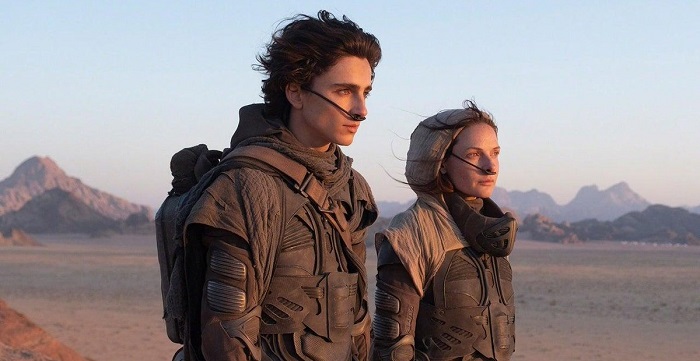
Set in the very distant future of 10191, “Dune” tells the story of young Paul (Timothée Chalamet), the gifted son of Duke Leto (Oscar Isaac), the leader of the powerful House Atreides. They live and rule on the planet Caladan where Paul, next in line to lead, is trained in combat by close friend and House Atreides warrior Duncan (Jason Momoa) and Leto’s top aide Gurney (Josh Brolin). His mother Jessica (Rebecca Ferguson), an acolyte of a mysterious sisterhood called the Bene Gesserit, teaches him the secrets of a mysterious inner power he possesses, a power that’s causing haunting dreams of a troubling future.
Meanwhile on the harsh desert planet of Arrakis, the brutal House Harkonnen, ran by the chillingly vile and grotesque Baron Vladimir Harkonnen (Stellan Skarsgård), have become obscenely rich controlling the planet’s production of a priceless mineral called Spice. The Harkonnens callously harvest the coveted natural resource, avoiding massive sandworms and persecuting the resilient indigenous clan known as the Fremen. Their leader is Stilgar (a solemn and reticent Javier Bardem) and also among their ranks is Chani (Zendaya), a young woman who has been appearing in Paul’s dreams.
Image Courtesy of Warner Bros.
After an imperial decree orders the Harkonnen off of Arrakis, the emperor grants stewardship of the planet to House Atreides. Suspicious of the mandate but loyal to the call, Leto accepts with hopes of forming an alliance with the native Fremen. That proves to be easier said than done. After 80 years of oppression, the Fremen are leery of any new offworlders. And can the Harkonnens be trusted to leave behind all the wealth and power found in the sands of Arrakis?
Ultimately the film very much belongs to Paul, a young man trying to find himself while being pulled in every direction. As Leto’s heir, everyone expects him to be next in line to lead House Atreides. Jessica’s sect (led by a wonderfully creepy Charlotte Rampling) hopes Paul is “the one” which they intend to use for their own cryptic purposes. And the Fremen, having heard of this messiah-like deliverer, wonder if Paul might be the fulfillment of that prophecy.
As Villeneuve patiently and methodically lays out his story, we’re struck by the surprising amount of narrative depth. Not only is “Dune” thematically rich, it’s filled with connected backstory. But to the screenwriting trio’s credit, they often (and smartly) allude to the lore rather than bury us in it. Yet there are still many layers to their story, and it’s impossible to narrow the film down to one single category. Of course it’s science fiction, but it’s also a coming-of-age story, a war movie, an anti-war movie, a sociopolitical parable. Another testament to the film’s richness.
But without question the movie’s biggest strength remains its world building. From the imaginative costumes to the jaw-dropping production design, Villeneuve and his talented team of creators have made a stunningly tactile world and every frame gives us something worthy to consume. Whether it’s the lush overcast Atreides homeworld with its vast waters and craggy coastlines or the stark yet gorgeous oceans of sand on Arrakis that look like golden brown meringue through DP Greig Fraser’s camera.
Image Courtesy of Warner Bros.
Interestingly, the technology of “Dune” leans more primitive than futuristic which helps the world feel rooted in our reality. There are no fancy LED panels and very little high-tech gadgetry. Even the structures convey this, often resembling old ruins rather than state-of-the-art facilities. The ships are massive and breathtaking spectacles yet designed with a cold austere simplicity. The machinery has a rusty industrial look and even the incredibly cool ornithopters (which resemble giant dragonflies) are a believable evolution of our standard helicopters.
To the performances, I admit to being a bit of a Chalamet skeptic. I’ve never thought he was a “bad” actor, just not up to the gushing hype that follows everything he does. Here he earns the praise he’s been getting. Chalamet brings a boyish petulance to Paul in the film’s early scenes, but over time convincingly turns his vulnerability to maturity. Isaac is fittingly stoic. Momoa is full of charisma. Brolin is stern and abrasive. Ferguson deftly manages the emotionally meatiest role. Skarsgård is devilishly menacing. Sharon Duncan-Brewster is mysterious yet exciting. Zendaya does fine with the few scenes she’s given.
I honestly didn’t know what to expect from “Dune”. I’ve never read Herbert’s book and I don’t remember a thing about David Lynch’s 1984 film. Perhaps that’s why “Dune” 2021 blew me away. From its opening shot to the final fade, I found myself enraptured and transported. Villeneuve’s captivating direction, Hans Zimmer’s brooding exotic score (one of his very best), the exquisite sound design, the visual feast that screams to be seen on the biggest screen possible. Together it all makes for a smart, evocative, and rousing experience that reminded me at every turn of why I love cinema. And this is just Part One of the story.
When most people hear the phrase ‘Spaghetti Western’ their minds automatically gravitate towards legendary Italian director Sergio Leone. It makes sense. In the mid-1960’s Leone changed the Western landscape with his trilogy of films starring a young Clint Eastwood – “A Fistful of Dollars”, “For A Few Dollars More”, and of course “The Good, the Bad and the Ugly”. In 1968 he would release his seminal work – the pioneering masterpiece “Once Upon a Time in the West”. Not only did Leone change the game, but he drew more eyes towards what would become known as the Spaghetti Western.
But Leone wasn’t the only Italian filmmaker who helped define the broad, stylish and violent sub-genre. Sergio Corbucci had already made several comedies and sword-and-sandal adventures before dipping his toes into Westerns. His first two ventures had a more traditional John Ford flavor. But then in 1966 along came “Django”, a Spaghetti Western through-and-through and the first of many Corbucci would make over the next several years.
“Django” checks most of the Spaghetti Western boxes with Corbucci adding a few extra marks of his own. The violence is a notch above even Leone’s movies. The line between good and evil is as muddy as the street in the film’s one-horse town. The lead character is aggressively antihero. Corbucci takes all of these elements plus some and weaves them throughout his gritty and often blood-soaked story.
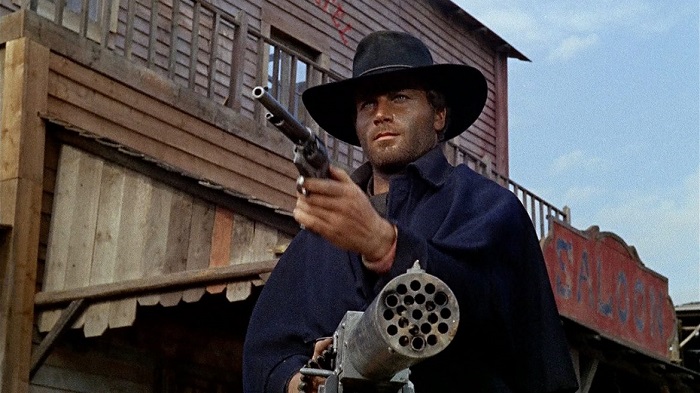
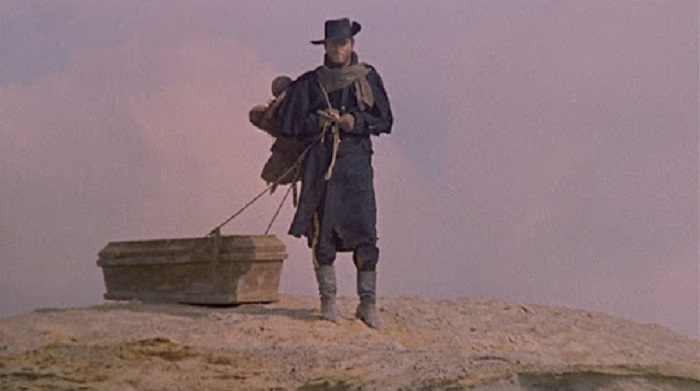
The movie follows a drifter named Django (played by Franco Nero) who roams the dry dusty borderland like a wandering spirit, draped in a fading Union army uniform and dragging a dusty wooden coffin behind him. The contents of his cargo is a mystery – is it full of gold, maybe guns, or is it the corpse of someone dear to him? Where is he coming from? Where is he going?
Django is the kind of character that the genre’s filmmakers would return to again and again – an unknown stranger with a fast draw who moseys into the mud-caked town with surreptitious intentions. Storywise Corbucci’s film falls in line with Akira Kurosawa’s “Yojimbo” and Leone’s “A Fistful of Dollars” but with its own notable twists. There’s a kind of pessimism that found its way into most of Corbucci’s spaghetti westerns including this one. There’s also the violence which at the time many felt was excessive. But it fits with the bleakness that Corbucci’s run of spaghettis would become known for.
There is also a colorful batch of characters who fill out Corbucci’s ugly world. There’s a prostitute named Maria (Loredana Nusciak) who Django uses to introduce himself into story. There’s the town’s slimy saloon-owner/pimp, Nathaniel (Ángel Álvarez). And of course there are the two battling bad guys, the racist ex-Confederate Major Jackson (Eduardo Fajardo) and Mexican General Hugo Rodriquez (José Bódalo).
Django puts himself right in the middle of Jackson and his henchman and Rodriguez and his bandits. His intentions are veiled but his presence is quickly noticed by the two sides. Again, it’s a familiar setup especially for fans of the aforementioned Kurosawa and Leone films. But Corbucci has enough of his own grit and verve to make his film stand out.
Many would later consider “Django” to be the first in what has been called Corbucci’s “Mud and Blood” trilogy. In terms of a direct sequel, there were over thirty unofficial movies that tried to copy and capitalize on the success of “Django”. But none included Corbucci or Nero. The only official sequel is 1987’s “Django Strikes Again”. Of course the influence of Corbucci’s original is still being felt (see Quentin Tarantino’s “Django Unchained”).
Some of the movie’s dialogue can be a little goofy and this particular English language dub is jarringly bad in spots. But if you’ve watched any number of spaghetti westerns you kinda expect that and it’s pretty easy to overlook. That’s mainly because Corbucci’s style and genre-rich direction gives the movie a kick that you don’t find in most studio Westerns. “Django” could be too much for traditionalists, but that’s exactly what will makes it so beloved by others.
The path to the big screen hasn’t been an easy one for “Dear Evan Hansen”, a film adaptation of the 2015 stage show by Benj Pasek and Justin Paul. The first trailer for this coming-of-age movie musical dropped back in May, and it only took a viral tweet or two for the film to become a social media punching bag. Much of the criticism centered around the choice to have Ben Platt reprise his Tony-winning role as the titular teen.
Let’s be honest, social media outrage isn’t the most reliable gauge. But in this case, Platt as a 17-year-old is a hard sell and slapping on pasty makeup and a plump crop of curly hair doesn’t help. But the whole age thing isn’t what makes “Dear Evan Hansen” a woefully misguided misfire. Its problems run a lot deeper.
The story kicks off with Platt’s Evan set to begin his senior year of high school. To help with his crippling anxiety, Evan’s therapist recommends that he start each day by writing a motivational letter to himself. “Dear Evan Hansen,” the letters begin. “Today’s going to be an amazing day and here’s why.”
Image Courtesy of Universal Pictures
The movie’s portrayal of mental health is hazy at best. Look no further than Evan himself who early on isn’t just socially awkward but almost nonfunctional. His inability to muster a single sentence to anyone other than his jerk of a “family friend” Jared (Nik Dodani ) hints at severe social anxiety. His several prescriptions point to depression. We even see evidence of possible autism. And then there is his childlike body language that comes across as paralyzing insecurity mixed with Platt’s exaggerated attempts to look younger.
The queasier stuff comes after his letter to himself is swiped by a bully and fellow outcast named Connor (Colton Ryan). A few days later Evan is summoned to the principal’s office where Connor’s parents, (Amy Adams and Danny Pino), inform him that their troubled son had committed suicide and they found Evan’s letter with him. They mistakingly take the letter as a sign that Connor actually had a close friend.
Evan tries to correct the grieving couple’s misunderstanding at first. But so hungry for human connection and with a particularly icky crush on Connor’s sister Zoe (a terrific Kaitlyn Dever), Evan turns the misunderstanding into a full-blown lie. Soon it takes on a life of its own as word of his fictional friendship gains him sympathy from his classmates. And after his speech/song at a school memorial service goes viral, Evan becomes a social media sensation.
The more devilish part of Evan’s ruse is in his scenes with the Murphy’s. At first he doesn’t have the heart to tell them the truth about their son. But he relishes their attention, the kind he doesn’t get at home from his hard-working and rarely present single mother (Julianne Moore). So he ingratiates himself with the family through bigger and more elaborate lies. Even worse is Evan’s manipulation of Zoe which makes him look like a creep despite the film’s efforts to paint him otherwise.
Image Courtesy of Universal Studios
Sprinkled in among all the weird and unsavory drama is a mixed bag of pop ballads from Pasek and Paul (the duo behind “La La Land” and ”The Greatest Showman”). None come close to being great, but among the better songs is the peppy opener “Waving Through a Window”, the mournful “Requiem”, and the crowd-pleasing “You Will Be Found”. But most of everything else is both dull and forgettable with a couple of songs even crossing the bounds of good taste.
You don’t have to look hard to see what ”Dear Evan Hansen” wants to be. You also don’t have to look hard to see the many ways it misses its mark. Some of its choices are baffling, such as the film’s willingness to use suicide as a plot device to move Evan’s story forward. Also the questionable ways it attempts to justify Evan’s deceit. And who thought stretching the runtime to 137 minutes was a good idea?
It all might work better if it was actually leading to something meatier. Instead the movie concludes with a toothless reckoning that ends up far tidier than it should. It only adds to the film’s nagging artificiality and makes the already shaky moral center even harder to digest. That’s especially frustrating considering the heavy topics it’s trying to deal with. The intentions are good and everyone’s heart is in the right place. But one too many missteps sink the film before it even gets started good. “Dear Evan Hansen” is out now in theaters.
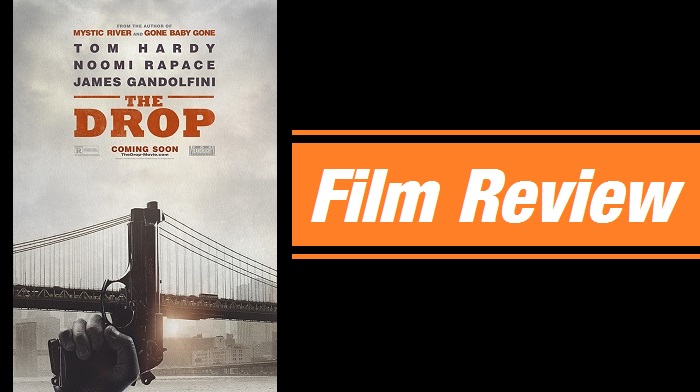
Tom Hardy has taken tough guy portrayals to new levels. Some actors naturally lean towards playing tough characters. It’s hard to see them as anything else. Hardy has that lean but he has managed to offer a number of cool variations. He has played a comic book villain, an MMA fighter, a moonshiner, and a Cold War Russian Agent just to name a few. In “The Drop” he gives us yet another bend to the tough guy character and just as before he does it exceptionally well.
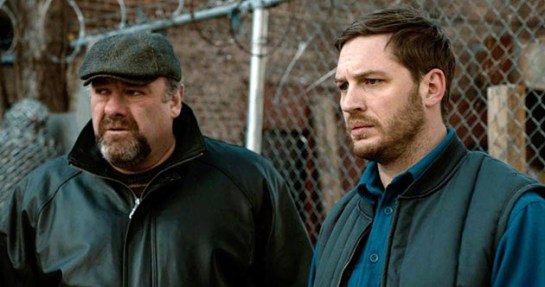
“The Drop” is a Brooklyn crime drama based on a Dennis Lehane short story. Lehane also wrote the screenplay with Michaël R. Roskam directing. Hardy plays a inner city bartender named Bob Saginowski. He works at “Cousin Marv’s”, a bar ran by his appropriately named cousin (played by James Gandolfini in his final role). Marv recently handed his bar to Chechen gangsters who now use it as a drop for money they have coming in.
At closing time two hoods rob the place at gunpoint stealing a load of the Chechen’s money. The gangsters hold Marv and Bob responsible leading them to desperately search for a way out of their predicament. Marv is bullish and old school in his approach to things while Bob is much quieter and a bit of an introvert. This effects how each go about handling what appears to be a dire situation.
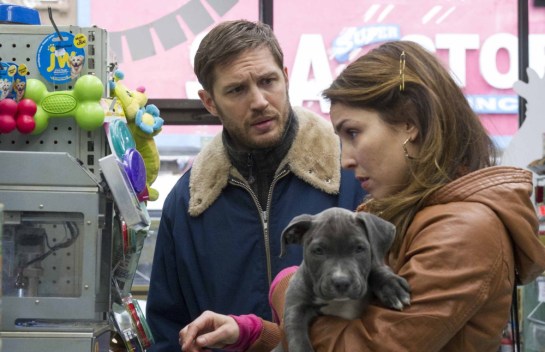
Bob is the main character and we learn a lot about him through a dog (of all things). He finds the abused pup in a trashcan belonging to a neighbor named Nadia (Noomi Rapace). The two spark a reluctant relationship which is complicated by her estranged thuggish boyfriend Eric (well played by Belgian actor Matthias Schoenaerts). The intensity ratchets up as Bob’s bar troubles and his relationship with Nadia come dangerously close to colliding.
Lehane’s script simmers and never allows the story to blow up into an everyday crime thriller. Roskam’s direction keeps thing under control and allows the script and the actors room to work among the seeping tension. I kept expecting it to turn towards the obvious and conventional. It never does. It’s surprisingly calculated and strategic in how it sets up and delivers its story points.
It also doesn’t hurt to have two superb lead performances. Hardy comes across as strikingly genuine and natural – a seamless and perfect fit for his character. Galdolfini’s work is a clear but sad reminder of his immense talents in front of the camera. His ability to absorb the audience in the complexities of his Marv character is a key to the film’s success.
It could be said that there is nothing particularly new or profound about “The Drop”. It’s hard to argue against that view. But at the same time it is a well-made film that may be small in cinematic stature but big in terms of smart and precise storytelling. Toss in a fine cast to help tell your story and the results are sure to be even more promising. Such is the case with “The Drop”.
South African filmmaker Neill Blomkamp made quite the memorable splash with his 2009 debut film “District 9”. The heady and perceptive sci-fi thriller set itself in an alternate 1982 and explored themes of xenophobia, class and income inequality. In addition to being a box office success, “District 9” was well-received by critics and it went on to earn four Academy Award nominations. His next two films weren’t quite as engaging, but both had big ideas to explore.
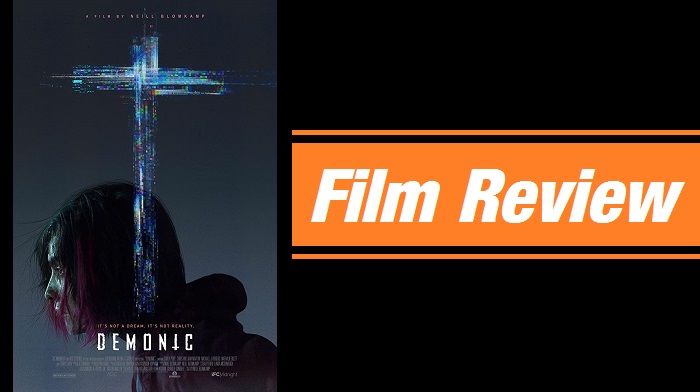
Now Blomkamp is back with “Demonic”, his first feature film in six years and one that sees him dipping his toes into a new genre. This low-budget and self-financed horror project was written in two months and shot over 24 days in the middle of the COVID-19 pandemic. You have to appreciate the filmmaker’s ambition in crafting his own unique vision and bringing it to life on screen.
Image Courtesy of IFC Films
Unfortunately “Demonic” ends up being a dry and toothless horror experience; one that’s never as captivating as it could be or as chilling as it needs to be. The mostly scare-free story introduces plenty of fun and crazy ideas, but it never fully embraces the sheer nuttiness that it teases. So we end up with a movie that can’t quite muster the frights and that isn’t willing to let loose and go full gonzo.
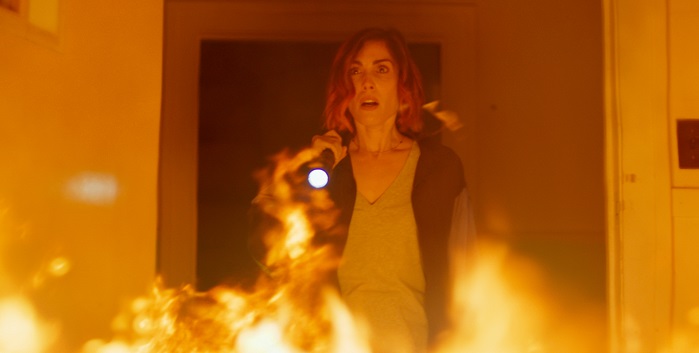
The story centers around Carly (Carly Pope), a woman haunted by nightmares of her incarcerated mother Angela (Nathalie Boltt) who she hasn’t spoken to in nearly two decades. Out of the blue, Carly is contacted by her former best friend Martin (Chris William Martin) who wants to meet up. Martin is a bit of a crackpot; the kind of guy who pushes all kinds of nutty conspiracies. He reveals to Carly that her estranged mother is in a coma and is part of an experimental study ran by a medical company called Therapol. Carly visits the company where an ambiguous “physician” named Michael (Micheal J. Rogers) and the head researcher Daniel (Terry Chen) let her in on the cutting-edge work they’re doing.
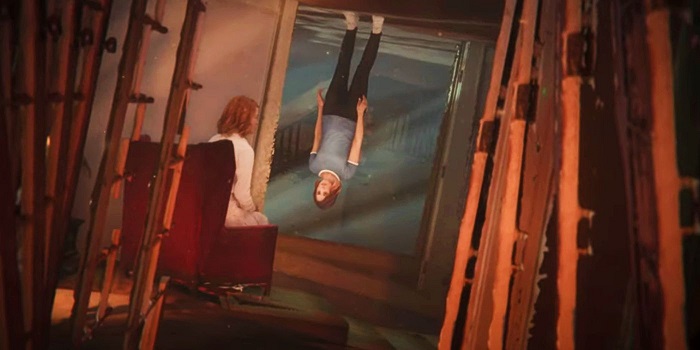
It turns out Therapol has developed a technology that allows them to enter a comatose person’s subconscious and communicate with them. During their recent simulations, Angela has been calling for her daughter. So they convince Carly to let them send her into Angela’s mind where she quickly learns that it may not be her tortured mom doing the calling. It might be something demonic.
Image Courtesy of IFC Films
The film’s budget constraints are hard to miss both inside and outside of the simulation. It’s especially noticeable in the final act. Aside from some clever lighting, we’re ushered through the surprisingly unremarkable finale without a single eye-catching visual touches to speak of. It’s much the same with the fizzling story as Blomkamp tries to bring everything to an exciting crescendo but instead lands it with an uneventful thud.
So what we’re left with is a bewildering movie – one with demons and possessions but not a scare to be found. One with goofy stuff like militarized Catholic exorcism squads and an ancient weapon called “The Holy Lance” yet it can’t squeeze out a single laugh. It’s really a shame because “Demonic” is the kind of movie you want to root for – a small independent film made outside of the big studio machine. But there is only so much you can look past and “Demonic” never delivers on its early promises. “Demonic” is in select theaters now.










 Keith & the Movies