REVIEW: “Emily the Criminal” (2022)

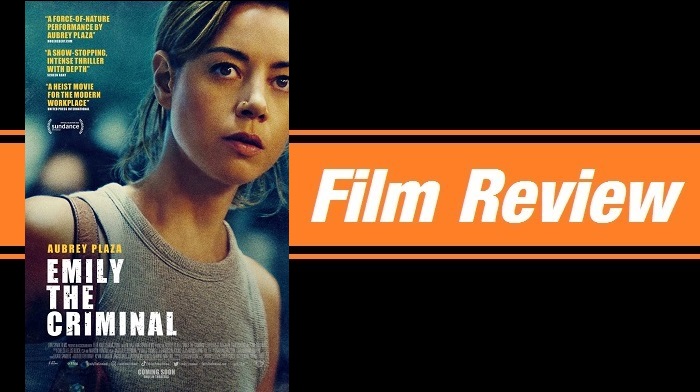
When it comes to Aubrey Plaza, most people immediately think of her quick-witted poker-faced style of humor. And rightly so. The 38-year-old Delaware native has mastered the art of dry deadpan comedy, and her steely stare along with her pitch-perfect comic timing have become signatures. For that reason it may be easy to forget that Plaza is also a really good dramatic actress. Her lights-out performance in “Emily the Criminal” is a nice reminder than she is far from a one-dimensional talent.

“Emily the Criminal” marks the impressive and assured directorial debut for John Patton Ford. He writes and directs this thoroughly compelling crime drama that takes a hard look at a slice of the Los Angeles underworld. By centering on Plaza’s character, Ford is able to offer us a unique perspective, not only into the inner-workings of the LA crime scene, but also into the societal ills that can drive a smart and talented young woman to the point of breaking the law.

Plaza plays Emily Benetto, an aspiring artist in LA who was forced to put aside her love for painting in order to make ends meet. Buried under $70,000 of student debt, Emily is stuck working for a food delivery and catering service just to pay the monthly interest on her loan. She’s tried to get a better job, but two blemishes on her permanent record keep coming back to haunt her. Liz (Megalyn Echikunwoke), Emily’s old high school friend who loves talking about her own successes, keeps promising she’s going to pull some strings to get Emily an interview at her ad agency. But like every other potential lead in Emily’s life, that has yet to happen.

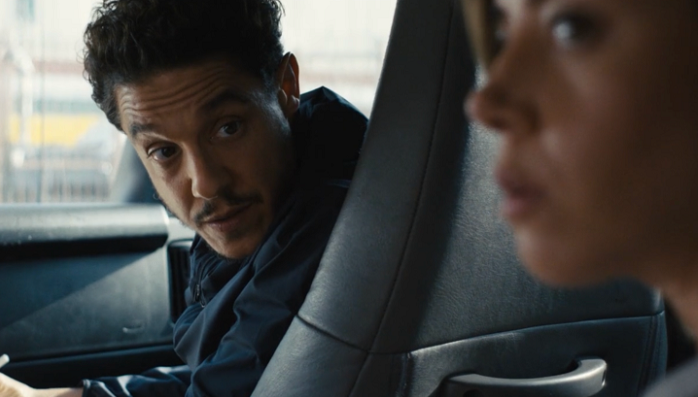
Frustrated with her inability to get a “real job”, Emily takes the advice of her coworker Javier (Bernardo Badillo) and texts a number that he says will score her an easy $200. She followers the address she’s given to an old dry cleaners where a smooth-talker named Youcef (Theo Rossi) and his cousins run a ‘dummy shopper’ scam.

It goes like this: the ‘shopper’ is given a credit card and a fake ID. They then go into a designated store and purchase a flat-screen television with the fake card. They drop off the merchandise to Youcef and collect $200. Here’s the catch – the information on the card is stolen. “You won’t be in danger. You won’t endanger another person. But you will be breaking the law.” You have to give him points for honesty.

After some very brief hesitation, Emily pulls off the job, collects her money, and impresses Youcef in the process. He introduces her to some riskier but higher paying scores before hooking her up with her very own racket. Before long Emily has fully reached ‘small-time criminal’ status, but when she accidentally breaks one of Youcef’s cardinal rules, it brings the dangerous side of the criminal world to her doorstep.
From there “Emily the Criminal” plays out like part crime drama and part character study. The genre conventions work well in large part because Ford keeps things grounded. But the character study element, laced with some well-handled social commentary, gives the film a sharper than expected edge and places the characters within a world than will resonate with many viewers who will see glimmers of their own experiences.

The movie does lean on a few hard-to-miss tropes in the final act as it reaches its eventual climax. And there is an element of Emily and Youcef’s relationship that needed more attention. But there is a steady tension throughout the second half that keeps you locked in. And I can’t say enough about Aubrey Plaza’s performance. Not only does she keenly capture Emily’s vulnerability but also her toughness – both pivotal ingredients to this fascinating character. And while some of her choices are unquestionably dishonest, Plaza earns our empathy and helps us to see Emily’s many layers. “Emily the Criminal” is out this Friday in select theaters.

VERDICT – 4 STARS

REVIEW: “Elvis” (2022)

I’ve never owned an Elvis Presley album. I’ve never been to Graceland. I’ve never watched his famous “Aloha from Hawaii” concert. I’ve never cared for his movies. Yet despite all of that, I fully understand the greatness of Elvis Presley. I’ve always recognized his long-lasting impact on American culture. And you can’t help but respect his legions of passionate fans who truly love the man dubbed the “King of Rock and Roll”.

Though I’m not what you would consider a true fan, I do like a handful of Elvis’ songs and it’s hard not to be fascinated by the larger-than-life presence he still maintains, some 45 years after his untimely death. That’s a big reason I was excited for “Elvis”, the new biographical odyssey from director and co-writer Baz Luhrmann. For me, the name Luhrmann comes packaged with uncertainty. I enjoyed his take on “The Great Gatsby” more than most. But I’ve struggled to connect with his style-driven filmmaking and haven’t particularly enjoyed his other movies (in fairness, I’ve yet to see “Strictly Ballroom”).

“Elvis” is quite the undertaking, and while Luhrmann’s style is certainly present, it never overpowers the film or festers into overindulgence. In fact, it often energizes the movie in a way similar to how Elvis himself would energize a crowd. Most importantly, Luhrmann shows enough restraint to keep this about the man himself. As a result, we get a film that brilliantly captures Elvis’ outer grandeur but also his inner demons. Call it an exhilarating cinematic portrait of triumph and tragedy.

Image Courtesy of Warner Bros. Pictures

It can’t be easy taking on a lead role destined to be so heavily scrutinized. But Austin Butler not only takes it on, he gives a star-making turn that makes any qualms with his portrayal feel like nitpicks. It’s more than just a spot-on impression. Butler burrows into the very soul of Elvis, highlighting his many ups and later his devastating downs. It’s a tough ask for a young actor that’s made even tougher by Luhrmann’s feverish directing style. But Butler is magnetic in what is a nomination-worthy performance.

“Elvis” attempts to cover a ton of ground in its hefty 159-minute running time. From his poverty-ridden childhood to his final days pushing himself to perform despite his failing health. It makes many personal and career stops in between, never staying in one place very long (especially in the first half of the movie). I’m not sure how much will be new to the well-studied Elvis fan. But for people like me, there’s a lot to soak up. It’s like fever-pitch CliffsNotes for the Elvis uninitiated.

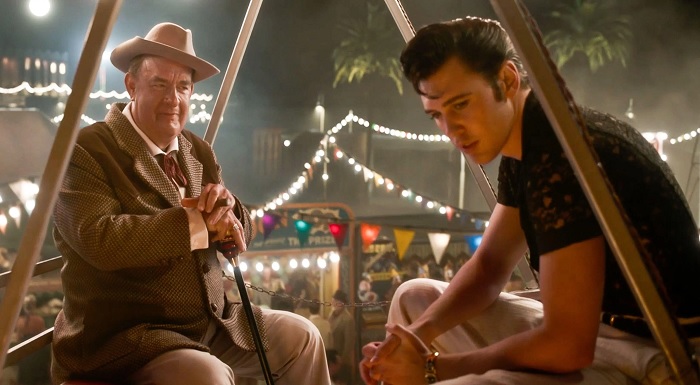
In an interesting move, Luhrmann and his team of co-writers (Sam Bromell, Craig Pearce, and Jeremy Doner) choose to tell much of the story from the perspective of Elvis’ long-time manager and promoter Colonel Tom Parker (played by Tom Hanks in various layers of latex and body suits). It’s framed as Parker on his deathbed, defending himself and his dubious reputation. Over the course of film, we’re asked the question: Was Colonel Tom Parker a villain or a visionary? The movie credits him as both, even making the case that Parker both made Elvis and killed him.

Image Courtesy of Warner Bros. Pictures

Col. Parker was a P.T. Barnum wannabe who saw gold in a good-looking young man from Memphis. Elvis was driving a truck by day to help support his family. When off work, he spent his time losing himself in the music of Beale Street. His long-held love for the Blues and African-American spirituals would forever shape his music. It was a song the younger Elvis recorded with Sun Records that caught the attention of Parker who quickly signed him and took him on his Southern tour which also featured country music artist Hank Snow (David Wenham).

Things take off in 1954 at the Shreveport-based Louisiana Hayride. That’s when Parker knew he had something special. Before long Elvis was his top draw. Parker secured his budding superstar client a deal with RCA Records, booked numerous television appearances, and tapped into the lucrative world of merchandising. Soon the “snowman” was raking in 50% of the “showman’s” earnings, taking advantage of Presley’s star wattage for his own personal gain

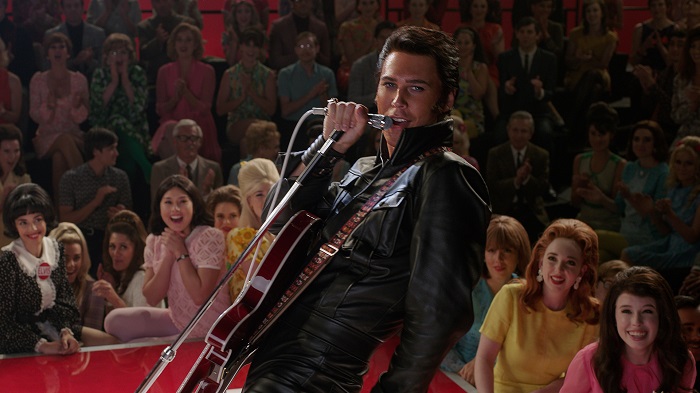
Luhrmann whips us through Elvis’ meteoric rise in popularity while also showing the harsh accusations of indecency and vulgarity he would face (The movie speaks to a deeper motive behind the outrage, namely Elvis’ connections with African-American music in the deeply segregated South). It touches on his short-lived tenure as a movie star, his triumphant comeback special in 1968, and his multi-year deal with The International Hotel in Las Vegas.

On the personal side, Luhrmann does a good job capturing Elvis’ closeness with his mother, Gladys (Helen Thomson) and the loving yet businesslike relationship with his father, Vernon (Richard Roxburgh). He shows us Elvis falling for and eventually marrying Priscilla Beaulieu (a very good but underutilized Olivia DeJonge). We see his purchase of Graceland and the pride he took in being able to support his family. And of course we see his genuine love for music and performing which shines most whenever Elvis took the stage.

Image Courtesy of Warner Bros. Pictures

But there was also the dark side of Elvis’ story. Luhrmann shows the crushing loss of his mother; his disappointment in his father; the revelation of Col. Parker’s double-dealing. We see his marriage crumble, watch his health deteriorate, and witness his growing reliance on pills. It culminates in a heartbreaking yet undeniably beautiful performance of “Unchained Melody” from 1977, just days before his tragic death at the age of 42.

While Luhrmann’s direction is key, Elvis is most vividly brought to life through Butler who pours his heart and soul into his portrayal. Everything about his performance clicks, from the few quiet moments to the high-energy stage numbers where his resemblance to Elvis really kicks in. It leaves you wanting more screen time for Butler. Unfortunately too much of the focus is on Parker who is both narrator and a steady presence throughout. The performance is fine, but too often all I could see was Tom Hanks in prosthetics rather than Colonel Tom Parker. I wanted more Butler.

At times Luhrmann’s kinetic pacing can make things a blur. And it doesn’t allow you to settle down and get comfortable during any stop the story makes on the Elvis Presley timeline. Normally that’s something I would struggle with. But here it feels right, especially for such an electrifying roller-coaster of a life. To Luhrmann’s credit, his film had its hooks in me from its first moments. And even though I’m not a big-time Elvis fan, this movie brought him to life in ways I wasn’t expecting. Now if you’ll excuse me, I’m off to plan a trip to Graceland. “Elvis” is now showing in theaters.

VERDICT – 4.5 STARS

REVIEW: “11M: Terror in Madrid” (2022)

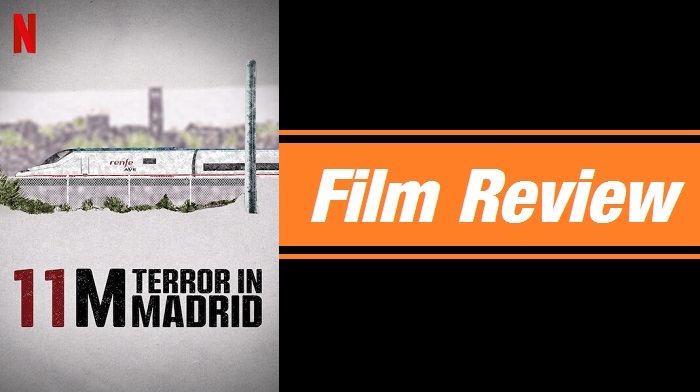
On March 11, 2004, one of the largest terrorist attacks in European history took place in Madrid, Spain. On that deadly Thursday morning, during the city’s busy rush hour, terrorists linked to Al-Qaeda detonated a series of bombs along Madrid’s commuter train system in an unprecedented coordinated attack. A total of 191 people were killed and around 2,000 were injured.

Now 18 years later, many of the survivors come together in the new Netflix documentary “11M: Terror in Madrid”. The film not only covers the horrendous attacks, but also the government’s handling of the investigation that followed and the various conspiracy theories that sprang up. And of course it examines the lasting impact the bombings have had on the city and on those who lived through it yet are still haunted by the trauma.

Director Jose Gomez covers a lot of ground in this documentary that delves into the violence of the attacks, the queasy politics, the media’s part in spreading disinformation, and the investigation that finally rooted out the real perpetrators. Gomez even goes back in time as far as 1994, showing the roots of the Al-Qaeda cell in Spain that eventually carried out the horrendous attacks. All together it tells a sobering, enlightening, and infuriating true story.

Image Courtesy of Netflix

For those not familiar with the meticulously planned attack, Gomez opens the movie by giving a detailed timeline of the events. He starts with survivors sharing how March 11th began as just another normal day. From there, the same people painful recall the detonations in crowded train stations as wagons begin exploding across the route. Gomez’s approach is sensitive yet also revealing. And we get an even fuller image of the devastating injuries and loss of life through the accounts of first responders, many of whom steal bear the scars of that horrific day.

But a bigger focus is put on the aftermath, mainly the government’s determined efforts to place the blame for the bombings on the Basque separatist group ETA. Designated as a terrorist group, the ETA made for an easy but also beneficial culprit for President José María Aznar. The problem is, there was no evidence linking the ETA with the attacks. But that didn’t stop Aznar and his cabinet from using the media to push their ETA ruse despite growing evidence pointing to Islamist radicals as those responsible.

Gomez lays out the politics behind Aznar’s actions and shows how it not only managed to influence the investigation but also the upcoming election. It’s truly appalling stuff. But Gomez makes sure the victims aren’t overshadowed by the unfathomable acts of the government and media. He circles back to them in the final minutes to ensure we remember those who suffered most. It’s the right move and it helps the movie anchor our emotions on top of opening our eyes to how ambitious leadership will go to any lengths to hand onto power. “11M: Terror in Madrid” is now streaming on Netflix.

VERDICT – 4 STARS

REVIEW: “Star Wars: Episode V – “The Empire Strikes Back” (1980)

While perusing my website’s ever-growing archive of movie reviews (you can find it HERE), I eventually came to the Star Wars films. It was there that I made an alarming discovery. Out of all the Star Wars movies I’ve written about, there were only two I haven’t reviewed, “The Empire Strikes Back” and “The Return of the Jedi”. I won’t rehash my deep adoration for the franchise, but this was particularly jarring, especially since these are my two favorite Star Wars movies. So it’s time to plug those two gaping holes starting with “Empire”

“The Empire Strikes Back” is an important movie to me for a number of reasons. Not only do I think it’s the very best Star Wars film. I also think it’s one of the best sequels ever made. And on a more personal level, it’s the movie that really opened up cinema for me in an entirely new way. I remember leaving the theater as a kid in awe. Not just at the incredible world George Lucas had expanded on or the swagger and swashbuckling of my favorite character, Han Solo (Harrison Ford). But it was the storytelling which left the youngster me utterly amazed and wondering what was coming next.

“Empire” released here in the States on May 21, 1980 and was a box office smash. It opened to fairly mixed reviews, but over time and following countless reappraisals, the film is rightly heralded as a great Star Wars movie and one of the greatest movies ever made. Directed by Irvin Kershner and co-written by Lawrence Kasdan and Leigh Brackett, “Empire” mixes an immersive story with great characters and dazzling world-building. And it all emanates from the creative mind of George Lucas.

While 1977’s “Star Wars” ended on a high note for the fledgling rebellion, the fitting title of “Empire” hints at the sequel’s darker tone. We see little in terms of victories for the rebels beginning with the film’s epic opening as Darth Vader (David Prowse/voiced by James Earl Jones) and his imperial troops lay siege to the hidden rebel base on the snow planet of Hoth. It’s quite the opening; one that does a great job reintroducing the major characters and raising the stakes which only get higher as the story progresses.

After being forced to evacuate on the Millennium Falcon, Han, Leia (Carrie Fisher), the loyal furball Chewbacca (Peter Mayhew), and protocol droid C-3PO (Anthony Daniels) find themselves pursued through space by Vader and his fleet of Star Destroyers. Meanwhile Luke (Mark Hamill) and the spirited astromech droid R2-D2 (Kenny Baker) are on their way to a remote swamp planet called Dagobah following a vision from Obi-Wan Kenobi (Alec Guinness). Luke’s old mentor (slain by Vader in the previous film) tells him to seek a Jedi Master named Yoda (puppeteer Frank Oz) who will complete his Force training.

Of course the movie finds a way to bring all of our heroes back together, this time in Cloud City where we’re introduced to fan favorite Lando Calrissian (Billy Dee Williams), the administrator of the floating mining colony. From there the movie gives Star Wars fans everything they could possibly want. There’s a daring escape, an epic showdown, a franchise-driving revelation, and an amazing cliffhanger that would set the table for the trilogy’s finale that would come three years later.

“The Empire Strikes Back” is a landmark movie for a number of reasons. Not simply because it’s a spectacular sequel with a great forward-moving story and cutting-edge special effects. But it also injected so much into pop culture, much of which still flourishes today. “Empire” launched Star Wars to heights that neither George Lucas or the world could have expected. And for many kids in the early 80s (like me), “Empire” etched Star Wars so deeply into from our childhoods that it left a permanent mark. And my love the franchise hasn’t waned a bit since.

VERDICT – 5 STARS

REVIEW: “Everything Everywhere All at Once” (2022)

The enthusiasm for A24’s latest “Everything Everywhere All at Once” has been deafening, with early reactions ranging from high praise to full-blown hyperbole. Admittedly, that has made keeping my own personal expectations in check a little difficult. On one hand A24 is a distributor with a tremendous track record when it comes to releasing bold original independent movies. On the other hand, first-takes can be a hard thing to gauge, and they can sometimes resemble trendy groupthink rather than original reactions.

After some initial worry, “Everything Everywhere All at Once” has finally made its way to our market. And while I appreciate much of what it’s going for, the movie ended up being a tough sit. Without question, the film is an ambitious undertaking for the co-writing and co-directing duo of Dan Kwan and Daniel Scheinert (who collectively refer to themselves as “Daniels”). Unfortunately their ambition often gives way to overindulgence making this overlong and overstuffed genre stew a well-meaning but exhausting experience.

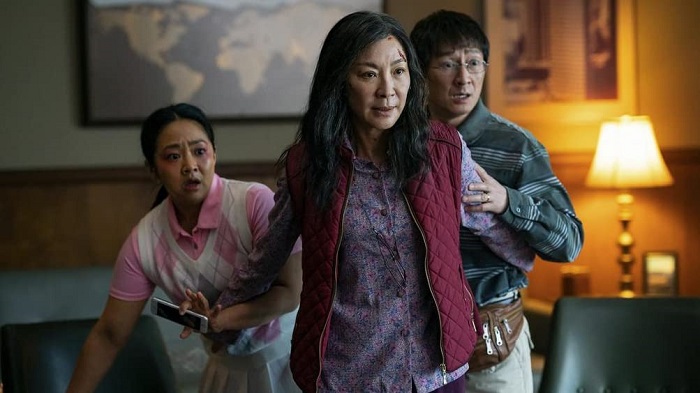
The film’s biggest plus is easily Michelle Yeoh. She’s long been a terrific actress and here she fully commits 110%. She truly is the movie’s anchor and her role demands a ton emotionally, physically, and even comedically. It’s pretty amazing watching Yeoh tie all of those threads together especially considering how erratic the movie can get at times. Blunt stylistic choices and some particularly wild attempts at humor make things needlessly messy, yet Yeoh never misses a beat.

Image Courtesy of A24

Yeoh’s character Evelyn is the story’s centerpiece. When she was young, Evelyn ran off and married Waymond (Key Huy Quan) much to the chagrin of her disapproving parents. These days the couple own and run a neighborhood laundromat and live in small apartment right above it. The movie begins with Evelyn chugging through her hectic yet mundane existence. “Laundry and taxes” is her life in a nutshell as she and Waymond struggle to keep their laundromat afloat while preparing for an audit by the IRS.

Meanwhile Evelyn’s elderly father (James Hong) is set to pay a visit and her rebellious daughter Joy (Stephanie Hsu) wants to introduce him to her girlfriend Becky (Tallie Medel). But knowing what her old-fashioned father’s reaction will be, Evelyn hides it, souring her relationship with her daughter even more. This forms one of the movie’s central themes – a mother reconnecting with her daughter after bucking her ‘old ways’ of thinking. It’s all pretty on-the-nose and it’s not hard to figure out how things are going to play out. The only real suspense is in how chaotic things will get in between.

The craziness kicks in when Evelyn is contacted by a Waymond from another universe. Call him Alpha Waymond and through a string of long never-ending exposition drops he explains to Evelyn (and us) the rules of this movie’s world. Over time Alpha Waymond rattles on about “infinite multiverses”, “bringing balance”, and even a line about Evelyn being “the One” (all obvious nods to “Star Wars”, “The Matrix”, and the MCU). I understand laying the groundwork, but to be honest I quickly grew tired of the details. And the more they went on about how it all worked the more my mind wandered.

Image Courtesy of A24

But that only scratches the surface. As it turns out, there are enough ideas and interests stuffed into this thing to fill at least three seasons of a television series. Yet it’s all crammed into this one movie which sees the Daniels frantically shoehorning in every possible idea that must have come to their collective minds. Operating under the notion that ‘more is not enough’, the filmmakers move from exposition-heavy to furiously bouncing across nearly every genre. That sounds cool, but too often the chaos overshadows the human element. In fact, at times the movie seems far more interested in its own boldness and peculiarity. That leaves it scrambling at the end to bring things back to an emotional level.

As Evelyn learns the technique of ‘verse-jumping’, she’s able to tap into the memories (and skills) of her parallel selves. This is where we’re introduced to a universe where everyone has hotdogs for fingers, a chef with a raccoon on his head, and there’s a verse-hopping bagel cult (yep, you read that right) ran by Alpha Joy, aka Jobu Tupaki. There’s actually meant to be a poignant mother/daughter element to the bagel cult. But as with so much in this movie, it’s overshadowed by the brazen showiness and all-out absurdity of nearly everything else.

What’s most frustrating about “Everything Everywhere All at Once” is that it has the pieces for something special. Tops on that list is the cast. Yeoh is sensational and it was great seeing Key Huy Quan handed a meaty role. We even get a bobbed Jamie Lee Curtis playing part IRS inspector/part bagel cult assassin (she’s terrific). And the story has good things to say about finding oneself, the messiness of life, and pondering the question of “What if?”. But whether it’s the draining exposition of the first half or the smothering non-stop ridiculousness of the second half, the film never finds a good balance. It ends up as something that could’ve possibly flourished as a streaming series rather than being the well-meaning but tiresome 140 minutes it becomes. “Everything Everywhere All at Once” is now showing in theaters.

VERDICT – 2 STARS

Sundance Review: “Emergency” (2022)

One of the last (and as it turns out most well received) movies I saw at this year’s Sundance Film Festival was Carey Williams’ “Emergency”, a feature film adaptation of a short film that Williams debuted at Sundance back in 2018. The movie introduces itself as a college buddy comedy, but it slowly takes a different form over the course of its lively 105 minutes.

Written by KD Dávila, the story revolves around two best friends with opposing world views who have their friendship challenged over the course of one long and wild night. While comedy plays a significant role, the movie soon reveals its deeper thematic interests, namely the bond of true friendship and what it means to be a young black man in America. The only problem is once you have a good sense of its message, it’s pretty easy to see where things are heading.

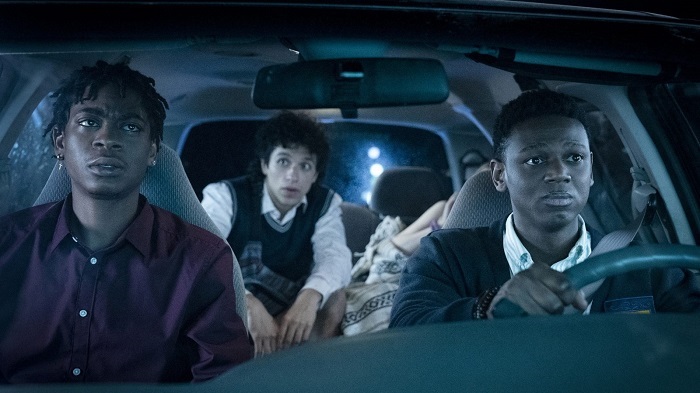
Kunle (Donald Elise Watkins) and Sean (RJ Cyler) are two best buddies and roommates at Buchanan University. While the two have a lot in common, they come from very different places. The buttoned-up and bookish Kunle is an aspiring doctor who comes from a wealthy suburban family. The more cynical and hardened Sean (RJ Cyler) comes from a much tougher background. Kunle has already been accepted into Princeton, but he needs to ace his thesis to seal the deal. Sean spends more time vaping and scouting out the local party scene than nailing down his goals for the future.

The two pals have a big plans for the evening – hitting seven legendary campus parties in one night. When they go to their apartment to prep for the “pre-game”, they discover an unconscious white girl (Maddie Nichols) laying in their living room floor. Kunle’s instincts are to immediately call 911. The more pessimistic Sean’s first thought is that once the police see two two young black man and an unconscious white girl, they’ll be arrested or maybe even gunned down.

Attempting to be the voice of reason, a nervous Kunle demands they at least take the girl to the hospital. Stoned and reeking of weed, Sean suggests dumping her on a nearby sorority house’s lawn. These are the kinds of wildly opposing ideas the two throw out for most of the film. With the help of their skittish Latino roommate Carlos (Sebastian Chacon), the trio load the girl into their car. But what follows is a madcap series of good intentions but horrible decisions.

Image Courtesy of Amazon Studios

To add another wrinkle, at a nearby party a brash and egotistical co-ed named Maddie (Sabrina Carpenter) realizes her sister Emma is missing. You guessed it – Emma is the girl passed out on Kunle and Sean’s living room floor. So she, her incredibly tolerant best friend Alice (Madison Thompson), and Alice’s hunky crush (Diego Abraham) set out to find Emma.

It all moves towards a comically combustible yet poignant finish – one that’s (unfortunately) predictable yet still manages to be powerful. One reason the finish packs such a punch is because of the performances from the terrific young cast. Watkins and Cyler are especially good, possessing a snappy chemistry that enables us to buy into every facet of Kunle and Sean’s friendship (despite getting painfully little in terms of their backstory). And when the ending does come, the two actors give us something that’s both emotionally rich and palpable.

Another of the film’s strengths is found in Williams’ willingness to scrutinize both young men’s perspectives. From Sean’s cynicism to Kumle’s naïveté, both are earnest and very much shaped by their own life experiences. But as the story plays out, we see the strong points and flaws in both worldviews. As a result, it presents a more honest examination, one that takes on its serious real-world subject matter with an open-eyed sincerity.

“Emergency” has a lot going for it and it’ll be interesting to see how big of an audience it attracts (it has already been picked up by Amazon Studios). It doesn’t fully avoid the occasional on-the-nose preachiness and unfortunately it does tip its hand well before we get to the film’s big finish. But Williams mostly stays on course and skillfully maintains his balance between buddy comedy silliness and insightful commentary. He also puts together some scenes that will stick with you, none better than a late conversation between Kunle and Sean that is a masterclass in dramatic writing. It’s also a showcase for these two fine young actors who we should a lot more of in the years to come.

VERDICT – 3.5 STARS