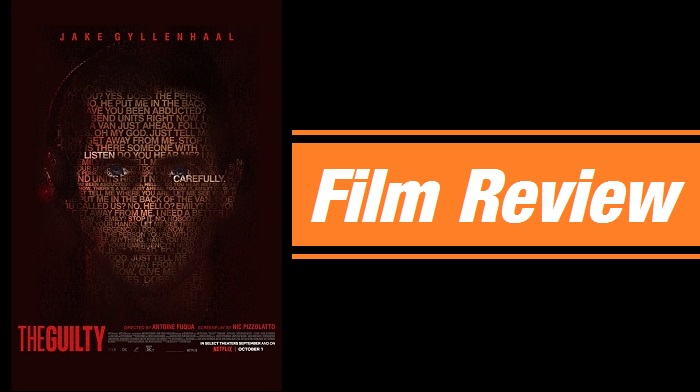
New on Netflix this weekend is Antoine Fuqua’s “The Guilty”, an American remake of a terrific 2018 Danish film from director Gustav Möller. “The Guilty” is an interesting choice for Fuqua and dramatically different than the more action-oriented movies the filmmaker is known for. To his credit, Fuqua captures much of the taut tension of the original film and he manages the single-setting challenges well enough.
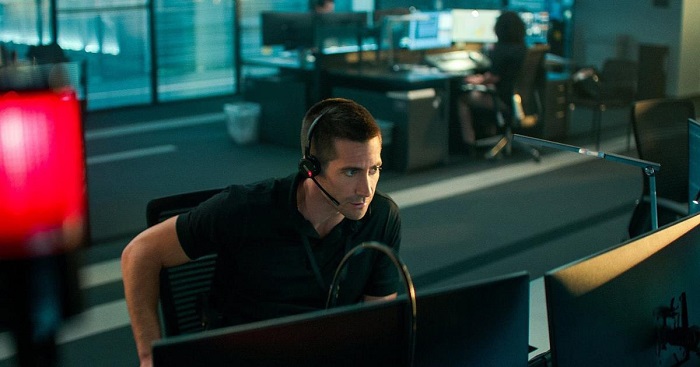
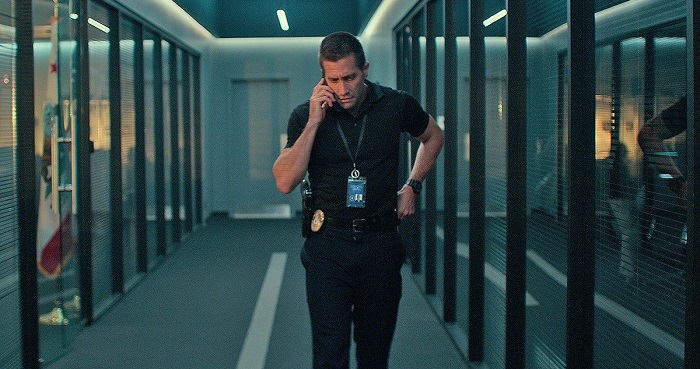
The entire film takes place in a 911 dispatch center where Joe Baylor (Jake Gyllenhaal) works as an operator. I won’t say too much about him considering a healthy chunk of the movie is spent unwrapping his troubled character over the course of one eventful night. Suffice it to say, he’s been taken off the streets pending an upcoming trial for [REDACTED]. The stress from his looming court date along with his recent split with his wife has Joe on edge.
Image Courtesy of Netflix
Joe’s evening takes a dramatic turn when he receives a call from a little girl named Abby (voiced by Christiana Montoya) who tells him her mother Emily (Riley Keough) has been kidnapped. Joe makes a promise to Abby that she will see her mother again. He then spends the rest of the night trying to keep his promise. Meanwhile Joe’s personal story gets messier as his own problems begin to fester. He’s in a mess as evident by the pesky Los Angeles Times reporter (Edi Patterson) who keeps calling. “I just want you to be able to tell your side of the story,” she claims.
The vast majority of the running time plays out over telephones and police radios. Fuqua does a sufficient job building suspenseful but has a hard time keeping the tension ratcheted up throughout the tight 90 minutes. The story (from screenwriter Nic Pizzolatto) unfolds at a pretty good pace, and we get some good voice work from Keough, Ethan Hawke, Paul Dano, Peter Saarsgard, and Eli Goree.
Image Courtesy of Netflix
Unfortunately the last 20 minutes sees the film’s central conceit begin to fizzle. It’s not helped by Gyllenhaal’s character who is relentlessly volatile, unlikable, and ever stressed to the point of almost snapping. The performance is solid, but Gyllenhaal is asked to portray Joe with such aggression that it’s almost impossible to connect with him.
Fuqua does add some interesting touches, such as setting his movie to the backdrop of the California wildfires. But no matter how hard the film tries, it’s never able to muster the same intensity or humanity as its Danish inspiration. Perhaps seeing the 2018 film set my expectations at a certain level. Fuqua’s version, though entertaining to a point, simply doesn’t have the same spark and ends up being a pretty pale comparison. “The Guilty” premieres Friday (September 24th) on Netflix.
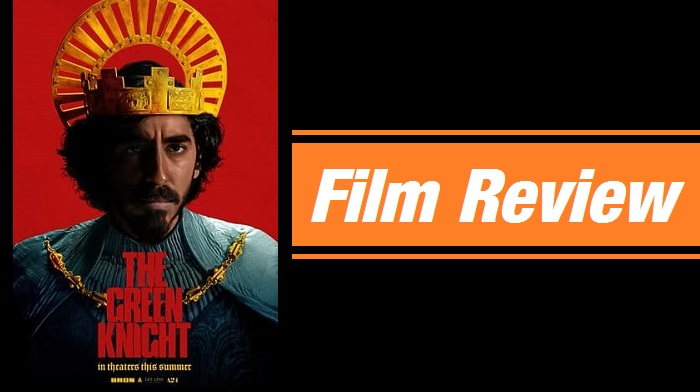
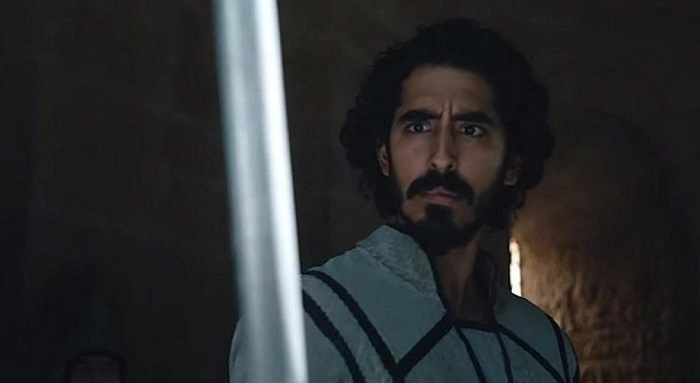
Few movies on the 2021 docket have captured the anticipation and curiosity of a segment of film fans quite like “The Green Knight”. This fresh retelling pulled from the rich and complex Arthurian mythology comes from writer-director David Lowery, an indie visionary who proves himself to be just the right person for the material. Surrounded by an almost deafening buzz from certain circles, “The Green Knight” is a savory feast sure to tantalize the taste buds of arthouse crowds while leaving some casual moviegoers frustrated and hungry.
“The Green Knight” is a dark and sometimes twisted medieval fantasy based on the 14th century poem “Sir Gawain and the Green Knight”. Or as the film itself states it, “the chivalric romance by anonymous”. Lowery puts his own unconventional spin on the material, focusing more on imagery, mood and atmosphere than dialogue, character building and traditional storytelling. It results in an eye-popping puzzle box of a movie with much to say about humanity, self-discovery, honor and what it means to be a legend. But gleaning its meaning through Lowery’s artful yet sometimes muddy lens can be a chore.
Who better to lead this beguiling dark fantasy twist than Dev Patel who has excelled at playing conflicted characters who often carry heavy burdens. The 31-year-old possesses a wide-eyed openness that makes him the perfect conduit between the audience and the material. Here he’s the key piece that keeps us connected both narratively and on a human level. Most of the other players we meet, though captivating, are shallow hulls who work more as representations than genuine characters. That may sound like a criticism and in a wishful way I suppose it is. But it’s an approach that fits well with the journey Lowery takes us on.
Image Courtesy of A24
Patel plays the impetuous Gawain, nephew to the sickly King Arthur (Sean Harris) and his equally unwell looking queen Guinevere (Kate Dickie). Gawain is next in line for the crown but shirks his royal duties, choosing to hide his insecurities by drinking and cavorting with the waifish Esel (Alicia Vikander). But his life turns on Christmas morning when the king’s round table festivities are interrupted by an unexpected visitor. He’s a menacing yet entrancing creature surrounded by a dull forest green glow. He has the head of a Tolkien Ent sitting upon a giant’s body that creaks like thick bending tree limbs whenever he moves. His face is covered in tree bark, his eyes unexpectedly soulful, and his voice reverberating with the deep booming tones of Ralph Ineson.
With the full attention of the room, the creature issues a challenge. He offers anyone in the King’s court a free strike with their blade but it comes with one ominous condition – he’ll return the same blow exactly one year later at his chapel deep within a faraway forest. The impulsive Gawain jumps at the opportunity and with one swift slice of a sword decapitates the creature and begins his own legend. The still-living body of the hulking knight picks up his detached head and rides off, leaving a ‘see you in a year’ laugh echoing through the chamber.
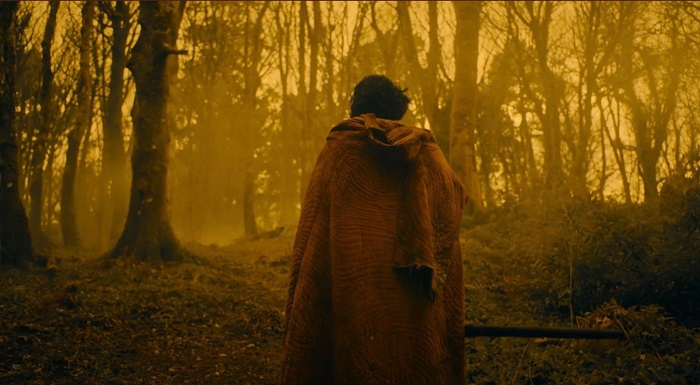
The bulk of the film follows Gawain’s journey to keep his end of the agreement. Will Gawain remain a selfish entitled slacker or will he become a poem-worthy Arthurian legend? To answer that, Lowery takes his protagonist across a plethora of breathtaking landscapes, each using nature (a strength of Lowery’s) and the individual uniquenesses of the Irish locations to create this absorbing visual language. That may sound like nonsensical critic-speak, but it’s exactly what Lowery and his DP Andrew Droz Palermo do. Their camera (with a little help from Daniel Hart’s gnawing score – one of the year’s best) communicate a lingering feeling of dread that bleeds through every doom-soaked composition.
Image Courtesy of A24
Equally effective are the countless visual touches scattered throughout Lowery’s moody epic. Tracking shots of Gawain riding across the dreary cloud-covered countryside. Holding certain shots slightly longer than we’re accustomed to. Exquisite camera pans including a particularly brilliant one (you’ll know it when you see it). The incredible use of darkness and shadows. There’s always something grabbing your eye and it says something that the film’s most indelible moments come through the camera.
As for Gawain himself, his path is marked by a string of encounters that challenge him in a variety of ways. On a dank and muddy battlefield littered with corpses he runs into a chatty scavenger played by Barry Keoghan. Later he crosses paths with a transfixing spirit (Erin Kellyman) in need of his help to retrieve something of immense value to her. One that doesn’t quite land as it should comes later when an exhausted Gawain happens upon the remote estate of a Lord (Joel Edgerton) and his lecherous wife (also Alicia Vikander). There’s a subtext of temptation versus a knight’s honor, but the sequence drags and gets caught up it’s own cryptic weirdness. But the movie quickly gets back on track and ends strong.
“The Green Knight” is a movie destined to be exalted by some and loathed by others. It’s utter indifference to mainstream acceptance will hurt it at the box office, but it’s part of what makes it special. David Lowery uses every ounce of his creative freedom to make something audacious, challenging, and unlike any Arthurian adaptation we’ve seen to date. It can be confounding and a touch too captivated by its own enigma. But you’ll be entranced from the very first frame, and once you fall under it’s hypnotic spell, it’s impossible to take your eyes off the screen.
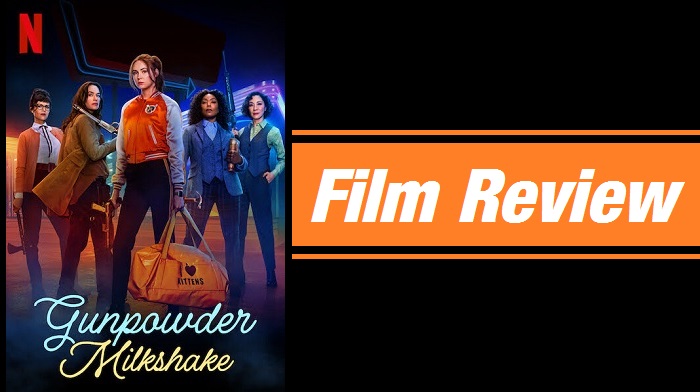
A killer cast (bad pun absolutely intended) leads the way in the upcoming Netflix film “Gunpowder Milkshake”, an action/black comedy packing plenty of girl power and one of the best titles of the year. It comes from director and co-writer Navot Papushado who puts together a stylish shoot-em-up that borrows from an assortment of action movies that came before it. That proves to be both part of the fun as well as the film’s biggest weakness.
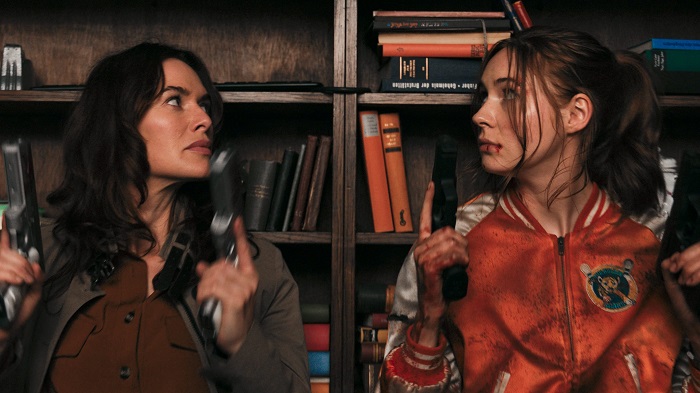
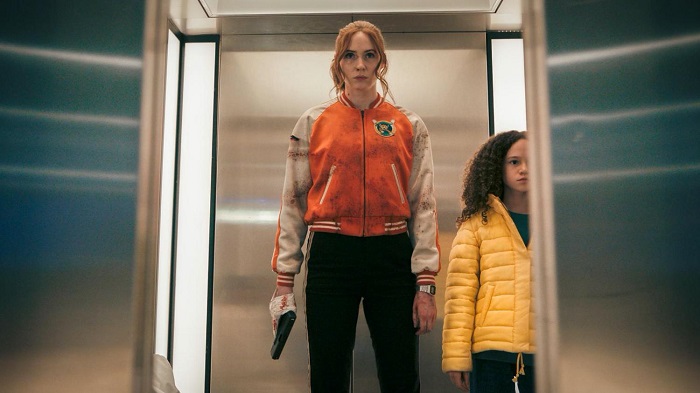
It’s impossible to watch “Gunpowder Milkshake” without thinking about “John Wick”. The similarities are just too pronounced to miss. The key difference is this is a female-driven version of that world. Here Karen Gillan plays the John Wick character, a lethal assassin named Sam. She had no choice but to grow up in the killing-for-hire business after her mother Scarlet (Lena Headey), also an assassin, left her 15 years earlier. Now she takes contracts from a shadowy underworld outfit called The Firm (you gotta love the comically vague names these organizations come up with).
Image Courtesy of Netflix
The movie kicks off with Sam finishing up her most recent contract. She takes out her target but is quickly confronted by a horde of armed thugs on her way out. She kills them all but leaves a pretty big mess behind. The Firm’s not too happy with the results even though they’re the ones who sent her in with bad intel. And little do they know, among the dead is the son of an Irish gangster named Jim McAlester (Ralph Ineson). And as these mob bosses are prone to do, McAlester wants revenge. “Now bring me the heads of the men who killed my boy”, he snarls.
Sam’s mentor Nathan (Paul Giamatti) is able to smooth things over with The Firm, even securing her a new contract. It sounds like an easy enough job – an accountant has stolen a satchel full of cash from the Firm. They want her to kill him and get their money back. But once again the job gets messy after Sam learns an innocent 8-year-old girl named Emily (Chloe Coleman) is caught in the middle. Refusing to leave her behind, Sam saves Emily but loses the Firm’s money in the process. You can probably see where this is going. Soon she finds herself on the run from both the Firm and a revenge-fueled McAlester. And as you might expect, lots of bullets, blood, and dead bodies follow.
Sam and her self-anointed “apprentice” Emily seek help from a sisterhood of assassins consisting of the bitter and brash Anna May (Angela Bassett), the soft-spoken but deadly Florence (Michelle Yeoh), and the hilariously genteel Madeleine (Carla Gugino). It’s a bummer, but this lethal sisterhood isn’t given much of a backstory. We learn there’s some bad blood between them and Sam’s mom. We see they operate out of a beautiful bygone-era library. Oh, and they’re extremely efficient killers. But thats about it. Thankfully the actresses inject the group with enough personality to get by.
Rather than focusing on story Papushado goes heavy into style both visually and in his choreography. We get a lot of sequences bathed in neon especially early on. He also does some clever things with his camera, specifically with different angles, perspectives, and movements. When it comes to the action the fight sequences and shoot-outs can be a little too tightly scripted but for the most part are still fun. And some are completely absurd (which I say as a compliment). My favorite may be a bloody hospital sequence between a partially paralyzed Sam and three hitmen who are high on laughing gas. It’s so ridiculous you can’t help but love it.
Image Courtesy of Netflix
Yet there are moments of indulgence that seem utterly pointless. Take the occasional slow motion shot that seems to be there just to have a slow motion shot. Do we really need to see some enter a diner and then suddenly start walking to their booth in slo-mo? Also the frequent nods to movies like “John Wick”, “Kill Bill”, and even “Sin City” keep this movie from having an firm identity of its own. Sure, there is the all-female protagonists and the mother/daughter dynamic. But story-wise there isn’t much to set it apart and you get the sense that you’ve seen it all before.
Thankfully the action and the cast carry most of the load. Gillan pours herself into the role and really shines in the fight sequences. She’s a bit stiff and cold in the handful of dramatic scenes (partially by design), but she makes up for it with her grit and physicality. Headey is tough as nails and the sisterhood have some good moments despite seriously lacking depth. And that’s ultimately the movie itself. There just isn’t enough story to sink your teeth into. Instead it puts all its money on its eye-catching action and some fun performances. Thankfully that’s enough to keep the film afloat. “Gunpowder Milkshake” premieres on Netflix tomorrow (July 14th).
“There’s something sinister in the woods.” It’s not a direct line of dialogue from NEON’s upcoming eco-horror film “Gaia” but it could have been. This eerie new chiller from director Jaco Bouwer utilizes the tried-and-true creepy forest setting to great effect, sucking us into another bizarre and unsettling deep-woods scenario that melds mystery with the macabre. And while not as good as Ben Wheatley’s “In the Earth” from early this year, “Gaia” has a skin-crawling sense of dread that reverberates through the entire film.
I had to do a little research to learn Gaia refers to a deity known as the ancestral mother of all life. In Greek mythology she’s the personification of earth which makes her name a fitting title for this film. Written by Tertius Kapp, this South African feature begins with two forest rangers canoeing down a river that snakes through a dense forest. As Winston (Anthony Oseyemi) does the paddling Gabi (Monique Rockman) mans her drone as it descends from high overhead into the trees. She maneuvers it down a trail and gets a glimpse of man who promptly knocks the craft out of the air. Determined to get her drone back, Gabi hops out of the canoe to retrieve it while Winston goes ahead to check their game cameras.
Image Courtesy of NEON
Now anyone who knows horror movies understands that splitting up is never a good idea. That definitely proves to be the case here. After a nasty foot injury, a hobbled and frightened Gabi encounters a father and son, both thin as tails, covered in grime and wearing nothing more than tattered rags. They nurse her back to health beginning this unconventional journey where uncoiling the film’s mystery is more central than a focused plot.
From there the chilling tension sets in as Bouwer and Kapp slowly and methodically let us in on the secret of the woods. Much of it is channeled through the father Barend (Carel Nel) who clearly knows more than he’s telling. He has a zealous connection to the forest, even penning his own mysterious manifesto on what looks like ancient parchment. His son Stefan (Alex Van Dyk) is mostly silent and reserved; impressionable despite being raised under his father’s rigid fanaticism.
“Gaia” pours a lot into its uneasy atmosphere which burrows deeper under your skin the further we get into the story. That anxious feeling is helped by Pierre-Henri Wicomb’s ominous score and the rich sound design which fills the forest with spooky sounds of creaking wood, slithering roots and unidentifiable screeches. Meanwhile the special effects and makeup are spectacular, suggesting nature is to be both admired and feared; that it is simultaneously a thing of beauty and a terrifying force.
Image Courtesy of NEON
While the setup and much of the execution is intensely effective, the movie doesn’t hit all of its marks. It’s underlying message about both nature and modern civilization is obvious on the surface but gets murkier as it plays out. The film clearly presents a meddling humanity and a ticked off Mother Nature, but as characters go in certain directions it’s easy to lose sight of the deeper meanings. There’s also a relationship between Gabi and young Stefan that’s really hard to figure out. It’s not helped by a trippy hallucinogenic dream sequence, the kind where the director gets to do all sorts of weird things with the camera and to his characters. It’s something we’re seeing more and more in horror flicks these days and I’m kind of over them.
While it has its issues, “Gaia” is still a quality slice of modern horror. This modestly budgeted import uses its single location and four-person cast to tell a story of a vengeful planet taking back what has been stolen from it. The visuals, the sound, the score, and the performances all suck us into this foreboding location where nature has began its revolt. It’s the storytelling and messaging that gets a little clunky, keeping the film from fully delivering the punch it hopes to. Still, as a pure horror experience, Bouwer knows how to make his audience squirm. “Gaia” opens in theaters June 18th and on VOD June 25th.
Christoph Waltz stars in and makes his directorial debut with “Georgetown”, a too-crazy-to-be-true crime drama that’s actually based on an true story. Well, sort of. The film is written by screenwriter David Auburn and is taken from a 2012 New York Times Magazine article by Franklin Foer titled “The Worst Marriage in Georgetown”. I haven’t read Foer’s piece so I’m ill-suited to parse fact from fiction. But clearly Waltz and Auburn have added their own spin to the story. Look no further than the film’s opening disclaimer: “This story does not, in any way, claim to be the truth. Nonetheless, it is inspired by actual events.”
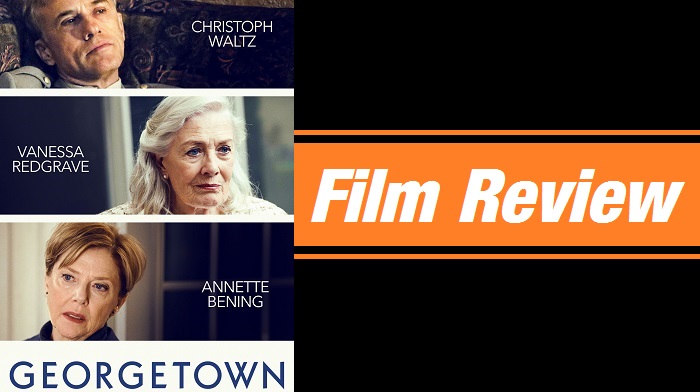
“Georgetown” tells the story of Ulrich Mott (Waltz), a smooth-talking con-artist who wins the heart of a wealthy and much older Washington DC journalist and socialite Elsa Brecht (Vanessa Redgrave). Against the wishes of her daughter Amanda (Annette Benning) who’s wise to Ulrich’s game, Elsa marries her much younger suitor (In the real-life account they wed in 1990, when she was 70 and he was 26). After several years of marital ups and downs, 91-year-old Elsa is found dead in their Georgetown home. At first it looks like natural causes, but the DC police uncover enough to open up a homicide investigation and despite his firm denials, Ulrich quickly becomes their chief suspect.
Image Courtesy of Vertical Entertainment
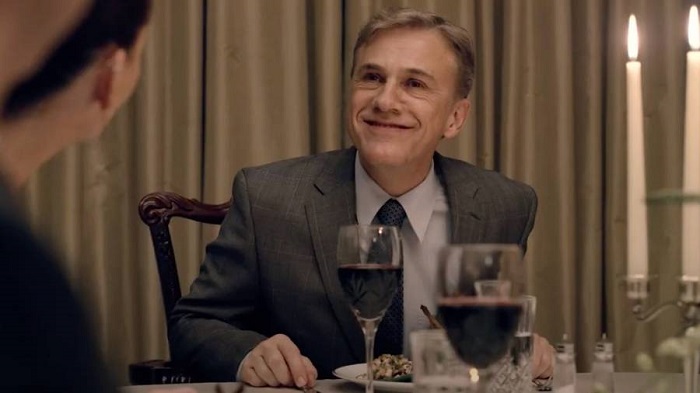
The movie unfolds to a rather unconventional structure. The main story begins at a dinner party on the night of Elsa’s death and then follows Ulrich’s arrest and eventual trial. It’s broken up by chaptered flashbacks that flesh out the couple’s peculiar relationship. It starts with Ulrich’s time as a Congressman’s intern hitting it off with Elsa after sneaking into the White House Correspondents’ Dinner. Later we see him as her butler, wooing her with breakfast in bed and driving her around town. Before long they’re married and he’s using her connections and resources to setup his own consulting firm, hobnobbing with senators, ambassadors, journalists, and White House officials to climb his way up the social ladder.
Things only get wackier from there as Waltz (both actor and director) chronicles the absurdity of his weirdly fascinating character. Whether Ulrich is masquerading as a Brigadier General for the Iraqi Special Forces (yep, you read that right) or driving his hapless defense attorney (Corey Hawkins) mad with his bewildering antics. In one sense Ulrich proves to be a sneaky charmer who could talk his way into relationships with rich and powerful people from all over the globe. Yet at times his smarmy unscrupulous facade leaves you wondering how Amanda is the only one who sees through him.
Image Courtesy of Vertical Entertainment
Speaking of Amanda, the tension between her and Ulrich is compelling and from the earliest scenes it’s pretty clear that she doesn’t trust him. But that conflict gets tossed aside and Amanda all but disappears for most of the second half. It’s a really good performance from Benning who could have used more screen time. And as you can probably guess, Waltz is well suited for his icky two-sided role. You can’t help but laugh as he strolls around his neighborhood in military duds that look official but are impossible to recognize. But then you get these brief burst of venom that show the character’s nasty core. The movie doesn’t always strike a good balance for him but he’s always fascinating.
“Georgetown” isn’t the easiest material to adapt yet Christoph Waltz manages a solid behind-the-camera debut. His movie gets a little bogged down after taking a strange geopolitical turn but in a weird movie like this it oddly fits. Solid performances from Waltz, Redgrave and Benning help sell this story that almost feels otherworldly. But its craziness is part of what makes it so compelling and it’s what keeps you glued to the screen even during its rocky patches. “Georgetown” is now streaming on VOD.
Three troubled teens unload years of pent-up rage over 48 hours of drugs, violence, and mayhem in “Gully”, the first narrative feature film from director Nabil Elderkin. Best known for his Hip Hop and R&B music videos for big acts like Kanye West, John Legend, and The Black Eyes Peas, Elderkin teams with screenwriter Marcus J. Guillory to tell an inner-city story with big aspirations that it never quite reaches.
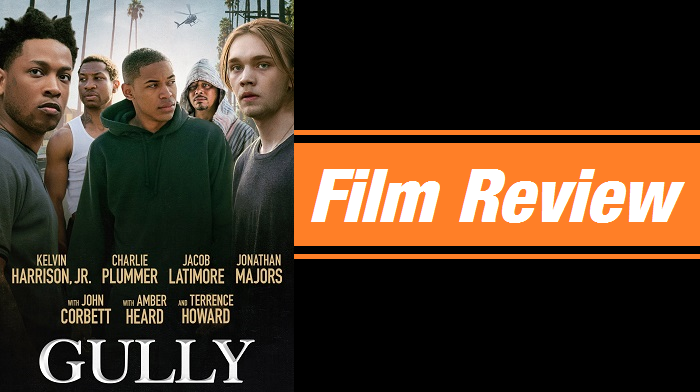
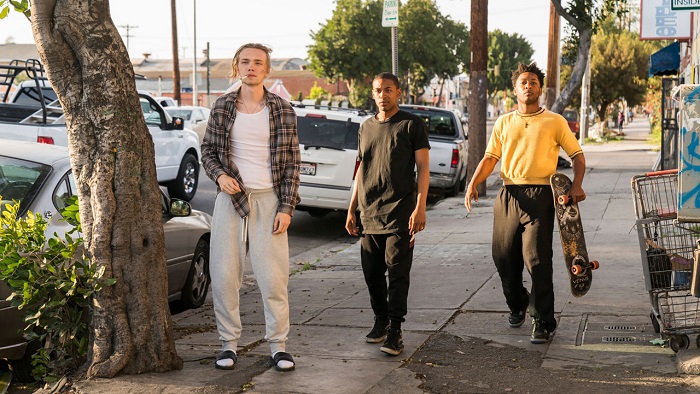
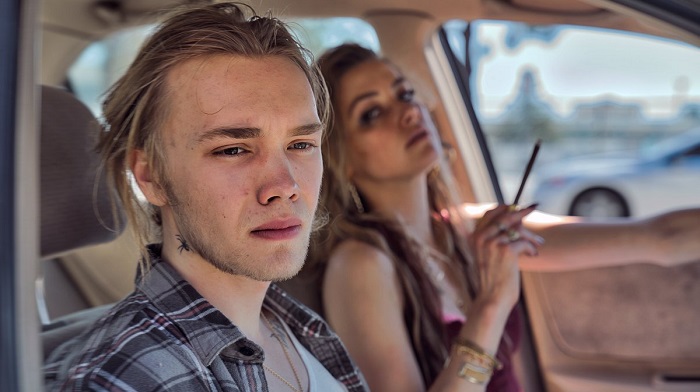
The three close friends at the film’s center seem doomed from the first moment we meet them. Calvin (Jacob Latimore) is a charismatic kid with a mental health condition who routinely skips out on his medication despite the pleas of his concerned mother (Robin Givens). Jesse (Kelvin Harrison, Jr.) is quiet and full of pain which he keeps bottled up and hidden even from his two buddies. Nicky (Charlie Plummer) witnessed unspeakable violence as a child and while we get glimpses of a playful and carefree exterior, especially at home with his addict single mother (Amber Heard), inside he’s a swirl of volatility just waiting to implode.
Image Courtesy of Paramount Pictures
The movie works overtime stacking the deck against these kids. Abuse, poverty, no real father-figures – just a few of the things touched on to show the hard lives they’ve had. They’re essentially abandoned, stripped of any childhood, trapped within their rough Los Angeles neighborhood, and left to exist by the dictates of an uncaring and unreliable culture and society. The problem is the destructive elements that have led to their delinquency are never examined the way they should be. Instead the film is content with wedging in a brief scene here and there in an effort to earn our sympathies. It helps us to understand the boys better, but not enough for us to like them the way the movie wants us to.
Elderkin seems far more interested in soaking us in the debauchery and violence than exploring its root causes. This leads to a frustratingly muddled messaging. I don’t want to say the film glamorizes their sordid behavior, but there are scenes where it certainly comes close. And their sudden shift from mischievous juveniles to violent criminals comes without so much as an explanation. One second they’re letting out their rage and angst through a Grand Theft Auto styled video game. The next scene they’re beating a complete stranger to a pulp and stealing his truck. And it only gets worse from there. Are we supposed to excuse it all simply because a handful of brief scenes show the three were dealt bad hands? The movie never finds that much needed balance.
Image Courtesy of Paramount Pictures
Strangely there’s another running story that almost feels like it’s own thing. In it we see a terrific Jonathan Majors playing a recent parolee determined to live straight. In many ways his story is the most interesting and watching his character reacclimate to neighborhood life is more compelling than anything the three teens do. Sadly his story never really goes anywhere and it’s connection to the main story is minimal at best. We also get Terrence Howard randomly popping up as a homeless street profit who pushes his shopping cart around and speaks incoherent musings on street life. It’s a thankless role.
Nearly every facet of “Gully” works noticeably hard to be as gritty as possible – the dialogue, the direction, even the performances. It’s unfortunate because it handcuffs the three terrific young leads who otherwise do the best they can with what they’re given. As a director, Elderkin knows his way around with the camera and there are a number of striking images and visual choices to prove it. But overall it’s hard to figure out exactly what the movie is saying. Is it speaking out against violent video games? Is it a warning that violence begets violence? Is it just another story about hard times in inner-city neighborhoods? It touches on all of that and more but never with enough conviction. So we’re left with a lot of questions and too many ideas that never get the full treatment they deserve. “Gully” opens in select theaters June 4th and on VOD June 8th.








 Keith & the Movies