
REVIEW: “Georgetown” (2021)

Christoph Waltz stars in and makes his directorial debut with “Georgetown”, a too-crazy-to-be-true crime drama that’s actually based on an true story. Well, sort of. The film is written by screenwriter David Auburn and is taken from a 2012 New York Times Magazine article by Franklin Foer titled “The Worst Marriage in Georgetown”. I haven’t read Foer’s piece so I’m ill-suited to parse fact from fiction. But clearly Waltz and Auburn have added their own spin to the story. Look no further than the film’s opening disclaimer: “This story does not, in any way, claim to be the truth. Nonetheless, it is inspired by actual events.”

“Georgetown” tells the story of Ulrich Mott (Waltz), a smooth-talking con-artist who wins the heart of a wealthy and much older Washington DC journalist and socialite Elsa Brecht (Vanessa Redgrave). Against the wishes of her daughter Amanda (Annette Benning) who’s wise to Ulrich’s game, Elsa marries her much younger suitor (In the real-life account they wed in 1990, when she was 70 and he was 26). After several years of marital ups and downs, 91-year-old Elsa is found dead in their Georgetown home. At first it looks like natural causes, but the DC police uncover enough to open up a homicide investigation and despite his firm denials, Ulrich quickly becomes their chief suspect.

Image Courtesy of Vertical Entertainment

The movie unfolds to a rather unconventional structure. The main story begins at a dinner party on the night of Elsa’s death and then follows Ulrich’s arrest and eventual trial. It’s broken up by chaptered flashbacks that flesh out the couple’s peculiar relationship. It starts with Ulrich’s time as a Congressman’s intern hitting it off with Elsa after sneaking into the White House Correspondents’ Dinner. Later we see him as her butler, wooing her with breakfast in bed and driving her around town. Before long they’re married and he’s using her connections and resources to setup his own consulting firm, hobnobbing with senators, ambassadors, journalists, and White House officials to climb his way up the social ladder.

Things only get wackier from there as Waltz (both actor and director) chronicles the absurdity of his weirdly fascinating character. Whether Ulrich is masquerading as a Brigadier General for the Iraqi Special Forces (yep, you read that right) or driving his hapless defense attorney (Corey Hawkins) mad with his bewildering antics. In one sense Ulrich proves to be a sneaky charmer who could talk his way into relationships with rich and powerful people from all over the globe. Yet at times his smarmy unscrupulous facade leaves you wondering how Amanda is the only one who sees through him.

Image Courtesy of Vertical Entertainment

Speaking of Amanda, the tension between her and Ulrich is compelling and from the earliest scenes it’s pretty clear that she doesn’t trust him. But that conflict gets tossed aside and Amanda all but disappears for most of the second half. It’s a really good performance from Benning who could have used more screen time. And as you can probably guess, Waltz is well suited for his icky two-sided role. You can’t help but laugh as he strolls around his neighborhood in military duds that look official but are impossible to recognize. But then you get these brief burst of venom that show the character’s nasty core. The movie doesn’t always strike a good balance for him but he’s always fascinating.

“Georgetown” isn’t the easiest material to adapt yet Christoph Waltz manages a solid behind-the-camera debut. His movie gets a little bogged down after taking a strange geopolitical turn but in a weird movie like this it oddly fits. Solid performances from Waltz, Redgrave and Benning help sell this story that almost feels otherworldly. But its craziness is part of what makes it so compelling and it’s what keeps you glued to the screen even during its rocky patches. “Georgetown” is now streaming on VOD.

VERDICT – 3.5 STARS

REVIEW: “Gully” (2021)

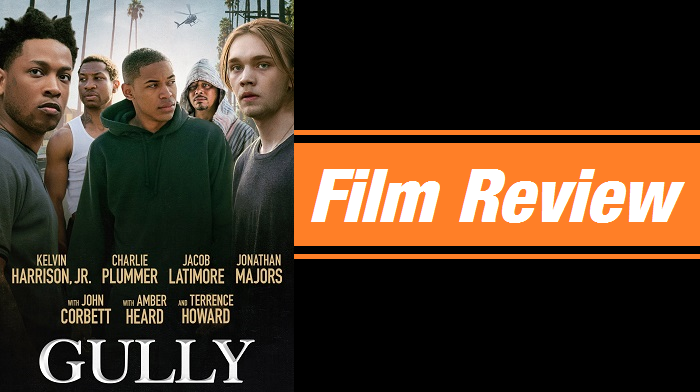
Three troubled teens unload years of pent-up rage over 48 hours of drugs, violence, and mayhem in “Gully”, the first narrative feature film from director Nabil Elderkin. Best known for his Hip Hop and R&B music videos for big acts like Kanye West, John Legend, and The Black Eyes Peas, Elderkin teams with screenwriter Marcus J. Guillory to tell an inner-city story with big aspirations that it never quite reaches.

The three close friends at the film’s center seem doomed from the first moment we meet them. Calvin (Jacob Latimore) is a charismatic kid with a mental health condition who routinely skips out on his medication despite the pleas of his concerned mother (Robin Givens). Jesse (Kelvin Harrison, Jr.) is quiet and full of pain which he keeps bottled up and hidden even from his two buddies. Nicky (Charlie Plummer) witnessed unspeakable violence as a child and while we get glimpses of a playful and carefree exterior, especially at home with his addict single mother (Amber Heard), inside he’s a swirl of volatility just waiting to implode.

Image Courtesy of Paramount Pictures

The movie works overtime stacking the deck against these kids. Abuse, poverty, no real father-figures – just a few of the things touched on to show the hard lives they’ve had. They’re essentially abandoned, stripped of any childhood, trapped within their rough Los Angeles neighborhood, and left to exist by the dictates of an uncaring and unreliable culture and society. The problem is the destructive elements that have led to their delinquency are never examined the way they should be. Instead the film is content with wedging in a brief scene here and there in an effort to earn our sympathies. It helps us to understand the boys better, but not enough for us to like them the way the movie wants us to.

Elderkin seems far more interested in soaking us in the debauchery and violence than exploring its root causes. This leads to a frustratingly muddled messaging. I don’t want to say the film glamorizes their sordid behavior, but there are scenes where it certainly comes close. And their sudden shift from mischievous juveniles to violent criminals comes without so much as an explanation. One second they’re letting out their rage and angst through a Grand Theft Auto styled video game. The next scene they’re beating a complete stranger to a pulp and stealing his truck. And it only gets worse from there. Are we supposed to excuse it all simply because a handful of brief scenes show the three were dealt bad hands? The movie never finds that much needed balance.

Image Courtesy of Paramount Pictures

Strangely there’s another running story that almost feels like it’s own thing. In it we see a terrific Jonathan Majors playing a recent parolee determined to live straight. In many ways his story is the most interesting and watching his character reacclimate to neighborhood life is more compelling than anything the three teens do. Sadly his story never really goes anywhere and it’s connection to the main story is minimal at best. We also get Terrence Howard randomly popping up as a homeless street profit who pushes his shopping cart around and speaks incoherent musings on street life. It’s a thankless role.

Nearly every facet of “Gully” works noticeably hard to be as gritty as possible – the dialogue, the direction, even the performances. It’s unfortunate because it handcuffs the three terrific young leads who otherwise do the best they can with what they’re given. As a director, Elderkin knows his way around with the camera and there are a number of striking images and visual choices to prove it. But overall it’s hard to figure out exactly what the movie is saying. Is it speaking out against violent video games? Is it a warning that violence begets violence? Is it just another story about hard times in inner-city neighborhoods? It touches on all of that and more but never with enough conviction. So we’re left with a lot of questions and too many ideas that never get the full treatment they deserve. “Gully” opens in select theaters June 4th and on VOD June 8th.

VERDICT – 2 STARS

REVIEW: “Godzilla vs Kong” (2021)

KONGposterr

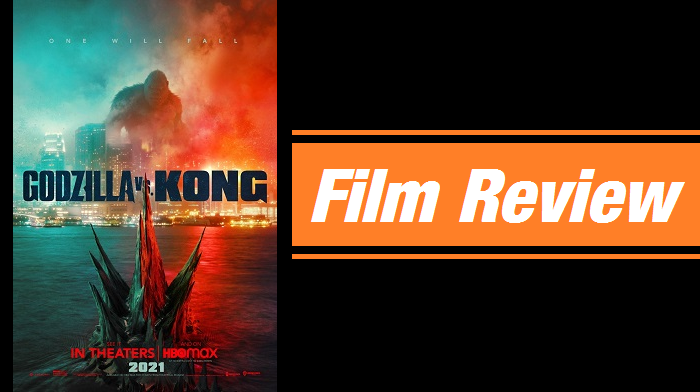
Sometimes a movie’s title says it all. That’s definitely the case with “Godzilla vs. Kong”, the fourth film in Legendary Entertainment’s MonsterVerse following two “Godzilla” movies and 2017’s “Kong: Skull Island”. It should go without saying, but you don’t enter into something called “Godzilla vs. Kong” with expectations of an emotionally layered and deeply nuanced story. Instead this is exactly what the title advertises. It’s 100% geek food and I was more than happy to fill my plate.

I’ve really enjoyed the MonsterVerse movies so far, much more than I expected. The three previous films each fed the shared-world space while still feeling individually unique. Some of the creative choices (especially in the “Godzilla” flicks) didn’t resonate with everyone, but I love how they gelled the classic approach to Godzilla with a more modern perspective. Meanwhile “Kong: Skull Island” was a straightforward, high-energy blockbuster full of fun yet surprisingly interesting characters and stunning eye-candy from start to finish.

KONG1

Image Courtesy of Warner Brothers Pictures

“Godzilla vs. Kong” goes for all of that plus some. When it goes big (which it does often) it makes good on its promises of big monster action and an epic showdown between two pop culture titans. The problems seep in with some of the human characters. But come on, this is all about King Kong, Godzilla, and a story that brings them together in a way that at least makes sense. By that measure director Adam Wingard and a writer’s room full of talent manage to pull it off, delivering a rousing crowdpleaser that’s sure to have kaiju fans high-fiving in the theater or on their couches.

The movie starts with some necessary table setting. The title creatures are believed to be the last two Alpha Titans on the planet. Kong is being held in a massive virtual reality containment dome on Skull Island by the Titan-studying organization Monarch. The facility is overseen by Dr. Ilene Andrews (Rebecca Hall) who has discovered a communication link with Kong via her adopted daughter Jia (Kaylee Hottle), a young deaf girl orphaned on Skull Island. The sweet bond between child and primate highlights the human bond Kong has always possessed dating back to his original 1933 RKO Radio Pictures movie. In that regard it makes sense that he gets more screen time.

KONG3

Image Courtesy of Warner Brothers Pictures

Though it took two movies of convincing, Godzilla is now viewed as a protector of mankind (although a moody one). But something has him stirred up and nobody knows what. For the first time in three years the scaly King of the Monsters emerges from the ocean waters and attacks a Pensacola, Florida research facility of Apex Cybernetics, an international tech corporation ran by the dapper Walter Simmons (Demián Bichir). Godzilla’s seemingly random rampage on the Gulf Coast complex has people of earth a little concerned including a returning Kyle Chandler who’s really only here to deliver deliciously hokey lines like “Godzilla is out there, and he’s hurting people, and we don’t know why!”

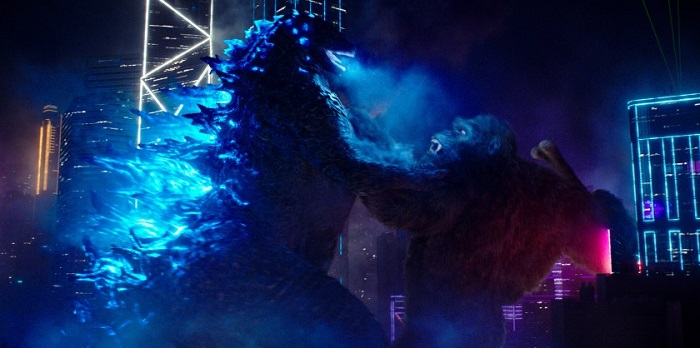
Following the attack, Simmons recruits tarnished ex-Monarch scientist Dr. Nathan Lind (Alexander Skarsgård) to head an expedition to Hollow Earth, a deep subterranean world and secret home of the Titans. Lind’s mission is to study a new-found energy source believed to possess enough power to enable mankind to defend itself against Godzilla. But to get to Hollow Earth Lind will need a guide. So he contacts Ilene on Skull Island and convinces her to let Kong lead them to the earth’s core. One problem – once Kong is out of containment Godzilla will likely sense the new threat and come for him. And of course he does. As a convoy of aircraft carriers and destroyers transport a lightly sedated Kong across the ocean, Godzilla attacks which leads to an exhilarating heavyweight rumble, the first of several eye-popping CGI clashes we’re treated to.

KONG2

Image Courtesy of Warner Brothers Pictures

I won’t labor on the plot (and there is more plot than you might expect), but it’s all quite ridiculous and that’s part of the fun. The biggest misfire is a silly side-story with Brian Tyree Henry as a podcaster and self-proclaimed whistleblower teaming up with a returning Millie Bobby Brown and her unfunny tag-along pal played by Julian Dennison. The trio suspects Apex of hiding something regarding Godzilla’s attack and through a series of meant-to-be-amusing sequences effortlessly break into and infiltrate the corporation’s highest security areas. The whole scenario is absurd and too hard to believe, and that’s saying a lot in a movie about two 350-foot(ish) tall behemoths duking it out. There are some smaller touches that are a lot funnier, mostly involving the creatures (take Kong waking up on Skull Island and taking a morning stretch to Bobby Vinton’s “Over the Mountain, Across the Sea”).

And that leads back the movie’s biggest draw – Godzilla and King Kong. Few of the human characters will stick with you save for young Kaylee Hottle who brings a ton of heart and warmth to the movie. But it’s the Rock’em Sock’em creature combat that audiences are going to show up for and the filmmakers know it. People want to see Godzilla’s radioactive fire breath and Kong’s primal chest pound. We come to a movie called “Godzilla vs. Kong” for big action and giddy spectacle. Wingard does exactly what he needs to – give us just enough story to move from set piece to set piece and then deliver the goods on a massive and glorious scale. I caught myself cheering, pumping my fist, and letting out more than one audible “WOW“, and that from a screener at home. I can’t wait to see it again this weekend, this time on a big screen. “Godzilla vs. Kong” opens Wednesday, March 31st in theaters and streaming on HBO Max.

VERDICT – 4 STARS

4-stars

REVIEW: “Greenland” (2020)

GREENpost

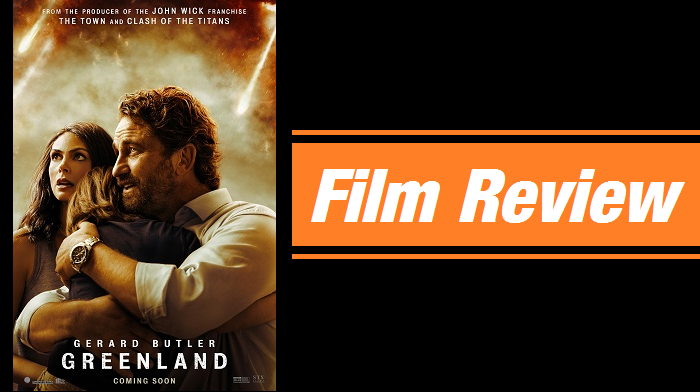
Except for the very rare surprise, you usually know exactly what you’re going to get with a Gerard Butler movie. It’ll either be silly, bombastic, and with more corn than a pan of Jiffy Pop or (if you’re lucky) a so-bad-it’s-good guilty pleasure. His latest film “Greenland” definitely falls within the “very rare surprise” category. Even more, it’s one of Butler’s best films in years; one that takes the familiar end-of-the-world idea and uses it to explore human nature in a surprisingly thoughtful way.

One of the biggest and most welcomed changes is that in “Greenland” Butler doesn’t play some invulnerable butt-kicking one-man-army. He’s not ex-special forces, ridiculously gun savvy, or spitting out machismo in ever line of dialogue. He’s a structural engineer. He has a son who is diabetic. And he’s trying to repair his fractured marriage. In other words he plays a character grounded in the real world. Kudos to screenwriter Chris Sparling for making that a focus of his script and to director Ric Roman Waugh for building his movie around the human element and avoiding the temptation to go big and loud.

GREEN1

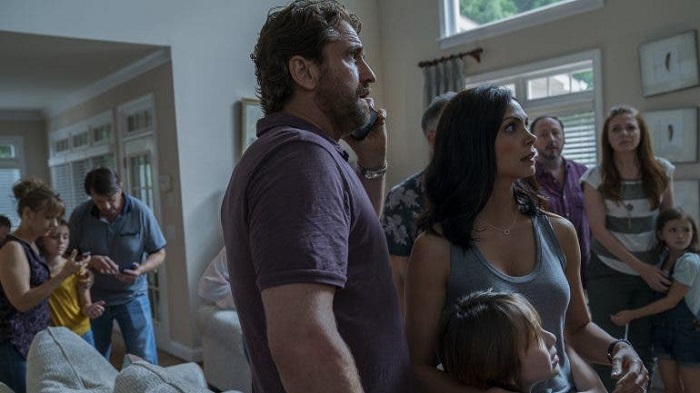
Image Courtesy of STX Entertainment

Not to be misleading, “Greenland” is still a disaster thriller. It has its nail-biting tension and explosive action. But those scenes in some way always serve the characters or the film’s human interests. It doesn’t wallow in scene after scene of CGI destruction nor does it waste time numbing our senses with inconsequential noise. In fact, audiences might be surprised at how much the film sticks to its convictions.

Butler reminds us that he has charisma and some acting chops playing John Garrity. We first meet him as he’s overseeing construction of an Atlanta skyscraper. But his mind isn’t on his work. He stares at his phone where a picture of his estranged wife Allison (Morena Baccarin) and young son Nathan (Roger Dale Floyd) brings a swell of emotion. We learn more about their separation later, but Allison has just allowed John to come back home. You can sense the hurt and uncertainty between them once he arrives. Meanwhile Nathan is just happy to have his father back.

As you probably know, disaster movies come pre-packaged with some kind of global threat. This time it’s an interstellar comet affectionately nicknamed “Clark” by scientists and the news media. It’s set to pass by earth with only a few harmless fragments expected to reach the atmosphere (yea right, “harmless”). As the cable news networks provide around-the-clock coverage, people put together neighborhood watch parties for this once in a lifetime event. But then the first fragment (predicted by “experts” to evaporate in the atmosphere) crashes into Florida evaporating the city of Tampa. Needless to say it changes everything.

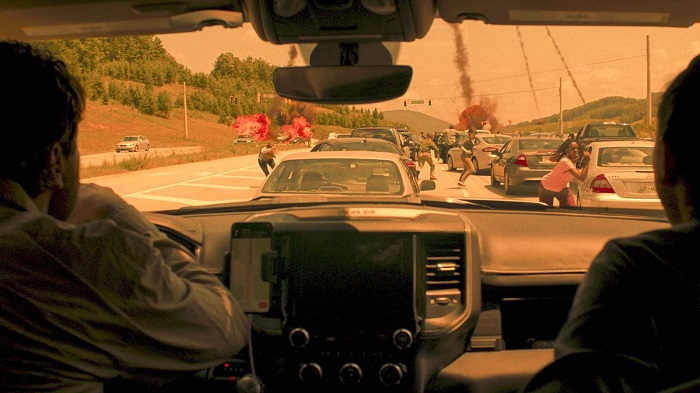
As more fragments approach, the government remains secretive in hopes of avoiding mass panic. Guess how that works. John receives a presidential alert on his phone telling him that he and his family are among a chosen group of citizens ordered to report to select military bases. Once there they will be checked in and then flown to an underground bunker in a secret undisclosed location. But when those not selected get wind of it they flock to the bases pleading to be allowed on the planes. And as more cities are decimated and with an “extinction level event” just 48 hours away, society begins to break down. This proves to be the biggest obstacle between Jack and his family and the safety of the secret bunker.

GREEN2

Image Courtesy of STX Entertainment

At different points in the story Jack, Allison, and Nathan get separated, something the film uses to explore the different facets of human nature. They encounter every make and model of humanity – some full of compassion and self-sacrifice, others who are malicious and opportunistic. It’s an unexpected layer of the story that really highlights one of the movie’s biggest interests. What does it look like when society begins to crumble? How does it look when kindness clashes with malice; when empathy meets callousness?

Adding to the film’s list of surprises, “Greenland” is consistently entertaining and never hits a lull. That’s because the whole thing is really about something more than comets and mass destruction. It’s about family. Yes we learn more about the government’s mysterious selection process and there is some interesting social commentary to boot. But it all comes back to the beauty of family; to fully appreciating what family means and the self-sacrifice required to grow it and protect it. I have to admit, that wasn’t what I was expecting when I heard Gerard Butler was doing a movie about an earth-killing comet. “Greenland” is now streaming on VOD.

VERDICT – 4 STARS

4-stars

REVIEW: “Gunda” (2020)

GUNDApost

I’ve always been amazed by cinema’s ability to take the simplest idea and turn it into something powerful and deeply affecting. It’s a mark of great moviemaking that has impacted generations since the birth of the industry. For a more recent example look no further than the quietly meditative and subtly message-minded “Gunda” from Russian filmmaker Viktor Kossakovsky. The film also sports Joaquin Phoenix as its executive producer.

This Norwegian documentary sees Kossakovsky directing, co-writing, co-editing as well as sharing cinematography duties. Shot in stunning high-contrast black-and-white, “Gunda” opens with a gorgeous still shot of a small wood pigsty. A sow lays on a bed of hay, its head partially out of the sty basking in the sun’s warm glow. The camera sits on the shot, admiring its simplicity and beauty. Then we notice movement in the shadows. Tumbling over its mother and out the doorway is a tiny piglet followed by another and then another. The shot cuts to inside where we get a clearer picture of what’s going on. Gunda, the eponymous sow is giving birth. It’s a beautiful scene and a clear introduction to the kind of film Kossalovsky has for us.

GUNDA1

Image Courtesy of NEON

“Gunda” shrewdly brings us into the farm animal’s world, immersing us in the everyday minutiae of farm life from their distinct perspective. To emphasize their point-of-view Kossalovsky is always shooting from his subject’s eye level. And when mixed with Alexandr Dudarev’s sublime sound design you get the indescribable sensation of not only being present but within arms length. Take an exquisitely captured sequence when Gunda and her piglets go for a stroll in the farmyard. The unintrusive camera subtly follows the rambunctious little ones at ground level, watching as they root and roughhouse while mama keeps a watchful eye. With the extraordinary closeness comes a certain unshakable intimacy and the clarity of the images means we catch every astonishing detail.

There are the occasional shifts to other livestock that almost work as interludes to Gunda’s story. One features a resilient one-legged chicken who refusing to let his disability slow him down. Later we watch cows burst out of a barn and then run across the field like kids on a playground racing to their favorite spot. Neither segment can cleanly escape feeling a little like filler. Yet both are shot with the same equally captivating photography and both feed into the film’s goal of getting its audience to reconsider how they think of farm animals.

GUNDA2

Image Courtesy of NEON

But Gunda and her piglets are the stars and the film always comes back to them after a chunk of time has passed. As the film moves forward and the piglets get older, an impending sense of doom sets in. Interestingly not a single human being is ever seen on screen nor a single voice ever heard. We only see the marks of their presence. But over time the audience is faced with the inevitable realization that it’s the humans who are the determiners of fate. This is shown with heartbreaking clarity in the film’s heartbreaking final moments.

While its message is crystal clear “Gunda” never lectures or browbeats. There’s no music to guide our emotions or narration to explain what we’re seeing. It doesn’t frame or stealthily edit scenes for dramatic effect. Instead “Gunda” asks its audience to observe, absorb and ponder. It’s unflinching dedication to its vision could prove too tedious for some. But for those able to fall in with the movie’s gorgeous poetic rhythm, it’s sure to resonate in a number unexpected ways. All while showcasing what Paul Thomas Anderson could only describe as “pure cinema”. “Gunda” received a limited release December 11th.

VERDICT- 4.5 STARS

4-5-stars

REVIEW: “Godmothered” (2020)

MOTHERpost

Only in a magical place called Motherland can aspiring fairy godmothers learn to plow their trade. And only in Motherland will you find June Squibb as the resident DJ proclaiming “It’s time to party like it’s 1699.” Actually there are a lot of amusing touches like that all through Disney’s upcoming family film “Godmothered”.

From director Sharon Maguire and co-writers Kari Granlund and Melissa Stack, “Godmothered” is a light, warm, and big-hearted fantasy comedy with just enough seasonal cheer to please Christmas movie fans. Its playful spirit and some charming performances carry it most of the way. But a very specific lack of originality and a bludgeoning final scene make it fall a little short of being perennial holiday viewing.

GODMOTHER1

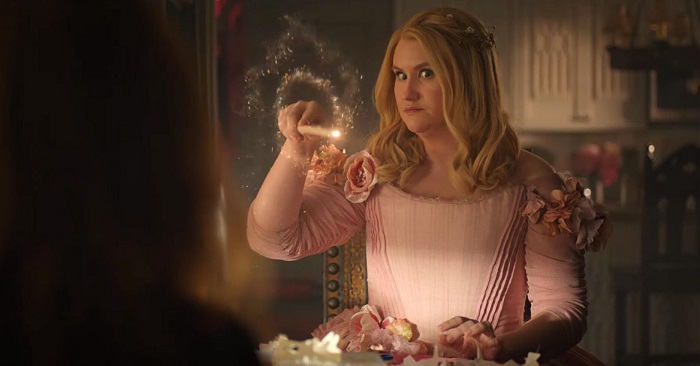
Image Courtesy of Disney+

Within minutes you can’t help but see the film’s biggest inspiration/problem. I don’t know how else to say it, but so much of “Godmothered” seems copied straight from 2003’s “Elf”. First is the concept, a kind-hearted outcast soul leaving a magical land to impart happiness and cheer to people who have lost it. A fish-out-of-water lead character visits a big American city for the first time. Sound familiar? Well it gets even more obvious than that. We even get specific gags and plot points shamelessly plucked right out of the Jon Favreau Christmas classic. There’s even a racoon!

Yet despite all that, “Godmothered” has an almost infectious charm much of which comes from it star Jillian Bell. She plays Eleanor, Motherland’s youngest fairy godmother trainee and the school’s only new applicant for decades. Turns out the world has stopped believing in “Happily Ever After” meaning fewer assignments for the godmothers. Because of this Moira (Jane Curtain), the head mistress and a strict enforcer of the outdated godmothering ‘formula’, is prepared to shut down the school and reassign the godmothers to dreaded tooth fairy duty.

Having none of it, Eleanor finds an old letter from 10-year-old McKenzie Walsh that fell through the cracks. Determined to prove the world still needs fairy godmothers, she secretly sets out to find McKenzie and grant her ‘happily ever after’ wish. The trail takes her to Boston where she quickly discovers McKenzie (played by Isla Fisher) is no longer 10-years-old. Instead she’s a cynical single mother of two who lost her husband years earlier and has given up on any chance at true happiness.

GODMOTHER2

Image Courtesy of Disney+

If you’ve seen “Elf” you know exactly where this story goes almost beat for beat. But the movie does bring a few laughs of its own and moments of genuine feeling. Fisher and Bell turn out to be real assets with surprisingly good comic chemistry. Both bring a sense of sincerity to their characters that offer emotional connections amid all of the silly fun. A smattering of good supporting performances fill out the story including the quirky Squib, Santiago Cabrera as McKenzie’s Clark Kent-ish co-worker, and Mary Elizabeth Ellis as McKenzie’s down-to-earth sister.

Still it’s hard to get past the lingering feelings of “I’ve seen this before”. And the film’s message, while handled well most of the way, is slammed home in a cringy, heavy-handed final speech that throws any hint of subtlety and nuance out the window. It’s hard not to like the film’s characters and the team of Fisher and Bell add sparkle and heart to an otherwise wacky premise. If only its lack of originality wasn’t so hard to overlook. “Godmothered” premieres December 4th exclusively on Disney+.

VERDICT – 2.5 STARS

2-5-stars