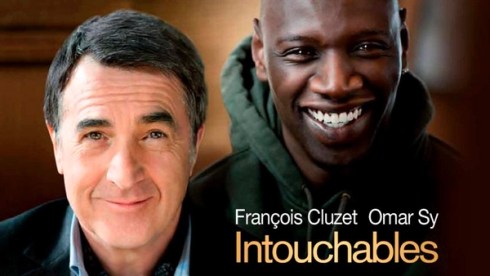
Rarely does a movie blatantly push all of my buttons yet completely win me over. That’s the case with the French drama The Intouchables. This is an irreverent and unashamed movie that aims to be a crowd pleaser and boy was it. It was a huge box office smash after its November 2011 release in France and eventually opened in the United States in 2012. But some critics have dismissed the film for its pandering to audiences and many critics who gave it positive reviews still spoke against its aim at broad appeal. But it doesn’t stop there. In absurd attempts to malign the film some critics have even deemed the movie to be racist and utterly offensive. Well this may not be the most well written quick response to these objections but I’ll say it anyway – Give me a break!
I have absolutely no problem with a movie aiming to be a crowd pleaser if it’s a good movie. The Intouchables is a very good movie and it works because of a smart and often times hilarious script and two fantastic lead performances. While it certainly goes for the feel-good emotion it also makes no apologies for its brash and playful handling of subjects that are often treated gingerly. For me that wasn’t a point of criticism. Instead it was fresh and new and one of the film’s several strong points. And the racism accusations defy reason. I’m not going to start breaking down plot points that prove the absurdity of the argument but let’s just say the film never promotes or depicts anything that led me to believe it was the slightest bit racist.
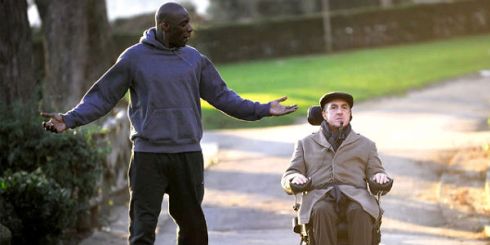
Now to the story – Olivier Nakache and Éric Toledano both wrote and directed this story of a wealthy quadriplegic man named Philippe (François Cluzet) and his new caregiver Driss (Omar Sy). The film starts with the two men speeding down a Paris street in Philippe’s Maserati. It’s obvious to us that the two have developed a bond and a friendship. From there the movie tells us their story through a one long flashback which begins with Philippe’s search for a new caregiver. A line of applicants sit in his lavish Paris mansion and among them is Driss. The other applicants are well dressed and educated in home care but all lack experience and some are just buffoons. Driss on the other hand is only there to get a signature to show he applied for the job and therefore qualify for a benefit. Fed up with waiting he barges in and gives a pretty brash “interview”.
Eventually Philippe hires him against the wishes of his staff. They find Driss to be loud and obnoxious but Philippe is looking for someone who doesn’t pity him and makes him feel alive. That’s the bond that fuels their relationship. The bulk of the film focuses on these two men and their improbable friendship. Both have their own set of issues and both find a release in the other. This is what I really responded to and not once did I find their relationship disingenuous or fabricated. I loved their playful banter and I appreciated how Philippe’s handicap was never used as a melodramatic pawn to anchor the narrative. Instead the film attempts to make him a real person to us. Yes he’s sympathetic but we also see him as experiencing life with the help of Driss.
The bigger reasons all this works are the two lead performances. Cluzet and Sy are brilliant and watching them play off each other is great entertainment. I found both performances to be full of sincerity and perfectly suited for the material. I had seen Cluzet in a handful of other French films including the more recent “Little White Lies” so his strong work here didn’t surprise me. But I was surprised at just how good Sy is. It’s really a big performance but it works very well. And I was blown away by his comedic timing, something that seems completely natural to him.

This leads me to another of The Intouchables strong points – the script. Nakache and Toledano put together a fantastic story that’s a great mix of heartwarming drama and hysterical comedy. For me it was the comedy that shined the brightest. Cluzet and Sy were great but a key reason for that was the well written screenplay. I loved the steady flow of humor and I have to say I haven’t laughed this much at a movie in a long time. But even the dramatic moments were strong and I was just as invested in them as anything else. They’re thoughtful and well conceived and aside from the occasional scene of contrived sentimentality it all comes together perfectly, just as you would hope it would.
There are several other things that I really loved about the film from the supporting work of Audrey Flouret and Anne Le Ny to the the beautiful piano driven score by Italian composer Ludovico Einaudi. But I think you get the point. Suffice it to say The Intouchables was a fantastic experience from its brilliant opening to its satisfying final scene. It’s an example of smart and capable filmmaking that can make you laugh as well as tug at your heartstrings. Yes it’s sometimes a bit showy and yes it sometimes plays to the masses, but I could care less. As long as it’s a good film I’m fine with it.
Check out my review of another solid French drama, “Girl on the Bridge“.