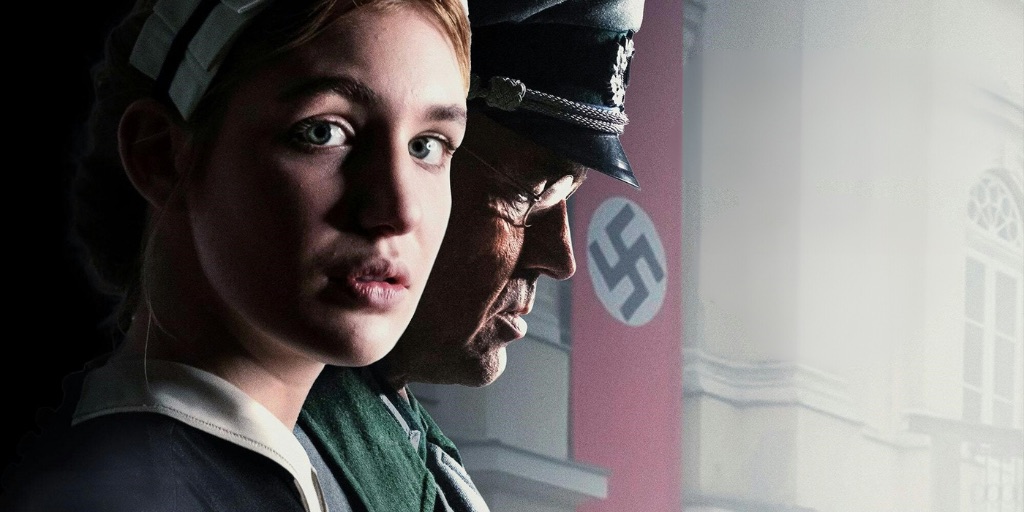
REVIEW: “I.S.S.” (2024)

Hats off to the creative minds behind “I.S.S.”, the smart and inventive science fiction thriller set aboard the low orbit International Space Station. Screenwriter Nick Shafir taps into real-world fears and tensions with his taut and suspenseful nailbiter. He offers up a frightening, paranoia-soaked vision of a not too distant future where mankind comes face to face with its own self-destructive nature. And he does so through a clever premise that unfolds within a most compelling setting.

Director Gabriela Cowperthwaite brings Shafir’s story to the screen with a firm control and a keen sense for tension building. She has a good grasp of the kind of movie she’s making, keeping a tight focus, skillfully managing budget constraints, and keenly utilizing the various facets of filmmaking (visual, sound, and performance more specifically). The result is a gripping sci-fi tale that resonates a lot more in our current day than we’d probably like to admit.

Following the Cold War the International Space Station (ISS) was constructed in a collaborative effort towards unity and progress between the United States and Russia. Primarily a research facility, the ISS has been instrumental in noteworthy advancements in technology, medicine, and the study of space. Pretty much all of that finds its way into the film’s story.

Image Courtesy of Bleecker Street

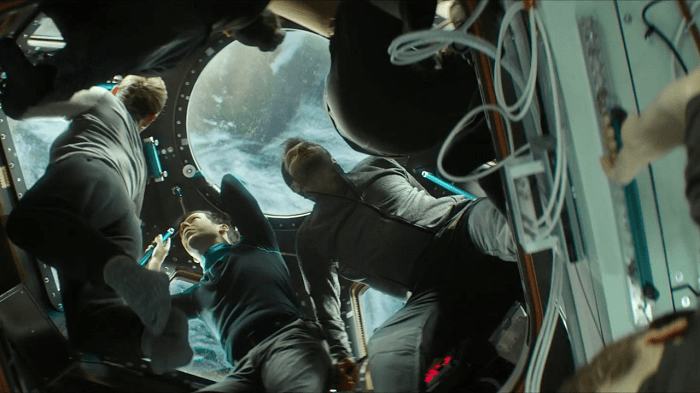
It opens with two United States astronauts, Kira Foster (Oscar winner Ariana DeBose) and Christian Campbell (John Gallagher Jr.) arriving at the ISS. They’re greeted by fellow American Gordon Barrett (Chris Messina) and three Russian cosmonauts, Weronika Vetrov (Masha Mashkova) and brothers Nicholai Pulov (Costa Ronin) and Alexey Pulov (Pilou Asbæk). This is Kira’s first time aboard the space station so she immediately starts learning the crew, getting acclimated to her new surroundings, and adjusting to life at zero gravity.

It doesn’t take long for Kira to take note of the camaraderie between the Americans and Russians. They’re a proudly unified group, never discussing the politics or the conflicts from the world below. But everything changes after they witness a series of massive explosions on the earth’s surface. Each group immediately attempts to contact their governments but to no avail. So as the earth burns down below, the crew aboard the ISS are left in the dark.

But only a short time later the Americans receive a chilling secret message from the surface. Their orders – take control of the ISS by any means necessary and no matter the cost. Surely the Russians received a similar message, right? From there Cowperthwaite steadily yet smartly ratchets up the suspense as crew members break off into factions, torn between their loyalties to each other and their calls to duty. Suspicions lead to distrust; apprehension gives way to panic.

Image Courtesy of Bleecker Street

Shafir’s script supplies an ample amount of twists and turns, leaning more on psychological tension than action-packed, effects-driven thrills. But that’s not to say the movie doesn’t look great. The stellar cinematography from Nick Remy Matthews creates a striking sense of claustrophobia and confinement within the station while also capturing the enormity of space outside. Meanwhile Anne Nikitin’s score looms ominously in the background adding to the growing dread.

If there’s one place “ISS” falls a little short it’s with the characters. They have very little depth leaving them hard to connect with on anything beyond a surface level. But even with that, they still fit nicely into the story, offering up different personas and perspectives that morph as their situation intensifies. The performances from the six-person cast are superb, especially from DeBose who turns out to be our fresh-eyed surrogate. It’s a strong feature film follow-up for the rising young star.

“I.S.S.” thrives thanks to a clever high concept idea from screenwriter Nick Shafir and fabulous execution by director Gabriela Cowperthwaite. The movie could have easily fizzled without one or the other. But both work in unison to bring us an impressively inspired and thoroughly entertaining genre film that happens to be the first big surprise of this young movie year. Don’t miss it. “I.S.S.” launches in select theaters on January 19th.

VERDICT – 4 STARS

REVIEW: “The Iron Claw” (2023)

Growing up as a kid in the South during the 1980s, professional wrestling had a huge impact. But it wasn’t just for knot-headed boys like me. Regional wrestling had fans of all shapes, sizes, and colors. Heck, it was my incredible grandmother who first introduced me to the wonderful world of pro wrestling. The two of us had a ritual. I would walk over to her house on Saturday mornings and together we would sit and watch Mid-South Wrestling. It was a special time.

During the territory days, the television shows, wrestling magazines, and arena cards were dominated by big names like Ric Flair, Harley Race, Junkyard Dog, Hacksaw Jim Duggan, and the Fabulous Freebirds (just to name a few). But few were bigger than the Von Erichs, a family of wrestlers originating out of Denton County, Texas. Brothers Kevin, David, Kerry, Mike, and Chris wrestled professionally under the leadership of their father Fritz. Sadly their many accomplishments inside the ring are often overshadowed by the personal tragedies that followed their famous family.

Sean Durkin writes and directs “The Iron Claw”, a wrenching biographical drama that sets out to share the story of the Von Erichs. Durkin highlights many of the family’s professional achievements and documents their rise in popularity. But his biggest focus is on their lives outside of the ring, namely the tight-knit brotherhood the boys shared and their well-meaning yet self-destructive drive to please their overbearing and demanding father.

Image Courtesy of A24

If you’re familiar with the true story of the Von Erichs you know “The Iron Claw” won’t be an easy watch. Durkin approaches it with honesty and empathy, palpably manifesting the pressurized father-sons dynamic and then hitting us with the inescapable heart-crushing results. It makes for a devastating family portrait. Yet it’s a story that doesn’t quite feel complete due to the odd omission of Chris Von Erich, the youngest brother who committed suicide in 1991. Durkin has stated Chris was left out because of running time concerns. But it could also have been an act of mercy – sparing us of even more anguish.

“The Iron Claw” is told mostly from the perspective of Kevin Von Erich (Zac Efron), the oldest son after the tragic death of his brother Jack Jr. at age 6. Through his eyes we see a family driven and ultimately decimated by a father’s personal war against a wrestling industry that never gave him the respect he felt he deserved. As a wrestler-turned-promoter, Fritz Von Erich (played with unnerving intensity by Holt McCallany) viewed everything through the prism of competition, pitting son against son and grooming them for his own selfish interests.

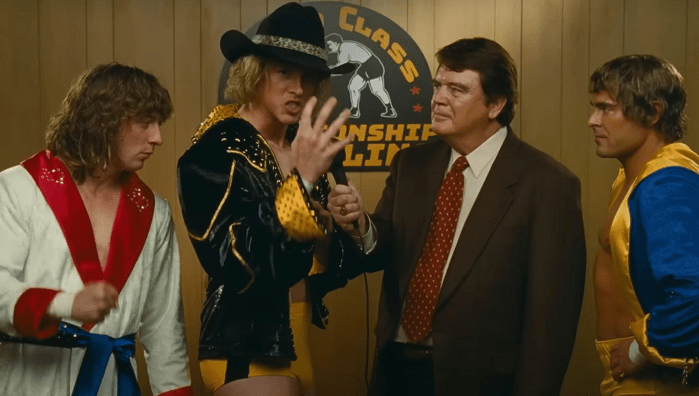
But Durkin keenly establishes the unbreakable fraternal bond between Kevin and his brothers David (Harris Dickinson), Kerry (Jeremy Allen White), and Mike (Stanley Simons). Their in-ring scenes are exquisitely choreographed and shot, often captured in rigorously detailed recreations of old television broadcasts and inside famed venues such as the Sportatorium south of downtown Dallas. When wrestling, the brothers have an electric presence that can energize a crowds (and us). These scenes are rich with nostalgia and loads of fun.

But it’s when they’re navigating the turbulence of their lives outside of the spotlight that their closeness really comes to light. Of course the brunt of that turbulence comes from their embittered father who shows little concern for the consequences of pushing his sons too hard. Fritz is especially tough on Mike who dares to have interests outside of wrestling. Their mother Dottie (Maura Tierney) isn’t much help. She refuses to get involved preferring to stay emotionally detached. So all the brothers really have are each other.

Image Courtesy of A24

The unfaltering love and devotion they share makes their eventual downward spiral all the more difficult to endure. “Ever since I was a child people said our family was cursed,” Kevin solemnly shares. It’s a thought firmly lodged in the back of his mind and that haunts him more with each devastating gut-punch to his family. There are moments of light, such as Kerry beating Ric Flair (Aaron Dean Eisenberg) for the NWA World Heavyweight Champion and Kevin meeting and falling for a straightforward sweetheart named Pam (Lily James). But in reality they’re doomed by a self-serving father’s iron claw-like grip on his family.

Thankfully Durkin does provide us with a needed emotional release – a cathartic final scene that’s wholeheartedly earned and that offers us a glimmer of hope. It’s a surprisingly tender stroke for Durkin and a fitting cap on his affecting screenplay – one of the year’s best. Equally great is the terrific ensemble cast led by Efron who has never been better. He physically bulks up for the part, almost to the point of being unrecognizable. But it’s his artlessness and heartfelt sincerity that imbues the performance with such authenticity and texture.

You don’t have to love professional wrestling to be enthralled with “The Iron Claw”. But that’s not to say old-school fans won’t love the numerous name drops and cool callbacks (Durkin has really done his homework). At the same time, you can’t put this film in a box with other sports dramas. The heart-rending true story it tells doesn’t allow it. And for that matter neither does Durkin. He has crafted a painfully absorbing feature through both his pen and camera. And even with the aforementioned omission, it’s clear he cares about this story. And the sincerity of his affection resonates in a really big way. “The Iron Claw” hits theaters December 22nd.

VERDICT – 4.5 STARS

REVIEW: “It Lives Inside” (2023)

In the supernatural horror film “It Lives Inside” Sam (Megan Suri) is an Indian-American high school student caught between fitting into western culture and honoring the traditions of her Hindu heritage. It’s a key conflict in the film with one side represented by dim and insensitive white kids and the other by Sam’s stern and legalistic mother Poorna (Neeru Bajwa). In that brief description lies both the strengths and weaknesses of this admirable yet unremarkable chiller.

Despite being a little too on the nose in how it’s represented, the above mentioned clash offers writer-director Bishal Dutta an opportunity to explore several compelling themes surrounding cultural identity, assimilation, and faith in our modern society. Unfortunately the movie never goes too deep into anything. But even a light treatment of such interesting and relevant subjects is welcomed. How long that good will lasts may vary.

Growing up, Sam and her childhood best friend Tamira (Mohana Krishnan) were inseparable. But once they entered high school Sam’s desire to make new friends led to them drifting apart. Sam fell in with the popular crowd while Tamira found herself bullied and an outcast. But something else is going on with Tamira. She looks as if she hasn’t slept for days. And she walks around clinging to a mysterious mason jar. A sympathetic teacher named Joyce (Betty Gabriel) encourages Sam to check on her estranged friend.

Image Courtesy of NEON

Meanwhile Sam’s strained relationship with her ultra conservative mother makes things difficult at home. Her more lenient father Inesh (Vik Sahay) tries to play peacemaker but to no avail. Dutta creates an interesting family dynamic and sets the table for some potentially thoughtful developments. But like so much in “It Lives Inside”, the movie barely scratches its thematic surface.

Then you have the movie’s horror element which offers plenty of atmosphere but very little in terms of genuine frights. Not wanting to ruin her newfound popularity, Sam eventually confronts Tamira, breaking her jar and unintentionally unleashing something quite sinister. Tamira suddenly vanishes and the demon begins terrorizing Sam. There’s certainly ambition and some of the symbolism is pretty smart. But the movie never gears up into something even remotely unsettling.

So we end up with a movie that hints at its cultural themes more than digs into them. And we end up with horror that’s too derivative to muster much tension. There are flashes that show Dutta’s potential as a filmmaker and the cast is solid despite the sometimes flimsy material. But as it is, “It Lives Inside” never quite reaches its mark. And that’s a shame because it has plenty of good ingredients that could have made for something tastier. “It Lives Inside” is in theaters now.

VERDICT – 2 STARS

REVIEW: “Indiana Jones and the Dial of Destiny” (2023)

Let me be perfectly honest and open – I have a soft spot for the Indiana Jones franchise that’s a mile wide and a mile long. It’s one of the biggest reasons that I loved the first three movies and genuinely disliked the fourth one. My childhood is marked by endless memories of the series’ titular archaeologist and college professor. Whether I was seeing the original three movies in the theaters or taking my replica whip and my grandfather’s wide-brimmed fedora and making up my own adventures, Indiana Jones has been indelibly etched into my personal history.

So there was no way I was going to miss seeing “Indiana Jones and the Dial of Destiny”, the fifth and final feature film adventure for this adored character. At the same time, I entered it with hopes that we would be seeing a fitting and heartfelt farewell for Indy and one that more closely resembled the first three films than the Crystal Skull debacle. It certainly had the potential. And with a budget nearing $300 million, it was clear Disney and Lucafilm weren’t taking any shortcuts.

This latest Indy adventure instantly had a lot going for it. It starts with Harrison Ford who returns to play what is arguably the 80-year-old screen legend’s most beloved character (although I know some Han Solo fans who might disagree). The film also benefits from having the great Mads Mikkelsen as its chief antagonist. He’s not handed the most well-rounded villain here. But Mikkelsen is always a treat.

Image Courtesy of Walt Disney Pictures

“Indy 5” is also helped by the addition of James Mangold, a smart and savvy director who clearly has a love for the franchise. He makes a few missteps and miscalculations, but for the most part Mangold is able to capture the spirit of Indiana Jones. His film is fun, action-packed, laced with humor, and with just the right amount of nostalgia to give us die-hard fans the warm and fuzzies.

But “The Dial of Destiny” isn’t without its problems. To its credit, it’s considerably better than Crystal Skull which admittedly isn’t the highest bar. But it doesn’t have the spark of the three earlier (and far superior) movies. There are flickers here and there, but it can’t maintain that playful energy of the better films. One reason is because it’s simply too long. Mangold and his three fellow screenwriters (Jez Butterworth, John-Henry Butterworth, and David Koepp) draw things out way longer than they need to and the occasional lulls are hard to miss.

There are also the issues of comedy and chemistry. The Indy movies have always had a sense of humor, much of it situational and almost always with pitch-perfect timing. The humor is definitely present in this one. But the jokes aren’t nearly as effective or even memorable.

Then there’s the chemistry. Among the many things the three earliest films had in common was a sparkling chemistry. In “Raiders” it was between Indy and Marion. In “Temple of Doom” is was between Indy and Short Round. In “Last Crusade” it was between Indy and his father. Sadly “Dial of Destiny” has nothing comparable. Phoebe Waller-Bridge is a nice addition playing Indy’s goddaughter, Helena Shaw. She and Ford share several good scenes and they play off each other fairly well. But there’s nothing that really stands out between them. I know that may sound like a small thing, but it’s noticeable.

Yet “Dial of Destiny” still connects in the places where it counts most. First off, the story is full of Indiana Jones signatures that fans should love. The awkward situations Indy finds himself in; the hilariously loud sound whenever he punches someone; the way his hat always finds its way back to him; how he continues to find ways to be a thorn in the Nazis’ side. And then there are the many references to classic franchise characters and past movie moments. Sure, there’s a bit of fan service involved. But it works.

Image Courtesy of Walt Disney Pictures

As for the story, the bulk of it is set in 1969 and follows a tired and melancholy Indy. He’s all alone after separating from his wife Marion and he’s left will little to do since recently retiring from teaching. But his dull and lonely life gets a jolt when his goddaughter Helena shows up inquiring about the Antikythera, also known as Archimedes’s Dial. It’s an ancient orrery split into three pieces and her late father lost his mind trying to unlock its secrets.

Indy has one piece of the dial and Helena wants it. But so does Nazi astrophysicist Jürgen Voller (Mikkelsen). Indy, Helena, and her sidekick Terry (Ethann Isidore) find themselves racing around the globe to find the remaining two pieces before Voller and his henchmen can get them and use the dial for their own nefarious purposes. It all culminates in a truly wacky yet undeniably fun final act spin before beautifully sticking the landing with a truly terrific final scene.

It may not capture every facet of a classic Indiana Jones adventure, but “Dial of Destiny” has so much that fans should enjoy. The action is mostly thrilling (despite some occasionally wonky CGI), John Williams’s final film score is as sweeping and epic as ever, and Harrison Ford simply IS Indiana Jones through and through. So resist the urge to over-analyze and embrace what you love about the previous films. If you do you’ll find a satisfying final chapter that lets the franchise end on a significantly better note. “Indiana Jones and the Dial of Destiny” is in theaters now.

VERDICT – 3.5 STARS
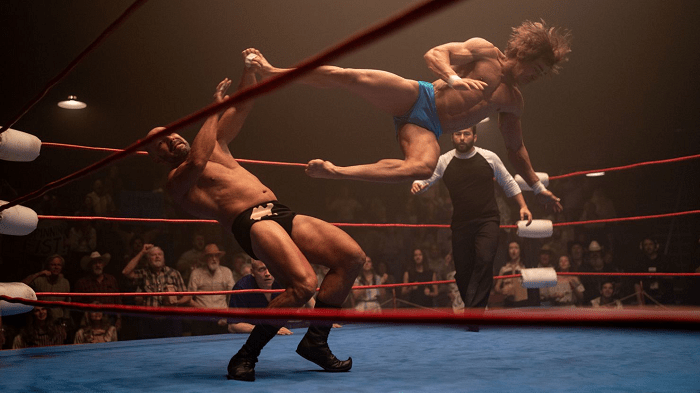
REVIEW: “Inside” (2023)

(CLICK HERE to read my full review in the Arkansas Democrat-Gazette)

I’ve always been impressed with Willem Dafoe’s broad range and versatility. With “Inside”, the seasoned and routinely compelling actor takes center stage in a high-concept genre confection from first time feature film director Vasilis Katsoupis. Penned by Ben Hopkins, working from a story by Katsoupis, “Inside” is a movie that sits somewhere between a stark survival thriller and a twisted exercise of the mind. And it sees Dafoe doing something he’s no stranger to – running his character through a mental and emotional wringer.

While you could call it a pandemic-era parallel or a genre lover’s cocktail, “Inside” has a lot more on its mind. It touches on isolation, anxiety, and the need for human connection. But at its core, the film explores the idea of art and its inseparable bond to the human will. It subtly (and occasionally not so subtly) poses thoughtful questions surrounding the purpose of art, keeping its answers vague enough for us to wrestle with.

Interestingly, the movie’s themes aren’t simply laid bare. It takes effort and plenty of observation to get what Katsoupis is going for. Clues are left like bread crumbs, scattered about and easy to miss if you aren’t paying attention. That may sound like a lot of work, but it invigorates the movie and keeps it from being just another solo survival experience.

Image Courtesy of Focus Features

Katsoupis wastes no time cranking up his story. Dafoe plays Nemo, a name that’s never revealed until the end credits. He’s an art thief who we first meet as he’s breaking into a lavish ultra-modern Manhattan penthouse belonging to a mysterious (and insanely wealthy) collector who is away in Kazakhstan. Nemo is aided by a voice on his two-way radio who first walks him through deactivating the security system. From there he’s told he has seven minutes to swipe a series of prized Egon Schiele paintings, most notably a self-portrait valued at a cool $3 million, and then make his escape.

Nemo nabs several expensive pieces but is surprised to find the self-portrait missing. With time running out, he’s forced to cut and run. But suddenly the security system malfunctions, sealing him behind locked doors, reinforced walls, and panes of unbreakable glass. His handler promptly abandons him, leaving Nemo to fend for himself. At first he frantically looks for a way to break out before the cops arrive. But it quickly becomes evident that no one is coming, and he is indeed trapped, left to his own faculties.

For the next little bit Katsoupis hones in on Nemo’s search for a way out of his posh impenetrable prison. He starts by chipping away at a gaudy ornate wooden door with his pocket knife. He attempts to bust out the giant windows overlooking the city. He tries to make a call but the phone is dead, and he can’t get online because there’s no internet service. It doesn’t take long before the realization of his situation sets in.

Image Courtesy of Focus Features

From there, Nemo’s ingenuity shifts away from escaping and towards survival. The dichotomy is almost surreal. There he sits in an ultra modern home surrounded by priceless works of art. In fact, you could say the penthouse itself is an art piece. But for Nemo it quickly becomes a hellish cell. Suddenly the heat turns on, sending temperatures climbing to over 100 degrees. Even worse, there’s no running water, and the refrigerator and cabinets are mostly bare.

As days rapidly pass, everything becomes expendable in the interest of staying alive and holding onto his sanity. And that includes the art, whether it’s using an expensive statuette to wedge a door open or busting a framed painting to use the wood and canvas. Yet even in Nemo’s dire circumstances, the movie shows the deeper values of art. For instance, as the freedom of the New York City skyline sits beyond panes of unbreakable glass like a cruel tease, art proves to be a soothing balm. Whether Nemo is sketching on shreds of paper or creating his own mural, we see his inherent urge to create and express.

It feels like a disservice to say much more as “Inside” is all about submerging us into the experience of its central character. It may sound dark and dour, and frankly it kinda is. There are brief moments of levity (such as “Macarena” by Los Del Río playing whenever the refrigerator door is left open too long). But through Katsoupis’ lens the feeling of confinement and being cut off from the outside world is palpable. And Dafoe’s physical and psychological transformation makes it all the more harrowing. His character may be a tad too opaque, but he’s fascinating nonetheless. Much like this reasonably demanding and slyly absorbing movie. “Inside” is out now in theaters.

VERDICT – 4 STARS

REVIEW: “I Came By” (2022)

Just a few days ago Netflix stealth dropped a chilling new potboiler called “I Came By”. Co-written and directed by Babak Anvari, this crafty yet overly ambitious thriller has a hard time finding the balance between social politics and straightforward genre filmmaking. Yet it still scratches at some meaty themes, and the genre thriller elements are a lot of fun. And it’s nice seeing a movie break from convention, even if its pieces don’t always fit.

Anvari takes an interesting approach to storytelling, ending his film in a dramatically different place than he begins it. He changes perspective several times, shifting between three different protagonists throughput the course of the movie. This infuses the movie’s fairly familiar premise with some unexpected layers. And there are more than a few surprises that keep the story simmering.

Image Courtesy of Netflix

Best friends Toby (George MacKay) and Jay (Percelle Ascott) have gained notoriety as what newspapers call “renegade graffiti vandals”. The masked duo targets wealthy and affluent Londoners, break into their swanky homes, and adorn their walls with their signature graffiti tagline, “I Came By”. Driven by their angst-filled convictions, Toby and Jay are products of a radical underground youth culture who are fed up with the establishment’s ways.

But their crusade against the rich hits a speed bump after Ray learns he and his wife Naz (Varada Sethu) are going to have a baby. He bows out of their cause, determined to settle down and be the best father he can be. A frustrated Toby chooses to carry on without his partner in crime, taking aim at a new mark – a recently resigned high court activist judge named Hector Blake played by a deliciously sinister Hugh Bonneville. This is a truly twisted turn from the man who plays the kindly Mr. Brown from the “Paddington” movies.

Image Courtesy of Netflix

Saying much more would be doing a disservice as this truly is a movie built around subverting your expectations. So the less you know the better. But it’s safe to say the movie’s change of perspective is key. It starts with Toby but soon shifts to his single mother Lizzie (Kelly Macdonald). She has a hard time connecting with her embittered son, and their turbulent relationship is rooted in some deep-seated pain. Macdonald is excellent, and while I wish Anvari would have dug deeper into her character, Macdonald does a good job making us care. Later, the movie shifts to Jay’s perspective which offers a much different take on the unfolding events.

But it’s Bonneville who makes the movie and takes it to some unsettling places. The film is at its very best when it lets him loose to uncoil the secret side of his otherwise esteemed character. It makes for some gnarly genre entertainment. Yes, shots at capitalism, greed, and corruption are certainly taken. But they don’t quite resonate the way the movie wants. They’re interesting additions that show the film has some things on its mind. But they don’t go far enough to leave an impression. Instead, it’s the thriller elements that energize the movie. Anvari shows himself to be a savvy filmmaker with enough tricks up his sleeve to keep us guessing. And that’s a big part of the fun. “I Came By” is now streaming on Netflix.

VERDICT – 3 STARS