
REVIEW: “Infinite” (2021)

Antione Fuqua has a filmography marked by an interesting assortment of action thrillers. Not all of them are hits, but even his misses are reasonably entertaining and have a particular level of grit and verve. His new film “Infinite” stands out from his other movies and not in the way you would hope. It essentially lacks all of the aforementioned grit and verve he’s known for. After seeing it it’s clear why the movie’s theater release was scrapped and it was sent straight to Paramount+ streaming platform with practically no promotion whatsoever.

In terms of concept, “Infinite” borrows from a number of other science-fiction thrillers including “Inception” and “The Matrix”, but never comes remotely close their level. I can only guess it’s a case of a film’s script (written by Ian Shorr) sounding a lot better on paper. The movie stars Mark Wahlberg, an actor not exactly known as the most emotive. Here he’s at his most emotionless, never showing an ounce of feeling other than occasionally raising his voice a pinch out of irritation. I still haven’t figured out if this was how Wahlberg was directed or if he is just bored out of his mind.

Image Courtesy of Paramount

Wahlberg plays Evan McCauley, a diagnosed schizophrenic with a history of violence who is in desperate need of a job to pay his rent and to get his meds (in some early narration we’re warned that things can go bad if he doesn’t get his meds). On the stranger side of things we learn he possesses a number of peculiar skills yet he has no idea where he learned them. For example, one second we watch Evan getting turned down in a job interview and then the next he’s forging a samurai sword. He has no idea where he learned how to do it. It’s just something he’s always known how to do. It sounds ludicrous, but along with dreams that feel like memories and a strange exhaustive knowledge of history, it really gets into one of the cooler elements of the story.

But that’s about as close as we get to exploring the the human implications or the emotional struggle that would come with such an unusual condition. Instead we get a story that is essentially drab and endless world-building bookended by an action-packed opening and ending. There are some cool car chases to start the movie and it has some preposterous yet amusing showdowns to finish. But the tedious and thoroughly uninteresting middle is hard to endure.

Image Courtesy of Paramount

The movie tries to sell us on a world full of reincarnated warriors called Infinites. We hear about how they have split up in to two warring sides, the Believers (the good guys) and the Nihilists (the baddies). The Believers feel it is their duty to protect humanity, much like they have done throughout time. The Nihilists…well you know. They’re led by Bathurst, a centuries old Infinite now running around in Chiwetel Ejiofor’s body. He has “lost faith” in the Infinite’s mission and is after a world-ending “egg” that will wipe out all life (trust me, it’s better not to ask too many questions). But the egg’s location is buried somewhere in Evan’s head making him the target of both the Believers and the Nihilists.

Perhaps the movie’s biggest shortcoming is that it spends a lot of time talking about relationships from the past rather than building any meaningful new ones on screen. So we end up following a bunch of hollow characters as they slowly move towards the inevitable bombastic finish. The compelling idea of a man haunted by other people’s memories has all the ingredients for a fun movie. But the lack of interesting characters, the relentless exposition, and the bland world-building make “Infinite” a humorless and soulless slog that a few well-shot action scenes can’t cover up. “Infinite” is now streaming on Paramount+.

VERDICT – 1.5 STARS

REVIEW: “In the Heights” (2021)

In 2016 Damien Chazelle and Justin Hurwitz brought some much-needed spice to the movie musical with “La La Land”. The film was a hit with critics and audiences alike and offered proof that the movie musical was still very much alive. And then you have Lin-Manuel Miranda’s “Hamilton”, a Broadway musical that went from Tony Award winner to full-blown cultural phenomenon. Those two productions helped pave the way for a film like “In the Heights”, a new musical that borrows from both “La La Land” and “Hamilton” yet for the most part still manages to make something uniquely its own.

There had been talks of an “In the Heights” film adaptation for at least ten years, but it was the success of “Hamilton” that really got things moving forward. Based on a stage musical by Quiara Alegría Hudes and Miranda, “In the Heights” is directed by Jon M. Chu of “Crazy Rich Asians” fame from a script written by Hudes and music by Miranda. It’s set in the Manhattan neighborhood of Washington Heights, a tight-knit and mostly Latino community pulsing with pride, music and culture.

Image Courtesy of Warner Brothers.

Much like “Hamilton”, Miranda’s music speaks its own unique language, often using rap, singing, and something in between in place a straight dialogue. It’s a skill no doubt, but one that can at times be frustrating and a little exhausting. The movie shines brightest in its big musical numbers where everyone is on their feet and the block bursts with energy and local flavor. It’s that hard-to-define lyrical style (not quite rap, not quite song, not quite spoken word) which turns out to be hit-or-miss. The good scenes crackle with fun free-flowing rhythm. But there are times when you wish Miranda would dial it back and just let his characters just speak.

While Miranda’s lyrics do most of the talking, Hudes gives us some welcomed moments of conversation that help form the backbone of the story. But her writing can be a little shaky, jumping from emotionally rich and moving to on-the-nose and even a bit cloying. Meanwhile the story as a whole struggles to find the right balance of tone. The first half is the best as we hang out with the characters, listen to their stories, and soak in the neighborhood through their eyes, ears, and voices. The final third is all over the place both narratively and tonally. It has several good moments, but much of it feels pasted together and lacks flow. And both Miranda and Hudes fumble their opportunities at political commentary by sloppily wedging in a couple of attempts that couldn’t feel any less organic. One ends an otherwise sublime swimming pool number while the other comes out of the blue and feels completely manufactured.

Image Courtesy of Warner Brothers

All that said, despite its hefty two-hour and 20-minute running time, there really isn’t that much story. But you barely notice because Miranda and Hudes do a great job of making us care about their characters and the deep communal bond that connects them. It’s what makes their individual stories both endearing and in some cases heartbreaking. And it’s the characters and our emotional commitment to them that brings Washington Heights to life. The characters ARE the story and everything from Miranda’s music to Hudes’ words to Chu’s camera emphasizes that. Meanwhile a top-to-bottom terrific cast elevate the script and Chu is smart enough to let them take the lead and carry the load.

The story unfolds over several hot summer days before, during, and after a blackout hits Washington Heights. We mostly follow two young couples, both obviously in love but poor at expressing it. Usnavi (Anthony Ramos) is a bodega owner who has his eyes firmly on Vanessa (Melissa Barrera) who gives him every opportunity to finally ask her out. The problem is he has big dreams of leaving the Heights and going back to the Dominican Republic to run a beachside business like his late father. She is an aspiring fashion designer with plans to move uptown closer to the industry she loves. The other couple is Nina (Leslie Grace) who has just returned home following a difficult first year at Stanford and dreads telling her father that she is considering quitting. She’s in love with Benny (Corey Hawkins) who works for Nina’s widowed father Kevin (Jimmy Smits) and is caught between the daddy-daughter tension.

Image Courtesy of Warner Brothers

The stories of the two couples cross over and include many of the same neighborhood people. There’s the aforementioned Kevin who can’t fathom his daughter not going back to California for her sophomore year. We get Usnavi’s fiery teen cousin Sonny (Gregory Diaz IV). And the barrio’s matriarch Abuela Claudia (Olga Merediz) who raised Usnavi and almost every other kid on the block. There are the three high-energy gossips who run the local salon (Daphne Rubin-Vega, Stephanie Beatriz and Dascha Polanco). Even Miranda pops up now and then pushing a cart and peddling flavored shaved ice to the local kids. They all form the beating heart of the movie. And led by a star-making turn from Ramos and the eye-opening presence of Barrera, this is easily one of the best ensembles of the year.

While Chu struggles with some awkward pacing on the film’s back-end and his movie is around a half-hour too long, he has no problem pulling us into the titular neighborhood. Alongside his terrific DP Alice Brooks, Chu captures the effervescent spirit of a changing Washington Heights and give us a taste of the music, personality, and culture that is so deeply a part of its identity. At the same time Christopher Scott’s kinetic choreography pops off the screen, mixing with Miranda’s hip-hop and Salsa infused beats to give us the film’s most vibrant scenes (an absolutely electric nightclub fiesta may be my favorite). It all leads to an imperfect yet rousing crowdpleaser that may be the ideal movie for those looking to finally burst out of quarantine. “In the Heights” opens today (June 11th) in theaters and streaming on HBO Max.

VERDICT – 3 STARS

REVIEW: “In the Earth” (2021)

EARTHposter

Filmed over the course of fifteen days during the COVID-19 pandemic, Ben Wheatley’s new film “In the Earth” is a micro-budget chiller with the anxieties of our current locked-down society sewn within its fabric. Coming off last year’s fun yet imperfect “Rebecca”, Wheatley returns to the dark and gnarly storytelling he cut his filmmaking teeth on. And at a time when so many are burned out from quarantining and itching to get out of the house, “In the Earth” may leave you second guessing that impulse.

Despite the obvious constraints of filming during a pandemic, “In the Earth” doesn’t deserve to be simply tagged as a ‘COVID movie’ the way some others do. None of the limitations show up on-screen which is quite an accomplishment. Even better, nothing about it feels like genre rehash. Wheatley takes several rather familiar horror ingredients (a creepy forest setting, ominous fog, etc.) and then twists them to fit into his unsettling and occasionally macabre mold.

EARTH1

Image Courtesy of NEON

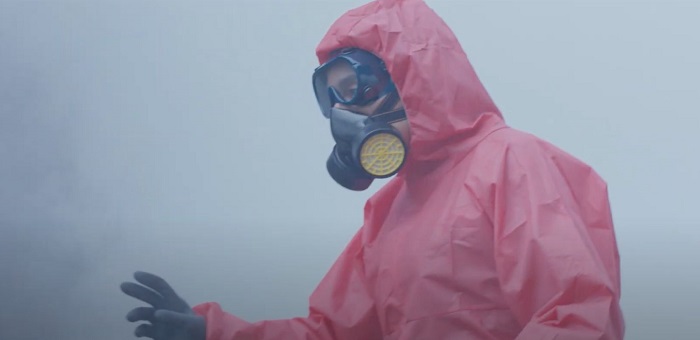
The film opens with science specialist Martin Lowery (Joel Frey) arriving at the Gantalow Lodge which has been turned into a research site. He’s there to check on a friend and former colleague Dr. Olivia Wendle (Hayley Squires). She came to the nature reserve to study the brain-like mycorrhizal network of roots believed to control the entire forest, but he hasn’t heard from her in months. As most of us are familiar with, Martin is immediately ushered through a series of safety and decontamination protocols. Blood tests and urine samples frame this is a much more severe pandemic than ours. But other touches (masks, gloves, hand sanitizer) seem plucked right out of our current climate.

Everyone at the lodge comes across as exhausted and drained, worn down by the isolation and ready for some semblance of normalcy (sound familiar?). Martin is no different. In fact we learn this is his first time outside in four months. So they all go through their testing routines with a detached sense of obligation. They passionlessly discuss the pandemic, Martin’s work, and even a local folktale about about a creepy forest entity called Parnag Fegg. During these early scenes Martin is introduced to Alma (Ellora Torchia), a park ranger who will guide him on the two-day walk to Olivia’s remote camp.

Early the next morning Martin and Alma begin their long and soon-to-be terrifying trek. Wheatley sets his audience up as an observant tag-along, listening in on their small-talk and shadowing the two as they make their way through the woods. Sometimes DP Nick Gillespie’s camera lurks several yards away, taking in more of their surroundings and slyly creating a sense of dread for what’s to come. Wheatley’s crafty visuals bring a subtly sinister quality to the forest especially when they set up camp after the first day’s walk. Tall trees creaking in the wind like old bones, indiscernible howls in the night – it’s all really effective. And the suspense ramps up even more once Martin and Alma meet a mysterious park squatter named Zach (Reece Shearsmith).

EARTH2

Image Courtesy of NEON

It would be a major disservice to go much further and not because there is a lot of plot to spoil. It’s more about experiencing what the characters experience and the murky revelations we get once Wheatley’s loose-fitting puzzle pieces start coming together. It all plays out like a wicked blend of horror sub-genres, from the sadistic splashes of gruesome body horror to the wild psychedelic mind-screw of the final 15 minutes. That’s where Wheatley starts mixing mysticism, technology, and science into one bizarre and somewhat macabre stew. And through it all Clint Mansell’s twisted synthesized score keeps things slightly off-kilter and us constantly on edge.

People get a bit funny in the woods sometimes.” That early line from a doctor back at the lodge turns out to be some pretty meaty foreshadowing. With “In the Earth” Ben Wheatley and his small but able cast and crew take that idea and run with it. The result is a movie full of unease; with moments that will make you squirm, and enough confidence to rely on its material rather than cheap scares. It doesn’t all come together in the clearest or cleanest way which manages to be both frustrating and strangely fascinating. Still the movie represents a fresh slice of horror which is something the well-traveled genre is always in need of. “In the Earth” premieres in theaters April 16th.

VERDICT – 4 STARS

4-stars

REVIEW: “I’m Your Woman” (2020)

WOMANposterr

2020 was quite a year for Amazon Studios. Take a quick gander at their catalog and you’ll find star-driven features, sharp-minded indies, ambitious anthologies, and some insightful documentaries. They have showcased a diverse selection of films and filmmakers while opening doors for some exciting new voices. And while all of those things are true, for some people it’s as simple as this – they’ve made some really entertaining movies. Now you can add “I’m Your Woman” to that list.

The movie is directed by Julia Hart who also co-wrote the script with her husband and co-producer Jordon Horowitz. The two are the minds behind 2018’s “Fast Color”, a wonderfully moving superhero drama that never quite got the audience it deserved. “I’m Your Woman” is a much different movie. It’s a neo-noir crime thriller that happens to have a lot to say about motherhood and carving out your own identity.

WOMAN1

Image Courtesy of Amazon Studios

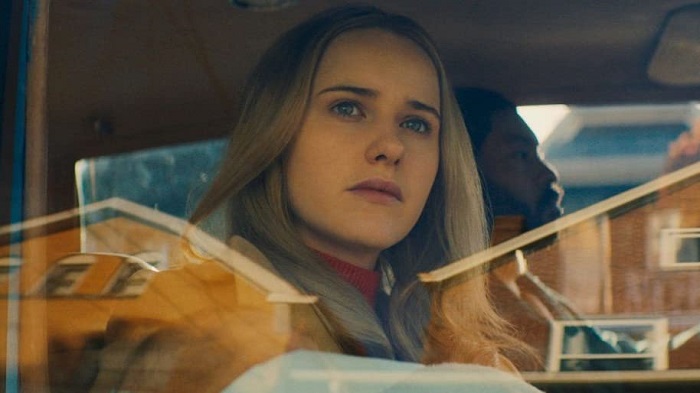
Rachel Brosnahan of “The Marvelous Mrs. Maisel” fame stars as Jean, a young wife living a comfortable life in the late 1970’s thanks to her husband Eddie (Bill Heck). He’s a small-time hood who keeps his activities to himself and Jean is content to ask no questions. In fact Eddie keeps his business so secretive that Jean is stunned when he suddenly brings home an infant baby. The couple has wanted children, but Jean hasn’t been able to get pregnant and they can’t adopt due to Eddie’s record. Yet a few minutes into the movie Jean finds herself a new mom.

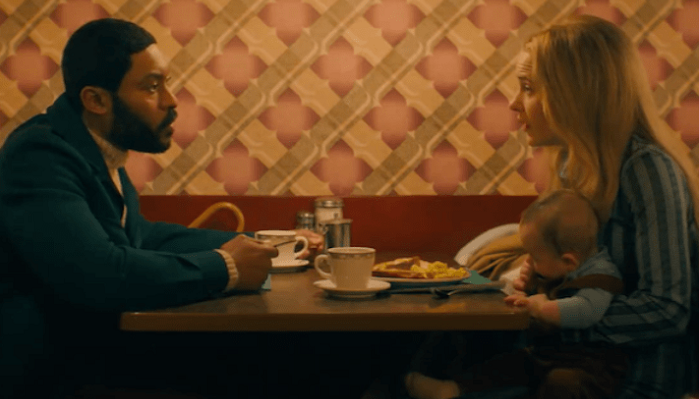
But things take a dramatic turn when Jean is awoken in the middle of the night and informed that Eddie’s latest job went south and some really bad people are not only looking for him but for her. Eddie has went into hiding but one of his associates named Cal (Arinzé Kene) is tasked with getting Jean and her baby to safety. From there the story makes several stops and introduces several new people. None of them really want to tell Jean (or us) anything so she spends a lot of time in the dark wondering who to trust. Eventually she learns Eddie wasn’t so small-time and it’s ultimately up to her to save herself and most importantly her child. And she’ll have to parse friend from foe in the process.

WOMAN2

Image Courtesy of Amazon Studios

The film moves along at an interesting but unusual pace. There are scenes of high tension and suspense especially in the moments when Eddie’s rivals close in on Jean. But then you’ll get quieter scenes showing Jean struggling with the responsibilities of motherhood but learning from different people she encounters. One of the most intriguing of the supporting characters is Carl’s wife Teri (Marsha Stephanie Blake), a tough-minded woman who is well versed in the life of a criminal’s wife. Like everyone else she has her secrets, but she also inspires Jean to toughen up and be ready for what’s to come.

Of course what’s coming is a violent final act where all of the consequences of Eddie’s actions come back to bite Jean. As someone who hasn’t seen “Mrs. Maisel” the performance from Brosnahan is an eye-opener. In addition we get strong supporting work, a good 70’s throwback vibe, and a surprisingly gritty finish. It can be a bit maddening waiting for the supporting characters to finally reveal to Jean what we already know, but it all adds up to a fun and satisfying female-led noir. “I’m Your Woman” is now streaming on Prime Video.

VERDICT – 3.5 STARS

3-5-stars

REVIEW: “I Care A Lot” (2021)

CAREposter

Rosamund Pike once again taps into her dark side for her latest film “I Care A Lot”, a snidely titled drama written and directed by J Blakeson. The film had its world premiere at the 2020 Toronto International Film Festival with its US distribution rights grabbed by Netflix. The film sees Pike stepping into the skin of a delightfully caustic character so unashamedly ruthless and vile that it makes her Amy character from “Gone Girl” look like a Girl Scout.

I’ve been poor. It doesn’t agree with me.” That’s a telling introduction to Pike’s character Marla Grayson, but even it doesn’t come close to fully representing the depths of her depravity. Marla is a social racketeer who makes her living scamming elderly people out of their money. It works like this: She appears in court convincing naive judges to appoint her the ‘legal’ guardian of seniors who can no longer take care of themselves. She then shuts out potentially troublesome family members, takes control of the person’s finances, puts them in a nursing home, and then drains their bank accounts dry. To add another sickening layer, her court-sanctioned elder abuse comes with the help of unscrupulous doctors who point her towards vulnerable marks and crooked nursing home administrators who house her wards for profit.

CARE1

Image Courtesy of Netflix

How’s that for detestable? And just think, she’s the movie’s protagonist! An impossible one to root for, but the protagonist nonetheless. She’s essentially a horrible person in a movie about horrible people. Still Marla is the toxic centerpiece, a ravenous predator with a devilish radiance who wields her blonde bob and illusive smile like a weapon. And what’s so unnerving is how unmoved she is by her actions; how she can sell her pack of lies to the court and never blink an eye. Pike’s Marla is cruel, perversely callous and with the help of her partner-in-crime and fellow leech Fran (Eiza Gonzalez), she manipulates her way through the system without a second of moral pause.

There are things about her hustle that doesn’t make sense, namely how she’s able to manage and pocket her victim’s assets once they’re put in a facility when in reality assets count against the patient and go towards their nursing home expenses until they run out. In real-life residents have to account for all of their assets from property to insurance policies with cash value before the state will pick up the cost. Then again maybe the movie is saying that in a system full of flaws who’s to say there aren’t holes big enough for snakes to crawl through?

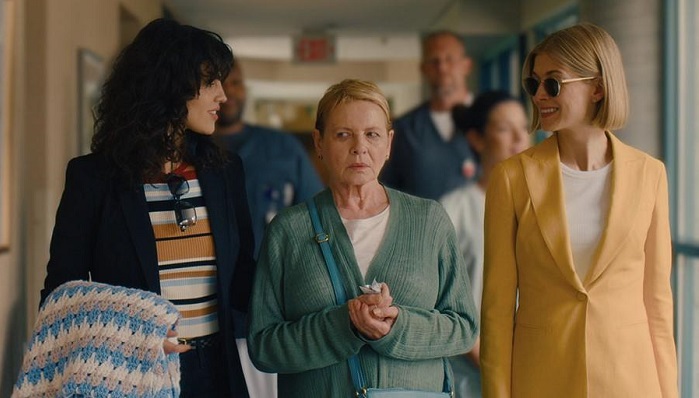
Marla’s perfect scam is complicated when she hones in on a wealthy new target named Jennifer (played by a superb Dianne Wiest). She seems like the perfect score – nice house, never married, no family. What follows is one of the film’s best sequences as Blakeson shows Marla in action. She and Fran coldly and methodically execute their well-oiled racket, from scouting out their potential victim to broadsiding Jennifer with a court order. In a snap Jennifer goes from having tea and reading the newspaper in her dining room to being shown her new ‘home’ at a nearby senior facility as a “ward of the state”. Meanwhile Marla strips the house bare, sells off Jennifer’s possessions, and begins funneling the money into her own account.

But this time Marla missed a key detail in her pre-scheme investigation. It turns out Jennifer has a very unique connection to an underworld figure named Roman Lunyov (Peter Dinklage) and he doesn’t take kindly to Marla’s actions. First he tries to handle it the ‘clean’ way by sending his lawyer Dean Erickson (Chris Messina) to meet with Marla. In my favorite scene of the film the two cunningly spar over Jennifer’s release in a meeting full of insincere smiles and poorly veiled threats. Marla refuses to cave while demanding to know who Dean works for. Dean not-so-subtly warns her that not complying could have…”uncomfortable” consequences. It’s such a good scene.

I Care A Lot: Rosamund Pike as “Martha”. Photo Cr. Seacia Pavao / Netflix

Image Courtesy of Netflix

Blakeson introduces some good tension in the middle act as Marla tries to figure out who she’s up against while Roman begins utilizing his unsavory resources to free Jennifer. Unfortunately it all comes unglued in the final third where the story relies on a series of absurdities to get us to the finale. Wiest who is so good vanishes from the screen and Marla goes from a sinister manipulator of the system to a half-baked 00 Agent of sorts. In a flash I went from repulsed (in a good way) and utterly fascinated to laughing out loud at how unintentionally preposterous things had become. The very end has a satisfying kick, but the lead-up to it feels like it belongs in an entirely different movie.

“I Care A Lot” starts as a wickedly potent dive into elder abuse, unethical healthcare practices, and unfathomable greed all channeled through a character so morally bankrupt that you can’t help but be mesmerized by her every word and action. Pike’s brilliantly hellish lack of compassion is burned into every scene, at least in the film’s first half. But then it takes its turn into something far less interesting and much harder to buy. It unravels in a way that’s both baffling and frustrating, so much so that its solid ending can’t fully get the movie back on track. “I Care A Lot” premieres this Friday on Netflix.

VERDICT – 2.5 STARS

2-5-stars

SUNDANCE REVIEW: “I Was a Simple Man” (2021)

SDsimple

Dying isn’t simple, is it?” It’s a question that echoes throughout the upcoming drama “I Was a Simple Man”. The film comes from writer-director Christopher Makoto Yogi and had its world premiere at this year’s Sundance Film Festival. Through his film Yogi turns something personal into a uniquely ethereal look at mortality, repression, and reckoning with the sins of your past. But it’s the perspective that’s distinct. Yogi tells the bulk of his story through the mind of a dying man.

“I Was a Simple Man” was inspired by Yogi’s personal experiences of being in the room as his grandfather was dying. The filmmaker recalled his grandfather calling out to people from his past and seeing faces in the room who weren’t there. The film is Yogi’s attempt to not only process what he saw, but to visualize what his grandfather might have been going through.

Set in Hawaii and shot with undeniable heart and pride, the movie makes it a goal to authentically portray Hawaiian culture, blemishes and all. Rather than deal in rose-colored idealism, Yogi simply tells a universally human story that’s still very specific to the islander tradition and way of life. Cinematographer Eunsoo Cho’s camera ensures the island’s natural beauty is never lost on us. But it’s his still observational style, especially in the early scenes, that plants our feet in the culture. The film is a visual feast but also very grounded.

SIMPLE1

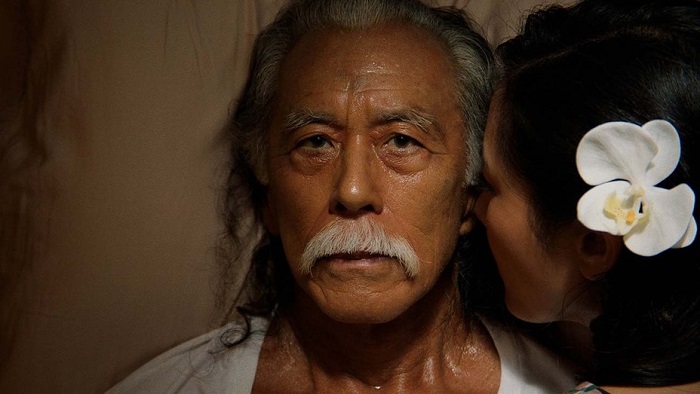
The story revolves around an elderly man named Masao (a wonderfully reserved Steve Iwamoto). He lives alone, quietly going about his daily routine. Yet there is a sadness in his eyes, an emptiness linked to a rocky past scarred by loss and regret. He has a family, three kids to be exact, but he’s not close to them. Since the death of his wife Grace decades earlier, Masao has given in to his sorrow and has been content to just let his life play out. “I’m going to drink until I’m very old and eventually I’ll die.”

But now he has reached a different stage of his life. He’s found out he is sick and dying. “I’m not ready,” he tells a concerned neighbor as he begins looking back on the years behind him. But the illness quickly takes its toll and Masao begins seeing a ghost from his past, Grace (Constance Wu) in the same beautiful blue flowery dress from the last time he saw her. Bed-ridden and with little time left, Masao’s mind begins parsing through key moments from his life. We get snippets to when he was young (Kyle Kosaki plays teenage Masao) and first met Grace. The more potent flashbacks feature Tim Chiou as adult Masao in 1959. On the same day many in Hawaii celebrated statehood, Masao was burying his wife leading to his eventual disconnection.

At the same time the film is very much a family drama dealing with heavy themes of resentment, forgiveness, and the thorny ground of familial connections. Yogi uses Masao’s daughter Katie (Chanel Akiko Hirai) and his grandson Gavin (Kanoa Goo) to convey similar yet different family points-of-view. “How am I supposed to care for him when he didn’t care for us?”, an embittered Katie asks. Meanwhile Gavin is not only looking death in the face for the first time, but he’s wrestling with how he’s supposed to feel about a grandfather who has never wanted to be a part of his life.

The fact that “I Was a Simple Man” manages to successfully juggle all of these feelings and ideas is pretty impressive. It speaks to Yogi’s vision and his willingness to take risks in bringing that vision to the screen. The results are both haunting and elegant; beautiful to the eyes and soul. And while Yogi’s restraint can sometimes leave you longing for more emotion, his heartfelt attachment to the material and his culture is evident in every frame.

VERDICT – 4 STARS

4-stars