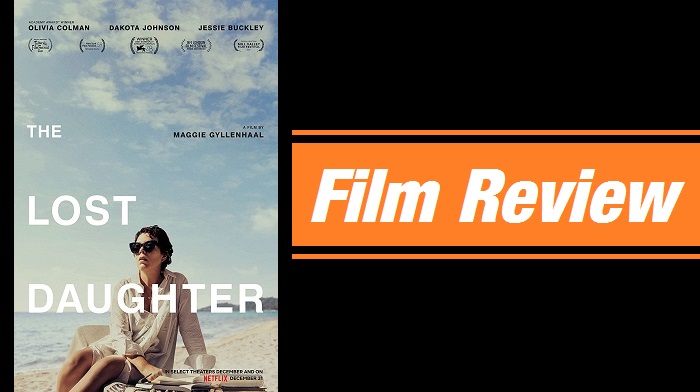
REVIEW: “The Lost Daughter” (2021)

(CLICK HERE to read my full review in the Arkansas Democrat-Gazette)

Maggie Gyllenhaal makes her directorial debut in “The Lost Daughter”, an assured and daring first feature that’s full of surprises both narratively and technically. It’s a worthwhile adaptation of the novella “My Brilliant Friend” by Italian author Elena Ferrante. The book is the first in Ferrante’s four-part series called the Neapolitan Novels and it’s definitely worth seeking out.

Empowered by Gyllenhaal’s keen writing and no-frills direction along with a terrific Olivia Colman lead performance, “The Lost Daughter” offers a subversive examination of motherhood from an angle we rarely (if ever) see in movies. It’s a slippery psychological drama that’s willing and unafraid to challenge cinema’s common perception of women. And it does so with an alarming clarity.

The script is soaked in mystery, beginning in one place before ending somewhere else entirely. The story revolves around an enigmatic 48-year-old woman vacationing in the Greek Isles. What at first feels like a tale of loneliness and loss soon curdles into something dark and sour. And to Gyllenhaal’s credit, she always keeps us guessing while never bending to our expectations.

Image Courtesy of Netflix

The sure-footed Colman plays Leda, a literature professor on summer vacation. As she arrives on the picturesque island she’s greeted by Lyle (Ed Harris), the caretaker of the area’s rental properties who lugs her suitcases full of books and clothes to her upstairs apartment. Their exchange provides our first glimpse into Leda’s demeanor. She’s friendly enough but somewhat socially awkward and at times plain-spoken to the point of being off-putting. In this case she wants to be left alone and she has no interest in Lyle’s spiel about the island’s history or how the air conditioner works.

Later Leda makes her way down to the beach to enjoy some peaceful alone time. But any hopes of quiet and solitude are shattered when a large and rambunctious family suddenly arrives. You can see the frustration simmering in Leda’s eyes as the noisy invaders become even harder to digest. But one member of the family catches her attention – a twenty-something mother named Nina (Dakota Johnson) struggling to keep her frisky daughter occupied.

Over time Leda’s curiosity turns into a creepy fixation that triggers flashbacks to her own time as an exasperated young mom. In those scenes, Jessie Buckley plays the younger Leda and she shares a startling symbiosis with Coleman. Their performances are both fueled by a similar emotional intensity and are so in-tune with each other that you never doubt you’re seeing the same woman.

Image Courtesy of Netflix

Gyllenhaal’s confidence in her storytelling really shows once the flashbacks are introduced. These scenes fluidly weave into and out of the central story, illuminating the main character with an uncomfortable clarity. I won’t dare spoil where the movie goes, but Leda’s story (both past and present) take us down some roads as unpredictable as they are unsettling.

“The Lost Daughter” quickly becomes a movie built around revelation. Gyllenhaal urges her audience to invest in Leda even if we don’t like what’s revealed about her. But that’s part of the film’s allure. It challenges our perceptions and expectations in a brutally frank way. It isn’t worried about us liking Leda. It’s far more concerned with portraying her honestly. So we’re left with a character so sincerely constructed that some will find her impossible to like. Me? I found myself juggling empathy with disdain for Leda which (I believe) is exactly the conflict the movie wants us to have.

While Maggie Gyllenhaal’s shrewd direction and cagey storytelling are real strengths, her visual choices range from sumptuous to suffocating. DP Hélène Louvart’s reliance on intense close-ups can be overpowering and a part of me wishes she had done more visually with the setting. At the same time, her unfussy approach keeps our focus where it needs to be – on the prickly, complicated Leda. She’s the true centerpiece of this achingly melancholy first feature from Gyllenhaal who shows she has a bright and exciting new future ahead of her.

VERDICT – 4 STARS

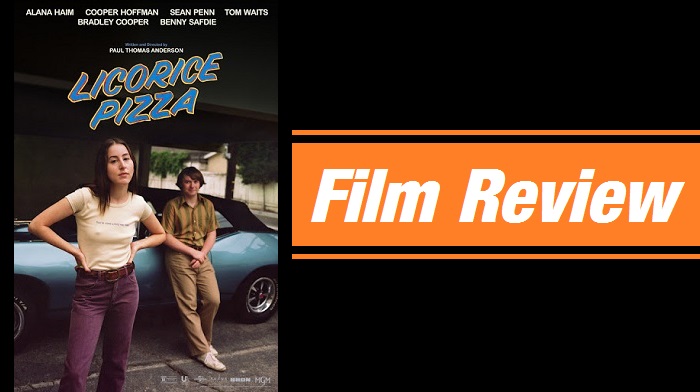
REVIEW: “Licorice Pizza” (2021)

In the world of cinephiles and movie critics, a new Paul Thomas Anderson movie is kind of a big deal. As with other seasoned filmmakers with well-defined styles (think Wes Anderson, the Coen brothers, etc.), PTA (as his fans affectionately call him) incites a high level of enthusiasm among his tight-knit faithful. A quick gander at the ever vocal Film Twitter and you’ll get a good sense of what I mean.

In what may be deemed sacrilege by some (friends of mine included), I’ve always been lukewarm on Anderson’s body of work. To his credit, I loved his last film, 2017’s “Phantom Thread”. And 2007’s “There Will Be Blood” remains one of my favorite movies of all time. But several of his other features, including the beloved “Boogie Nights”, “The Master”, and (to a lesser degree) “Inherent Vice”, are well made movies with enough cracks to leave themselves open to some criticism.

Now four years since his last film we get “Licorice Pizza”, a coming of age dramedy (I hate that word, but it fits) set in Anderson’s old stomping ground, the San Fernando Valley. Considering my history with PTA’s work, I went into our press screening wondering where his latest would land with me. To be honest, I’m still trying to sort that out.

Right off the bat you can’t help but notice its almost startling change of pace from the bulk of Anderson’s other films. This one’s breezy, free-spirited, and dare I say tender (a word rarely associated with PTA’s movies). At the same time, it’s not a movie without its issues including one big one that it mostly avoids until it doesn’t. More on that in a moment.

Image Courtesy of MGM

The film’s quirky title is taken from a former chain of Southern California record shops that were popular in the ’70s and ’80s. You won’t find a reference to them anywhere in the movie. No one utters the words “licorice” or “pizza” at any point. But according to Anderson, the two words together capture the vibe of his film. He’s not wrong.

The entire story (written by Anderson) revolves around the relationship between 15-year-old Gary Valentine (Cooper Hoffman, the son of Anderson favorite the late Philip Seymour Hoffman) and 25-year-old Alana Kane (Alana Haim). The movie opens with the two meeting at Gary’s school. He’s a student and she’s an assistant with a photography business on campus to shoot class pictures. Alana immediately catches Gary’s eye, and he’s certain he’s met the girl he’ll one day marry.

Anderson doesn’t put much effort into bringing the two together. Basically they meet at the school, Gary turns on the charm, Alana gets a kick out of him, he asks her to meet him at his favorite restaurant for a date, she laughs him off reasonably noting their age difference, and then she shows up anyway without much of an explanation why. From there, the rest of the movie plays out like ’The Adventures of Gary and Alana’, highlighting their various ups and downs both in business and in their fun-to-borderline queasy relationship.

That may sound like a slight, but I actually enjoyed Anderson’s free-wheeling storytelling. He bounces his two charismatic leads from one escapade to the next, showing their journey together yet also giving each time on the own. The film’s best scenes are when Hoffman and Haim share the screen. We see their flirty enthusiasm as they start up their own waterbed enterprise (older readers will remember that craze), and in my favorite sequence involving a movers truck, no gas, and an unhinged Bradley Cooper. All show a playful side to PTA‘s storytelling that gives the movie its heart.

Image Courtesy of MGM

But I also like that Anderson explores how their significant age difference sometimes pulls them apart. It creates a needed tension although it sometimes sends the story into less interesting directions. Such as Alana’s sudden zeal to work on a young councilman’s mayoral campaign and Gary’s foray into the freshly legalized pinball business. There’s nothing wrong with those storylines themselves. In fact they give PTA a chance to play around in his early 70s setting (which he exquisitely recreates on screen). They’re just hampered by a surprising lack of narrative detail – an issue that pops up throughout the movie.

For instance, how is a 15-year-old able to open up a waterbed store and pinball arcade seemingly on a whim (yes, there are references to him being a hustler and having a keen business sense, but come on)? Or what about Alana’s funny quirk of repeating everything twice which suddenly vanishes after a couple of early scenes. Taken by themselves, these are all little things. But when taken together they become more noticeable.

But then there’s the bigger more nagging issue – the budding romance between a 25-year-old and a 15-year-old. Anderson tries to have it both ways. There’s clearly a line he wants to straddle. But while he succeeds in hugging it for most of the way, he ends up crossing it on a couple of glaring occasions. Some may appeal to the honesty of Anderson’s depiction of Alana and Hary’s relationship and there’s truth to that defense. But as a father of two kids who fit right into that younger age range, I can tell you how I feel as a parent. The movie’s lack of conviction is a bit troubling.

“Licorice Pizza” won’t be for everyone. It’s a movie that doesn’t really go anywhere and it doesn’t have all that much to say. It’s more of an easygoing trip down memory lane, full of nostalgic callbacks and needle drops. But for some, their enjoyment may ultimately come down to their ability to overlook the ickiness that simmers underneath the central relationship. I’m guessing PTA will mostly get a pass (we tend to do that with filmmakers we really admire). But there’s enough there worth wrestling with, even if the movie never really does. “Licorice Pizza” is now showing in limited release and opens wide on December 25th.

VERDICT 3 STARS

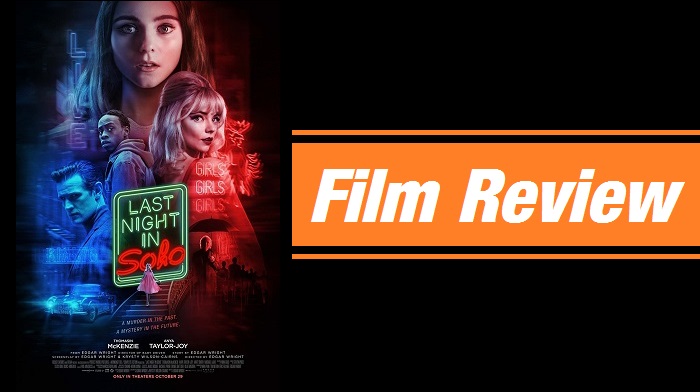
REVIEW: “Last Night in Soho” (2021)

Stephen King meets “The Twilight Zone”. That’s the vibe I got from the trailers for Edgar Wright’s much anticipated new movie “Last Night in Soho”. Turns out I wasn’t too far off. This psychological horror thriller has elements that would be right at home on the pages of an early Stephen King novel or being introduced by Rod Serling on a Fall Friday evening on CBS. Yet you can’t miss Wright’s own special ingredients sewn into the fabric of his film.

“Last Night in Soho” explores the darker side of London’s West End during the not-so-groovy 1960s through the eyes of Eloise “Ellie” Turner, a young aspiring fashion designer and dressmaker. Much like Gil Pender in Woody Allen’s “Midnight in Paris”, Ellie holds onto a romanticized image of a bygone era. For her it’s the lights, the music, and the energy of London’s Swinging Sixties. But as Wright so vividly informs us, there was a dirtier, seedier side that could eat you alive. Especially wide-eyed unsuspecting young women.

We first meet Ellie (played with mousy charm by the always terrific Thomasin McKenzie) in her own homemade dress dancing to Peter and Gordon’s “A World Without Love”. Having lost both of her parents, Ellie lives in rural Cornwall with her loving and supportive grandmother (Rita Tushingham). And then a dream comes true when she’s accepted into the London College of Fashion. Soon she’s leaving the security of home, hopping a train for London with nothing but a suitcase and a Dansette record player.

Image Courtesy of Focus Features

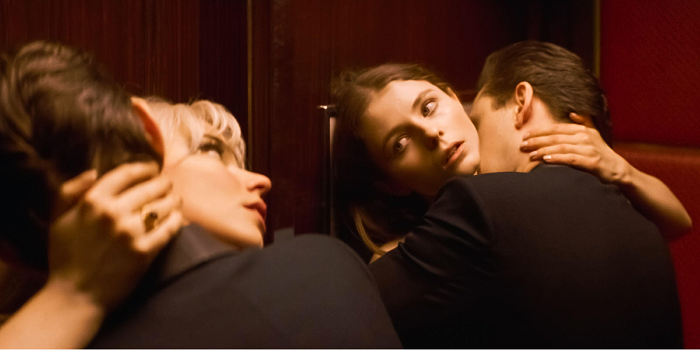
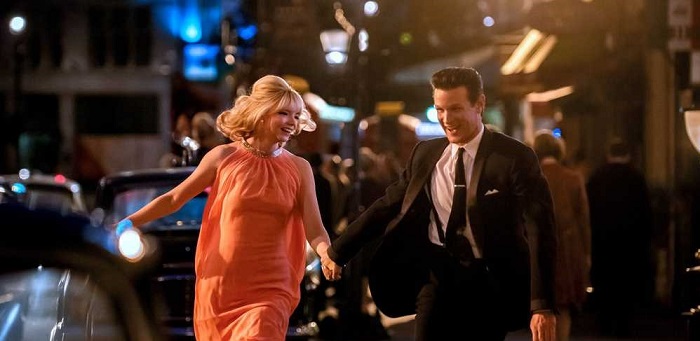
Dorm life proves to be overwhelming for Ellie with the non-stop parties and her despicable snoot of a roommate Jocasta (Synnove Karlsen). So she scraps together her money and rents out a small but cozy bedsit owned by the elderly Ms. Collins (Diana Rigg). During her first night she has a dream that transports her back to 1966. In it she walks the bustling Soho streets ending up at the Café de Paris nightclub. Inside she’s swept away by the glow of the lights and buzz of the crowd. But in the mirror she sees a reflection, not of herself, but that of a beautiful confident blonde named Sandie (Anya Taylor-Joy). Sandie is charmed by the club’s manager, a shifty looking sort named Jack (Matt Smith) and the two end the dream with some bubbly Old Hollywood swoon.

Wright uses a number of cool visual touches that help tell Sandie’s story while also reminding us that this is Ellie’s dream – clever tricks that repeatedly show Sandie as Ellie’s reflection. But at times he surprises us with nearly undetectable changes in perspective where Ellie is suddenly cast as the reflection. It’s a crafty bit of foreshadowing that teases layers of the story that will be peeled back later in the movie.

As the dreams of Sandie and Jack continue each night, Ellie finds inspiration. She dyes her hair blonde and uses her visions to create new fashion designs at school. But when the dreams slowly turn to nightmares, Ellie struggles to grasp what is real and what isn’t. Is she having a breakdown much like her mother did years earlier? Is she losing her identity? Or is it something more sinister?

The story (written by Wright and Krysty Wilson-Cairns) is made up of two very different halves. Without question, the first half is the strongest both in terms of telling Ellie’s story and in transporting us back in time. The 1960s sequences are especially grand with their incredible period detail and dreamy nostalgic pull. But as Wright and Wilson-Cairns begin chipping away at that facade, they expose a tangibly dirty and forbidding underbelly. The slow shift in tone within the first half is deftly handled and builds some of film’s best tension.

Image Courtesy of Focus Features

The second half turns into a delirious duel-pronged mystery as we try to find out what’s going on inside Ellie’s mind, and she tries to find out the truth about Sandie. Was she real? If so, what happened to her? Several other characters play bigger roles in the second half. The great Terrance Stamp plays a creepy silver-haired gent who I wish had more screen time. Instead that time is given to Ellie’s puppy dog admirer John (Michael Ajao), an unconvincing cookie-cutter love interest who quickly wears out his welcome.

While a really good Anya Taylor-Joy has been getting much of the attention, it’s Thomasin McKenzie who propels the movie. It’s absolutely essential that we connect with her character and understand the emotional complexities Ellie brings with her to London. McKenzie makes it easy with her natural earnestness and disarming warmth. The more erratic second half leads her in a few directions that don’t exactly play to her strengths, but that’s a fault of the writing more so than the performance.

Over the years Edgar Wright has earned himself a loyal and enthusiastic following. While I admire his skill behind the camera, I haven’t always connected with his movies the way others do. That’s a big reason why I was genuinely excited to see him try something new with “Last Night in Soho”. While the results are a bit uneven, it’s an audacious effort with lots to like: the fantastic cast, the killer soundtrack, its intoxicating style and verve. And while it loses its way a bit and ends on a mixed note, Wright and his cast make this wickedly enchanting journey worthwhile. “Last Night in Soho” is now playing in theaters.

VERDICT3.5 STARS

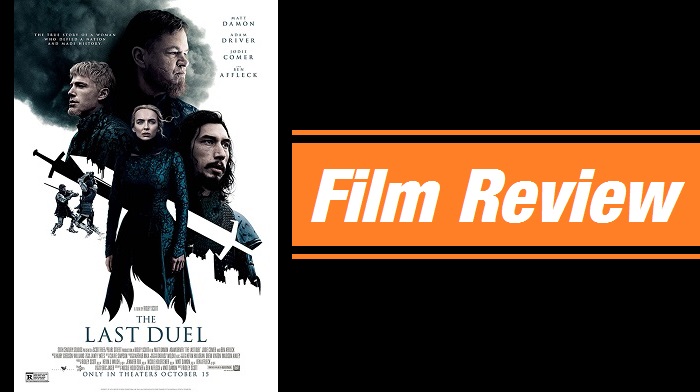
REVIEW: “The Last Duel” (2021)

(CLICK HERE to read my full review in the Arkansas Democrat-Gazette)

It goes without saying that 83-year-old Ridley Scott is no stranger to sprawling period epics. His latest film “The Last Duel” fits snugly alongside “Gladiator”, “Kingdom of Heaven”, and 2010’s underappreciated “Robin Hood” (a movie I still happily defend). It’s massive in both scope and scale, it brilliantly recreates history through some jaw-dropping production and costume design, and it doesn’t shy away from the brutality. At the same time, this one has some interesting qualities that distinguish it from those other pictures.

“The Last Duel” sees Ben Affleck and Matt Damon penning a screenplay together for the first time since winning the Academy Award for 1997’s “Good Will Hunting”. They’re joined by Nicole Holofcener who wrote 2018’s “Can You Ever Forgive Me?”. The trio’s script is based on Eric Jager’s 2004 book about the last recorded Trial By Combat duel which happened in medieval France on December 29, 1386.

Image Courtesy of 20th Century Studios

The movie opens in 1386 Paris where two combatants, Jean de Carrouges (Matt Damon) and Jacques Le Gris (Adam Driver), prepare for a duel to the death. Both men look intense and focused; doing their best to hide their apprehension. The two leave their quarters and mount their horses, riding into the center of a small arena where France’s King Charles VI (Alex Lawther) presides.

On a nearby platform stands Carrouges’ wife Marguerite (Jodie Comer), clad in black from head to toe and with her ankles tightly shackled. An accusation has led to the duel and she knows that the barbaric outcome will determine her fate. This duel between two men, not her own testimony, will decide whether she lives and is vindicated or she’s stripped, lashed and burned alive. The physical and psychological grotesquery of the scenario isn’t fully felt in the opening. But when we revisit this scene in the final 20 minutes it hits like a ton of bricks.

We learn that Marguerite has accused Le Gris of raping her while her husband was away at war. Le Gris denies the claim which eventually leads to the eponymous showdown. But what is the truth behind the accusation? What really happened? After the gripping tease, the “Rashomon” effect kicks in and we’re treated to three chapters, each beginning with “The Truth According to…”. Scott gives us three tellings of the story, told from the perspectives of Carrouges, Le Gris and finally Marguerite.

It doesn’t take long to figure out the mystery behind what really happened. In fact, the second chapter (the truth according to Le Gris) all but spells it out. Instead we’re tasked with figuring out who these characters really are. Along the way we learn how the duelers went from friends to foes. We’re shown how Carrouges, a man of war, met and married Marguerite, the daughter of a disgraced landowner. We see Le Gris wiggle his way into the good graces of the powerful and hedonistic Count Pierre d’Alençon (a scene-stealing Ben Affleck). And there’s the inevitable ending – a bruising display of savagery between two men where any semblance of humanity vanishes.

Image Courtesy of 20th Century Studios

Unruly accents aside, the cast is uniformly superb. Damon overcomes a truly hideous mullet to give a brawny yet surprisingly layered performance. Driver portrays his preening entitled opportunist at just the right temperature. And then there’s Comer, a talented actress who navigates her character through an era where misogyny was ingrained in society and issues with women were “matters of property“. Comer brings a quiet strength and resiliency to Marguerite, and while not every scene in her chapter rings true, the performance always does.

“The Last Duel” sees Ridley Scott in top form. His film is oozing with exquisite period detail, captivating characters, and good old-fashioned storytelling. And his staging of the brutally intense finale visually rivals anything he’s done before. It’s a talky movie which may surprise some. But it’s never a slog, and the relevance of its subject matter packs one wicked wallop. It also makes for a nice alternative to the waves of horror and big franchise films filling the multiplexes.

VERDICT – 4 STARS

REVIEW: “Lamb” (2021)

No other 2021 movie trailer threw me for a loop quite like the one for “Lamb”. Independent film distributor extraordinaire A24 did their job in delivering a fascinating albeit trippy tease for this Nordic folk-horror tale. The movie premieres this weekend and the trailer certainly had the trippy part right. But it’s a little misleading when it comes to the horror element. “Lamb” is a far cry from conventional and the horror it’s going for is far more subdued.

“Lamb” is directed by Valdimar Jóhannsson working from a script he wrote with poet, novelist and playwright Sjón. The film premiered at this year’s Cannes Film Festival and the first reactions intrigued me far more than the trailer. “Lamb” is unquestionably one of the weirdest movies of 2021. It’s also captivating from start to finish, beguiling and unsettling, and at times darkly funny in a way that fully embraces the absurdity that’s built into the story.

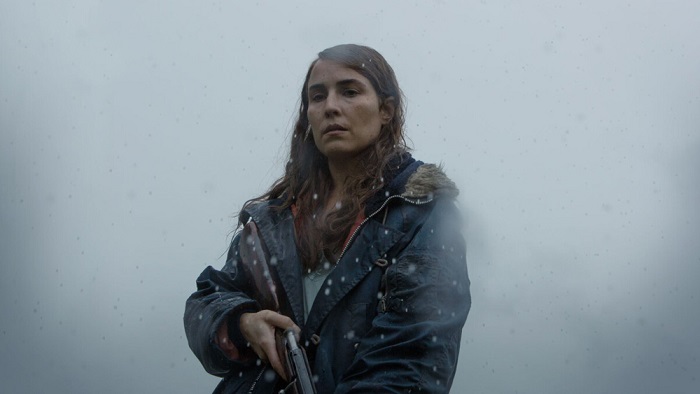
“Lamb” kicks off with a scene that introduces us to one of the film’s biggest assets – DP Eli Arenson. In the opening, his camera slowly eases across a stark snowy tundra where something moving in the icy mist has spooked the local animals. Arenson shoots the sequence from the lumbering something’s point-of-view and the only hint of what it may be is found in its deep heavy breathing and the crunch of the snow under its feet. The camera ends at a barn full of rattled sheep. Cut! Jóhannsson smartly ends the scene, giving us just enough to wet our appetites.

Image Courtesy of A24

That gives you a good sense of Jóhannsson’s approach to storytelling – patient, methodical, and as reliant on the gaze of Arenson’s camera as the three lone (yet sublime) performances. The dialogue is sparse at times (particularly in the first of the three chapters) and the use of music is strategic. And then there’s Ingvar Lunderg and Björn Viktorsson’s crafty sound design which plays a big part in developing mood and instilling a lingering sense of unease.

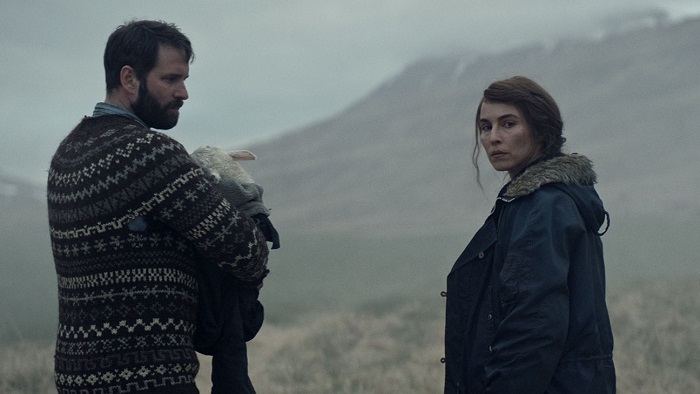
The above mentioned barn belongs to Maria (Noomi Rapace) and her husband Ingvar (Hilmir Snær Guðnason), owners of a sheep farm nestled in a scenic mountain valley in Iceland. The farm is as distant and remote as Maria and Ingvar’s relationship. There are no signs of enmity or bitterness between them. They’re just two emotionally withdrawn souls marching to the somber beat of their own drums. Their few conversations consist mostly of farm talk. Attempts at anything else comes across as awkward and frivolous.

But things turn towards the peculiar when a young ewe lamb is born; one alarmingly different than all the others. How is it different? Jóhannsson doesn’t show us, at least not at first. Instead he focuses solely on the farm couple’s astonished expressions. It’s yet another smart directing choice that connects us emotionally with Maria and Ingvar while effectively building our curiosity and anticipation.

Maria’s maternal instincts immediately kick in and she takes the lamb as her own, much to the consternation of the bleating birth mother. Maria names the lamb Ada, wraps her in warm blankets, and let’s her sleep in a washtub bassinet until Ingvar can dust off an old crib from the barn. Something is clearly off with this scenario and the audience members aren’t the only ones who recognize it. The observations of the couple’s sheep dog and house cat as well as the eerie cutting stares of the disapproving sheep convey a similar apprehension.

Image Courtesy of A24 Studios

Things get even more complicated when Ingvar’s deadbeat brother Pétur (Björn Hlynur Haraldsson) shows up unannounced needing a place to crash. He is immediately taken aback by Ada and his wordless deadpan first reaction is an instance of both perfect timing and perfect framing resulting in a true laugh-out-loud moment. It’s that kind of subtle dark humor that Jóhannsson sprinkles throughout his middle chapter. Yet he always maintains a straight-faced sincerity that keeps his movie from becoming farce.

I won’t spoil anything, but it’s pretty easy to figure out what’s going on. What you won’t predict is what happens in the final ten minutes. Myself, I’m still trying to figure out how well the ending works. On one hand, it feels underdeveloped, abrupt, and a bit too ambiguous for its own good. On the other hand, it’s startling, bizarre, and in a sense a perfectly fitting wrap for a movie like this. The emotional payoff is almost certain to hit people differently and the final shot is as puzzling as it is affecting. Does it make for a satisfying finish? I’m still wrestling with that.

If you’ve read everything up to this point, you’ve probably figured this out – “Lamb” won’t be for everyone. Its strangeness alone will confound some while it’s simmering slow born may push away others who bought into the trailer’s more conventional sales pitch. Personally, I gravitate towards this deliberate observational style. Jóhannsson’s keen direction, the striking visuals, and the palpable emotion from the performances carry a lot of weight and ground the story (as absurd as it is). At the same time, themes of parenthood, loss, and human/animal coexistence bubble under the surface, often snapping us out of the film’s intoxicating hypnotic spell. “Lamb” opens in select theaters tomorrow (October 8th).

VERDICT – 4 STARS

REVIEW: “The Last Mercenary” (2021)

The action movies of the 80’s and early 90’s had a goofy and over-the-top style all their own. During my teen years and early twenties I couldn’t get enough of them. At the top of the food chain were the marquee names Arnold Schwarzenegger and Sylvester Stallone. Just a step below were a handful of others including the martial artist known as The Muscles from Brussels (yes kids, that’s what some called him) Jean-Claude Van Damme.

For several years Van Damme was a big box office draw, but he fell out of the mainstream once the cinema landscape began its shift away from the machismo-infused romps that made him and others famous. Still, Van Damme has continued to make movies, releasing mostly straight-to-DVD action flicks every year since 2001. His latest film is “The Last Mercenary”, a French action-comedy from Netflix Studios.

Image Courtesy of Netflix

“The Last Mercenary” is a weird experience. At times it’s a painfully bland and erratically edited genre blend that bounces here to there with no real sense of flow. But then you see a self-deprecating JVD, his hair a little thinner and his wrinkles a little deeper. You see him joyously riffing on his past action star persona (even his infamous bad dancing). You watch him poke fun of his own enigmatic up-and-down movie career. Suddenly you can’t help but smile.

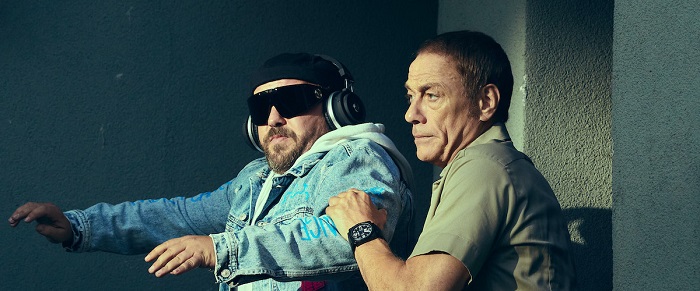
The film is directed by David Charhon and co-written by Charhon and Ismael Sy Savane. Their story puts the 60-year-old JVD in the role of the near mythical mercenary Richard Brumère aka “The Mist”. He comes out of seclusion after learning that the French government has accused his dim dope-peddling son Archibald (Samir Decazza) of being a wanted arms dealer named Simyon.

The movie features an off-beat blend of action and comedy that’s built around a fairly predictable father/son reconciliation. Richard left his son and late wife to protect them from the violence that comes with his job. Archibald feels his father abandoned him, and his mother’s death only deepened those wounds. There are occasional moments of heart where this fractured relationship gets some attention. But it always feels secondary to getting a laugh.

Image Courtesy of Netflix

In order to protect Archibald from the real Simyon (wildly overplayed by Nassim Lyes) and to root out the corrupt government officials working to keep Simyon’s identity concealed, Richard forms a team of local outcasts to help him. Dalila (Assa Sylla) and her brother Momo (Djimo) make for good comic sidekicks while Alexandre (Alban Ivanov), who was booted from the French Ministry for getting too close to the truth, is the movie’s clown – occasionally funny but way too over-the-top.

It’s fun watching JVD ham it up, whether he’s winking at a poster of his breakout movie “Bloodsport” or donning goofy disguises reminiscent of Peter Sellers’ bumbling Inspector Clouseau. But even that eventually wears thin leaving us with a haphazard movie that has more in common with a hyperactive cartoon. The humor ranges from silly to cringe-worthy with the worse being this running gag about Richard’s ‘ladies man’ status. Meanwhile the skittish editing only emphasizes the story’s overall clunkiness. And JVD’s best (and silliest) efforts can’t quite make up for it.

VERDICT – 2 STARS