REVIEW: “The Last Mercenary” (2021)

The action movies of the 80’s and early 90’s had a goofy and over-the-top style all their own. During my teen years and early twenties I couldn’t get enough of them. At the top of the food chain were the marquee names Arnold Schwarzenegger and Sylvester Stallone. Just a step below were a handful of others including the martial artist known as The Muscles from Brussels (yes kids, that’s what some called him) Jean-Claude Van Damme.

For several years Van Damme was a big box office draw, but he fell out of the mainstream once the cinema landscape began its shift away from the machismo-infused romps that made him and others famous. Still, Van Damme has continued to make movies, releasing mostly straight-to-DVD action flicks every year since 2001. His latest film is “The Last Mercenary”, a French action-comedy from Netflix Studios.

Image Courtesy of Netflix

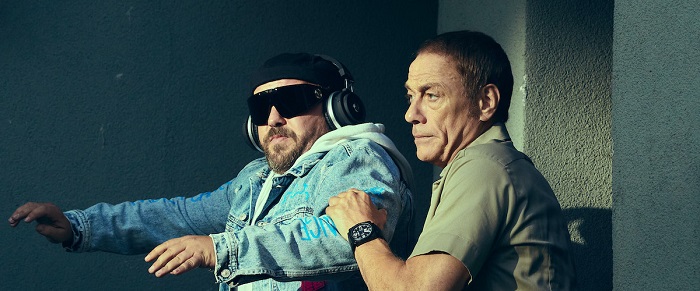
“The Last Mercenary” is a weird experience. At times it’s a painfully bland and erratically edited genre blend that bounces here to there with no real sense of flow. But then you see a self-deprecating JVD, his hair a little thinner and his wrinkles a little deeper. You see him joyously riffing on his past action star persona (even his infamous bad dancing). You watch him poke fun of his own enigmatic up-and-down movie career. Suddenly you can’t help but smile.

The film is directed by David Charhon and co-written by Charhon and Ismael Sy Savane. Their story puts the 60-year-old JVD in the role of the near mythical mercenary Richard Brumère aka “The Mist”. He comes out of seclusion after learning that the French government has accused his dim dope-peddling son Archibald (Samir Decazza) of being a wanted arms dealer named Simyon.

The movie features an off-beat blend of action and comedy that’s built around a fairly predictable father/son reconciliation. Richard left his son and late wife to protect them from the violence that comes with his job. Archibald feels his father abandoned him, and his mother’s death only deepened those wounds. There are occasional moments of heart where this fractured relationship gets some attention. But it always feels secondary to getting a laugh.

Image Courtesy of Netflix

In order to protect Archibald from the real Simyon (wildly overplayed by Nassim Lyes) and to root out the corrupt government officials working to keep Simyon’s identity concealed, Richard forms a team of local outcasts to help him. Dalila (Assa Sylla) and her brother Momo (Djimo) make for good comic sidekicks while Alexandre (Alban Ivanov), who was booted from the French Ministry for getting too close to the truth, is the movie’s clown – occasionally funny but way too over-the-top.

It’s fun watching JVD ham it up, whether he’s winking at a poster of his breakout movie “Bloodsport” or donning goofy disguises reminiscent of Peter Sellers’ bumbling Inspector Clouseau. But even that eventually wears thin leaving us with a haphazard movie that has more in common with a hyperactive cartoon. The humor ranges from silly to cringe-worthy with the worse being this running gag about Richard’s ‘ladies man’ status. Meanwhile the skittish editing only emphasizes the story’s overall clunkiness. And JVD’s best (and silliest) efforts can’t quite make up for it.

VERDICT – 2 STARS

REVIEW: “The Last Letter From Your Lover” (2021)

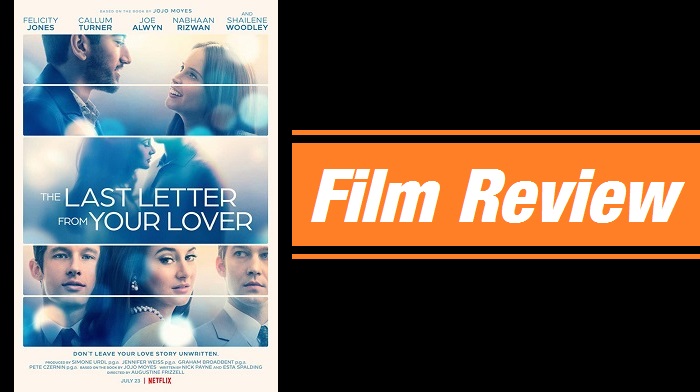
The new Netflix romantic drama “The Last Letter From Your Lover” strolls across three(ish) timelines to tell the story of two lovers who embark on one illicit love affair during the summer of 1965. Bouncing back and forth between the then and now, “The Last Letter” sets out to capture the look and feel of a classic Hollywood romance while at the same time contrasting it with a budding modern love story. It’s nothing we haven’t seen before, but there’s just enough spark to keep us caring.

Directed by Augustine Frizzell and written by Nick Payne and Esta Spalding, the film is an adaptation of a 2012 novel of the same name by Jojo Moyes. The time-hopping narrative begins in 1965 London. Jenny (Shailene Woodley) sits in the car gazing out the window with a look of poorly veiled apprehension and uncertainty. A scar on the left side of her face runs from the corner of her eye to mid-cheek, hinting at the story we’re about to be told. “Everything’s going to be fine darling” says her seemingly concerned husband Larry (Joe Alwyn).

Image Courtesy of Netflix

We learn Jenny is returning home from the hospital following a serious car accident. In addition the the scar, the wreck also left her with short-term memory loss. But when she stumbles upon a letter tucked away in a book, pieces of her memory slowly start falling back into place. She begins to recall details of a romantic relationship she had with a young writer named Anthony (Callum Turner). Soon she’s searching everywhere for more letters that can help her remember this man and what he meant to her.

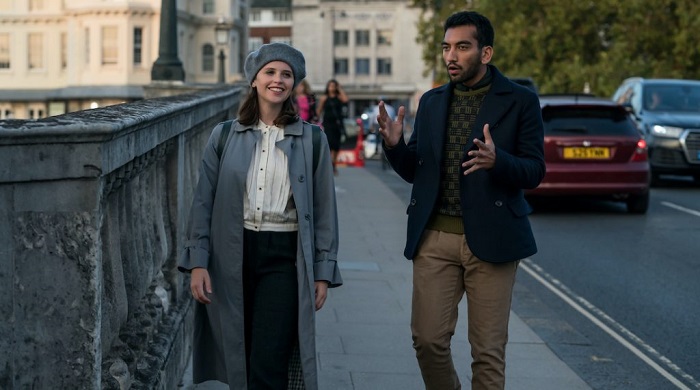
Jump ahead to current day. Ellie Haworth (Felicity Jones) is a features writer for the London Chronicle who comes across an old love letter while researching for another story. It’s addressed to someone called “J” from someone going by “Boot”. Captivated, Ellie begins looking for more letters, enlisting the help of the company’s jittery archivist Rory (played with just the right amount of humor and warmth by Nabhaan Rizwan).

Now stay with me, Jenny in 1965 and Ellie in the present day begin pasting together the romance behind the letters. The movie hops back six months prior to Jenny’s car accident when she and Larry are in the French Riviera. There she meets Anthony O’Hare who’s in town to write a piece on her husband. Hurt by her husband’s belittlement and neglect, Jenny sees the opposite in Anthony and soon the two are engaged in a whirlwind affair across the beautiful French countryside.

As you can probably guess (or if you saw the trailer) all of storylines eventually converge with various degrees of success. For the most part Frizzell holds it all together (the time-jumping is a little clunky but never becomes convoluted or overbearing). And while the story has its share of contrivances, Frizzell maintains a good sense of pacing so we never get stuck in one place very long. Also, I wouldn’t call the film visually flavorful, but Frizzell and DP George Steel do give us several scenes, almost exclusively in the 1965 setting, that crackle with old Hollywood style.

Image Courtesy of Netflix

The movie’s biggest issue comes with the current day storyline where Ellie begins a romance of her own with Rory; one that never gets above room temperature. Not enough time is given to building the connection between them and their relationship feels like an awkward inevitability, existing strictly because it’s in the script. The movie could lose the entire angle and never miss a beat.

In a very real way I’m glad “The Last Letter From Your Lover” exists. It’s extremely rare to get a true romance these days, not a romcom or a teeny flick, but a straight-up old-school romance soaked with longing and full of heart-pumping desire. They don’t come along very often. Today’s filmmakers have no interest in them and studios seem happy to leave them for the Hallmark Channel made-for-television assembly line. But there is something robustly cinematic about a well-made romance. “The Last Letter From Your Lover” isn’t the movie to usher in a new wave of romance films, but it does give a little taste of what the genre can be. I just wish it was a more filling meal. “The Last Letter From Your Lover” is now streaming on Netflix.

VERDICT – 3 STARS

REVIEW: “Lorelei” (2021)

In “Lorelei”, the feature film debut for writer and director Sabrina Doyle, an ex-con, a single mother, and three children form the backbone of this blue-collar story set in the Pacific Northwest. On the surface it’s an unconventional family drama about people trying to find their way individually and together. But underneath it’s a movie about pressing forward and not being anchored to the past.

The movie opens as a man named Wayland (Pablo Schreiber) is getting out of prison after serving a 15-year sentence for armed robbery. After a night of boozing with his biker buddies Wayland checks into a halfway house ran by the amiable Pastor Gail (Trish Egan). Shortly after, he bumps into his old girlfriend Delores (Jenna Malone) and the two quickly reconnect. We learn that they were high school sweethearts and had big plans together. “We were something, me and you,” she laments.

But instead of moving to Los Angeles and spending their life together, Wayland went to prison and Delores went through a rough patch of her own. Now he’s an ex-con and she’s a struggling single mother of three working as a housekeeper at a rundown motel. But they still share a mutual affection and soon Wayland has moved in with Delores and her three children (played with stunning authenticity by first-time performers Amelia Borgerding, Parker Pascoe-Sheppard, and Chancellor Perry). It feels like a recipe for disaster and an arrangement doomed to fail.

Image Courtesy of Vertical Entertainment

Thankfully Doyle writes textured characters who are firmly grounded in the real world. They don’t fit any conventional mold so we’re never sure how things are going to turn out. She doesn’t gloss over their flaws or sugarcoat their failures. In fact, it’s impossible to condone some of the choices her characters make. But at the same time Doyle gives us glimmers of hope – faint and often hard to recognize, but hope nonetheless.

Also, Doyle’s story dodges many of the trappings that often come with this type of subject matter. “Lorelei” could have easily been just another small town tragedy. And while there are tragic elements, the movie digs deeper into real-world experiences that many will relate too. It’s all strengthened by Doyle’s working-class roots which gives her a clear-eyed perspective into the struggles of economically depressed communities and those drowning under the poverty line. There is a palpable realism in the situations her characters face and the choices the make feel natural.

While “Lorelei” plays like an authentic slice of life, dramatically it stays on slow simmer. Nothing about it feels false, not the characters or their stories. But it more or less stays in one gear. And it introduces several compelling supporting players, but (with a couple of exceptions) few of them are given more than a scene, two at the max. But in fairness to Doyle, she has a very specific story she’s telling and her laser-sharp focus on that story is what makes the movie tick. It looks great and the performances are terrific. But it’s Doyle’s grounded true-to-life perspective that gives “Lorelei” its pulse. “Lorelei” is now showing in select theaters and on VOD July 30th.

VERDICT – 3.5 STARS

REVIEW: “Loki” (2021)

The delightfully strange and occasionally perplexing “Loki” is the third foray into streaming television for the Marvel Cinematic Universe. First there was the homage heavy and magic filled “WandaVision”. It was followed by the scattershot yet stage-setting “The Falcon and the Winter Soldier”. Then along came “Loki”, a six-episode mini-series that I can safely say has practically nothing in common with the previous two shows. It is completely it’s own thing which is part of what makes it work so well.

The enigmatic “Loki” was created by Michael Waldron who set out to make a time-hopping adventure that would constantly subvert audience expectations. Marvel Studios president and producer Kevin Feige brought in Kate Herron, a big fan of the Loki character, to direct all six episodes. Their creative efforts would result in a show that Feige said would have “more impact on the MCU than any show so far” and “lay the groundwork” for the MCU’s future.

Image Courtesy of Marvel Studios

So was he right? Well, in a nutshell YES. It’s true that we don’t know for sure how things are going to play out, but “Loki” is a genuine game-changer and its events are certain to reverberate throughout the entire MCU. One thing’s for sure, “Loki” has a style all its own (both visually and narratively) that feels unique within the MCU catalog. It’s also brazenly bizarre at times which is one of its biggest strengths. As usual some episodes are better than others, but overall there’s more than enough fun and offbeat ambition to make this a must-watch for any Marvel fan.

To no one’s surprise, a key ingredient that makes the whole thing work is Tom Hiddleston reprising his role as the titular god of mischief. I feel like we say this a lot about the MCU’s stellar casting, but Hiddleston has been a perfect fit and he has truly made the character his own. Like many, I was surprised to hear that Marvel Studios was investing in a Loki series. I was even more surprised to see how fun and wildly original it turned out to be. And not just that, but it is the first Disney+ series that I would call essential viewing for anyone following the MCU. Both “WandaVision” and “TFATWS” set up some things for the future but nothing as far-reaching as what we get here.

The series begins with Loki being snatched up by the Time Variance Authority (TVA), an secret bureaucratic organization tasked with monitoring and protecting the “Sacred Timeline”. Loki threatened the timeline with his hijinks way back in the first Avengers movie. While in custody he is questioned by Agent Mobius (an absolutely delightful Owen Wilson) who reveals that Loki is what’s called a variant, a term that suddenly carries a lot of weight in the MCU. Essentially a variant is someone who branches off of the pre-ordained Sacred Timeline, disrupting its flow and creating an alternate path. The TVA then apprehends the “criminal” variant and restores the timeline.

Image Courtesy of Marvel Studios

To no surprise Loki doesn’t buy it, but Mobius can be pretty persuasive especially when showing off just how powerful the TVA really are. Standard procedure would be to eradicate Loki. Instead Mobius recruits him to help catch a rogue variant who has been killing TVA agents and wrecking havoc across the timeline. Over time Mobius takes a liking to the cunning trickster. Hiddleston’s manic energy along with Wilson’s goofy charm brings a fun buddy time-cop vibe to some of the earlier episodes.

Not everyone at the TVA is as convinced as Mobius that Loki can be an asset. Namely Mobius’ friend and superior Ravonna Renslayer (Gugu Mbatha-Raw), a high-ranking TVA judge overseeing the Loki investigation. She has a lot on her plate with running the TVA and reporting to the Timekeepers, three all-knowing ancient beings who basically write and preserve the Sacred Timeline. Loki wants an audience with the Timekeepers in exchange for his help catching the rogue variant. Renslayer doesn’t trust him and is only allowing him to help because of her friendship with Mobius. So there are several interesting dynamics at play.

But then a wild card is added to the mix – a pivotal character named Sylvie (Sophia Di Martino) whose identity is best left for you to discover for yourself. She turns out to be a major piece of the story going forward and has discovered some damning revelations about the TVA that makes her a threat. Di Martino and Hiddleston have a sparkling chemistry that’s a nice mix of humor and dramatic tension. And the relationship between their characters has a surprising amount of depth and nuance.

Image Courtesy of Marvel Studios

To say anymore about the story or character arcs would be a disservice. Just know you can expect all kinds of time-hopping shenanigans, fun character moments, and some wild unexpected flourishes that you never see coming. There is one stray episode that’s slower and less compelling than the others. But even it move things forward by focusing on and building up one of the story’s central relationships. And then you get to the end, a surprising and welcomed departure from the MCU’s usual action-fueled finales. Instead “Loki” finishes with an mesmerizing dialogue-rich showdown that’s sure to have MAJOR implications.

There’s even more to like about “Loki” including Natalie Holt’s beguiling score, the terrific production design (highlighted by the eye-popping TVA headquarters with its ominous blend of Soviet brutalism and neo-futurism), and the truly zany turns it takes in the later episodes (episode 5 introduces a certain scaly caiman variant that more-or-less steals the show). It all adds up to the strongest MCU series to date. Not a perfect one, but a show that feels important, is full of surprises, and adds a spark that the MCU roadmap needed. All six episodes of “Loki” are now streaming on Disney+.

VERDICT – 4 STARS

REVIEW: “Lansky” (2021)

There have been a couple of periods in movie history when gangster movies were a dime a dozen. They were all the rage and for a time big studios were quick to get behind them. They aren’t quite as plentiful these days, but as someone long fascinated with the rise and decline of the Mafia in the United States, I’m always up for a good gangster flick. “Lansky” is certainly a good one, but your reaction to it may depend on how much you already know about the notorious Jewish mobster.

Meyer Lansky was a major player in organized crime for sixty years and was instrumental in putting together the National Crime Syndicate with Italian mob boss and long-time friend Charles “Lucky” Luciano. Yet despite decades of underworld activity in New York, Las Vegas, even Cuba, Lansky evaded serious prison time much to the chagrin of a dogged FBI. Lansky was brilliant and knew how to run his business and manage money. He was also loyal to the gangland code which earned him respect with both the Jewish and Italian gangs.

With “Lansky” writer-director Eytan Rockaway sets out to do two things – give a biographical sketch of Lansky’s rise to power within the Mafia and tell the story of a struggling writer offered the opportunity of a lifetime but forced to be a pawn for the FBI. The film is based on actual interviews conducted with Lansky by the director’s father Robert Rockaway. This adds an undeniable authenticity to the mobster’s story that (along with two really strong performances) drives the film. In fact the Lansky bio is done so well that the writer’s story can only pale in comparison.

Image Courtesy of Vertical Entertainment

In 1981 David Stone (Sam Worthington), a talented yet down-on-his-luck writer, is in Miami for what could be a career defining opportunity. He tells his frustrated wife he’s in Miami to do some book signings. In reality he’s been summoned there to meet the infamous Meyer Lansky. After 60 years in the mob business Lansky has finally mustered the courage to quit only to find out he is terminally ill. So he offers David the chance to tell his real story which is only to be published after he dies. And lest we forget that he’s still a man of the old ways, Lansky offers David a rather blunt warning, “Betray me and there will be consequences.”

Lansky’s story is told through a series of meetings in a Miami diner. Over cups of coffee and with a disarming gentleness, the aged gangster (played by an intensely convincing Harvey Keitel) begins unpacking his complex life. Rockaway covers a lot of ground including a scene from Lansky’s childhood in New York City where as a kid he was already working numbers at back alley dice games. But the vast majority of the flashbacks focus on his gang days where he’s played by John Magaro. The impeccably cast Magaro is just the right fit in terms of demeanor and stature. And if you close your eyes, at times you’ll swear you’re hearing Joe Pesci.

Rockaway gives us a vivid picture of just how powerful and influential Lansky became. We see both his smarts and ruthlessness in his early days running gambling rooms with close friend Ben “Bugsy” Siegel (David Cade). We witness him putting together a group of wise guys to beat down Nazi sympathizers in the early days of World War 2. We watch as he forms the brutal Murder Inc., a team of cold-blooded killers responsible for the murder of hundreds at the behest of the Syndicate. And we get a look at his days operating post-war casinos for the Cuban government. This is just some of the ground covered, all of it connected by Keitel’s pitch-perfect storytelling. We occasionally see small glimmers of remorse in the gangster’s eyes. But then we get telling scenes such as when he coldly recounts the execution of a father of three while casually eating a piece of pie.

Image Courtesy of Vertical Entertainment

Rockaway emphasizes what made Lansky such a complex man by sometimes stepping away from the world of speakeasies and mob hits. The director tries to capture his human side by showing personal moments such as his relationship with his son who has cerebral palsy. Or his sympathies for Israel and the Jews who suffered during the Holocaust. We also get a taste of the deep feelings of betrayal when Israel refused to grant him citizenship. And we gets glimpses into his marriage which starts happy but slowly crumbles under the weight of Lansky’s mob priorities.

As for the other story, Worthington gives us a solid performance playing a man with his own crumbling home life and out-of-whack priorities. In one sense he feels he’s doing the right thing and that this book will get him back on track. But at what cost to his marriage? There’s some good groundwork there, but ultimately his story needs more heft. It drags a bit with a flat romantic angle with a mysterious woman at his motel (Minka Kelly), but then picks up when the FBI approach him. Despite a failed decades-long investigation, the feds are convinced the impenetrable Lansky has $300 million stashed away somewhere. Desperate and out of options, they attempt to bully Dave into becoming their informant.

I doubt “Lansky” will ever find itself mentioned among the very best from the gangster movie genre. But that doesn’t mean Rockaway hasn’t put together something well worth watching. Keitel and Magaro team up to give a captivating portrayal of Meyer Lansky that is firmly rooted in the real account. I still wonder how it will play for those with no knowledge of his gangland history or the context surrounding many key events in his life. And I doubt the secondary story will be enough to make up the difference. But I was enthralled with Lansky’s story and Keitel’s re-enforces his status as one of the overlooked acting greats. “Lansky” releases June 25th in select theaters and on VOD.

VERDICT – 4 STARS

SUNDANCE REVIEW: “Land” (2021)

LANDposter

Robin Wright both stars in and steps behind the camera to make her directorial debut with “Land”. This solemn and subdued drama, written by Jesse Chatham and Erin Dignam, had its world premiere at this year’s Sundance Film Festival. Wright describes her film as being about “resilience in the face of adversity“. It’s also a delicate study on the crushing effects of unchecked grief and an examination of both physical and emotional isolation.

Wright plays Edee Mathis, a middle-aged woman crumbling under the weight of sadness. The reasons are mostly left for later, but we do get hints in some brief scenes with her sister that someone incredibly close to her has recently died. “It’s really difficult to be around people“, she confesses to her therapist. When asked about her withdrawal from those closest to her Edee responds “Why would I want to share that with anyone“. In an almost prophetic warning the therapist replies, “But that means you’re alone with your pain.”

Image Courtesy of Focus Features

It’s this crushing sorrow that drives Edee to leave the city, leave her friends, and leave every trace of her old life behind. In an elegant opening credits sequence we see Edee driving through the gorgeous Northwest, probably Wyoming or Montana. She’s purchased a rundown yet charmingly rustic cabin on the side of a mountain. Against the previous owner’s advice, she pays him to return her rental car and U-Haul trailer, leaving her isolated and disconnected from everything other than her pain.

It’s here that Wright shows a remarkable amount of restraint. With a striking simplicity both in front and behind the camera, Wright shows us Edee’s attempt to adapt to living in the wilderness. Wright’s camera sits quietly watching Edee clean up the cabin, tow water from a nearby stream, try her hand at fishing. From one angle it all looks like an attempt to run away and start over solely on her own. In a darker way it feels like she has sentenced herself to live out her remaining days in solitude. And content to let nature have its way even to the point of taking her life. It’s a means to end her pain while in a roundabout way keeping a promise she made to her concerned sister. “Don’t hurt yourself. For me.”

She nearly gets her wish when the harsh winter months hit. Out of food, with no fire, and no connection to the outside world, Edee  is about to succumb to the elements when she’s discovered by a passer-by named Miguel (Demián Bichir) who nurses her back to health. Soon he’s teaching her the proper way to fish, hunt, and trap. His visits are seasonal at first, intent on respecting her wishes to be left alone. But then they become more frequent and the two develop a quietly distinct bond. One built around mutual feelings of loneliness, loss, and a special shared affection for 1980’s music.

Image Courtesy of Focus Features

Watching the trailer my first instinct was to see Miguel as a ghost; a figment of Edee’s imagination to keep her company and to help her find her way. Or maybe he was an invention by the filmmakers to add more layers to her character. But Miguel’s presence is far more nuanced. He symbolizes the very thing Edee loses when isolated – kindness, compassion, and companionship. Miguel echoes the better side of humanity. And when we learn he’s a widower carrying the effects of a personal tragedy all his own, he evolves into a symbol of hope.

“Land” could have easily fallen into any number of narrative traps or taken one of many well-worn and more conventional routes. I admit there is a hint of familiarity to the movie’s premise. But Wright’s performance and direction pulls us into her character’s journey through a tight and intimate focus and a subtly affecting minimalism. And she never passing up a chance to show the majesty of nature. We end up with a story about finding peace and solace, not in isolation but in communion. And during time of so much division, it turns out to be an especially timely message. “Land”

VERDICT – 4 STARS