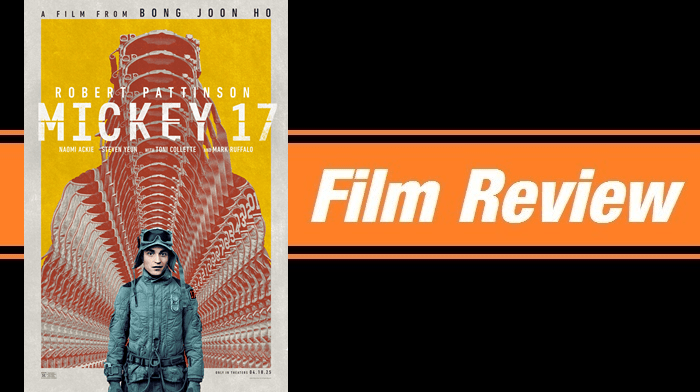
REVIEW: “Mickey 17” (2025)

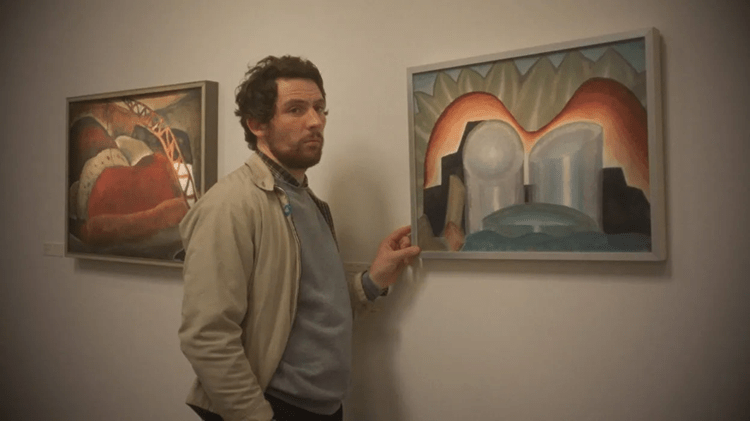
Bong Joon-Ho follows his universally acclaimed 2019 Best Picture winner “Parasite” with the wildly ambitious yet wildly uneven “Mickey 17”, a science-fiction dark comedy based on Edward Ashton’s novel “Mickey7”. While nowhere near as absorbing and clever as the filmmaker’s heralded Oscar darling, Bong’s social critique wrapped in sci-fi dressing has a lot to say and has a lot of fun saying it. But that alone doesn’t equal a good movie.

“Mickey 17” is as wacky as it is unwieldy. As you might expect from a Bong Joon-Ho film, it has a wealth of big ideas swirling all around. But while it delivers a few well-packaged laughs here and there, it’s never as funny as it tries really hard to be. Similarly, the big budget world Bong creates never quite lives up to its promise. Worst of all, the story he’s telling drags on for an eternity and is hampered by pacing that ranges from erratic to lethargic. In a nutshell, “Mickey 17” is an extravagant mess.

Image Courtesy of Warner Bros. Pictures

To his credit, an endearing Robert Pattinson gives it his all playing Mickey Barnes (Pattinson). After their business venture goes belly-up, Mickey and his childhood friend Timo (Steven Yeun) find themselves on the run from a sadistic loan shark. In an impulsive act of desperation, the two sign up for a space expedition leaving Earth to colonize the distant planet of Nilfheim. Timo gets hired on as a pilot. Mickey signs up for the Expendable program without really knowing what it is. Not the best idea.

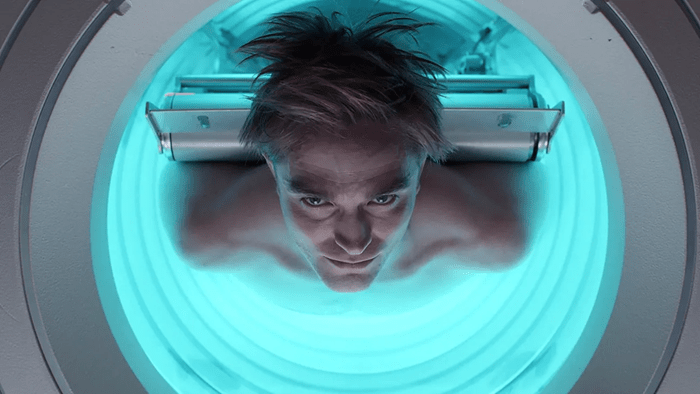
As an Expendable Mickey is assigned to an array of extremely dangerous missions that almost always result in his death. But here’s the catch – each time he dies his body is “reprinted” using a controversial cloning method that has been outlawed on Earth. The scientists then upload his mind from their database (quite literally a brick with a few flashing lights) into his new body and get him ready for his next mission.

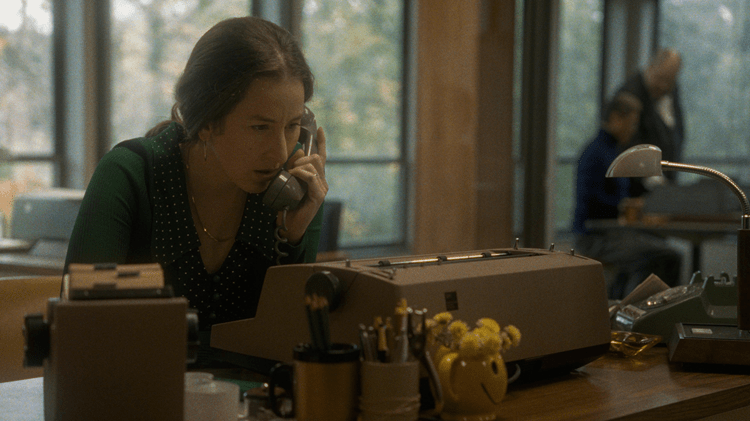
Filling out the supporting players, Naomi Ackie plays Nasha, a security guard and Mickey’s supportive love interest. Her character is all over the map, but Ackie’s performance is solid. The same can’t be said for the comically bad Mark Ruffalo playing Kenneth Marshall, a failed politician and raving egomaniac who’s somehow leading the expedition. The deliberately exaggerated Ruffalo keeps his act cranked up to 10, gnawing the scenery whenever he’s in front of the camera. He’s exhausting and often smothers out the much funnier Toni Collette who plays Marshall’s devious wife, Ylfa.

Image Courtesy of Warner Bros. Pictures

The second half shakes things up after the 17th iteration of Mickey is believed to be dead after an encounter with a native species. So they “reprint” Mickey 18. But what they don’t realize is that Mickey 17 is still alive leading to a strictly forbidden case of “multiples”. From there the movie seems to take one wild swing after another. It lurches from point to point, leaving holes all throughout its story while stitching them up with handy voiceovers and vain attempts at humor. It results in a long-winded and surprising unfunny affair.

Bong’s track record may earn him a pass with the faithful, but it’s hard not to see “Mickey 17” as a disappointment. We do see some of his signatures including his unique use of visual language and his commentary-soaked storytelling. But much of what he is going for gets bogged down amid so-so digital effects and a lumbering (and at times incoherent) story. Even Bong’s sermons, hammered most through Ruffalo’s shrill authoritarian televangelist impersonation, pale in comparison to his more incisive and insightful past efforts.

VERDICT – 2 STARS

EDFF 2025 REVIEW: “Max Dagan”

Writer-director Terre Weisman tells a deeply human story with “Max Dagan”, a penetrating crime drama that follows two shattered families whose overwhelming personal animosity towards each other leaves everyone involved wounded in one way or another. Weisman’s feature premiered in New York at Dances With Films and just screened at the El Dorado Film Festival. It’s now preparing for distribution and it’s certainly a movie to look out for.

“Max Dagan” is a drama driven by flawed and in some cases damaged characters. It’s a story about bad choices and painful consequences. But it’s also a story about not letting those choices and consequences define you. It’s about overcoming your faults and finding mercy for those who have wronged you. But Weisman doesn’t pretend it’s easy. In fact, it can sometimes feel impossible. Such is the case with the characters in “Max Dagan”, most of whom find themselves struggling with past mistakes.

The altercation that sets the main story in motion takes place in an extended prologue. Ilene Brennan (Lisa Roumain) is a battered alcoholic; John (Richard Neil) is her abusive husband and a cop whose personality can change in a snap. After an argument turns violent, Ilene slips away to secretly meet Albert Dagan (Rob Morrow) who she’s been having an affair with. But a suspicious John surprises them and begins brutally beating Albert. Weisman cuts the scene short, leaving the details a little hazy. But we have a good idea how things played out.

In the incident’s aftermath, John ends up dead and Albert is charged with manslaughter. His lawyer and brother Bob (Rob Brownstein) makes a strong case for self-defense. But the jury finds Albert guilty and the judge sentences him to fifteen years in prison. Left in the rubble is Albert’s 15-year-old son, a guitar prodigy named Max (Harry Holden White) who now has nowhere to go. Bob won’t accept custody for reasons involving his wife that never makes much sense. So Max becomes a ward of the state. But he runs away before he can be taken to a foster home.

From there we jump ahead several years as Max (now played by Zachary Gordon) has become a successful guitar player for a popular rock band. He has also been working hard to get his father out of prison. But so far they’ve lost every parole hearing in large part due to the testimonies of John’s heartbroken daughter, Alaina (a superb Lindsey Dresbach) and a dirty detective named Dan Clancy (Michael Madsen) whose shady motives remain murky throughout.

But a new sense urgency comes after Albert is diagnosed with terminal brain cancer. With only a short time to live, Max hopes his father is granted a ‘compassionate release’ rather than dying in prison. But getting such a release won’t be easy, and it may require working with his uncle who he still blames for not taking him in. It may also require convincing Alaina to show mercy and not testify against his dad.

From there the story unfolds at a well-modulated pace as Weisman unknots and then reties the many narrative threads that make up his story. Meanwhile the performances stay grounded and feel firmly rooted in the gritty and textured Los Angeles setting. DP Tim Banks shoots the city in a way that helps vividly bring the characters and their circumstances to life.

Not everything in the story comes together as it should and we’re left with a few head-scratching questions. But those things don’t stop Terre Weisman from telling a compelling story that is imbued with humanity from beginning to end. The film deals with some weighty subject matter and difficult themes. But in the end it’s the characters who take center stage and who steadily grow through the tensions that bind them. Weisman keeps them as his main focus, and as the audience, so do we.

VERDICT – 3.5 STARS

REVIEW: “My Dead Friend Zoe” (2025)

Kyle Hausmann-Stokes makes an impressive directorial debut with “My Dead Friend Zoe”, a deeply personal feature inspired by the tragic deaths of two of his platoonmates. There’s a number of powerful themes sewn into the fabric of his movie. But its chief interest is in exploring the experiences of military veterans in America. Hausmann-Stokes honors them through a poignant and honest examination of the wartime scars combat vets often return home with.

Merit (played by a brilliant Sonequa Martin-Green) is a troubled veteran who spent eight years in Afghanistan as a light-wheel mechanic for the U.S. Army. While serving she became close friends with the brash and boisterous Zoe (Natalie Morales). But Zoe’s life met a tragic end which is revealed to us over the course of the movie. Now Merit sees visions of her late friend and the two routinely carry on conversations. During their frequent tête-à-têtes, Zoe’s barbs range from darkly funny to piercingly cruel.

The idea of a deceased friend popping up to crack jokes and needle our protagonist may sound insensitive, especially considering the weight of the film’s subject matter. And this certainly isn’t the first movie to use this device in its storytelling. But kudos to Hausmann-Stokes who takes a thoughtful and schmaltz-free approach. At no point does his handling of the material feel insincere or gimmicky. Instead it adds a crucial emotional layer to the story that helps ground it in reality.

Aside from the flashbacks in Afghanistan, most of the story takes place in Oregon. Following an accident at her warehouse job, Merit is charged with criminal negligence and ordered by the court to attend group therapy meetings for former soldiers struggling with PTSD. The sessions are led by Dr. Cole (Morgan Freeman), a VA counselor who refuses to coddle Merit but also shows her a great deal of compassion.

Meanwhile Merit gets a call from her mother, Kris (Gloria Reuben) telling her to go check on her grandfather, Dale (Ed Harris) who has been taken to the hospital. The doctor diagnoses Dale with early stage Alzheimer’s leading Merit and her mother to consider some difficult choices. As they do, Merit moves in with her surly grandfather at his beloved lakeside cabin, rekindling a strained but cherished relationship that may help her finally confront her own emotionally crippling pent-up trauma.

Hausmann-Stokes does a superb job delicately balancing a post-service soldier story with an affecting domestic drama, connecting them in a way that raises awareness to a number of potent real-world issues. The performances are top-to-bottom strong led by Sonequa Martin-Green’s eye-opening leading turn. And the sturdy Ed Harris proves again why he’s such a cherished actor. Morgan Freeman is effortlessly solid in what is a small-ish role while Utkarsh Ambudkar adds some levity playing an awkward retirement home administrator and part-time cemetery caretaker.

On the surface, its concept may sound far-fetched. But nothing about “My Dead Friend Zoe” comes across as exaggerated or inauthentic. Even the measured and well-tuned injections of humor fit well with the story Hausmann-Stokes is telling. We have to maneuver through a few narrative cliches to get to the ending and it’s a bit rushed once we get there. But those things do nothing to hinder the clarity of the filmmaker’s firsthand inspiration. It pulsates all throughout this stirring and insightful slice of reality. Opening in theaters February 28th.

VERDICT – 4 STARS

REVIEW: “The Monkey” (2025)

Osgood Perkins crafted one of 2024’s very best films with his exceptional serial killer horror thriller “Longlegs”. It was a movie that was rightly met with positive reactions from audiences and critics. But it was good enough to deserve serious awards season consideration. Sadly, the film was mostly ignored by end of the year voting members from critics associations (including my own) to major award groups.

And just like that Perkins is back with his follow-up, “The Monkey”. This warped and twisted horror blend is based on Stephen King’s 1980 short story. Perkins writes, directs, and takes countless liberties in his adaptation of King’s work. The most noticeable addition is the infusion of comedy into what is an otherwise a hyper-gory splatter film. Perkins keeps his tongue firmly lodged in his cheek as he has us chuckling one minute while spraying us with blood and guts the next.

Unfortunately his mix of horror and humor doesn’t quite gel the way he wants it to. The movie features several wild and spectacularly gory deaths that are sure to earn some audible gasps. And there are genuinely funny lines of dialogue scattered all throughout. But it’s the story that attempts to connect it all that underwhelms. Not only is it a mess, but it bungles the heavier themes it introduces. So we’re left with little more than gore and goofiness and both wear out their welcome over time.

Back in 1999, twin brothers Hal and Bill Shelburn (Christian Convery) lived with their single mother, Lois (Tatiana Maslany). The boys weren’t especially close as the punk Bill relentless bullied and belittled his more timid brother Hal. Their lives are violently turned upside down after they discover a wind-up musical monkey in a closet among their absent father’s old things.

Now to the movie’s rules. Apparently whenever someone winds the key on the monkey’s back and it plays it drum someone is killed in a gruesomely outrageous manner. Why? We never know. Who or what is behind the monkey’s ‘power’? Your guess is as good as mine. The movie has no interest in answering such questions which naturally come from such a story.

The closest we get to answers are in the film’s abject cynicism. As one character states, “Everyone dies and that’s life” – no purpose, no point, no pattern. That may make for an interesting philosophical discussion, but it doesn’t automatically equal good cinema. In “The Monkey” it feels more like a cop-out than a thought-provoking statement on the absurdity of death. It gives Perkins a reason to splash the screen with viscera in a creative array of ways.

Some 25 years later, the estranged brothers (now played by Theo James) haven’t spoken in years. Hal lives in seclusion but has a son named Petey (Colin O’Brien). In one of the film’s most underdeveloped story threads, Hal goes to pick up Petey for their once-a-year visit. While there, he’s informed by his ex-wife (Laura Mennell) that her successful new husband (Elijah Wood in a rather silly cameo) is adopting Petey. It’s a wonky domestic angle that feels thrown together rather than thought out.

But of course the monkey finds its way back into their lives. Hal and Bill thought they were rid of it and each other when they threw it down a well as kids. But it returns with another string of grisly and graphic deaths. And it brings the estranged brothers back together in a way that’s more ridiculous than convincing. It all plays out in an outrageous final act that’s either care-free to the point of incoherence or smugly poking fun at genre fans and their willingness to consume anything as long as it’s coated in blood.

“The Monkey” continues a growing trend in modern horror. It’s yet another movie that goes all-in on gore while making no real attempt at being scary. In this case, far more effort is put into being funny. But too often the horror and the humor are working against each other. At times they click, leading to some pretty good comic payoffs. But those efforts are overshadowed by the tonal chaos, its lack of tension, and the half-baked story which almost feels like an afterthought.

VERDICT – 2 STARS

REVIEW: “Mothers’ Instinct” (2024)

The top-tier teaming of Jessica Chastain and Anne Hathaway drive “Mothers’ Instinct”, a pulpy and fun suburban thriller from director and cinematographer Benoît Delhomme. The two luminous stars sink right into their roles as neighbors, best friends and mothers who watch their relationship crumble following a horrific tragedy. Anders Danielsen Lie and Josh Charles add sturdy supporting roles, but this is Chastain and Hathaway’s show and their magnetism makes the film’s blemishes a little easier to get past.

With “Mothers’ Instinct” Delhomme plays with a premise that could have been plucked straight out of Hitchcock’s oeuvre. His film is a remake of Olivier Masset-Depasse’s 2018 Belgian thriller that was an adaptation of Barbara Abel’s 2012 novel of the same name. The screenplay is by Sarah Conradt who does a good job playing with our perceptions of her characters. But it shows cracks as plot holes begin to add up, specifically in the film’s second half.

Image Courtesy of NEON

Set in the 1960s, Alice (Chastain) and Celine (Hathaway) are best friends and next-door neighbors living in a sunlit and tree-lined suburbia. Their almost matching two-story homes sit pristinely on immaculately manicured lawns that are separated by one long green hedge. Both have 8-year-old sons who are best buddies and spend much of their time together. And both have husbands who leave early for work while the wives stay behind and manage the home. It’s a glossy snapshot of a segment of 1960s society.

Alice and Celine’s relationship forever changes after Celine’s son Max (Baylen D. Bielitz) falls from his home’s top-floor balcony and is tragically killed. Alice could see Max from her yard but couldn’t reach him in time. Celine, who had been cleaning house in another room when her son fell, plunges into a deep depression while her husband Damian (Charles) sinks into the bottle.

In the days that follow, Celine goes out of her way to avoid Alice which causes the anxious Alice to worry that Celine may blame her for Max’s death. But things really take a more twisted turn after Celine starts showing extra attention to Alice’s son, Theo (Eamon Patrick O’Connell). Alice’s husband Simon (Lie) brushes it off as Celine’s way of coping with her grief. But Alice isn’t so sure which leads to a mounting tension between the former best friends.

Image Courtesy of NEON

But here’s the movie’s big trick – which woman is coming unglued? Is it Celine, Alice, or both? Delhomme gives us ample reasons to question both, shifting our suspicions from one to the other until everything comes into focus during the final act. As the drama unfolds, Conradt uses social norms of the time to divert our attention and mask where the story is really going. It doesn’t all gel as intended, but it certainly makes following along a lot of fun.

That said, the movie still wobbles under the unfortunate weight of obvious plot holes and lapses in logic. Several seemingly meaningful elements of the story turn out to be little more than devices that are utterly forgotten once they move the story to its next point. It’s a nagging issue that keeps this otherwise well acted and visually striking psychodrama from being as memorable as it could have been. But it’s still Chastain and Hathaway – two actresses who make everything they’re in worth seeing. It’s no different here.

VERDICT – 3.5 STARS

REVIEW: “Megalopolis” (2024)

It looks as if the most polarizing movie of 2024 may be from one of the greatest American filmmakers of all-time. Five-time Academy Award winner and New Hollywood legend Frances Ford Coppola lets his cinematic imagination run wild in “Megalopolis”, a hard to categorize but altogether captivating experience that is sure to be unlike anything else you’ll encounter in a movie theater this year.

Coppola’s initial idea for “Megalopolis” had its genesis way back in 1977. Six years later he began putting together a script. By 1989 Coppola was scouting locations and planning shoots. But the film was eventually shelved. It was revived in 2001 with Coppola going as far as doing table reads with potential actors. But after the 9/11 terror attacks, the movie was once again put on hold. During the years that followed, Coppola determined to self-finance his movie. In 2019 he put up $120 million of his own money and after navigating the COVID-19 pandemic, production finally began in 2021.

“Megalopolis” is as demanding as it is rewarding. It’s a movie that doesn’t allow itself to be easily consumed like the usual big screen product. There is nothing routine about its style, structure, or story. Rather it’s made to be experienced, absorbed, considered, and reconsidered. It’s meant to sweep you away with its audacity and grandiosity while provoking you to wander outside of your ideological comfort zone. It means to impress you with its extravagance, perplex you with its incoherence, yet stimulate you with its artistic fervor and deep-rooted convictions.

Image Courtesy of Lionsgate

It’s vital that you don’t venture into “Megalopolis” expecting conceptual precision or even narrative cohesion. Don’t look for an involving plot, well-defined stakes, or even one singular vision. It’s a movie that thrusts us into the mind of its creator where we witness a plethora of profoundly personal ideas that bounce off each other in fits of indulgent madness. Coppola knows all of this and apparently foreknew the responses. It’s probably why he later added the subtitle “A Fable” – to help shape expectations and curb misconceptions.

At the same time, “Megalopolis” is very much an imaginative tour de force that sees Coppola working free of anyone’s rules, including his own. It’s an operatic tale full of pseudo-Shakespearean prose designed to be Coppola’s direct voice to us. Through his characters (some avatars and some metaphors) he shares his fears, pleads his cases, issues dire warnings, and plants seeds of hope. Meanwhile his astounding visual language reveals someone who is just as concerned with saving cinema as he is with saving civilization.

Coppola’s story is set in the collapsing metropolis of New Rome, a fascinating retro-futurist fusion of New York City with ancient Rome. It’s a sprawling place where poverty, crime, and corruption has crushed a once thriving city. Visionary architect Cesar Catilina (played by a spellbinding Adam Driver) is called upon to reimagine and transform a huge segment of New Rome. He calls his audacious city-within-the-city Megalopolis. It’s envisioned as a prosperous state-of-the-art utopia; a pure architectural and technological wonder, unmatched in its beauty and abundance.

Image Courtesy of Lionsgate

To realize his vision, Cesar has discovered a powerful and imperishable material called Megalon. Its source is a mysterious story all its own, but it grants Cesar the ability to manipulate space and time. There are those who understandably fear its power. But Cesar has learned how to harness it in ways that allow him to bring to life the magnificent constructs from his mind.

But Cesar immediately gets pushback from New Rome’s mayor, Franklyn Cicero (Giancarlo Esposito) who is perfectly content with the status quo. Franklyn vehemently opposes what he perceives to be Cesar’s vanity project, preferring more practical means of renewal such as building a new casino (because that’s sure to put a spiraling city back on its feet). The power struggle between Cesar and Franklyn sets up a central conflict that drives much of the drama.

Things get even more complicated for the bitter rivals after Cesar falls in love with Julia (a luminous Nathalie Emmanuel), a pampered but well-centered socialite who happens to be the mayor’s daughter. She finds herself torn between the two men she loves and their competing visions. Emmanuel is both a radiant and grounding presence, often serving as our window into Coppola’s world.

Image Courtesy of Lionsgate

Meanwhile a colorful cadre of supporting players help complete Coppola’s opus. Aubrey Plaza plays Wow Platinum, a television news personality whose lust for power trumps any desire for a good story. Soured by rejection from Cesar, she sets her sights on the rich and much older bank executive, Hamilton Crassus III (Jon Voight). Then you have Shia LaBeouf as the envious and depraved Clodio Pulche, a lewd deviant turned populist power-player driven by his disdain for his cousin, Cesar. Laurence Fishburne plays Cesar’s loyal assistant, driver, and personal historian while Dustin Hoffman plays Franklyn’s reliable fixer.

While most of the performances are top-notch, Plaza and LaBeouf prove to be problematic. They both veer wildly over-the-top, often seeming as if they’re working in an entirely different movie. Without question, their characters are inherently hedonistic and flamboyant, and Coppola lets his two stars off their leashes to leave no question about their debauchery. But they go too big, leaving them feeling out of place, even in a movie that’s big on theatrics.

The sheer range of techniques employed by DP Mihai Mălaimare Jr. give “Megalopolis” a dreamlike quality that’s fitting for a movie of such cosmic ambition. Detailed compositions melding long lens and digital backdrops, soul-baring closeups, classic iris shots, kaleidoscopic effects – they’re all used to immerse us but also to inform. For example, the visuals are sometimes noticeably gaudy – an intentional choice used to emphasize the gold-plated facades of the rich and pampered whose hollow lives are marked by privilege and excess.

Image Courtesy of Lionsgate

As his central theme of crumbling empires takes form, Coppola surrounds it with stories of love of all kinds: love of family, love of self; love of art, love of power; love of advancement, love of decadence; love for creating, love for destroying. In the process he offers us a daring perspective on our modern world through an experience conceived from heartfelt concern, shaped by classical influences, and delivered with unflinching earnestness. It’s a broad and bulky endeavor, at times almost buckling under its own creative weight. But it never collapses due to Coppola’s belief in his message and his go-anywhere willingness when it comes to sharing it.

I’ve heard it said that art shouldn’t aim to satisfy the masses, but to express the heart of the artist. Obviously there’s a fine line when it comes to movies, and for my money Coppola walks it like a tightrope. His “Megalopolis” is as breathtaking as it is bewildering; as compelling as it is confounding. It doesn’t hold hands or pander. Nor does it submit to expectations. Yes, at times it’s erratic and untethered. It takes wild swings, some of which miss their marks. But it is undeniably the work of a man’s heart and soul, and you feel it in every trenchant soliloquy and every eye-catching image.

I feel it goes without saying, but “Megalopolis” won’t be for everyone. While the movie has its champions, it has just as many vocal detractors who have wasted no time tearing it apart. Interestingly, people said similar things about Coppola’s “Apocalypse Now” when it first released. But since then, time has spoken much differently. I’m not calling “Megalopolis” the new “Apocalypse Now”, but could it have the same fate? Call me crazy, but I wouldn’t be surprised. “Megalopolis” is in theaters now.

VERDICT – 4.5 STARS