REVIEW: “Megalopolis” (2024)

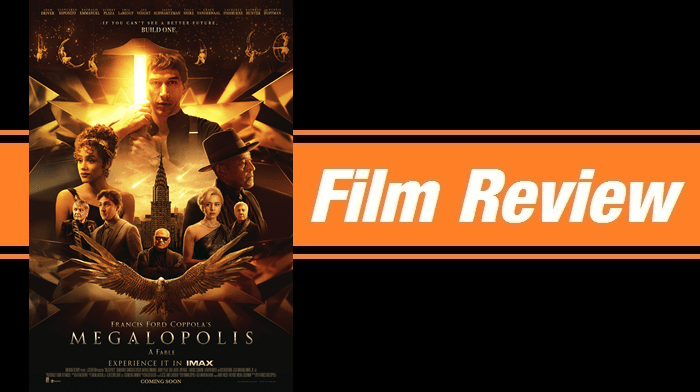
It looks as if the most polarizing movie of 2024 may be from one of the greatest American filmmakers of all-time. Five-time Academy Award winner and New Hollywood legend Frances Ford Coppola lets his cinematic imagination run wild in “Megalopolis”, a hard to categorize but altogether captivating experience that is sure to be unlike anything else you’ll encounter in a movie theater this year.

Coppola’s initial idea for “Megalopolis” had its genesis way back in 1977. Six years later he began putting together a script. By 1989 Coppola was scouting locations and planning shoots. But the film was eventually shelved. It was revived in 2001 with Coppola going as far as doing table reads with potential actors. But after the 9/11 terror attacks, the movie was once again put on hold. During the years that followed, Coppola determined to self-finance his movie. In 2019 he put up $120 million of his own money and after navigating the COVID-19 pandemic, production finally began in 2021.

“Megalopolis” is as demanding as it is rewarding. It’s a movie that doesn’t allow itself to be easily consumed like the usual big screen product. There is nothing routine about its style, structure, or story. Rather it’s made to be experienced, absorbed, considered, and reconsidered. It’s meant to sweep you away with its audacity and grandiosity while provoking you to wander outside of your ideological comfort zone. It means to impress you with its extravagance, perplex you with its incoherence, yet stimulate you with its artistic fervor and deep-rooted convictions.

Image Courtesy of Lionsgate

It’s vital that you don’t venture into “Megalopolis” expecting conceptual precision or even narrative cohesion. Don’t look for an involving plot, well-defined stakes, or even one singular vision. It’s a movie that thrusts us into the mind of its creator where we witness a plethora of profoundly personal ideas that bounce off each other in fits of indulgent madness. Coppola knows all of this and apparently foreknew the responses. It’s probably why he later added the subtitle “A Fable” – to help shape expectations and curb misconceptions.

At the same time, “Megalopolis” is very much an imaginative tour de force that sees Coppola working free of anyone’s rules, including his own. It’s an operatic tale full of pseudo-Shakespearean prose designed to be Coppola’s direct voice to us. Through his characters (some avatars and some metaphors) he shares his fears, pleads his cases, issues dire warnings, and plants seeds of hope. Meanwhile his astounding visual language reveals someone who is just as concerned with saving cinema as he is with saving civilization.

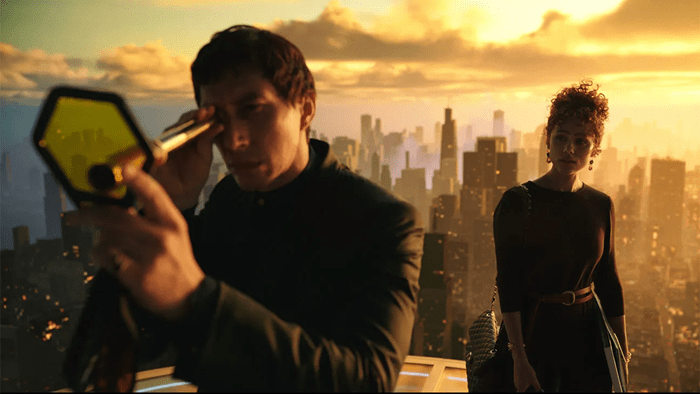
Coppola’s story is set in the collapsing metropolis of New Rome, a fascinating retro-futurist fusion of New York City with ancient Rome. It’s a sprawling place where poverty, crime, and corruption has crushed a once thriving city. Visionary architect Cesar Catilina (played by a spellbinding Adam Driver) is called upon to reimagine and transform a huge segment of New Rome. He calls his audacious city-within-the-city Megalopolis. It’s envisioned as a prosperous state-of-the-art utopia; a pure architectural and technological wonder, unmatched in its beauty and abundance.

Image Courtesy of Lionsgate

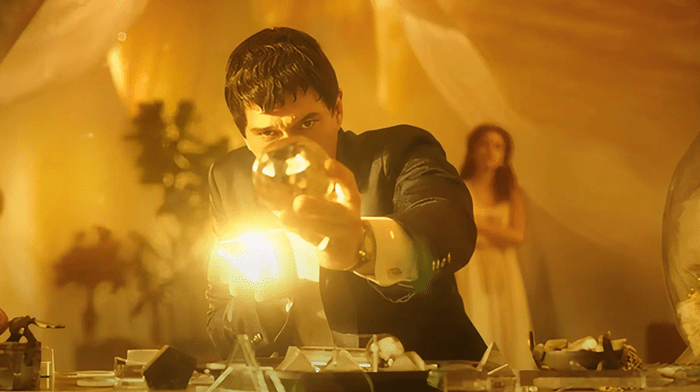
To realize his vision, Cesar has discovered a powerful and imperishable material called Megalon. Its source is a mysterious story all its own, but it grants Cesar the ability to manipulate space and time. There are those who understandably fear its power. But Cesar has learned how to harness it in ways that allow him to bring to life the magnificent constructs from his mind.

But Cesar immediately gets pushback from New Rome’s mayor, Franklyn Cicero (Giancarlo Esposito) who is perfectly content with the status quo. Franklyn vehemently opposes what he perceives to be Cesar’s vanity project, preferring more practical means of renewal such as building a new casino (because that’s sure to put a spiraling city back on its feet). The power struggle between Cesar and Franklyn sets up a central conflict that drives much of the drama.

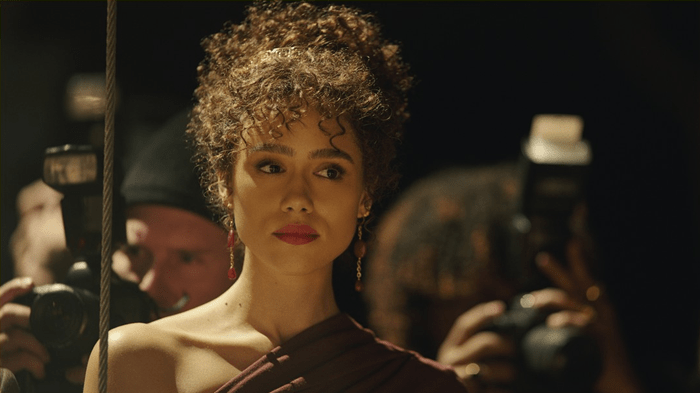
Things get even more complicated for the bitter rivals after Cesar falls in love with Julia (a luminous Nathalie Emmanuel), a pampered but well-centered socialite who happens to be the mayor’s daughter. She finds herself torn between the two men she loves and their competing visions. Emmanuel is both a radiant and grounding presence, often serving as our window into Coppola’s world.

Image Courtesy of Lionsgate

Meanwhile a colorful cadre of supporting players help complete Coppola’s opus. Aubrey Plaza plays Wow Platinum, a television news personality whose lust for power trumps any desire for a good story. Soured by rejection from Cesar, she sets her sights on the rich and much older bank executive, Hamilton Crassus III (Jon Voight). Then you have Shia LaBeouf as the envious and depraved Clodio Pulche, a lewd deviant turned populist power-player driven by his disdain for his cousin, Cesar. Laurence Fishburne plays Cesar’s loyal assistant, driver, and personal historian while Dustin Hoffman plays Franklyn’s reliable fixer.

While most of the performances are top-notch, Plaza and LaBeouf prove to be problematic. They both veer wildly over-the-top, often seeming as if they’re working in an entirely different movie. Without question, their characters are inherently hedonistic and flamboyant, and Coppola lets his two stars off their leashes to leave no question about their debauchery. But they go too big, leaving them feeling out of place, even in a movie that’s big on theatrics.

The sheer range of techniques employed by DP Mihai Mălaimare Jr. give “Megalopolis” a dreamlike quality that’s fitting for a movie of such cosmic ambition. Detailed compositions melding long lens and digital backdrops, soul-baring closeups, classic iris shots, kaleidoscopic effects – they’re all used to immerse us but also to inform. For example, the visuals are sometimes noticeably gaudy – an intentional choice used to emphasize the gold-plated facades of the rich and pampered whose hollow lives are marked by privilege and excess.

Image Courtesy of Lionsgate

As his central theme of crumbling empires takes form, Coppola surrounds it with stories of love of all kinds: love of family, love of self; love of art, love of power; love of advancement, love of decadence; love for creating, love for destroying. In the process he offers us a daring perspective on our modern world through an experience conceived from heartfelt concern, shaped by classical influences, and delivered with unflinching earnestness. It’s a broad and bulky endeavor, at times almost buckling under its own creative weight. But it never collapses due to Coppola’s belief in his message and his go-anywhere willingness when it comes to sharing it.

I’ve heard it said that art shouldn’t aim to satisfy the masses, but to express the heart of the artist. Obviously there’s a fine line when it comes to movies, and for my money Coppola walks it like a tightrope. His “Megalopolis” is as breathtaking as it is bewildering; as compelling as it is confounding. It doesn’t hold hands or pander. Nor does it submit to expectations. Yes, at times it’s erratic and untethered. It takes wild swings, some of which miss their marks. But it is undeniably the work of a man’s heart and soul, and you feel it in every trenchant soliloquy and every eye-catching image.

I feel it goes without saying, but “Megalopolis” won’t be for everyone. While the movie has its champions, it has just as many vocal detractors who have wasted no time tearing it apart. Interestingly, people said similar things about Coppola’s “Apocalypse Now” when it first released. But since then, time has spoken much differently. I’m not calling “Megalopolis” the new “Apocalypse Now”, but could it have the same fate? Call me crazy, but I wouldn’t be surprised. “Megalopolis” is in theaters now.

VERDICT – 4.5 STARS

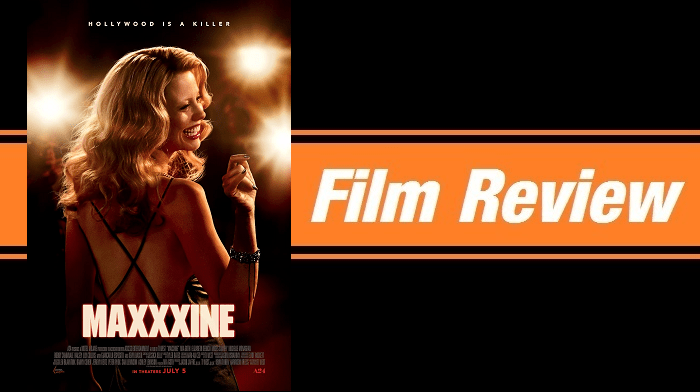
REVIEW: “MaXXXine” (2024)

Though only two films in, Ti West’s X film series has been quite the rollercoaster. His first movie “X” was said to be a tribute to slasher films although he wasted far more time on other interests. It was a trashy imitation rather than a bonafide homage. His second installment, “Pearl” was a delightfully brutal blast of technicolor-soaked horror – one that was impossible to put into a single box. It was a rural horror flick, a psychological thriller, a pitch-black comedy, and a gonzo exploitation flick all wrapped into one. I loved it.

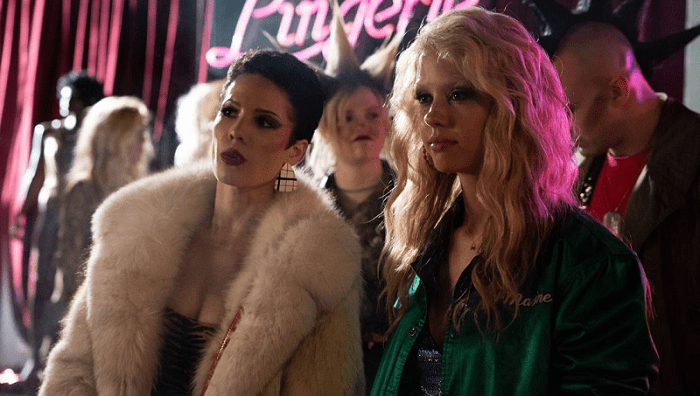
With all of that swirling around in the back of my mind, it was hard to know what my expectations should be for “MaXXXine”, the third film in the trilogy and a direct sequel to “X”. Series star Mia Goth returns, this time with a star-filled ensemble that includes Kevin Bacon, Elizabeth Debicki, Bobby Cannavale, Michelle Monaghan, Giancarlo Esposito, Lily Collins, Halsey, and Moses Sumney. That alone is a big shift from the two earlier films and it certainly adds some supporting star wattage.

Image Courtesy of A24

“MaXXXine” leaves the small town setting of its predecessors for seedy 1985 Los Angeles. As the brutal Night Stalker murders make headlines across Southern California, 34-year-old Maxine Minx (Goth) is in Hollywood, still obsessed with being famous. When not snorting cocaine and stripping for peep shows, Maxine has made a name for herself in adult movies.

West pours a lot of energy into portraying Hollywood as an unforgiving grimy cesspool. But in his excitement to depict exploitation, you get the sense that he’s doing the same thing to his own characters. Too many times his retro obsessions and style choices take precedent over everything else including a cohesive story, meaningful depth, or thematic conviction. What we do get feels muted and shallow while constantly taking a backseat to an endless parade of 80’s nods and Hollywood references. Even the sleaze he soaks his screen in feels fabricated by a filmmaker rather than of a specific time and place.

Maxine finally gets her big break after she wins a part in her first “real movie”. It’s a horror sequel titled “The Puritan II” that’s directed by the imposing, no-nonsense Elizabeth Bender (Debicki). But just as her twisted dream seems to be coming true, Maxine finds herself hounded by a slimy private investigator (an amusing yet exaggerated Bacon) working for a client who threatens to expose the violent deeds of her past.

Making matters worse, Maxine’s red light district friends begin turning up dead which draws the attention of two dogged Los Angeles police detectives (Cannavale and Monaghan). Are her friends victims of the notorious Night Stalker or is there a copycat killer? Perhaps it’s something more personal? Either way it threatens the unstable Maxine’s newfound success which she is determined to protect at all costs.

Image Courtesy of A24

As you can tell there’s a lot going on in “MaXXXine”. Without question there are pieces here for a really good movie. But they remain just that – pieces. West isn’t able to corral his MANY interests and influences into anything substantive. Too much of the film comes across as surface-level self-indulgence. Many of its problems are encapsulated in the movie’s ludicrous ending that doesn’t land well regardless of how you view it.

There’s no doubt that Ti West is talented behind the camera and it’s hard not to be impressed by his visual style and intense attention to detail. In “MaXXXine”, he shows off those talents mostly in how he uses genre as his sandbox. But at the same time, he gets so absorbed with his presentation that he forgets some of the essentials that every movie needs – namely a good story and interesting characters. Similar to “X”, West’s preoccupations with other things leaves his movie feeling shallow and shortchanged. Oh well, at least we’ll always have “Pearl”. “MaXXXine” is in theaters now.

VERDICT – 2 STARS
REVIEW: “The Ministry of Ungentlemanly Warfare” (2024)

Packing a cracking cast and one hilariously ungainly title, “The Ministry of Ungentlemanly Warfare” is in many ways a Guy Ritchie flick through and through. Like so many of his movies, it features Ritchie’s signature style, swagger, and offbeat sense of humor. For some that’s a strong selling point; for others it may be a turn-off. Either way, Ritchie remains an interesting filmmaker who’s able to get big studio support and big names to star in his films. I can understand why.

His latest is based on Damien Lewis’ 2014 nonfiction book “Churchill’s Secret Warriors: The Explosive True Story of the Special Forces Desperadoes of WWII” and focuses specifically on Britain’s 1942 clandestine mission dubbed Operation Postmaster. Ritchie takes a more embellished approach to the event, nailing down the historical basics and then creating his own proudly cheeky and joyously violent genre movie. In this case it’s like a spaghetti western in World War II dressing.

To no surprise, the brazenly self-aware “Ungentlemanly Warfare” is colored with the style and energy of its creator. There is plenty of wit and a number of bloody and bombastic action sequences to take in. But Ritchie surprises with stretches of unexpected restraint that allows the more serious elements of history to filter through. It’s an important touch that calls back to other classic men-on-a-mission movies while showing that Ritchie’s interests go beyond just checking his own boxes.

Image Courtesy of Lionsgate

With German U-boats prowling the Atlantic, cutting off vital supply chains and keeping the United States from joining the war, Churchill (a not-so-convincing Rory Kinnear) green-lights a covert operation as a last-ditch effort to avoid surrendering to the Nazis. The Prime Minister’s liaison known as “M” (Cary Elwes) is tasked with putting together a team. Not of everyday soldiers, but of ruthless men who have no issue with breaking the rules in order to complete their task.

“M” immediately calls for the one man who can pull off such a job – Gus March-Phillipps (played by an utterly delightful Henry Cavill, sporting a curly mustache, shaggy beard, and charm to spare). Gus is brought in from prison (yep, prison) and briefed. He’s told that a merchant ship called the Duchessa d’Aosta will be docking in Fernando Po, a small Spanish island in the Gulf of Guinea. Once there it will be loaded with essential Nazi supplies that are to be distributed to the U-boats. The mission – blow up the ship and the supplies, ultimately crippling the U-boats in the Atlantic.

Gus agrees to take on the “unsanctioned, unofficial, unauthorized” mission but only if he brings his own team. A desperate “M” agrees. So Gus summons his band of highly skilled rogues, each with their own reason for wanting to kill Nazis. They include the brawny Swedish brute Anders Lassen (Alan Ritchson), explosives guru Freddy Alvarez (Henry Golding), and expert sailor Henry Hayes (Hero Fiennes Tiffin). And they’ll need to make a stop in the Canary Islands to save an old friend and master tactician Geoffrey Appleyard (Alex Pettyfer) who’s being held at a Nazi base (the rousing rescue sequence is the film at its finest).

Image Courtesy of Lionsgate

As Gus and his team sail towards Fernando Po, two secret operatives, Marjorie Stewart (Eiza González) and Heron (Babs Olusanmokun), arrive early by train to begin preparations. Marjorie is tasked with seducing Heinrich Luhr (Til Schweiger), the sadistic Nazi officer who oversees the port. Heron is the Rick Blaine of Fernando Po – a well-connected club owner who will setup diversions so that Gus and his men can sail in and do their duty. But in the movies things rarely go as planned and the teams will have to navigate some harrowing hurdles to pull off their mission.

Everyone from the charismatic cast to Ritchie himself seems to be having a blast and it certainly carries over to us. The chemistry, the playfulness, the panache – it all clicks. Not everything is lighthearted fun. We get instances that bring us back to earth and remind of the true story’s stakes. Just not many of them. That’s because this movie is much more about our unsavory yet likable antiheroes killing LOTS of Nazis in a number of ungentlemanly ways while thumbing their noses at the weak-kneed Admirals cowering back in London. Who wouldn’t love that?

For the most part “Ungentlemanly Warfare” bops along at a good pace, only lagging a bit in the second half before picking back up on its way to an action-fueled payoff. There’s a reasonable amount of suspense, some humorous dialogue, and well-shot action that swings between savage and comical. And all of it plays to the pulpy rhythms of composer Christopher Benstead’s toe-tapping score. I doubt there will be a sequel. But if Churchill were to once again come calling, I would happily follow Cavill and company on another Nazi-slaying adventure.

VERDICT – 4 STARS

REVIEW: “Monkey Man” (2024)

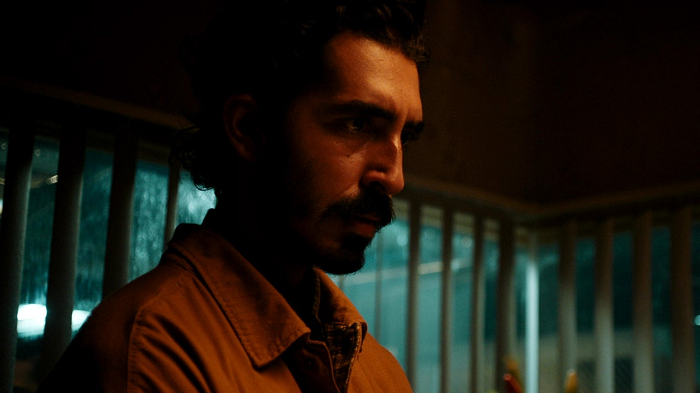
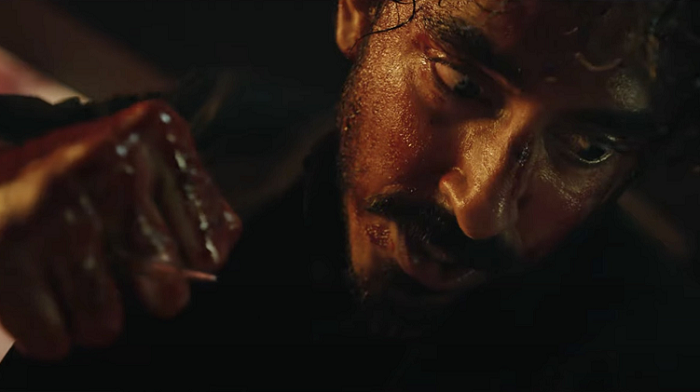
Dev Patel jumps head-first into the action arena with “Monkey Man”, an intriguing revenge thriller that marks the 33-year-old actor’s directorial debut. The ambitious “Monkey Man” is a brutal and bloody amalgamation that attempts to pull equally from Hollywood and Indian action cinema. Patel’s management of both styles, in front of and behind the camera, is a big reason his hard-hitting first feature works when it does. That said, it’s not without its flaws.

In addition to directing and starring, Patel also conceived the story, co-wrote the screenplay, and co-produces alongside Jordan Peele. His film was nearly cancelled after numerous delays during the COVID-19 pandemic. But Patel pushed through and his finished film was acquired by Netflix. Soon after, Peele saw the movie and was impressed. He purchased it from Netflix and inked a distribution deal with Universal Pictures. And just like that Patel’s passion project had its path to the big screen.

Image Courtesy of Universal Pictures

Some have compared “Monkey Man” to the John Wick films and from the trailers it’s easy to see why. But with the utmost respect, this is no John Wick. And the comparisons don’t do Patel’s film any favors. First off, this is not the fast-flowing, action-fueled movie you might expect. The bulk of the action in concentrated into two expanded sequences – one in the first half, the other in the final act. That’s pretty much it. And while Patel pours himself into it physically, the sequences are lacking in several ways. More on that in a second.

Patel plays a somber young man with no name who’s tormented by his troubled past. We learn that as a child he witnessed the savage murder of his mother (Adithi Kalkunte) at the hands of a cold-hearted Chief of Police, Rana Singh (Sikandar Kher). Donning a blood-stained gorilla mask, the young man now works in an underground fight club where he gets beaten to a pulp for cash. But in the back of his mind all he can think of is paying back every crooked police officer, corrupt politician, and spiritual guru involved in his mother’s death.

The young man’s quest for revenge starts when he gets a job at a swanky night club/restaurant ran by Queenie Kapoor (Ashwini Kalsekar), a child trafficker and close associate of Rana Singh. He carefully crafts a plan and patiently waits to make his move. Unfortunately things don’t go as planned and he misses his chance to kill Rana. He manages to escape but is badly wounded and severely beaten. His near lifeless body is nursed back to health by a vaguely defined transgender religious sect who use a few chants, some drum beats, and a burlap sack full of rice to turn him into a one-man killing machine. Yep.

Of course the young man gives vengeance another whirl, this time leaving behind a much higher body count. Much like the earlier action sequence, the finish has its moments and Patel’s intensity and physicality carry the load. Yet even with some beautifully violent flashes of brilliance, the action as a whole feels surprisingly inert. That’s because Patel’s big stylish swings can sometimes get in the way. But by far the biggest problem with the action is Patel’s frustrating over-reliance on shaky-cam and quick-cuts. It mucks up the scenes and can be borderline disorienting.

Image Courtesy of Universal Pictures

Meanwhile through it all Patel attempts to weave in commentary on Indian politics and religion although without much context. And he makes several broad statements on power, class, and marginalization. But they too are more surface level than explored. It’s obvious what Patel is going for. But “Monkey Man” ends up stuck in a rather unsatisfying middle ground. The lack of depth in its setups and treatments weakens its messaging. At the same time, its attempts at messaging takes away from the action which could have driven the film if given more attention.

All of that said, Patel still accomplishes quite a bit. First, he remains a terrific actor and he gives yet another astonishing performance in a role unlike anything he’s done in the past. He also shows some keen senses and an unbridled ambition behind the camera. His decisions don’t always come together, but he clearly has a bright future as a director. As for “Monkey Man”, it’s an admirable yet perplexing first effort in desperate need of some fine-tuning. It’s a movie with flashes of genius but hampered by a few head scratching choices and some miscalculations that unfortunately hold it back. “Monkey Man” is in theaters now.

VERDICT – 2.5 STARS

REVIEW: “Madame Web” (2024)

Spider-Man is easily one of the most popular superheroes in existence. Among the many things that fans love about the revered webslinger is the amazing array of characters who fill out his world. Allies, villains, non-superpowered side characters – the list is long and diverse. Over the years many have found their ways onto the big screen and one thing has become abundantly clear, some characters have fared considerably better than others when it comes to Spidey movies.

Adding to the list of those who haven’t fared well is Madame Web, a supporting character in the Spidey comics who now gets her own movie in Sony’s Spider-Man cinematic universe. Unfortunately what we get is an exercise in futility that stretches the Spider-Man brand beyond its limits. Directed by S.J. Clarkson and (somehow) written by a team of FOUR screenwriters, “Madame Web” is a hodgepodge of fair to downright terrible ideas, thrown together to form one of the more excruciating superhero movies to endure.

Opening in 1973, deep in the Amazonian jungles of Peru, Ezekiel Sims (Tahar Rahim) provides security for a science and research expedition led by Constance Webb (Kerry Bishé). There they discover a new species of spider with healing properties capable of curing all kinds of diseases. In true villain form, Ezekiel turns on Constance and their team, claiming the discovery for himself and leaving Constance for dead. A mysterious local tribe attempt to save Constance and her unborn baby using some kind of magical spider venom. But Constance dies while delivering her daughter, Cassie.

Image Courtesy of Sony Pictures Releasing

From there we jump ahead to 2003 as what happened in the thirty years between is mostly left unanswered. Cassie (Dakota Johnson) is a New York City paramedic working alongside Ben Parker (Adam Scott). When an emergency call ends with Cassie having a near-death experience, she begins having strange and unexplainable visions. She first tries to dismiss them as simple déjà vu. But over time she realizes her visions are actually glimpses into the future.

Meanwhile Ezekiel, who has premonition and physical powers all his own, has set his sights on three unconnected teenagers, Julia Cornwall (Sydney Sweeney), Anya Carazon (Isabela Merced), Mattie Franklin (Celeste O’Connor). Ezekiel has been haunted by visions of the future where these girls (somehow) gain their own spider-powers and use them to kill him. Determined to prevent his death, Ezekiel sets out to kill the girls first. But when Cassie’s newfound powers reveals Ezekiel’s plans, she’s compelled to save and protect the girls, all while trying to understand her strange abilities.

As vague and poorly defined as it is, there are hints of an original and potentially interesting premise. But Clarkson and the team of writers never get beyond teasing those ideas. Instead their movie meanders to the point of tedium. The characters are dull and uninspired as is the action which is hampered by poor staging, choppy editing, and mediocre-to-bad CGI.

Image Courtesy of Sony Pictures Releasing

The dreadful script doesn’t help things. It’s full of gaping holes, narrative shortcuts, and some astonishingly bad dialogue. The glaring oversights (and there are many of them) are especially funny. Take Cassie being wanted by police for kidnapping the girls she actually saved. Yet she drives all over New York City in a stolen cab, walks around in broad daylight, gets flights in and out of the country without the cops every getting wind. It’s as if the movie completely forgets the whole police angle.

“Madame Web” is capped off with an unimaginative and utterly preposterous finale that leaves you scratching your head at how poorly its pieces come together. There’s no real stakes and as a result there’s no real suspense. Add to it our general lack of investment and you have a doomed ending with no real chance of offering up a satisfying conclusion. Its best quality is that it mercifully ends what is a flailing mess of a movie – one that seems perfectly content with riding Spider-Man’s coattails rather than trying for something smart, original, and coherent. “Madame Web” is in theaters now.

VERDICT – 1.5 STARS

REVIEW: “Mea Culpa” (2024)

It seems that Tyler Perry’s latest self-branded feature “Mea Culpa” wants to be a number of things including a legal thriller, an erotic thriller, and a psychological thriller. The problem is there’s not a thrill of any kind to be found in this astonishingly bad, completely hollow, and downright trashy straight-to-streaming debacle. In fact, it’s only the unintentional laughs (and there are MANY of them) that make the film the slightest bit bearable.

Produced, written, and directed by Perry, “Mea Culpa” is the kind of movie that will find an audience just by being plastered all over the Netflix homepage. And to be fair, a lot of people will watch it just because Perry’s name is attached. But that doesn’t excuse the kind of shoddy quality that we get in “Mea Culpa”. While Perry’s direction is nothing to write home about, the real culprit is his writing from the utterly absurd storyline, to the incredibly shallow characters, to the laughably bad dialogue.

Image Courtesy of Netflix

Kelly Rowland is given the unenviable task of playing Mea Harper, a defense attorney whose marriage is on the rocks. Her husband Kal (Sean Sagar) lost his job as an anesthesiologist for showing up to work wasted. Even worse, he may have cheated on Mea. To complicate matters even further, Kal has an unhealthy attachment to his domineering and dying mother, Azalia (Kerry O’Malley) – a baffling addition to the story that plays out about as poorly as possibly.

While at her law firm, Mea is approached by an edgy contemporary artist named Zyair Malloy (a bone-dry and lifeless Trevante Rhodes). He’s suspected of killing his girlfriend and is set to be prosecuted by the District Attorney. The police have gobs of evidence against him yet Zyair claims his innocence. He wants Mea to defend him in court and after lengthy consideration she agrees. After all, with her husband not working they need the money.

There’s only one problem with Mea taking the high-profile case – the District Attorney is her brother-in-law, Ray (Nick Sagar) who has aspirations of running for mayor and plans on using a conviction of Zyair as part of his campaign. Obvious family conflicts ensue, most of which begin sending the story in a new direction that happens to be as predictable as it is implausible.

To avoid the paparazzi (and to provide a convenient reason for them to be alone), Mea begins meeting in Zyair’s loft to discuss the case. But to no one’s surprise the legal talk quickly takes a back seat to seduction. Despite there not being an ounce of notable chemistry between Rowland and Rhodes, the insipid sexual deviant Zyair begins wooing the supposedly sharp and intelligent Mea.

Image Courtesy of Netflix

And that gets to one of the film’s biggest problems. Everything that plays out makes the allegedly ‘strong female lead’ as dumb as a box of rocks. The terrible choices she makes, her inability to see the obvious, her overall lack of good instincts and judgement – Mea gets shockingly dumber as the story progresses which I’m guessing wasn’t what Perry was going for. Yet the material is so bad leaving Rowland in a no-win situation. There’s simply nothing she can do to make us believe in the Mea that Perry wants.

None of the supporting cast or characters fare any better (and I do mean NONE). I mentioned the deflated Rhodes who can’t muster a spark of energy or charisma. Everyone else is cranked up too high – the overly oblivious Kal, the overly ruthless Azalia, the overly haughty Ray. And then there’s Mea’s friend, Jimmy (RonReaco Lee), one of the worse private investigators you’ll find in a movie. But again, the cast can only do so much with such a dreadful script. And Perry’s direction routinely puts them in positions that no amount of good acting could overcome. “Mea Culpa” is now streaming on Netflix.

VERDICT – 1 STAR